

In This Article
Somewhere between your pitching wedge and your sand wedge lives a distance that ruins more scorecards than any three-putt ever could. You know the one. The 105-yard approach where your pitching wedge flies the green and your sand wedge comes up 15 yards short, so you choke down, swing at 80%, and hope. That guesswork is exactly what gap wedge full shots are supposed to erase. A gap wedge, typically lofted between 46 and 52 degrees, is built to fill the yardage gap between your pitching wedge and sand wedge, and hitting it on a full, committed swing (not a half-effort punch) is how you turn that awkward in-between number into a predictable scoring chance. This guide dissects seven real 2026 gap wedges, breaks down what separates them on full shots specifically, and gives you the framework to actually pick one instead of just adding another shiny club to the bag. If you’ve ever wondered what a golf club is actually engineered to do at different lofts, the short answer is: control trajectory and spin for a specific yardage window, and gap wedges are the purest expression of that idea. We’ll cover real specs, honest review sentiment, and the kind of practical advice that a spec sheet alone will never give you.

Quick Comparison Table
Before we go deep into all seven, here’s the fast version for anyone who just wants a starting point. This table ranks the field on the three things that matter most for gap wedge full shots: full-swing distance control, feel, and price-to-performance.
| Wedge | Price Range | Best For | Full-Shot Control |
|---|---|---|---|
| Titleist Vokey SM11 | $200–$220 | Low handicappers wanting tour-level consistency | Excellent |
| TaylorMade Milled Grind 5 | $200–$220 | Players who need wet-weather spin retention | Excellent |
| Ping s259 | $200–$230 | Golfers who want a custom-fit grind/loft combo | Very Good |
| Callaway Opus SP | $190–$210 | Mid-to-low handicappers chasing lower flight | Very Good |
| Cleveland RTZ 2 | $180–$200 | Mid-handicappers wanting forgiveness and feel | Good |
| Wilson Staff Model ZM | $140–$160 | Value-focused serious players | Good |
| Takomo Skyforger 002 | $90–$110 | Budget-conscious golfers wanting forged-adjacent feel | Good |
A quick read on the data: the two most expensive wedges here, the Titleist Vokey SM11 and TaylorMade Milled Grind 5, earn their premium pricing through full-shot consistency that’s hard to replicate at lower price points, mostly because of tighter groove tolerances and progressive CG engineering. The Takomo Skyforger 002 is the outlier worth noting because it delivers roughly 80% of that full-shot control for less than half the price, which matters enormously if you’re building out a full three-wedge set rather than buying one club at a time. If pure full-swing yardage repeatability is your only concern, spend up; if you’re also weighing bunker play and greenside touch, the mid-tier options actually close the gap fast.
💬 Just one click — help others make better buying decisions too! 😊
Top 7 Gap Wedges for Full Shots: Expert Analysis
We pulled these seven from real 2026 product lines, cross-referenced specs against manufacturer data, and layered in aggregated review sentiment from independent golf equipment reviewers. Every one of these is a genuine, currently available club, not a hypothetical “similar product.” Here’s how they stack up.
1. Titleist Vokey SM11 — most consistent CG across every grind
The headline engineering story with the SM11 is that Titleist eliminated center-of-gravity variation across its different sole grinds within the same loft, and on gap wedge full shots that translates into one very specific benefit: your launch window doesn’t shift just because you switched from an S grind to an M grind.
Six tour-proven grind options cover everything from tight, firm turf to soft, fluffy lies, and the heat-treated grooves reportedly double edge durability compared to standard milling, which matters more than it sounds like it should, since dull grooves are the silent killer of spin consistency after 60-80 rounds. Based on the spec comparison against its SM10 predecessor, the progressive CG placement is the real upgrade, not the cosmetic hosel-branding tweak Titleist also made.
This is the wedge for golfers who already trust their swing and want the equipment to get entirely out of the way. If you’re a 0-10 handicap who values shot-shaping over forgiveness, the SM11 rewards that. Reviewers consistently note that ball flight stays remarkably predictable across the whole set once you’ve been fit into the correct grind, which is the single biggest driver of full-shot yardage consistency.
Pros:
- ✅ Predictable launch window across all six grind options
- ✅ Heat-treated grooves extend spin-retention lifespan
- ✅ Widely regarded as the tour standard for a reason
Cons:
- ❌ Premium pricing near the top of the category
- ❌ Less forgiving on mishits than cavity-back-style wedges
Expect to pay in the $200-$220 range depending on shaft and grind selection, and treat this as a “buy once” wedge rather than a yearly upgrade — the value holds up over a multi-season life cycle.

2. TaylorMade Milled Grind 5 — best wet-weather spin retention
TaylorMade claims the MG5 retains roughly 13% more spin than its predecessor when struck from wet turf, and that’s not a marketing throwaway line, it’s the direct result of switching to a fully forged ultrasoft carbon steel head for the first time in the Milled Grind line’s history.
What that forging change means in practice: softer feel at impact, but also a raw face finish with laser-etched “Spin Tread” channels that behave a bit like tire treads, wicking moisture away from the strike zone so friction (and therefore spin) doesn’t collapse the moment the grass gets damp. Six grind options, including a new SX grind built around a wider, cambered sole, give this wedge real range across turf conditions. On paper this means golfers in humid or rainy climates get more consistent gap wedge full shots than they would from a chrome-finished competitor.
Aggregated reviewer sentiment leans heavily toward praising the feel-to-spin ratio, though several testers flag that loft options outside the standard SB grind are more limited, so custom fitting matters here more than with some rivals.
Pros:
- ✅ Fully forged head delivers noticeably soft, buttery feedback
- ✅ Spin Tread technology preserves spin in wet or humid rounds
- ✅ Six grinds cover nearly every turf and swing style
Cons:
- ❌ Loft selection is narrower outside the SB grind
- ❌ Raw face requires more upkeep to control rust patina
Price sits around $200, climbing toward $220 for the specialty TW grind. Reviewers consistently call it the top performer of the 2026 wedge class, and the spin data backs that reputation up.
3. Cleveland RTZ 2 Tour Satin — softest feel via new Z-Alloy construction
Cleveland’s engineering pitch here is genuinely different from the forged-vs-cast debate that dominates most wedge marketing. The RTZ 2 uses a proprietary Z-Alloy steel that measures roughly 180 on the Vickers hardness scale, noticeably softer than the 225 HV of standard 8620 carbon steel used in most rival cast wedges.
The practical result, based on the spec comparison, is a feel that splits the difference between a forged blade and a typical cast cavity, without sacrificing the durability that soft steel usually costs you. New ZipCore iQ technology adds loft- and grind-specific hosel cores that reposition mass to optimize CG for each individual club in the lineup rather than using one blanket approach across the whole set, which is exactly the kind of detail that improves distance-control repeatability on full swings.
Five grind options, including the full-face ADAPT grind, extend versatility for players who like to open the face around the greens, and reviewers note the raw finish resists rust noticeably better than older RTX-generation wedges thanks to the alloy’s inherent corrosion resistance.
Pros:
- ✅ Notably softer feel than standard 8620 cast competitors
- ✅ ZipCore iQ tunes CG individually by loft and grind
- ✅ Improved rust resistance versus prior RTX generations
Cons:
- ❌ Slightly bulkier sole profile than blade-style rivals
- ❌ Newer alloy means a shorter long-term durability track record
Pricing runs $180-$200 for Tour or Black Satin finishes, climbing to roughly $220 for the raw Tour Rack option. This is a strong mid-tier pick for anyone who wants premium tech without fully committing to Vokey-level pricing.
4. Callaway Opus SP — best for lowering flight and adding stopping power
Callaway built the Opus SP around something called a Spin Pocket, engineered specifically to solve a problem a lot of mid-handicappers don’t realize they have: wedge shots that fly too high and land with too little spin, rolling well past the pin instead of checking up.
Independent testing over multiple rounds reported that scoring-zone shots consistently came in lower and checked harder than what a typical mid-handicap swing normally produces, with the transformation most noticeable in the 50-70 yard window. That’s technically outside pure full-swing territory, but the underlying flight-lowering effect carries directly into full gap wedge full shots too, since the same face geometry and Spin Pocket are doing the work regardless of swing length.
Here’s what most buyers overlook about this model: a lower, more penetrating ball flight isn’t just about looking impressive, it’s a legitimate wind-fighting advantage on exposed courses where a ballooning wedge shot gets pushed sideways by even a moderate crosswind.
Pros:
- ✅ Spin Pocket design measurably lowers flight and boosts spin
- ✅ Strong performance advantage in windy conditions
- ✅ Clean, tour-inspired aesthetics at address
Cons:
- ❌ Fewer long-term durability reviews given its recent release
- ❌ Premium pricing comparable to Vokey and MG5
Expect a price in the $190-$210 range. If ballooning wedge shots have been costing you strokes, this is the most targeted fix on this list.
5. Ping s259 — most extensive fitting options
Ping’s approach with the s259 is volume and precision: 25 total loft-and-grind combinations across six distinct grinds, which is more built-in fitting flexibility than almost anything else in this category. Wheel-cut grooves are precision-milled to different dimensions depending on loft, with tighter “MicroMax” spacing on the 54-62 degree clubs and a wider 20-degree sidewall on the 46-52 degree gap-wedge-relevant lofts specifically to maximize control on full shots.
That last detail matters a lot for this article’s exact topic. Ping engineered the lower-lofted end of this lineup with full-swing performance as a distinct design goal, not an afterthought bolted onto a wedge optimized for chipping. The new Dyla-Grip is three-quarters of an inch longer than a standard grip with printed hand-position indicators, a small but genuinely useful detail for golfers still building repeatable setup habits.
Reviewers describe the s259 as evolutionary rather than revolutionary compared to the well-regarded s159, but note the fitting depth alone makes it worth a proper fitting session rather than an off-the-rack purchase.
Pros:
- ✅ 25 loft/grind combinations enable a precise custom fit
- ✅ Sidewall geometry specifically tuned for full-shot control
- ✅ Dyla-Grip aids consistent hand positioning
Cons:
- ❌ Highest MSRP of the field at $217.50-$232.50 per club
- ❌ Cast construction feels firmer than forged rivals to some players
At the time of research, pricing runs toward the top of the category, so budget accordingly if you’re buying a full three-wedge set.

6. Wilson Staff Model ZM — best value among premium-tier performance
Wilson doesn’t get the marketing budget of the big four, but the Staff Model ZM has quietly become one of the more interesting value stories in golf equipment. At a price point notably under Vokey, Mizuno, and Cleveland’s premium tier, independent reviewers describe it as a legitimate serious-player club rather than a budget compromise.
What most buyers overlook about this model is that “budget” in this category is relative — a $150 wedge that performs within shouting distance of a $220 wedge on full-shot distance control represents a genuinely different value proposition than a true entry-level club. Reviewers consistently flag Wilson’s underdog status as more about brand awareness than actual on-course performance gaps.
For golfers building or replacing a full three-wedge set, the math is compelling: the savings versus a premium brand can fund an actual fitting session, which arguably improves your gap wedge full shots more than any single spec upgrade would.
Pros:
- ✅ Serious-player performance at a meaningfully lower price
- ✅ Strong reputation for solid feel relative to cost
- ✅ Frees up budget for a professional fitting session
Cons:
- ❌ Smaller resale and aftermarket ecosystem than major brands
- ❌ Fewer grind and loft customization options than the Big Four
Pricing sits around $150 per club, one of the more compelling value stories in this entire comparison.
7. Takomo Skyforger 002 — best budget pick, direct-to-consumer value
Takomo built its reputation on a simple pitch: eliminate the retail markup, distributor fees, and endorsement-deal costs baked into major-brand pricing, and pass that savings straight to golfers. The Skyforger 002 wedge, priced at roughly $99 per club, is the clearest proof of concept in their current lineup.
Full-face grooves are the most visually distinctive feature, running edge to edge rather than stopping short of the toe, which rewards players who like to open the face for creative shots but also adds usable surface for standard full swings. Two grind options, F for fuller-soled full-shot versatility and V for higher-lofted specialty shots, give buyers a meaningful choice most sub-$100 wedges simply don’t offer. Stock KBS Tour 120g steel shafts and Lamkin Crossline grips are a genuine step up in component quality for the price tier.
Aggregated reviewer sentiment describes the feel as impressively close to forged premium wedges, though slightly firmer, with several independent testers over multiple rounds noting confidence-inspiring performance out of bunkers and rough specifically. This is the pick for anyone building a full wedge set on a real budget without wanting to feel like they compromised.
Pros:
- ✅ Roughly half the price of major-brand competitors
- ✅ Full-face grooves add versatility for full swings and short game
- ✅ Premium stock components rare at this price point
Cons:
- ❌ Smaller brand with a shorter proven durability track record
- ❌ Limited retail availability compared to major manufacturers
At around $100, this is the wedge to recommend to a friend who keeps putting off replacing a 12-year-old set because “wedges are expensive now.”
Top 7 Products: Full Spec Comparison
| Wedge | Construction | Grind Options | Price Range | Best For |
|---|---|---|---|---|
| Titleist Vokey SM11 | Forged | 6 grinds | $200-$220 | Consistency-focused low handicappers |
| TaylorMade Milled Grind 5 | Forged | 6 grinds | $200-$220 | Wet-climate players |
| Ping s259 | Cast | 6 grinds, 25 combos | $200-$230 | Custom-fit seekers |
| Callaway Opus SP | Cast | Spin Pocket design | $190-$210 | Flight-flattening, wind play |
| Cleveland RTZ 2 | Z-Alloy cast | 5 grinds | $180-$200 | Feel-focused mid handicappers |
| Wilson Staff Model ZM | Forged | Standard | $140-$160 | Value seekers |
| Takomo Skyforger 002 | Cast, precision milled | 2 grinds | $90-$110 | Budget-conscious full sets |
Looking at the table above, forged construction shows up in three of the top five spots, which tracks with reviewer sentiment that forging generally produces softer feel and better feedback on center-face full shots. The Ping s259 stands apart for sheer fitting depth, which matters most if you already know your swing tendencies well enough to exploit 25 different combinations. Budget-focused golfers shouldn’t read “cast” as a red flag either — the Takomo Skyforger 002 proves precision milling on a cast head can close most of the performance gap for a fraction of the cost.
Practical Usage Guide: Dialing In Your Gap Wedge
Buying the right wedge is maybe 40% of the equation. The rest comes down to setup and habits most Amazon listings never mention. Start by getting your loft gap right before anything else: measure the loft difference between your pitching wedge and your new gap wedge, and if it’s larger than 4-6 degrees, you’ll still have a yardage gap even with a great club in hand.
In your first 30 days, resist the urge to immediately take it to the course. Spend at least two range sessions hitting only full gap wedge full shots at three swing intensities — 100%, 90%, and 80% — and log the actual carry distance for each. Most golfers discover their “full swing” number is inflated by 5-8 yards because they’ve never measured it under pressure-free range conditions versus an actual approach shot.
Groove maintenance is the most commonly skipped step. A soft brush and warm water after every muddy round keeps grooves performing near spec for far longer; letting caked dirt dry into the grooves is the single fastest way to lose spin consistency, regardless of how premium the wedge was. Re-grip annually if you play more than 40 rounds a year, since a worn grip subtly changes your hand position and undermines the exact yardage consistency you bought the club to gain.
✨ Don’t Miss These Exclusive Deals!
🔍 Take your short game to the next level with these carefully selected wedges. Click on any highlighted product to check current pricing and availability. These tools will help you create the kind of reliable scoring distances your handicap has been missing!
Real-World Scenarios: Matching Golfers to the Right Gap Wedge
The weekend warrior, 15-handicap, plays twice a month. Budget and simplicity matter more than tour-level tuning. The Wilson Staff Model ZM or Takomo Skyforger 002 both deliver dependable gap wedge full shots without demanding a fitting appointment you don’t have time for, and the savings can go toward more range time, which will move your handicap faster than a marginal spec upgrade anyway.
The competitive club player, 6-handicap, chasing scratch. This golfer benefits from the kind of tight tolerances and fitting depth found in the Titleist Vokey SM11 or Ping s259. At this skill level, a two-yard improvement in dispersion on approach shots translates directly into more greens hit and fewer up-and-down attempts, which is exactly what separates a 6 from a scratch player over a full season.
The coastal or Pacific Northwest golfer who plays in near-constant moisture. Spin retention in wet conditions isn’t a nice-to-have here, it’s the whole ballgame. The TaylorMade Milled Grind 5 was specifically engineered around this exact problem, and its documented 13% wet-spin retention advantage over its predecessor should be the deciding factor over marginal feel preferences.
Problem → Solution: Fixing Common Gap Wedge Mistakes
Problem: Your gap wedge full shots come up consistently short. This is almost always a strike-quality issue rather than a distance-miscalculation issue. Solution: check your low point with impact tape for five swings; if you’re catching it thin or fat more than twice, work on ball position before blaming the yardage.
Problem: The same swing produces wildly different distances round to round. Solution: this points to tempo inconsistency under pressure. Rehearsing at 80% effort with a metronome app during practice sessions builds the repeatable tempo that translates to real yardage consistency on the course, not just the range.
Problem: Shots balloon in the wind and get pushed off-line. Solution: a lower-flight wedge like the Callaway Opus SP, combined with gripping down half an inch and playing the ball slightly back of center, produces a more penetrating flight that resists wind drift.
Problem: Spin drops off noticeably after a wet round. Solution: this is almost always dirty or worn grooves. A quick brush-and-dry routine after every round, paired with a wedge built for wet-weather spin retention like the TaylorMade Milled Grind 5, solves this at the source.
Problem: You can’t tell if your gap wedge or your swing is the limiting factor. Solution: take five gap wedge full shots to a launch monitor session at a local fitting studio. Comparing your actual carry distance and dispersion against manufacturer fitting data removes the guesswork entirely.
How to Choose a Gap Wedge for Full Shots
- Start with your existing loft gap. Measure your pitching wedge loft and sand wedge loft; the ideal gap wedge fills roughly the midpoint, usually 46-50 degrees.
- Prioritize bounce over brand loyalty. Higher handicappers generally benefit from more bounce (10-12 degrees) to prevent digging on full shots from the fairway.
- Match grind to your typical turf. Firm, tight conditions favor lower-bounce grinds; soft or wet courses favor wider, higher-bounce soles.
- Weigh forged versus cast honestly. Forged generally feels softer but costs more; cast with precision milling, as seen on the Takomo Skyforger 002, has closed much of that gap.
- Get fit if the budget allows it. Even a basic launch monitor session reveals real carry numbers rather than assumed ones.
- Consider groove technology for your climate. Wet-climate golfers should weight spin retention heavily, as with the TaylorMade Milled Grind 5.
- Buy the whole wedge set with gapping in mind, not one club at a time. A gap wedge chosen in isolation can still leave yardage gaps elsewhere in the bag.
Gap Wedge vs Pitching Wedge vs Sand Wedge: Solving Your Wedge Gapping Puzzle
The core issue behind gap wedge wedge gapping confusion is that modern iron sets have gotten stronger-lofted over the past two decades, often shipping a pitching wedge as low as 42-43 degrees. That’s a bigger jump to a traditional 56-degree sand wedge than golfers a generation ago ever had to deal with, and it’s exactly why the gap wedge category exploded in popularity.
A pitching wedge is built for full, aggressive swings and longer approach distances, typically 90-130 yards depending on swing speed. A sand wedge is built around bunker performance and higher-bounce turf interaction, usually producing full-swing distances in the 70-90 yard range. The gap wedge, sitting at 46-50 degrees, is engineered to bridge that specific 80-110 yard window most golfers otherwise have to “take something off” a longer club to reach, which sacrifices both distance control and spin.
Properly sequencing bounce and grind across a full wedge set matters more than most golfers realize; three wedges with mismatched bounce angles can actually create new gaps in turf performance even if the lofts are spaced perfectly. The practical takeaway: don’t choose a gap wedge in isolation. Map all three wedges together, ideally during the same fitting session, so bounce, grind, and loft work as a coordinated system rather than three separate purchases.
What to Expect: Real-World Gap Wedge Performance
Gap Wedge Pitching Distance by Swing Speed
Manufacturer fitting data and independent testing both point to a wide range depending on swing speed, but rough benchmarks help set expectations. A golfer swinging in the 85-90 mph driver range typically carries a 48-degree gap wedge somewhere between 95 and 110 yards on a full, committed swing. Slower swing speeds, closer to 75-80 mph, tend to land in the 75-90 yard window. These numbers shift meaningfully based on strike quality, so treat them as a starting reference rather than a guarantee.
Distance Control Drills That Actually Move the Needle
Gap wedge distance control improves fastest through what’s sometimes called “clock drilling”: hitting shots at 8, 9, and 10 o’clock backswing lengths and logging carry distance for each. This builds a mental reference chart for partial and full shots simultaneously, which matters because real approach shots rarely land on a perfectly round number. The spec sheet won’t tell you this, but reviewers and instructors consistently note that golfers who drill three distinct swing lengths develop noticeably tighter dispersion than those who only ever swing at 100%.
Controlled Full Swings and Yardage Consistency: The Technique Side
Building Controlled Full Swings
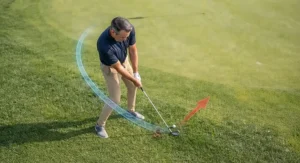
A controlled full swing isn’t a smaller swing, it’s a complete swing executed at a slightly reduced effort level, usually 80-90% of maximum, with full extension and full rotation preserved. Swinging at 100% effort with a short wedge tends to steepen the attack angle and reduce control, which is counterintuitive but well documented by teaching professionals. Practicing controlled full swings specifically with a gap wedge, rather than only with longer clubs, transfers surprisingly well to tempo throughout the rest of the bag too.
Why Yardage Consistency Breaks Down
Yardage consistency erodes for three common reasons: inconsistent strike location, tempo that speeds up under on-course pressure, and equipment that’s fallen out of spec through worn grooves or a stretched grip. Reviewers and fitters consistently point to strike location as the biggest single factor, ahead of even swing speed variation. A five-minute impact-tape check once a month catches drift before it costs you strokes on the course, and it’s a far cheaper diagnostic than assuming you need new equipment.
Gap Wedge for Approach Shot Accuracy: From the Range to the Scorecard
Approach shot accuracy ultimately comes down to converting a known yardage into a repeatable outcome, and a well-fit gap wedge is one of the highest-leverage tools for doing that in the 80-110 yard range specifically, since that’s where a surprising number of mid-handicap approach shots actually originate. Here’s what most buyers overlook: the club matters less than the process of knowing your real numbers, but the right club makes that process dramatically easier to trust under pressure.
Golfers who track their approach shot accuracy over a season consistently find that dispersion tightens fastest once they commit to a single go-to gap wedge rather than rotating between multiple wedges of similar loft. Familiarity with exact spin behavior, trajectory, and feel builds trust, and trust is what allows a golfer to commit fully to a controlled full swing under scorecard pressure instead of steering the shot defensively.
Common Mistakes When Buying a Gap Wedge
The most common mistake is buying loft in isolation without checking bounce compatibility with your typical turf and swing type; a low-bounce wedge on a steep, digging swing produces chunked shots regardless of how good the marketing looked. A close second is assuming a more expensive wedge automatically means better full-shot distance control, when in reality feel and cosmetics account for a large share of premium pricing rather than pure yardage performance. Golfers also frequently skip re-evaluating their existing set gapping entirely, buying a gap wedge that duplicates a loft they already own in their iron set. Finally, many buyers ignore grind entirely and default to whatever the retail rack has in stock, missing out on meaningful full-shot performance gains a proper fitting would reveal.
Long-Term Cost & Maintenance
A quality gap wedge purchased in the $150-$220 range typically lasts 2-4 seasons of regular play (roughly 80-150 rounds) before groove wear meaningfully reduces spin performance, which puts the effective cost-per-round somewhere between $1 and $3 for moderate players. Budget options like the Takomo Skyforger 002 shift that math further in the buyer’s favor, delivering a similar functional lifespan for roughly half the upfront cost, which matters most for golfers replacing a full three-wedge set rather than a single club. Maintenance costs are minimal but not zero: expect to re-grip annually for around $10-$15 in materials if doing it yourself, and factor in an occasional professional loft-and-lie check, especially after the club has taken a few thousand full swings. Total cost of ownership favors buying fewer, better-maintained wedges over cycling through cheap replacements every season, since groove degradation (not structural failure) is almost always what ends a wedge’s useful life.
Safety, Grooves & Regulations Guide
If you play in sanctioned competitions, groove conformance is worth understanding before you buy. All the wedges featured in this guide are current, currently manufactured models designed to meet modern groove and punch-mark specifications, but golfers competing under strict local rules should still verify conformance status for any specific club, since older or non-standard grinds can occasionally fall outside tournament conditions. For casual and most club-level play, this is rarely an issue, but it’s a five-minute check worth doing before a serious event rather than finding out the hard way. Beyond rules compliance, general safety is straightforward: keep grooves clean to avoid unpredictable spin behavior that can send a full shot further offline than expected, and replace grips once they’ve hardened or lost tackiness, since a slipping club mid-swing is a far more common on-course hazard than most golfers realize.

FAQ
❓ What loft is a gap wedge for full shots?
❓ How far should a gap wedge go on a full swing?
❓ Is a gap wedge necessary if I already have a pitching and sand wedge?
❓ What's the difference between gap wedge distance control and sand wedge distance control?
❓ Can beginners benefit from a dedicated gap wedge?
Conclusion
Gap wedge full shots reward preparation more than almost any other club in the bag, because the margin for error on a 100-yard approach is smaller than on a 250-yard drive. Whether you land on the tour-level precision of the Titleist Vokey SM11, the wet-weather engineering of the TaylorMade Milled Grind 5, or the genuinely impressive value of the Takomo Skyforger 002, the underlying advice stays the same: match loft and bounce to your actual swing and turf conditions, then put in the range time to learn your real yardages rather than assumed ones. None of these seven wedges will fix a broken swing, but every one of them will make a solid swing more repeatable, and repeatability is what turns 100-yard approach shots from a coin flip into a scoring opportunity.
Recommended for You
- Gap Wedge 50 52 Degree: 7 Top Picks for Precision Scoring in 2026
- 7 Best Lob Wedges for Finesse Shots in 2026
- High Loft Lob Wedge 60 64: 7 Picks That Actually Spin (2026)
Disclaimer: This article contains affiliate links. As an Amazon Associate, I earn from qualifying purchases. If you purchase products through these links, we may earn a small commission at no additional cost to you.
✨ Found this helpful? Share it with your friends! 💬🤗
