In This Article
Forged irons for advanced golfers are compact, soft-steel irons shaped from a single heated piece of steel. They are tuned for feedback, trajectory control and shot-shaping rather than maximum forgiveness. They suit consistent ball strikers who want the clubface to report exactly where the ball met it.

Here’s the twist for 2026: the category no longer means “unforgiving.” A few years ago, choosing forged irons for advanced golfers meant accepting blade-sized punishment in exchange for feel. Today, engineers slip tungsten into cavities, thin the faces and hide hollow bodies inside heads that still look museum-worthy. The menu is wider than ever, and the decision is trickier.
This guide narrows it to seven real sets. They run from the Tour-proven Titleist T100 to the value-minded Wilson Staff Model CB. Everything here comes from published specs, manufacturer launch data and recurring themes in independent reviews. It does not come from anyone pretending to have swung all seven. Where reviewers disagree, we’ll say so. Where something can’t be verified, we’ll say that too.
Along the way we’ll untangle forged vs cast irons, explain why shaft weight quietly changes how a set feels, and look at golf irons for low handicap golfers from scratch to single digits. We’ll also dig into scoring irons, the 8-iron through wedge, where most strokes are won. Prices below are ranges, so check current price before you buy.
Quick Comparison: The 7 Best Forged Irons for Advanced Golfers at a Glance
| Model | Head Style | Forgiveness (editorial, spec-based) | Best For |
|---|---|---|---|
| Titleist T100 | Forged multi-material cavity back | Medium | Single-digit players wanting Tour-proven precision |
| Mizuno Pro M-13 | Multi-construction forged | Medium | Feel-first ball strikers |
| Srixon ZXi7 | Single-piece forged cavity | Medium-low | Shot-shapers who love soft feel |
| TaylorMade P7CB | Single-piece forged cavity back | Medium | Players wanting consistent launch through the set |
| Ping Blueprint S | Forged cavity, pocket-forged long irons | Medium | Scratch-to-5 players wanting long-iron help |
| Callaway Apex Ai150 | Forged hollow body | Medium-high | Players wanting speed in a compact shape |
| Wilson Staff Model CB | Forged cavity back | Medium | Value-focused traditionalists |
Looking at the table, the Titleist T100 and Ping Blueprint S sit at the precision end, while the Callaway Apex Ai150 leans hardest toward speed and long-iron help. The Mizuno Pro M-13, Srixon ZXi7 and Wilson Staff Model CB form the feel-first trio. The TaylorMade P7CB splits the difference with its constant-center-of-gravity design.
One thing the forgiveness column can’t show is that forgiveness in forged irons for advanced golfers is rarely uniform. Most of these sets hide their technology in the 3-7 irons and revert to simpler, more traditional designs in the scoring irons, where a low handicapper wants pure feedback. Read each row as a gradient across the set, not a single number.
Budget buyers should note that the gap between the cheapest and priciest set here is a few hundred dollars. That’s real but small next to the cost of a wrong shaft or lie angle, which is why fitting keeps coming up below. If you remember one thing from this table, choose the head style that matches your typical miss, not your best day.
💬 Just one click — help others make better buying decisions too!😊
Top 7 Forged Irons for Advanced Golfers: Expert Analysis
Every entry below follows the same path: what the specs mean on the course, who should care, what reviewers keep saying, and where the value lands. Price ranges reflect a seven-iron steel set at launch or in recent listings, so treat them as guideposts.
1. Titleist T100 — Tour-proven shape with hidden tungsten forgiveness
The Titleist T100 earns its reputation by hiding its help. Split high-density tungsten in the heel and toe stabilizes off-center strikes inside a slim players’ cavity profile.
In practice, Variable Face Thickness in the 3-7 irons keeps ball speed from collapsing when contact drifts. More aggressive grooves in the mid and short irons should help you hold greens from light rough. Lofts run about a degree stronger than the 2023 version, so recheck your wedge gapping.
Based on the spec comparison, this suits single-digit players who want the shape reviewers say is the most-played iron model on the PGA Tour, without total exposure on a thin strike. Titleist’s fitters can now adjust hosel angles and head weights on the fly, and roughly 90% of its fittings reportedly end in blended sets.
Reviewers consistently praise the minimalist look and soft sound. A recurring critique is that the muted response can make strike location harder to read, and that gains over the 2023 model are modest.
Pros:
- ✅ Tour-proven compact shape with minimal offset
- ✅ Tungsten stability on off-center strikes
- ✅ Fitting tools built for blended sets
Cons:
- ❌ Modest gains over the previous generation
- ❌ Muted sound hides strike feedback for some
Expect roughly $1,400-$1,600 for a seven-club steel set; check current price. Value verdict: solid if you’ll use the fitting, weaker if you already own the 2023 set.

2. Mizuno Pro M-13 — one-piece forged feel where scoring happens
The Mizuno Pro M-13 is really three constructions under one coat of chrome. That’s the point.
The 4-5 irons use a pocket-cavity forging with a stainless back piece for launch. The 6-8 irons use a micro-slot design with a face reportedly 0.3 mm thinner than the Pro 243 it replaces. The short irons return to one-piece forging for pure feedback. Stock lofts run 32° in the 7-iron and 44° in the pitching wedge, so distance help is modest and deliberate.
Here’s what to weigh: you get speed where launch is hardest and feel where distance control matters most. Golf Digest’s launch breakdown positions the M-13 as the true players’ model. The hollow Mizuno Pro M-15 covers the distance-first buyer.
Early reviewers, writing since the February 2026 retail release, praise the topline and size profile. They describe it as a players’ iron that’s actually playable, though the review pool is still small.
Pros:
- ✅ Pure one-piece forged scoring irons
- ✅ Launch help built into the long irons
- ✅ Copper underlay tunes feel and sound
Cons:
- ❌ Premium pricing versus most rivals
- ❌ Limited long-term review data so far
Launch pricing put a seven-club set roughly in the $1,500-$1,750 range, depending on retailer. Value verdict: premium, but justified for feel-first players.
3. Srixon ZXi7 — softest-feeling forging through condensed technology
Condensed forging is the Srixon ZXi7‘s party trick. A second forge presses raised features back into the head, adding strength exactly where it’s needed.
That strength lets Srixon soften its steel further (the maker says its S15C is 7% softer). A larger forged ridge behind the sweet spot, called PureFrame iQ for 2026, steadies the impact zone. The translation is a dense, cushioned center in a thin-topline head, with no bigger footprint. The stock shaft is a Dynamic Gold Mid.
Srixon’s own suggested combo puts the more forgiving Srixon ZXi5 in the 4-6 irons and the ZXi7 in 7-PW or 8-PW. That tells you where it’s happiest: as a scoring-iron specialist for shot-shapers.
Reviewers consistently call it among the best-looking and best-feeling players’ cavities. One noted a sole that can feel slightly one-sided for steeper deliveries, and others call the 2026 updates refinements rather than revolution.
Pros:
- ✅ Exceptionally soft, dense impact feel
- ✅ Compact, tour-preferred shaping
- ✅ Easy combo building within Srixon’s family
Cons:
- ❌ Sole may not suit every delivery angle
- ❌ Upgrades over prior generation are incremental
Listings cluster around $200-$215 per club, roughly $1,400-$1,550 for seven. Value verdict: strong among premium forgings.
4. TaylorMade P7CB — constant center of gravity for repeatable launch
A constant center of gravity is the TaylorMade P7CB‘s calling card, and it’s rare in forged irons.
Each head is forged five times from 1025 carbon steel before the face is CNC-milled. A hidden co-forged tungsten weight adds stability, and the sole is 2 mm wider than the P7MC it replaced. Stock lofts are traditional: 33° in the 7-iron and 46° in the pitching wedge. Because the CG stays constant, launch and spin behave alike from 4-iron to wedge. Some players love that consistency; others find it limiting up top.
TaylorMade claims a 4-6 yard carry deficit versus the faster-faced TaylorMade P770 in the mid and long irons. One reviewer’s data didn’t fully back that gap, while another reported losing height and ball speed and moved toward the P770 at the top of the set.
Reviewers consistently describe soft feel, predictable flight and a less intimidating look than the older P7MC.
Pros:
- ✅ Single-piece forged feel with tour shaping
- ✅ Wider sole improves turf interaction
- ✅ Blends cleanly with the P770
Cons:
- ❌ Gives up carry to faster hollow-style models
- ❌ Long irons may need extra launch help
Expect roughly $1,300-$1,500 for seven irons. Value verdict: excellent if constant launch appeals.
5. Ping Blueprint S — forged cavity back with pocketed long-iron help
Ping’s first forged cavity back in over a decade, the Ping Blueprint S splits its set in two on purpose.
The 3-5 irons use a patented pocket forging that frees about 10 grams for extra stability, with an elastomer insert keeping feel dense. The 6-PW are single-piece forgings for control. The 8620 carbon steel head carries tungsten toe and tip weights for swing-weight tuning. Standard lofts (about 33° in the 7-iron per one retailer’s listing) match the Ping Blueprint T and the i230, so blending is straightforward.
On paper, that means long-iron help without sacrificing scoring-iron feel. What reviewers add is that traditional lofts run short of modern sets. One tester’s 7-iron carried like a modern 8-iron, so ask about Power Spec lofts if distance matters.
Reviewers praise pinpoint accuracy (one likened it to throwing darts), minimal offset and a solid, dense impact. The main complaints are price and short stock distance.
Pros:
- ✅ Pocket-forged 3-5 irons add stability
- ✅ Matched lofts simplify blended sets
- ✅ Retro and Power lofts available
Cons:
- ❌ Traditional lofts sacrifice yardage
- ❌ Premium launch pricing
Launch pricing works out to roughly $1,500-$1,700 for seven irons. Value verdict: fair, and purpose-built for blending.
6. Callaway Apex Ai150 — hollow-body speed in a blade-like profile
The Callaway Apex Ai150 is the speed merchant of this group: a forged hollow-body head shrunk into a compact profile.
A 455 face cup in the 3-7 irons boosts ball speed and launch. Stainless 17-4 faces from the 8-iron down neutralize extra speed for spin and distance control. Stock lofts sit at 24° in the 5-iron, 31° in the 7-iron and 44° in the pitching wedge, so expect more yardage than the traditional-loft sets here. It replaces the Apex Pro in Callaway’s lineup, with MIM weights tuning each head’s CG.
Here’s what to weigh: this is for advanced golfers who want ball speed and a tighter dispersion window without a bulky look. Hollow construction also means the sound is livelier than a classic forging.
Reviewers consistently cite tight dispersion and long-iron help. The critiques are a louder sound that announces distance, and a head that’s less compact than the truest players’ irons.
Pros:
- ✅ Long-iron help from hollow-body design
- ✅ Tight dispersion reported by reviewers
- ✅ Split face materials protect scoring control
Cons:
- ❌ Sound less traditional than solid forgings
- ❌ Not as compact as blade-style rivals
Expect roughly $1,500-$1,700 for a seven-club set. Value verdict: best for speed-minded players.
7. Wilson Staff Model CB — soft 8620 forging at a value price
Restraint is the Wilson Staff Model CB‘s superpower: no hollow body, no fireworks, just soft forged steel.
The head is forged from 8620 carbon steel. A Fluid Feel Hosel moves weight toward the toe for stability and to discourage the low-left miss, and a precision-milled face aims for more consistent spin. Lofts stay traditional; the 2024 model carried a 34° 7-iron.
That’s an accuracy-first recipe. One tester measured roughly five yards shorter than a Titleist T150, which fits the trade of ball speed for feel. It also pairs with Wilson’s blades in the short irons or the XB in the long irons.
Reviewers consistently praise the looks, dense feel and straight flights. Critiques are that it gives up distance and forgiveness to hollow-body sets, and that it rarely gets the attention its rivals do.
Pros:
- ✅ Classic forged feel at traditional lofts
- ✅ Competitive value in this class
- ✅ Blends with Wilson blades and XB
Cons:
- ❌ Shorter than modern-loft competitors
- ❌ Less forgiving than hollow-body sets
Expect roughly $1,200-$1,450 for seven irons. Value verdict: the best price-to-pedigree ratio here.
Side-by-Side Snapshot: Tech and Price
| Model | Standout Tech | Price Range (7 clubs) | Best For |
|---|---|---|---|
| Titleist T100 | Split tungsten + VFT | $1,400-$1,600 | Precision with fitting support |
| Mizuno Pro M-13 | Three-construction forging | $1,500-$1,750 | Feel-first scoring irons |
| Srixon ZXi7 | Condensed forging | $1,400-$1,550 | Soft-feel shot-shapers |
| TaylorMade P7CB | Constant CG | $1,300-$1,500 | Repeatable launch |
| Ping Blueprint S | Pocket-forged long irons | $1,500-$1,700 | Blended set builders |
| Callaway Apex Ai150 | Hollow body + face cup | $1,500-$1,700 | Speed in a compact head |
| Wilson Staff Model CB | 8620 forging + Fluid Feel Hosel | $1,200-$1,450 | Value traditionalists |
Prices are approximate and may vary by shaft and retailer. The Wilson Staff Model CB and TaylorMade P7CB anchor the value end. The Mizuno Pro M-13 and Ping Blueprint S cost more for specialized construction. If ball speed is your priority, the Callaway Apex Ai150 justifies its premium; if feedback wins, the Srixon ZXi7 does.
Your First 30 Days With Forged Irons: Setup, Break-In and Mistakes to Avoid
New forged irons for advanced golfers deserve a plan, not just a first bucket of balls. Here’s a simple timeline.
Week 1: verify the specs. Have a fitter or reputable builder check loft, lie and length before your first round. Soft carbon steel bends easily, which is why makers like Callaway highlight easy adjustment. It also means a rough drop can quietly change a lie angle.
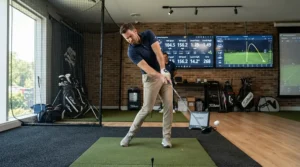
Week 2: map your gaps. Hit ten shots with each 7-PW club on a launch monitor and record carry, not total distance. Sets like the Mizuno Pro M-13 and Ping Blueprint S step about four degrees per club. Then compare your pitching wedge against your wedges, because stronger modern lofts often leave a hole.
Weeks 3-4: play them, and track misses. Use impact tape or spray to see whether you miss toe-side, heel-side or thin. That pattern tells you whether a more forgiving long-iron blend is worth a fitting visit.
Care basics: rinse grooves with warm water and a soft brush, and dry the heads after wet rounds so carbon steel finishes stay clean. Avoid abrasive cleaners.
Three common mistakes:
- Judging feel by mishits. Forged irons punish poor strikes, which is feedback rather than a defect.
- Changing shafts within days. Give the build a fair sample first.
- Ignoring wedge gaps after moving to stronger lofts.

Real-World Scenarios: Which Forged Irons for Advanced Golfers Fit Which Player?
Scenario 1: the 2-handicap who plays 60 rounds a year. The budget is flexible, and the conditions are firm summer courses plus winter mats. The Titleist T100, possibly with Titleist T150 long irons in a fitter-built blend, or the Srixon ZXi7 suits this player. Both reward precise shot-shaping while giving a small safety net when a strike drifts.
Scenario 2: the 6-handicap competitor chasing forged feel without losing greens. He plays about 30 rounds a year on soft parkland courses. The Ping Blueprint S gives pocket-forged long-iron help. The Callaway Apex Ai150 is the alternative if his carry distances lag, since hollow construction adds speed.
Scenario 3: the scratch player on a budget who prefers traditional lofts. She practices weekly and plays 100 rounds a year. The Wilson Staff Model CB or TaylorMade P7CB delivers forged feel at the lower end of this price band.
Buyer’s decision shortcut:
- If feel matters most, choose the Mizuno Pro M-13 because its short irons are one-piece forged.
- If consistent launch matters most, choose the TaylorMade P7CB because its center of gravity stays constant.
- If long-iron help matters most, choose the Ping Blueprint S or Callaway Apex Ai150 because both add stability or speed up top.
How to Choose Forged Irons for Advanced Golfers
To choose forged irons for advanced golfers, match head style to your typical miss, verify lofts and gapping, choose a construction that fits your feel priorities, and confirm shaft weight in a fitting. In more detail:
- Know your miss. Track a few rounds to see whether you miss thin, toe-side or short. That points you to a compact blade-style or a helpful cavity.
- Match head style to skill. Golf irons for low handicap golfers range from full blades to hollow forged cavities, and most single-digit players sit in between.
- Read lofts, not labels. A 7-iron that’s two degrees stronger is not longer by magic; it’s simply a different loft.
- Choose your construction. One-piece forging emphasizes feel; multi-piece or hollow designs emphasize speed.
- Consider a combo set. Mix forgiving long irons with precise scoring irons.
- Choose shaft weight and flex deliberately (see the shaft section below).
- Get fit. Titleist’s fitting approach, as described in one review, focuses on distance, dispersion and descent angle.
Forged vs Cast Irons: What Really Changes for Advanced Players
The forged vs cast irons debate is older than most launch monitors, and it’s partly myth. Forged heads are shaped from heated steel; cast heads are poured into molds. That gives casting more design freedom for perimeter weighting, which is why nearly every game-improvement iron is cast.
| Factor | Forged | Cast | Best For |
|---|---|---|---|
| Feel and feedback | Softer, denser, more information | More uniform, dampened | Forged: players who read strikes |
| Forgiveness | Model-dependent | Usually higher via weighting | Cast: inconsistent strikers |
| Workability | High | Lower in max-distance models | Forged: shot-shapers |
| Price | Higher labor cost | Generally lower | Cast: value seekers |
| Durability | Softer steel can show wear sooner | Harder and more durable | Cast: heavy practice loads |
Looking at the table, the forged vs cast irons gap is now a spectrum. The Callaway Apex Ai150 is forged but hollow, and the TaylorMade P770 uses a forged face insert. Feel depends heavily on design and weight distribution, not just material. For advanced golfers, forging still offers the most reliable feedback, but a cast long iron blended into a forged set is common and perfectly reasonable.
Golf Irons for Low Handicap Golfers: Blade, Cavity Back or Hollow Body?
Golf irons for low handicap golfers cover a wide range. Reviewers generally define low handicap as roughly 0-9, and the sweet spot depends on where you sit within it.
Players around 1-3 can handle a full blade or a compact forged cavity like the Wilson Staff Model CB or Srixon ZXi7. Players closer to 5-9 often play better with the pocketed Ping Blueprint S or the hollow Callaway Apex Ai150, which give more help on off-center strikes. Golf Monthly’s guidance notes that most single-digit players still appreciate assistance when they don’t flush it.
The real principle is less demanding is better. Choose the least demanding iron that still gives you the look, feel and workability you want. Many golf irons for low handicap golfers end up in blended sets: more forgiving in the 4-6 irons, tighter in the 7-PW. That approach fits the Titleist T100, TaylorMade P7CB and Ping Blueprint S, all of which are designed with blending in mind.
Shaft Weight: The Overlooked Half of Your Forged Set
Shaft weight changes tempo, timing and control, and it does so independently of flex. Steel iron shafts typically run about 85-130 grams, while graphite runs about 55-85 grams. Most stock sets ship with roughly 95-110 gram steel.
Today’s Golfer’s shaft testing notes that 120-gram-plus tour-weight shafts (such as Dynamic Gold, Project X and KBS C-Taper) usually suit above-average swing speeds. Mid-weight shafts around 90-110 grams fit slower or smoother tempos. Dynamic Gold typically sits at 120 grams and up, while KBS Tour more often falls in the 110-120 range.
Here’s the practical read. Heavier shaft weight can calm an aggressive transition and lower launch, but go too heavy and you’ll fatigue and lose speed. Go too light and control suffers. Stock choices reflect this: the Callaway Apex Ai150 ships with a Dynamic Gold Mid 115 and the Srixon ZXi7 with a Dynamic Gold Mid.
Two cautions: flex labels aren’t standardized between brands, and shaft weight has relatively little effect on swing weight. Trust a fitting over a label.
Scoring Irons: Why Your 7-PW Decide Your Scores
Scoring irons, typically the 8-iron through pitching wedge, are where forged irons for advanced golfers justify their price. Approach shots from 100-150 yards decide most low-handicap scorecards, and that’s exactly where designers strip out tech.
The Mizuno Pro M-13 returns to one-piece forging for its short irons. The Ping Blueprint S keeps its pocket construction to the 3-5 irons, leaving 6-PW as single-piece forgings. The Callaway Apex Ai150 switches to 17-4 faces from the 8-iron down to control speed and spin. Srixon ZXi7 recommends its 7-PW as the sweet spot for the model.
Watch the loft ladder. Pitching wedges run about 44-46° across these sets (44° for the Mizuno Pro M-13 and Callaway Apex Ai150, 46° for the TaylorMade P7CB), so your gap wedge will likely sit near 48-50°. Blend scoring irons for precision, but verify each transition on a launch monitor.
Long-Term Cost & Maintenance of Forged Irons
A seven-club set costs roughly $1,200-$1,750 depending on the model. Add upgrades: graphite options at Titleist T100-level pricing add roughly $100 per club, and custom shafts, grips and lie adjustments add more.
Ownership costs are modest but real. Forged heads use softer steel, so grooves and soles can show wear sooner than harder cast heads, especially with heavy practice. Plan on regripping periodically and rechecking loft and lie after a year of play.
Resale softens the blow. One retailer listed a used 2024 TaylorMade P7CB seven-iron set around a third below its launch price. If you play 50 rounds a year and keep a $1,500 set for four seasons, that’s about $7.50 per round before resale. Spread across a handicap-lowering season, that’s a fair price for feedback you can actually use.
FAQ
❓ How much do forged irons for advanced golfers cost in 2026?
❓ Should golf irons for low handicap golfers be blades or cavity backs?
❓ Is a heavier shaft weight better in forged irons?
❓ Can I mix different scoring irons with my long irons?
❓ Do forged irons wear out faster than cast irons?
Conclusion
Forged irons for advanced golfers are no longer a punishment for skill. They’re a set of trade-offs you can now choose on purpose. The Titleist T100 offers Tour-proven precision with fitting support. The Mizuno Pro M-13 and Srixon ZXi7 chase feel, and the TaylorMade P7CB chases repeatable launch. The Ping Blueprint S builds help into the long irons, and the Callaway Apex Ai150 trades tradition for speed. Meanwhile, the Wilson Staff Model CB proves you don’t need a hollow body or a top-shelf price to get real forged feel.
The pattern across every section above is the same: match the head style to your typical miss, mind your scoring irons, respect shaft weight, and treat forged vs cast irons as a spectrum rather than a religion. Golf irons for low handicap golfers work best when they’re fit, not just bought. Book a session, hit two or three of these on a launch monitor, and let your numbers make the call.
Recommended for You
- Players Irons For Advanced Golfers: 7 Best Picks (2026)
- Golf Club Set For 15 Handicap Golfers: 7 Picks To Break 90 (2026)
- 7 Best Golf Irons For Intermediate Players In 2026
Disclaimer: This article contains affiliate links. As an Amazon Associate, I earn from qualifying purchases. If you purchase products through these links, we may earn a small commission at no additional cost to you.
✨ Found this helpful? Share it with your friends! 💬🤗
