

In This Article
Somewhere between “I can clear that tree” and “why did that ball run through the green like it had somewhere better to be,” a lot of golfers realize their wedge lineup has a hole in it. That hole usually sits right at the top of the loft chart. A high loft lob wedge 60 64 isn’t a luxury club for scratch players who like fancy equipment — it’s the tool that turns a buried lie behind a bunker or a tight pin tucked past a pond into a shot you actually want to hit instead of one you’re praying over.

This guide walks through seven real wedges spanning budget to tour-level, all built around that 58-to-64-degree range where trajectory gets steep, spin gets aggressive, and mistakes get magnified. We’ll dig into specs the way a fitter would — not just listing numbers, but explaining what a 4-degree bounce increase or a milled groove pattern actually does to your ball flight. You’ll also get honest, review-grounded commentary on what golfers report after months of real use, plus practical guidance on choosing between a 60 and a 64, hitting over trees without ballooning your shot, and getting that soft, one-hop-and-stop landing everyone wants but few consistently produce.
Whether you’re replacing a worn-out sand wedge, adding a dedicated flop-shot club, or just tired of chunking greenside shots, there’s a fit here. Let’s get into it.
What Is a High Loft Lob Wedge (60-64 Degrees)?
A high loft lob wedge 60 64 is a short-game club with 60 to 64 degrees of loft, the steepest face angle in a standard bag. It’s designed for maximum-height shots over obstacles, soft-landing pitches, and bunker escapes where a lower-lofted wedge would run the ball too far past the target.
Quick Comparison Table
| Wedge | Loft Range | Best For | Price Range |
|---|---|---|---|
| Titleist Vokey SM10 | 58°-64° (WedgeWorks) | Tour-level shot versatility | $180-$220 range |
| Cleveland RTX 6 ZipCore | 58°-60° | Spin on a mid-tier budget | $120-$140 range |
| Callaway Jaws Raw | 58°-62° | Aggressive, raw-face spin | $170-$200 range |
| Ping Glide 4.0 | 58°-60° | Wet-weather, forgiving turf interaction | $190-$230 range |
| Mizuno T24 | 58°-60° | Feel-first players, forged consistency | $160-$190 range |
| TaylorMade Hi-Toe 3 | 58°-64° | Ultra high loft, full-face grooves | $170-$190 range |
| Wilson Staff Harmonized | 60°-64° | Budget-friendly first lob wedge | Under $70 |
Looking at the spread above, the TaylorMade Hi-Toe 3 and Titleist Vokey SM10 stand out as the only two lines here that stretch loft options all the way to 64 degrees, which matters if you’re specifically chasing an ultra high loft option rather than a standard 60. Budget-conscious golfers shouldn’t overlook the Wilson Staff Harmonized, since it’s one of the only mainstream wedges available at 64 degrees for well under $100. Mid-range buyers get the most head-to-head value tension between the Cleveland RTX 6 ZipCore and Mizuno T24, both of which trade a little brand prestige for genuinely competitive spin numbers.
💬 Just one click — help others make better buying decisions too!😊
Top 7 High Loft Lob Wedges (60-64°): Expert Analysis
1. Titleist Vokey SM10 — most trusted on professional tours
The standout here isn’t a gimmick feature — it’s simply that the Vokey SM10 has been the most-played wedge on the PGA Tour for two decades running, and that pedigree shows up in fit consistency more than raw marketing.
Titleist repositioned the center of gravity forward and away from the heel on this generation, which in practice means lower, more penetrating launch and tighter spin consistency even on strikes that miss the center of the face. The line now includes low-bounce 58.06K and 60.06K options with a wider K-Grind sole, aimed at players with shallow deliveries or those grinding on firm, tour-style turf. With 27 loft, bounce, and grind combinations, this isn’t a one-size-fits-all wedge — it’s a system, and that’s precisely the point.
Based on the spec comparison against competitors in this list, the Vokey SM10 rewards golfers who are willing to get properly fit rather than grab one off the rack; a mismatched grind here won’t outperform a cheaper, correctly-fit alternative. Reviewers consistently note that the milled and heat-treated grooves hold their bite longer than older Vokey generations, and aggregated feedback frequently mentions the wide grind selection as both a strength and a source of decision fatigue for first-time buyers.
Pros:
- ✅ Most tour-proven wedge line in professional golf
- ✅ Six grind options fit nearly any swing type
- ✅ Groove durability improved via localized heat treatment
Cons:
- ❌ Grind selection can overwhelm first-time buyers
- ❌ Premium pricing versus mid-tier alternatives
Typically found in the $180-$220 range, the Vokey SM10 earns its price if you’ll actually use the fitting options; casual players who just want “a 60-degree wedge” may be paying for versatility they won’t tap.
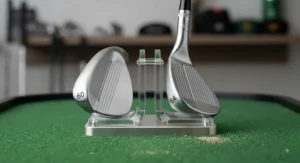
2. Cleveland RTX 6 ZipCore — best spin-to-price ratio in this lineup
What jumps out immediately is the ZipCore construction, a low-density core that shifts the center of gravity precisely behind the strike zone without inflating the price the way premium tour wedges do.
The face uses dynamic blast media and laser-etched patterns that vary by loft grouping, with rougher texturing on the 54-60 degree models specifically to maintain spin in wet or dewy conditions. Three sole grind options are available: a low 6-degree bounce C-shaped sole for players who open the face frequently, plus mid and full sole variants for steeper attack angles. Stock length runs about 34.5 inches in the 58-62 degree range, slightly shorter than full-swing wedges to help control trajectory on partial shots.
What most buyers overlook about this model is that it’s essentially built on the same spin philosophy as wedges costing 50% more — the ZipCore technology trickles down from Cleveland’s tour-level research rather than being a stripped-down budget design. Reviewers consistently report strong first-impression spin numbers, particularly from the rough, and aggregated feedback frequently praises the stock True Temper Dynamic Gold Spinner shaft for feel.
Pros:
- ✅ Strong spin performance from wet and rough lies
- ✅ Three grind options without a huge price jump
- ✅ Tour-level shaft included as stock equipment
Cons:
- ❌ Fewer loft/grind combinations than Vokey or Callaway
- ❌ Finish wears faster than premium chrome options
Priced generally in the $120-$140 range at retail, the Cleveland RTX 6 ZipCore is arguably the strongest value pick on this list for golfers who want tour-adjacent spin without the tour-adjacent invoice.
3. Callaway Jaws Raw — most aggressive face texture for maximum bite
The standout feature is right in the name: a raw, unplated face that’s designed to rust intentionally in the scoring zone, increasing friction and spin the more it’s played.
Callaway added tungsten weighting to the sand and lob wedge heads for the first time in company history, which centers the CG for more consistent feel across strike locations. Grooves feature a steep 37-degree wall angle plus offset “groove-in-groove” micro-texturing angled at 20 degrees, both aimed squarely at close-range spin on chips, pitches, and full lob shots. Four grind options — S, W, X, and the newer Z grind — cover everything from full-swing sand play to low-bounce, open-face creativity around the green.
Here’s what the spec sheet won’t tell you, but reviewers note: the raw face genuinely changes appearance and grip over the first few rounds as it oxidizes, which some golfers love for the added texture and others find visually unappealing on a $180+ club. Aggregated review sentiment is largely positive on sound and feel at impact, with several independent reviewers specifically calling out the stock shaft’s role in trajectory control as a pleasant surprise.
Pros:
- ✅ Raw face friction genuinely increases with wear
- ✅ Tungsten weighting improves CG centering
- ✅ Four grind options cover diverse attack angles
Cons:
- ❌ Raw finish rusts, which not everyone wants
- ❌ Aggressive grooves may feel harsh off-center
Expect to pay in the $170-$200 range depending on finish, making the Callaway Jaws Raw a fair trade for golfers who prioritize spin over cosmetics longevity.
4. Ping Glide 4.0 — best for wet weather and inconsistent strikes
The multi-material construction pairs 8620 carbon steel with a larger, softer elastomer insert, expanding face contact by roughly a third to deliver a noticeably softer feel than the previous Glide generation.
Grooves are wheel-cut with a 20-degree sidewall on full-swing lofts and a steeper 28-degree sidewall on the 54-60 degree partial-shot lofts, paired with an emery-blasted face finish that adds friction independent of the grooves themselves. The Hydropearl 2.0 coating sheds water on contact, which is why independent Trackman testing has repeatedly flagged this wedge as a standout performer specifically in wet or rough conditions. Four sole options — Standard, Wide, Thin, and the distinctive rounded Eye2-style E-Sole — mean the loft-to-grind matrix here is nearly as deep as Vokey’s.
On paper this means the Ping Glide 4.0 should underperform in pure accuracy metrics compared to blade-style competitors, and that tracks with third-party testing data showing it scoring below average on dispersion while excelling at spin consistency. Reviewers consistently note that this is one of the rare wedges where spin numbers barely drop off between dry and wet lies, a meaningful edge for golfers in humid or rainy climates.
Pros:
- ✅ Spin holds up remarkably well in wet conditions
- ✅ Softer feel from expanded elastomer face insert
- ✅ Four sole grinds including a unique rounded E-Sole
Cons:
- ❌ Below-average accuracy scores in independent testing
- ❌ Larger head profile than blade-style alternatives
At a typical $190-$230 range, the Ping Glide 4.0 makes the most sense for golfers in wetter regions or those who value forgiveness over a compact, tour-blade look.
5. Mizuno T24 — best forged feel for players who grew up on blades
What stands out immediately is the Grain Flow Forged 1025 Boron steel construction, a manufacturing process Mizuno is famous for in irons and now applies with real consistency to its wedge line.
Groove count and spacing change by loft: 17 narrower grooves dominate the 46-52 degree range for full-swing grip, while 15 wider grooves take over from 54-60 degrees specifically to channel away grass, sand, and moisture on partial shots. Five sole grinds — S, D, C, V, and X — span everything from a full-shot-focused sole to the aggressive, heavily relieved X-Grind built for extremely shallow attack angles. The topline has been visually slimmed by removing mass from the toe and hosel transition, which several independent reviewers say improves confidence at address without sacrificing actual forgiveness.
Based on the spec comparison, the Mizuno T24 occupies a genuine middle ground — not as deep a fitting matrix as Vokey, but noticeably more feel-focused than Cleveland or TaylorMade thanks to the forged construction. Reviewers consistently praise the feedback at impact, describing mishits as still communicative rather than dead, and aggregated sentiment suggests this wedge blends particularly well into bags that already carry Mizuno’s forged iron sets.
Pros:
- ✅ Forged construction delivers exceptional feedback and feel
- ✅ Loft-specific groove design channels debris effectively
- ✅ Five grind options cover most swing types
Cons:
- ❌ Smaller brand footprint means fewer fitting locations
- ❌ Doesn’t extend to 62° or 64° lofts
Generally priced in the $160-$190 range, the Mizuno T24 is the pick for golfers who care as much about how a wedge feels as what it does on a launch monitor.

6. TaylorMade Hi-Toe 3 — the ultra high loft option built for full-face spin
The defining feature is right there in the name: a toe that stands roughly 5mm taller than a conventional wedge, raising the center of gravity for a lower, more penetrating launch with more spin, and — critically for this keyword — genuine availability up to 64 degrees.
Full-face scoring lines extend from 56 to 64 degrees, meaning even a badly struck toe shot out of thick rough still makes meaningful contact with grooves instead of skidding off a smooth, ungrooved section. TaylorMade’s internal impact-location research on more than 130,000 golfers found nearly two-thirds of players strike the toe more than the center, which directly informed this shape. Three bounce configurations — 7-degree low, 9-to-10-degree standard, and 13-degree high — plus a four-way cambered sole give this wedge a surprisingly wide fitting window for something built around a single unconventional shape.
What most buyers overlook about this model is that the high-toe shape isn’t just cosmetic; it functionally extends the usable hitting area for exactly the kind of open-face, high-spin shots this article is about. Reviewers consistently mention noticeably increased backspin compared to previous-generation TaylorMade wedges, and aggregated feedback frequently cites the raw face’s grip-enhancing rust pattern as a bonus rather than a drawback.
Pros:
- ✅ Full-face grooves usable up to 64 degrees of loft
- ✅ High-toe shape rescues off-center toe strikes
- ✅ Three bounce options fit varied turf conditions
Cons:
- ❌ Unconventional shape takes adjustment at address
- ❌ High bounce version can feel clunky on tight lies
Priced around $170-$190, the TaylorMade Hi-Toe 3 is the clearest pick on this list for anyone specifically hunting an ultra high loft option beyond the standard 60-degree ceiling.
7. Wilson Staff Harmonized Trouble Wedge — most accessible entry point at 64 degrees
The standout advantage here is simple: this is one of the only mainstream wedges on the market offered at a full 64 degrees of loft for a fraction of the price of the premium options above it.
Available across six lofts from 50 to 64 degrees, the Harmonized line offers standard and wide sole grind options, with the wide grind aimed specifically at soft or sandy conditions where digging is a concern. Construction is straightforward stainless steel with a wedge-flex steel shaft as standard, prioritizing simplicity over the multi-material, multi-grind complexity found in tour-level lines. There’s no elaborate groove-by-loft engineering here — just a dependable, no-frills shape designed to get the ball up and out of trouble.
Here’s what the spec sheet won’t tell you, but honest analysis has to acknowledge: at this price point, you’re trading fitting depth and premium groove technology for accessibility, and that’s a completely reasonable trade for a golfer’s first dedicated lob wedge or a beginner still deciding whether a 64-degree club earns a permanent bag spot. Reviewers consistently describe it as best suited for golfers seeking value over maximum performance, and aggregated sentiment notes some inconsistency in loft accuracy and grip quality on certain production runs — worth a quick check at purchase.
Pros:
- ✅ One of the few mainstream 64-degree options available
- ✅ Dramatically lower cost than premium tour wedges
- ✅ Wide grind version helps in soft, sandy lies
Cons:
- ❌ Limited grind and shaft customization
- ❌ Some reported inconsistency in loft/grip quality
Sitting comfortably under $70 in most cases, the Wilson Staff Harmonized is the rational starting point if you’re not yet sure a dedicated high loft lob wedge 60 64 belongs in your bag long-term.
How to Choose a High Loft Lob Wedge (60-64°)
Picking the right one comes down to matching a handful of variables to your actual game, not just grabbing the highest number on the shelf.
- Know your existing wedge gapping first. If your sand wedge is already 56 degrees, jumping to a 60 gives you a clean 4-degree gap; jumping straight to 64 can leave an awkward hole in your distances.
- Match bounce to your typical turf, not your ego. Higher bounce (10-14°) helps diggers and soft turf; lower bounce (6-8°) suits shallow swingers on firm ground, according to fitting guidance from Golf Digest’s wedge loft breakdown.
- Decide how often you actually hit flop shots. If it’s once or twice a round, a 60 with a versatile grind may outperform a rarely-used 64.
- Prioritize spin technology if you play in wet climates. Face texture and groove sidewall angle matter more here than brand prestige.
- Test open-face performance, not just square-face contact. Most high-loft shots are played with an open face, so evaluate the sole grind under those conditions specifically.
- Factor in feel preference. Forged wedges like the Mizuno T24 feel different at impact than cast, multi-material options like the Ping Glide 4.0 — this is personal, not objectively “better.”
- Set a realistic budget before you fall for a raw finish. Premium spin technology helps, but a well-fit Wilson Staff Harmonized will outperform a poorly-fit tour wedge every time.

Practical Usage Guide: Setting Up and Getting the Most From Your Lob Wedge
Buying the right high loft lob wedge 60 64 is only half the job — dialing it in changes how it actually performs on the course. Start by hitting 20-30 balls at three swing lengths (quarter, half, and three-quarter) to establish real carry distances rather than guessing; most golfers overestimate how far they hit a 60-degree wedge by 5-10 yards. Check your lie angle at setup, since even a well-fit wedge can produce toe- or heel-biased contact if the shaft isn’t matched to your posture.
In the first 30 days, the most common mistake is decelerating through impact on partial shots — a shortened, accelerating swing produces far more consistent spin than a full swing choked down. Clean grooves after every few holes with a groove brush or tee; packed dirt in the grooves is one of the fastest ways to lose the very spin you paid for. Rotate wedges out of heavy bunker use when possible, since sand is genuinely abrasive and accelerates groove wear compared to turf contact. Finally, re-check your gapping every season — swing speed and technique both drift, and a gap that made sense last year might not this year.
Real-World Scenarios: Matching Golfers to Lofts
The weekend player with a 56-degree sand wedge already in the bag typically benefits most from adding a standard 60-degree option like the Cleveland RTX 6 ZipCore, since it fills the gap without demanding a dramatic swing change.
The low-handicap player who regularly faces tight pins over bunkers is the classic candidate for a properly fit Titleist Vokey SM10 or Callaway Jaws Raw, where grind selection genuinely changes shot-making options around the green.
The golfer who plays a tree-lined course and needs to go up and over obstacles often should look hardest at the TaylorMade Hi-Toe 3 for its full-face grooves at higher lofts, since off-center strikes on these shots are common and this design specifically compensates for them.
The beginner or high-handicap player unsure if a dedicated lob wedge fits their game yet is well served starting with the Wilson Staff Harmonized, testing the shot type for a season before investing in a premium fitting.
Lob Wedge Over Trees: Trajectory and Vertical Descent Angle
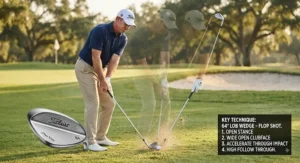
Hitting a lob wedge over trees is really an exercise in managing vertical descent angle — the steepness at which the ball falls back to earth, not just how high it flies. A shot that balloons up but comes down at a shallow angle will still release and roll, which defeats the purpose if there’s trouble beyond the green. Higher loft alone doesn’t guarantee a steep descent; spin rate and swing speed both influence it, which is exactly why grooves, face texture, and CG placement get so much engineering attention in wedges like the Ping Glide 4.0 and Callaway Jaws Raw.
What most buyers overlook is that a properly struck 60-degree wedge with strong spin will often produce a steeper, more controllable descent than a poorly struck 64-degree club. Reviewers consistently note that the extra 4 degrees of loft on models like the TaylorMade Hi-Toe 3 matters most on shots requiring both maximum height and a near-vertical drop, such as clearing a tall tree with very little green to work with on the far side. For golfers who face this shot regularly, testing both a 60 and a 64 on a launch monitor — where vertical descent angle is measurable, not guessed — is worth the trip to a fitter.
Achieving a Lob Wedge Soft Landing: Spin, Bounce, and Turf Interaction
A soft landing is the product of three things working together: sufficient loft, high backspin, and a descent angle steep enough that the ball has nowhere to go but down on contact. Maximum spin control comes primarily from groove sharpness and face texture — this is why raw, unplated faces like the Callaway Jaws Raw and aggressively milled options like the Mizuno T24 consistently outperform smoother, older-style faces in independent spin testing.
Bounce plays a quieter but equally important role. Too little bounce on soft turf causes the leading edge to dig, killing both distance control and spin; too much bounce on firm turf causes the club to skid into the ball’s equator instead of its lower half, reducing spin dramatically. Based on the spec comparison across this list, wedges offering multiple sole grinds — Titleist Vokey SM10, Ping Glide 4.0, and Mizuno T24 among them — give golfers the best shot at matching bounce to their actual course conditions rather than a generic average. Reviewers consistently report that switching to a properly bounced wedge, more than any single swing change, was what finally produced the soft, “one-hop-and-stop” landing they’d been chasing.
Ultra High Loft Options: When to Go Beyond 60 Degrees
A 64-degree wedge is a specialist’s club, and treating it as a generalist replacement for your 60 is where most buyers go wrong. The extra 4 degrees genuinely matters in three specific situations: extremely short-sided bunker shots with almost no green to work with, flop shots over a tall obstacle with a shallow landing area, and greenside rough where you need maximum height with minimal forward roll.
Outside those scenarios, an ultra high loft option can actually hurt your scoring, since full swings with 62-64 degree wedges are notoriously hard to control on distance — the margin for error shrinks as loft increases. If you’re considering the jump, the TaylorMade Hi-Toe 3 and Titleist Vokey SM10 WedgeWorks options are the strongest choices in this list specifically because their groove technology extends fully to those higher lofts rather than treating 62-64 as an afterthought bolted onto a standard lineup.
High Loft Lob Wedge vs Standard Sand Wedge: Which Do You Need?
A standard sand wedge, typically 54-56 degrees, is built as a full-swing, all-purpose bunker and approach club, while a high loft lob wedge 60 64 is a specialist tool for maximum height and minimal roll-out. The practical difference shows up most clearly inside 60 yards: a sand wedge from that distance produces a longer, lower trajectory with more roll, while a lob wedge produces a shorter carry with a steep drop and almost no release.
For golfers who already carry a well-gapped sand wedge, adding a lob wedge like the Cleveland RTX 6 ZipCore or Wilson Staff Harmonized extends shot-making options without duplicating what the sand wedge already covers. Golfers who only carry three wedges total should weigh this trade-off carefully — a lob wedge is genuinely situational, and some players are better served with tighter gapping (50-54-58) than with a dedicated 60 or 64 they rarely use, a point echoed in wedge-gapping guidance from GOLFTEC’s wedge selection guide.

Common Mistakes When Buying a High Loft Lob Wedge
Even careful buyers trip over a handful of predictable errors when shopping this category.
Buying loft before checking bounce. A 60-degree wedge with the wrong bounce for your swing and turf conditions will underperform a correctly bounced 58. Ignoring existing wedge gapping. Adding a 64 without checking what’s already in the bag can create a distance gap rather than closing one. Assuming premium price equals better fit. The Titleist Vokey SM10 is excellent, but only when the grind actually matches your delivery — an unfit premium wedge loses to a well-fit budget one. Skipping a real short-game test. Full-swing feel on a range mat says almost nothing about how a wedge performs on delicate, partial greenside shots. Overlooking groove wear on trade-ins. Worn grooves on a used lob wedge can quietly erase most of the spin advantage that justified the purchase in the first place.
Long-Term Cost & Maintenance
A lob wedge isn’t a lifetime club the way a putter often is — grooves wear down, and spin performance measurably declines well before the head looks visibly damaged. Most golfers who play weekly should expect noticeably reduced spin after 60-80 rounds, sooner if bunker play is frequent, since sand accelerates groove erosion compared to turf contact.
Thinking in cost-per-round rather than upfront price changes the calculus. A Wilson Staff Harmonized at under $70 that needs replacing after a season of heavy use may cost more per round than a Cleveland RTX 6 ZipCore that holds its spin for two full seasons. Premium options like the Callaway Jaws Raw and Titleist Vokey SM10 carry a higher purchase price but often justify it through groove durability treatments — Vokey’s localized heat treatment on the impact area, for example, is specifically designed to extend groove life beyond untreated equivalents. Regardless of price tier, a $10-15 groove brush and the discipline to use it after every few holes is the single cheapest maintenance step that meaningfully extends any wedge’s useful spin life.
Safety, Regulations & Groove Compliance
Grooves aren’t just a performance spec — they’re a regulated part of the game. Since 2010, the USGA and R&A have enforced specifications limiting groove volume and edge sharpness on irons, wedges, hybrids, and fairway woods, a rule originally aimed at tour-level competition but relevant to any golfer entering a sanctioned amateur event. Every wedge covered in this guide, including current-generation models from Titleist, Cleveland, Callaway, Ping, Mizuno, and TaylorMade, is manufactured to conform with these standards as sold new, though it’s worth confirming conformance directly through the USGA’s official grooves resource hub if you plan to compete under strict local rules.
Beyond formal compliance, there’s a practical safety note worth mentioning: high-loft wedges with aggressive raw faces, like the Callaway Jaws Raw, can be genuinely sharp when new. Handle them carefully in a crowded bag, and consider a head cover if you’re walking with a stand bag where the face could contact skin or clothing during transport.
✨ Don’t Miss These Exclusive Deals!
🔍 Take your short game to the next level with these carefully selected wedges. Click on any highlighted item to check current pricing and availability. These clubs will help you create the soft, controlled landings your scorecard has been missing!
Frequently Asked Questions
❓ What is the difference between a 60 and 64 degree lob wedge?
❓ Do I need both a 60 and a 64 degree wedge?
❓ What bounce is best for a high loft lob wedge?
❓ How often should I replace my lob wedge grooves?
❓ Can beginners use a 64 degree lob wedge?
Conclusion
A high loft lob wedge 60 64 earns its spot in the bag by solving a very specific problem: getting the ball up fast, over trouble, and stopping it close to where it lands. The right pick depends less on brand prestige and more on matching loft, bounce, and grind to how you actually play — a properly fit Wilson Staff Harmonized will beat a poorly fit Titleist Vokey SM10 every single time.
If wet conditions are your biggest obstacle, the Ping Glide 4.0 deserves a serious look. If you’re chasing an ultra high loft option that still performs at 64 degrees, the TaylorMade Hi-Toe 3 is the strongest fit in this lineup. Budget-focused golfers testing the waters should start with the Wilson Staff Harmonized, while players ready to invest in tour-level fitting depth will find it hard to beat the Titleist Vokey SM10 or Callaway Jaws Raw. Whichever you choose, remember that groove maintenance and a proper fitting matter more to real-world spin than any single marketing claim — take the time to get both right, and the soft landings will follow.
Recommended for You
- 7 Best Versatile Sand Wedge Picks for 2026
- Bounce Sand Wedge Bunker Guide: 7 Best Picks for 2026
- Super Game Improvement Lightweight Irons: 7 Best Picks for 2026
Disclaimer: This article contains affiliate links. As an Amazon Associate, I earn from qualifying purchases. If you purchase products through these links, we may earn a small commission at no additional cost to you.
✨ Found this helpful? Share it with your friends! 💬🤗
