
In This Article
Let’s be honest about something most equipment articles won’t say out loud: your 7-iron is not the problem. Your swing speed, your strength, your available practice time — those are the actual variables. Everything else is just steel and graphite trying to compensate. That’s exactly the job description for super game improvement lightweight irons — the most forgiving, most launch-friendly category golf manufacturers make. In plain terms, they’re oversized-head irons built with wide soles, weight pushed to the perimeter, and lightened components (shafts, grips, even internal medallions) so a slower swing still produces real ball speed. If you’ve ever watched a playing partner half your age outdrive you by 40 yards while somehow looking bored about it, this category exists specifically to close that gap.
This guide breaks down seven real, currently available models spanning roughly $800 to well over $1,400 per set, with honest commentary on who each one actually suits — not generic praise. We’ll also dig into super game improvement wide sole design, what super game improvement perimeter weighted really means for mis-hits, and why easy swing weight matters as much as the clubhead itself. Every spec here comes from manufacturer data and independent equipment testing, cross-checked against the USGA’s clubhead moment of inertia limit, which caps how forgiving a legal clubhead can be for competitive play.
Quick Comparison Table
| Iron | Best For | Price Range (per iron) | Standout Trait |
|---|---|---|---|
| Tour Edge Exotics X725 | Tightest budgets | ~$100-$130 | Hybrid-style shallow face |
| Wilson Dynapower Max | Max sole width | ~$130-$160 | Cupface wide-sole design |
| Cobra King Max | Lightweight feel | ~$130-$160 | 3D-printed lattice medallion |
| Srixon ZXiR HL | Soft feel seekers | ~$140-$170 | Lighter, softer i-alloy head |
| TaylorMade Qi Max HL | Slice fighters | ~$140-$170 | Anti-slice cap-back weighting |
| Mizuno JPX925 Hot Metal HL | Feel + forgiveness | ~$150-$180 | Tungsten-loaded wide sole |
| Ping G740 | Premium all-rounder | ~$190-$220 | Highest perimeter weighting |
At a glance, price and forgiveness climb together, but not in a straight line — the Wilson Dynapower Max and Cobra King Max both punch above their price bracket on sole width and launch assistance, which matters more than brand prestige for anyone chasing effortless distance. The Ping G740 costs the most for a reason: independent Hot List testing puts it in the top five for performance among high-handicap testers, largely because Ping engineered draw bias directly into the standard lie angle rather than leaving it to a custom-fit upcharge. If your budget caps out under $1,000 for a full set, start your shortlist with the Tour Edge Exotics X725 or Wilson Dynapower Max and don’t feel like you’re settling — both were built from the same forgiveness-first philosophy as the flagship models, just with fewer premium materials.
💬 Already leaning toward one of these? A quick click gets you current pricing and availability before you commit.
What Is Super Game Improvement Lightweight?
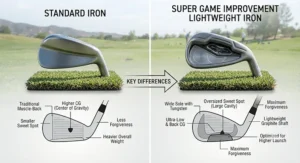
Super game improvement lightweight irons are the most forgiving iron category sold today — oversized clubheads, thick toplines, and generous offset paired with lightened shafts and grips so golfers with slower swing speeds can generate more clubhead speed with less physical effort. They’re built to launch the ball high and straight even on off-center strikes, prioritizing forgiveness and ease over shot-shaping control.
Top 7 Super Game Improvement Lightweight Irons: Expert Analysis
1. Tour Edge Exotics X725 — hybrid-style shallow face for easy launch
The Tour Edge Exotics X725 takes Tour Edge’s best-selling iron-wood concept and dresses it up in an “Exotics” trim, and the shallow, hybrid-inspired face is the whole story here. A diamond-shaped face with three distinct thickness zones boosts ball speed specifically on strikes away from center — the exact spot where most high-handicap contact happens. Weaker lofts (7-iron sits around 29 degrees, roughly 3-4 degrees weaker than a standard game improvement 7-iron) push the ball higher with more spin to help it hold greens, while a deeper center of gravity from the lightened face structure keeps launch angle high without you having to change your swing. Based on the spec comparison against pricier rivals in this roundup, the Tour Edge Exotics X725 is doing a genuinely similar job for roughly half the per-iron cost. It’s built for golfers newer to the game or anyone whose handicap sits north of 20 and who wants forgiveness without financing a small vacation. Reviewers consistently note strong straight-line accuracy and a surprisingly quiet strike thanks to internal thermoplastic urethane damping, though a few mention the look is more utilitarian than premium. Independent testing has ranked it top-five for forgiveness among high-handicap players in its category.
Pros:
- ✅ Lowest per-iron price in this lineup
- ✅ Hybrid-style face forgives low, thin strikes
- ✅ Internal dampening keeps sound refined for the price
Cons:
- ❌ Less premium look than flagship-brand sets
- ❌ Fewer shaft customization options at retail
At around $100-$130 per iron, a seven-piece Tour Edge Exotics X725 set typically lands well under $1,000 — check current price and availability, as Tour Edge inventory can fluctuate by retailer.

2. Wilson Dynapower Max — widest-feeling sole for turf glide
Wilson built the Wilson Dynapower Max as a full iron set (not the hybrid-style “Launch Pad” alternative), and the headline feature is a cupface construction that wraps around both the topline and sole. What that means practically: the face itself flexes more at impact, adding ball speed while simultaneously muting the sharp “clack” sound that cheaper cast irons produce. A channel behind the face and in the sole lets that flex happen without the club feeling hollow, and Wilson pushed extra mass into the topline specifically to stabilize shots struck high on the face — a common miss for golfers swinging up on the ball. Compared to the standard Dynapower irons, this Max version carries a noticeably wider sole and significantly weaker lofts (7-iron around 30 degrees), meaning the same swing that produces a low liner with a blade will get real hang time here. What most buyers overlook about wide-sole irons like this one is that the width isn’t cosmetic — it prevents the leading edge from digging into turf on a slightly steep angle of attack, which is exactly the miss pattern most mid-to-high handicappers have. Aggregated review sentiment consistently flags the forgiving feel and easy launch as strengths, with occasional notes that the set’s chunkier profile won’t appeal to golfers who still want a “player’s” look at address.
Pros:
- ✅ Cupface design boosts ball speed on off-center hits
- ✅ Genuinely wide sole reduces fat-shot penalties
- ✅ Muted, controlled sound at impact
Cons:
- ❌ Bulkier profile than mid-tier game improvement sets
- ❌ Weaker lofts mean longer clubs needed for short-game gapping
Priced around $130-$160 per iron, the Wilson Dynapower Max sits in the mid-$1,000s for a full set — always confirm the current price before ordering, since Wilson runs frequent retailer promotions.
3. Cobra King Max — lightest-feeling head thanks to 3D-printed lattice
Cobra leaned hard into weight-saving engineering with the Cobra King Max, and the standout piece is a 3D-printed lattice medallion inside the clubhead that shaves roughly five grams compared to a solid equivalent — weight Cobra then repositions lower in the head to help the ball get airborne with less effort. A 75-gram weight sits low and back specifically in the 4- through 7-irons, dropping the center of gravity while still letting the face, body, and sole flex for ball speed. The face itself uses an L-cup construction with variable thickness, built from 17-4 stainless steel, and a leading-edge channel runs from the sole into the toe to keep the face active across a wider hitting area. Here’s what to weigh: compared to the standard Cobra King irons, the Max version has a longer blade length, thicker topline, two degrees more loft, and a flatter, less cambered sole for smoother turf interaction. On paper, this means golfers who struggled with the standard King’s smaller forgiveness window get meaningfully more room for error here without losing Cobra’s characteristically lighter overall feel. Reviewers frequently describe the feel as noticeably lighter in the hands through the swing compared to steel-only competitors, which tracks with Cobra’s stated engineering goal.
Pros:
- ✅ Lattice-saved weight repositioned for easier launch
- ✅ Noticeably lighter swing feel than solid-head rivals
- ✅ Flatter sole glides through turf with less resistance
Cons:
- ❌ Longer blade length reduces workability for better players
- ❌ Thicker topline may look bulky to traditionalists
Expect around $130-$160 per iron for the Cobra King Max — prices may vary by retailer, so check current listings rather than relying on last season’s numbers.
4. Srixon ZXiR HL — softest feel from a genuinely lighter alloy
Srixon’s Srixon ZXiR HL stands out for a material choice most competitors skip: a proprietary “i-alloy” steel that’s roughly 10 percent softer and less dense than the 431 stainless steel used in most game improvement heads. In practice, that lighter, softer alloy is why testers consistently describe this model’s feel as cushiony rather than clicky, even though it’s still a cast, forgiveness-first design. Srixon built the set using real-golfer swing data to determine loft and length gapping, which is also why the set starts at the 5-iron rather than a traditional 4-iron — most players in this HL (High Launch) category rarely hit a 4-iron well anyway, so Srixon simply didn’t build one. The variable-thickness face uses a milled pattern on the back to boost both ball speed and forgiveness, and the “Tour V.T.” sole is noticeably wider here than on the standard ZXiR, which makes sense given this player group’s tendency to catch shots slightly heavy. What most buyers overlook about a softer alloy is that it doesn’t just feel nicer — it also tends to produce a lower-pitched, less jarring sound at impact, which for many golfers is the difference between confidence and hesitation over the ball. Reviewers frequently cite the ZXiR HL’s feel as its biggest differentiator from cast competitors in the same price tier.
Pros:
- ✅ Genuinely softer, lighter i-alloy head material
- ✅ Wide Tour V.T. sole forgives heavy strikes
- ✅ Data-driven set makeup skips the unhittable 4-iron
Cons:
- ❌ Highest lofts in this roundup mean shorter carry distances
- ❌ 5-iron-start set may leave a distance gap for some bags
The Srixon ZXiR HL typically runs around $140-$170 per iron — as always, confirm the current price range rather than an exact figure, since retailer pricing shifts.
5. TaylorMade Qi Max HL — engineered specifically to fight the slice
TaylorMade rebuilt its super game improvement offering from the ground up for the TaylorMade Qi Max HL, and the headline change is a multi-material cap back that’s lighter than the steel it replaces, wrapped specifically around the high-toe area of the clubhead. Here’s what to weigh: less weight up in the toe makes the club noticeably easier to square at impact, which directly attacks the open-face, left-to-right miss that plagues so many mid-to-high handicappers. Extreme heel-toe weighting adds stability across the face, while slots cut into the sole let the face flex more freely, recovering ball speed that the weaker lofts (7-iron around 31 degrees) would otherwise cost. A compression damper fitted into the 4- through 8-irons cuts down on the buzzy vibration feel that mis-hits usually produce, and TaylorMade lowered the center of gravity progressively through the set — low in the long irons for launch, rising through the short irons so wedge-distance shots don’t balloon in the wind. Compared to the standard Qi Max, this HL version carries a longer blade and thicker topline for extra stability on off-center strikes. Reviewers and testers alike have flagged the Qi Max HL as a genuine step up from TaylorMade’s prior super game improvement effort, particularly for golfers whose miss is a slice rather than a pull.
Pros:
- ✅ Toe-weight reduction specifically fights slice tendencies
- ✅ Compression damper meaningfully reduces mis-hit vibration
- ✅ Progressive CG design supports controlled short-iron trajectory
Cons:
- ❌ Weaker lofts require careful gapping with existing wedges
- ❌ Premium materials push price above true budget territory
Pricing on the TaylorMade Qi Max HL generally sits around $140-$170 per iron — check current price before buying, since TaylorMade’s newest releases tend to see early-season premiums that ease later in the year.
6. Mizuno JPX925 Hot Metal HL — tungsten-loaded wide sole with real feel
Mizuno’s reputation is built on feel, and the Mizuno JPX925 Hot Metal HL is the rare super game improvement iron that doesn’t ask you to sacrifice it. The face uses a high-strength chromoly 4140M steel that’s thinned around its perimeter, increasing rebound effect and, therefore, ball speed even on strikes that miss the center. The wide sole pairs with tungsten weighting positioned low in the 4- through 7-irons specifically to help get the ball airborne, while internal ribs are tuned to produce a softer feel alongside a more explosive sound at impact — a combination that’s genuinely difficult to engineer well. Mizuno pulled real swing data from its shaft-optimizer database and found that slower-swinging golfers consistently struggled to get sufficient height on iron shots, which is why lofts here run up to three degrees weaker than Mizuno’s standard and Pro lines. Based on the spec comparison, this is the set for a golfer trading up from blades or players’ cavity-backs who needs the forgiveness of a true super game improvement iron but isn’t ready to give up Mizuno’s signature feel. Independent testing has repeatedly placed this model in the top tier for both performance and feel among high-handicap testers, a rarer combination than the category usually delivers.
Pros:
- ✅ Tungsten-loaded wide sole boosts launch without bulk
- ✅ Chromoly face rebound adds ball speed on mis-hits
- ✅ Mizuno’s signature soft feel, unusual for this category
Cons:
- ❌ Among the pricier options outside the true premium tier
- ❌ Wide sole may feel unfamiliar to golfers used to blades
The Mizuno JPX925 Hot Metal HL generally runs $150-$180 per iron — prices may vary, so verify current availability before purchase.
7. Ping G740 — highest perimeter weighting and built-in draw bias
The Ping G740 is the premium anchor of this list, and it earns that price with genuinely data-driven engineering rather than marketing gloss. Ping pulled real shot-tracking data (via Arccos) showing high-handicap golfers consistently need draw-bias help, so the standard lie angle here is built one degree more upright than typical — directly fighting the slice before you even swing. The sole is 22 percent wider and the blade length 3 percent longer than Ping’s own G440, and combined with a thicker topline, that pushes weight further to the perimeter and drops the center of gravity, which is precisely what super game improvement perimeter weighted design is meant to achieve: a bigger effective hitting area that stays forgiving even when contact isn’t centered. A shallower face and shorter hosel freed up weight that Ping repositioned into the back cavity, improving sound at impact, while a dual-camber sole helps the leading edge glide through turf instead of digging. What most buyers overlook here is that the thin, flexible face is supported by a three-piece badge in the back specifically to absorb vibration — so despite the aggressive forgiveness engineering, mis-hits don’t feel harsh in the hands. Independent Hot List testing placed the Ping G740 in the top five for performance among high-handicap testers, and reviewers frequently cite the built-in draw bias as the standout real-world benefit over competitors that require custom fitting to achieve the same effect.
Pros:
- ✅ Built-in draw bias without needing custom fitting
- ✅ Highest perimeter weighting and lowest CG in this lineup
- ✅ Refined sound engineering despite maximum forgiveness focus
Cons:
- ❌ Highest per-iron price in this roundup
- ❌ Longer blade length may look large to some golfers
Expect around $190-$220 per iron for the Ping G740 — as with every model here, treat that as a range and check current pricing rather than an exact figure.
Top 7 Products at a Glance
| Product | 7-Iron Loft | Sole Width vs. Standard | Best For | Price Range |
|---|---|---|---|---|
| Tour Edge Exotics X725 | ~29° | Wide (hybrid-style) | Absolute best value | ~$100-$130/iron |
| Wilson Dynapower Max | ~30° | Widest cupface design | Digging/fat-shot fixers | ~$130-$160/iron |
| Cobra King Max | ~29.5° | Wide, flatter camber | Lightest overall feel | ~$130-$160/iron |
| Srixon ZXiR HL | ~32.5° | Wide Tour V.T. sole | Softest feel seekers | ~$140-$170/iron |
| TaylorMade Qi Max HL | ~31° | Wide + toe-weight cut | Slice-prone swingers | ~$140-$170/iron |
| Mizuno JPX925 Hot Metal HL | ~31° | Wide + tungsten low | Feel-and-forgiveness combo | ~$150-$180/iron |
| Ping G740 | ~28° | 22% wider than G440 | Built-in draw bias | ~$190-$220/iron |
The pattern across this table is impossible to miss: every single model leans on a super game improvement wide sole to solve the same underlying problem — turf interaction on a slightly steep or handsy swing. But loft tells its own story too. The Srixon ZXiR HL carries the weakest 7-iron loft in the group at roughly 32.5 degrees, meaning it launches the highest but also flies the shortest per club, while the Ping G740‘s stronger 28-degree loft banks on its wider sole and superior perimeter weighting to deliver forgiveness without sacrificing distance. If raw yardage matters more to you than launch height, that loft column is worth studying as closely as the price column.
How to Choose Super Game Improvement Lightweight Irons
Picking the right set isn’t about finding the “best” iron in the abstract — it’s about matching real specs to your actual swing. Here’s the reasoning, step by step:
- Start with swing speed, not brand loyalty. Golfers swinging a driver under 90 mph generally see the biggest benefit from lightweight shafts and heads, since less mass means the same physical effort produces more clubhead speed.
- Prioritize sole width if your miss is fat or thin. A genuinely wide sole, like the Wilson Dynapower Max or Mizuno JPX925 Hot Metal HL, forgives inconsistent low-point control far more than a narrower “game improvement” sole ever will.
- Check loft gapping against your current wedges. Because these sets run 3-4 degrees weaker than standard irons, your existing pitching wedge and gap wedge may no longer overlap cleanly — plan the whole bag, not just the irons.
- Weigh perimeter weighting against feel. More weight at the edges (perimeter weighting) means more forgiveness but historically less feedback; models like the Mizuno JPX925 Hot Metal HL narrow that gap better than most.
- Factor in easy swing weight, not just total club weight. A lighter total club with the wrong swing weight can feel unstable through impact — this is where a proper fitting earns its cost.
- Decide your budget band before you shop. Anchoring to a price range (budget, mid, premium) before browsing prevents the common mistake of overspending on features you won’t use.
- Read aggregated review sentiment, not just star ratings. A 4.5-star average tells you little; look for recurring themes across dozens of reviews to spot real strengths and weaknesses.
Common Mistakes When Buying Lightweight Game Improvement Irons
The single most common mistake is buying based on shaft flex labels alone. “Senior flex” or “regular flex” varies meaningfully between manufacturers, so the same label on two different brands can produce noticeably different feel and trajectory — always cross-reference actual shaft weight and flex data, not just the printed label. A second frequent error is ignoring lie angle entirely. Because super game improvement irons like the Ping G740 now build draw bias into a more upright standard lie angle, pairing that with a swing that already draws the ball can turn a helpful bias into an unwanted hook. Third, buyers often skip checking whether a set’s loft gapping still overlaps sensibly with their existing wedges, leading to an awkward distance gap between the pitching wedge and gap wedge. Fourth — and this one’s sneaky — some golfers assume “lightweight” automatically means “better for me,” when in reality a swing weight mismatch (too light relative to your tempo) can actually hurt consistency rather than help it. Finally, plenty of buyers chase the most expensive option assuming price equals performance; as the comparison table above shows, the Tour Edge Exotics X725 delivers legitimately strong forgiveness scores in independent testing at a fraction of the Ping G740‘s cost.
Super Game Improvement vs Standard Game Improvement Irons
The line between these two categories has blurred in recent years, but the core distinction still holds: super game improvement irons push every design lever — offset, topline thickness, sole width, and loft — further toward forgiveness, while standard game improvement irons keep some workability for golfers who occasionally want to shape a shot. Ultra game improvement irons, another name you’ll see used interchangeably with “super game improvement,” typically add two to four degrees of loft weakening compared to standard game improvement models, plus noticeably more offset to help square the face at impact. In practical terms, a standard game improvement 7-iron might sit around 32-33 degrees of loft, while the super game improvement equivalents in this guide run closer to 28-32 degrees — weaker lofts that trade a small amount of workability for a significantly larger forgiveness window. The tradeoff matters most at the extremes: a 20-plus handicap golfer with a slow, inconsistent swing will almost always score better with the super game improvement category, while a 10-15 handicapper who occasionally wants to hit a controlled draw or fade may find standard game improvement irons strike a better balance. Neither category is “better” in isolation — it depends entirely on how much workability you’re realistically going to use versus how much forgiveness you actually need on off-center strikes.
✨ Not sure which category fits your game? Compare specs side-by-side before you buy — current pricing and availability are one click away.
Practical Setup Guide: Getting the Most From a New Set
Buying the right irons is half the equation; setting them up correctly is the other half. Start with a proper lie-angle check within the first few rounds — even off-the-rack “standard” fitting can be a couple of degrees off for your height and posture, and a mismatched lie angle undermines the built-in forgiveness these irons are designed to deliver. Next, resist the urge to bag every club in the set immediately; many golfers get more value pulling the 4-iron (or even the 5-iron) in favor of a hybrid, since hybrids typically outperform long irons for higher-handicap swing speeds anyway. During your first 30 days, pay attention to strike pattern using impact tape or foot spray — it’s the cheapest way to confirm whether the wide sole and perimeter weighting are actually compensating for your typical miss, or whether a swing change (not new equipment) is the real fix needed. Grip maintenance matters more than golfers expect with lightweight shaft setups, since a worn or slick grip forces tighter hand tension, which quietly cancels out the easy swing weight the manufacturer engineered in. Finally, re-check swing weight after any grip regripping — swapping grip weight by even a few grams shifts the swing weight enough to change how the club feels through impact, undoing some of the fitting work you paid for.

Real-World Scenarios: Who Should Buy What
The weekend beginner. Sam is 58, plays twice a month, and posts scores in the 100s. Budget matters, and so does confidence off the tee. The Tour Edge Exotics X725 fits this profile well — its hybrid-style face forgives the toe strikes and thin contact common to newer players, and the lower price means Sam isn’t over-investing before knowing if the game sticks.
The returning golfer rebuilding distance. Priya is 61, played competitively decades ago, and is coming back after a long layoff with a slower swing speed than she remembers having. The Mizuno JPX925 Hot Metal HL suits this case nicely — she still wants the feel she remembers from forged irons, and the tungsten-loaded wide sole gives her forgiveness without the visually chunky look some super game improvement sets carry.
The chronic slicer chasing consistency. Marcus is 45, swings a driver around 88 mph, and has fought a two-way miss (mostly slice) for years despite lessons. The TaylorMade Qi Max HL‘s toe-weight reduction directly targets that miss pattern, and paired with the Ping G740‘s built-in upright lie and draw bias as a comparison point, either model addresses the root mechanical issue rather than just adding generic forgiveness.
Features That Actually Matter (And Those That Don’t)
Marketing copy loves to lead with headline numbers — ball speed gains, ping-pong-paddle sole widths, dramatic-sounding alloy names — but not every spec moves the needle equally. Sole width and perimeter weighting genuinely matter; they’re the two features most directly tied to forgiveness on real mis-hits, which is the entire point of this category. Loft strength matters too, but only in context — a weaker loft helps launch but forces a rethink of your wedge gapping, so it’s not a pure upgrade. What tends to matter less than the marketing suggests: exact face material branding. Whether it’s chromoly, i-alloy, or a proprietary steel blend, the practical difference between these materials shows up mostly in feel and sound, not in measurable forgiveness or distance for the average golfer. Cosmetic details — medallion designs, color accents, “tour-inspired” shaping — matter zero percent for performance and everything for how confident you feel standing over the ball, which is a real but separate consideration from what the spec sheet promises.
Long-Term Cost and Maintenance
A super game improvement iron set is a multi-year purchase for most recreational golfers, so total cost of ownership matters more than the sticker price alone. Beyond the initial $800-$1,500-ish range depending on which model you choose, budget for occasional regripping (roughly once every 1-2 seasons for regular players, sooner in humid climates), which runs a modest amount per club at most golf shops. Groove wear is a slower-moving cost — cast, forgiveness-focused faces like these generally don’t need the frequent reshaping that a tour player’s forged blades might, so expect the grooves to stay serviceable for years of normal play. The real long-term value case, though, is indirect: a set that’s genuinely easier to hit consistently reduces the temptation to chase upgrades every season, since you’re less likely to blame the equipment for a bad round. Club head speed naturally tends to drop with age as fast-twitch muscle fiber declines, and for golfers feeling that dip, replacing an old set with a genuinely lighter, more forgiving one is one of the more cost-effective ways to offset the decline without an expensive swing overhaul.
Easy Swing Weight and Why It’s Not Optional
Swing weight gets less attention than head design, but it directly determines how a “lightweight” iron actually feels in motion. In simple terms, swing weight measures the balance between the head weight and grip weight at a standard reference point on the shaft, and manufacturers aim for consistency across an entire set — every club should feel like the same relative weight in your hands, from the shortest wedge to the longest iron. Get this wrong, even with a genuinely light clubhead, and the set will feel either sluggish (swing weight too heavy) or unstable through impact (too light). Swing weight is measured on a lettered scale rather than as a direct weight figure, which is why two irons of identical total weight can feel completely different depending on how that weight is distributed. If you’re fitted for any of the seven models in this guide, ask specifically about swing weight, not just shaft flex — it’s the detail most off-the-rack buyers skip, and it’s often the difference between a set that feels effortless and one that just feels lighter on a scale.
Safety, Fitting, and Equipment Conformity
Every model in this guide is built to conform with current USGA and R&A equipment rules, which matters if you play in any sanctioned competition or handicap-tracked league. The most relevant rule for this category caps clubhead moment of inertia — the technical measure of forgiveness — meaning even the most aggressively engineered super game improvement head still has to stay under a legal ceiling. That’s actually good news for buyers: it means the forgiveness gap between a $115-per-iron budget set and a $200-per-iron premium set is smaller than the price difference suggests, since both are bumping against the same regulatory limit. Beyond conformity, a proper fitting session remains the single best safety-adjacent investment you can make, since an ill-fitting lie angle or length can quietly reinforce bad swing habits or even contribute to overuse strain from compensating swing patterns.
🔍 Ready to stop guessing and start hitting greens? Check current pricing on any model above before your next round.
Frequently Asked Questions
❓ What are the lightest super game improvement irons?
❓ Are super game improvement irons good for beginners?
❓ How much do super game improvement irons cost?
❓ What loft should a 7 iron be for game improvement?
❓ Do lightweight golf irons really add distance?
Conclusion
Choosing among the seven models in this guide really comes down to three honest questions: what’s your realistic budget, what’s your specific miss pattern, and how much do you value feel versus outright forgiveness. The Tour Edge Exotics X725 remains the smartest entry point if cost is the deciding factor, while the Ping G740 justifies its premium price with genuinely data-driven draw-bias engineering that most competitors still leave to custom fitting. Somewhere in between, the Mizuno JPX925 Hot Metal HL stands out for golfers who refuse to trade away feel for forgiveness, and the TaylorMade Qi Max HL deserves a serious look from anyone whose miss is specifically a slice rather than generic inconsistency. Independent testing and aggregated review sentiment both point in the same direction across this whole category: super game improvement lightweight irons genuinely do make the game easier for the golfers who need that help most — not through gimmicks, but through wide soles, perimeter weighting, and swing weights engineered specifically for slower, less consistent swings. Whichever model you land on, get fitted before you buy if at all possible; even the best-engineered iron on this list underperforms if the lie angle and swing weight don’t match your actual swing.
Recommended for You
- Super Game Improvement Max Forgiveness Irons: 7 Best Picks (2026)
- Players Irons Forged Feel: 7 Best 2026 Pick
- Tour Players Irons Compact: 7 Best Picks for 2026 Precision
Disclaimer: This article contains affiliate links. As an Amazon Associate, I earn from qualifying purchases. If you purchase products through these links, we may earn a small commission at no additional cost to you.
✨ Found this helpful? Share it with your friends! 💬🤗
