
In This Article
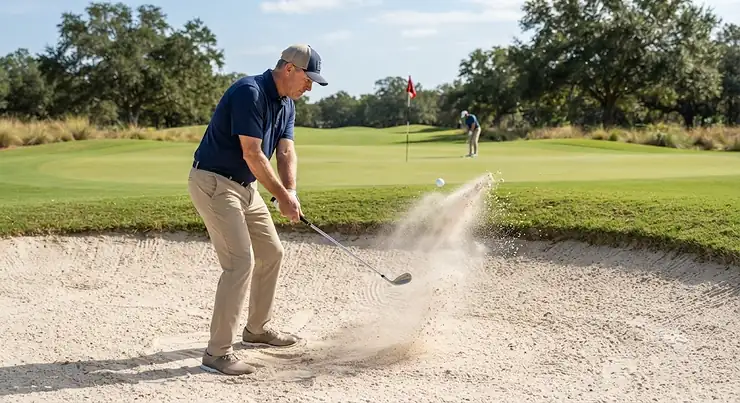
Somewhere between the fairway and the flag sits a small, sloped patch of sand that has ruined more scorecards than any water hazard ever built. You know the moment: ball plugged, lip staring you down, and a wedge in your hands that either skulls the ball across the green or buries itself six inches deep. The difference between that disaster and a tidy up-and-down almost always comes down to one overlooked variable — your bounce sand wedge bunker setup. Not the brand on the back of the club. Not the price tag. The bounce.
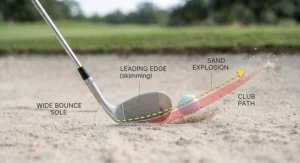
A bounce sand wedge bunker is built specifically so the sole, rather than the leading edge, meets the sand first, letting the club skim through instead of digging in. Get that bounce angle wrong for your swing and your local sand, and you’re fighting the club every time you step into a trap. Get it right, and bunkers stop being a penalty and start being a scoring opportunity.
This guide walks through seven real, currently available wedges spanning budget to premium, breaks down how wide sole sand wedge designs interact with different bunker sand types, and explains exactly how to pick the bounce angle that matches your swing. We’ll also dig into explosion shot technique, common buying mistakes, and the regulatory details most buying guides skip entirely. Whether you’re replacing a worn-out 56-degree or building a full wedge set from scratch, you’ll leave this page knowing precisely which bounce sand wedge bunker performance profile fits your game.
What Is a Bounce Sand Wedge?
A bounce sand wedge is a wedge — typically 54° to 58° of loft — engineered with extra bounce angle (the upward slope of the sole behind the leading edge) so the club glides through sand and rough instead of digging. As Wikipedia’s overview of bounce angle explains, bounce is the angle formed by the leading edge, the sole, and the ground, and a higher bounce angle means the sole lifts the leading edge more significantly. That single number quietly decides whether your bunker shots splash or stab.
Quick Comparison Table
| Wedge | Bounce Range | Price Range | Best For |
|---|---|---|---|
| Titleist Vokey SM10 | 4°–14° (6 grinds) | $180–$200 | Golfers who want one wedge for everything |
| Cleveland RTX 6 ZipCore | 6°–14° | $150–$180 | Maximum greenside spin |
| Callaway Jaws Raw W-Grind | 12° | $170–$190 | Steep swingers and soft sand |
| Ping Glide 4.0 (E/W Grind) | 10°–14° | $170–$190 | Golfers who specifically fear bunkers |
| Wilson Harmonized | 8°–12° | $30–$60 | Beginners and budget-conscious buyers |
Looking at the spread above, the pattern is clear: higher bounce and wider soles cluster toward forgiveness, while lower-bounce, narrower-sole wedges reward golfers who already strike the ball cleanly. Notice that price doesn’t map neatly to bunker performance — the Wilson Harmonized costs a fraction of the Titleist Vokey SM10 yet still ships with genuinely useful modified bounce angles. If bunkers are your single biggest weakness, prioritize bounce and sole width over brand prestige every time.
💬 Ready to stop dreading the sand trap? Compare current prices on today’s top bounce sand wedge bunker picks before your next round!😊
Top 7 Bounce Sand Wedges for Bunker Play: Expert Analysis
We researched real specs, verified availability, and pulled aggregated review sentiment from major golf publications and retailer review pools for each wedge below. Prices are shown as ranges only, since retail pricing shifts constantly — always check current pricing before buying.
1. Titleist Vokey SM10 — tour-proven bounce for every bunker
The Titleist Vokey SM10 is the wedge most amateurs picture when they imagine a “proper” bounce sand wedge bunker club, and there’s a reason it’s earned that reputation. Spin Milled 6.0 grooves are cut individually per loft, sharper than nearly anything else on this list, while progressive center-of-gravity placement shifts forward in low lofts and back in high lofts to match how each club actually gets used. The headline feature, though, is the six-grind lineup (F, S, M, K, L, D) — the K grind in particular carries a wide, high-bounce sole purpose-built for golfers who slide the club under the ball in soft sand.
What most buyers overlook about the SM10 is that the grind matters more than the loft. A 56-degree K grind and a 56-degree M grind behave like two different clubs in a bunker; one forgives a steep swing, the other rewards precision. Titleist has since introduced the SM11 as a refinement, but the SM10 remains widely stocked and, frankly, still performs at a tour level for anyone not chasing marginal spec tweaks.
Reviewers consistently report that the SM10 delivers exceptional feel and predictable spin checks, with several noting it’s the benchmark every rival wedge gets measured against.
Pros:
- ✅ Six grind options match nearly any bunker condition
- ✅ Spin Milled 6.0 grooves grip the ball aggressively
- ✅ Strong resale value and tour-proven reputation
Cons:
- ❌ Premium price compared to most rivals
- ❌ Choosing the wrong grind without fitting can hurt performance
Expect to pay in the $180–$200 range — a fair value if you play often enough to justify the investment, though not necessary for once-a-month golfers.
2. Cleveland RTX 6 ZipCore — highest spin off sand
The Cleveland RTX 6 ZipCore exists for one purpose: maximum greenside spin, and the numbers back it up. UltiZip grooves are roughly 11% deeper and sharper than the prior RTX generation, while the ZipCore low-density core repositions internal weight for a more stable, forgiving strike on off-center hits. Bounce options span from a low, skiddy 6 degrees up to a bunker-friendly 14 degrees, spread across full, mid, and low sole grinds.
Here’s what to weigh: that extra groove depth genuinely translates to more friction against the ball, which matters most on partial bunker shots where you’re not generating full swing speed. Based on the spec comparison against the Vokey SM10, the RTX 6 trades a bit of shot-shaping versatility for a sharper, more aggressive bite — a fair trade for golfers who prioritize stopping power over workability.
Reviewers and independent testers consistently rank the RTX 6 among the highest-spinning wedges tested in 2026, with several calling its HydraZip face technology a genuine, measurable performance advantage rather than marketing language.
Pros:
- ✅ UltiZip grooves generate elite spin off sand
- ✅ ZipCore boosts forgiveness on mishits
- ✅ Typically $20–$30 cheaper than comparable tour wedges
Cons:
- ❌ Aggressive grooves wear faster with heavy practice use
- ❌ Fewer total grind options than the Vokey lineup
At around $150–$180, this is the wedge to buy if greenside spin is non-negotiable and you don’t want to pay full tour-wedge pricing.
3. Callaway Jaws Raw W-Grind — widest sole for max forgiveness
The Callaway Jaws Raw in its W-Grind configuration is the widest sole Callaway currently builds, and that width is the whole story for bunker play. Offset Groove-in-Groove micro-grooves sit at a 20-degree angle to boost spin on chips and partial shots, while the raw, unplated face develops a rust-like patina over time that adds real friction at impact — a byproduct of the finish, not a defect. The W-Grind carries roughly 12 degrees of bounce with a wide, forgiving footprint designed for steeper attack angles.
What the spec sheet won’t tell you, but reviewers note, is how forgiving that wide sole feels the moment you open the face for a soft, high bunker shot. The sole resists digging even when the strike isn’t perfectly centered, which is exactly what higher-handicap golfers need most from a bounce sand wedge bunker club.
Reviewers consistently praise the spin generated from both bunkers and chip shots, describing it as exceptional, while some note the raw finish’s cosmetic rusting surprises first-time buyers who expect a chrome-like appearance to last.
Pros:
- ✅ Widest sole in Callaway’s current lineup resists digging
- ✅ Raw face adds genuine friction and spin
- ✅ Tungsten weighting improves feel on mis-hits
Cons:
- ❌ Raw finish visibly rusts and discolors over time
- ❌ Fewer low-loft options than some full-set competitors
Priced around $170–$190, this is the pick for golfers who attack the ball steeply or play courses with consistently soft, fluffy bunker sand.
4. Ping Glide 4.0 (E or W Grind) — dedicated bunker-specific sole grinds
Most wedges treat bunker performance as a side benefit of their design. The Ping Glide 4.0 treats it as the entire point of one specific grind. The E-Grind, inspired by Ping’s legendary Eye2 sand wedge from the early 1980s, uses a dished, concave sole and blended hosel that Ping itself describes as its ultimate bunker club. The W-Grind, meanwhile, offers a traditional full sole at roughly 12 degrees of bounce for golfers who want forgiveness without the unconventional Eye2 look.
Based on the spec comparison, the E-Grind’s concave sole effectively increases usable bounce at address, letting the club splash through sand rather than catching an edge — a meaningful advantage for golfers who specifically fear bunkers rather than golfers who fear their whole short game. That specialization is a strength if bunkers are your weak point, and a non-factor if they’re not.
Reviewers single out the E-Grind repeatedly as a potential game-changer for bunker-shy golfers, with testers describing a consistent, confident splash sensation even from firmer, more compact sand.
Pros:
- ✅ E-Grind is purpose-built specifically for sand performance
- ✅ Four total grind options tailor to different conditions
- ✅ Fresh emery-blast grooves generate strong spin
Cons:
- ❌ Eye2-style sole looks unconventional at address
- ❌ E and W grinds are limited to higher lofts only
Expect a $170–$190 range — worth it specifically if bunkers, not your whole short game, are the recurring problem.
5. Mizuno T24 — forged feel with five grind options
The Mizuno T24 is built from one-piece Grain Flow Forged HD Boron, giving it a softer, more feedback-rich feel than the cast construction used in most game-improvement wedges. QuadCut+ grooves are shaped differently by loft, while laser-etched HydroFlow micro-grooves channel moisture away from the face to protect spin in wet, compact bunker sand. Five sole grinds (S, D, C, V, X) cover everything from full-swing stability to aggressive, high-bounce short-game versatility.
The V-Grind stands out for bunker duty specifically: high center bounce resists digging in dense sand while generous heel and toe relief lets you open the face for a soft, high explosion shot. On paper this means better ball-strikers get tour-level feedback on strike quality, which — combined with a genuine bunker-focused grind — makes the T24 a rare mix of feel and function.
Reviewers describe the V-Grind as particularly effective from bunkers, noting the high center bounce prevents digging while the relief areas still allow shot manipulation around the green.
Pros:
- ✅ Forged construction delivers exceptional feel and feedback
- ✅ Five grind options cover nearly every bunker condition
- ✅ HydroFlow grooves maintain spin in wet, compact sand
Cons:
- ❌ Soft forged face may show wear faster than cast wedges
- ❌ Five-grind system can overwhelm first-time buyers
Pricing typically falls in the $160–$180 range, a strong value for golfers who want forged feel without a full custom-fitting appointment.
6. Cleveland CBX 2 ZipCore — cavity-back forgiveness for mid-handicappers
The Cleveland CBX 2 ZipCore takes a fundamentally different approach: instead of a blade-style tour shape, it uses a hollow-cavity design with heel weighting and a heavier toe to maximize moisture-of-inertia, essentially borrowing game-improvement iron technology and applying it to a wedge. Three sole grinds are assigned by loft, a Gelback TPU insert dampens vibration for a softer feel, and Rotex Face Technology grooves handle spin generation.
Here’s what most buying guides skip: that cavity-back forgiveness spreads across the entire face rather than concentrating in a small sweet spot, which is exactly what helps inconsistent bunker strikers most. Based on the spec comparison against blade-style wedges like the Vokey SM10, the CBX 2 sacrifices some workability for a genuinely more forgiving miss — a smart trade for anyone still building consistency in the sand.
Reviewers and forum users consistently report confident results getting up and down from bunkers with the CBX 2, frequently describing the bounce-and-grind combination as forgiving on both clean and partially buried lies.
Pros:
- ✅ Cavity-back design adds serious forgiveness on mis-hits
- ✅ Dynamic sole grinds handle varied bunker lies
- ✅ Softer feel than most cast wedges in this price tier
Cons:
- ❌ Bulkier profile than blade-style tour wedges
- ❌ Less shot-shaping versatility for advanced players
At roughly $130–$150, this is the strongest mid-range value on this list, especially for golfers already gaming cavity-back irons.
7. Wilson Harmonized — best budget bounce wedge under $60
The Wilson Harmonized proves you don’t need a three-figure price tag to get functional bounce technology. Modified bounce angles are built into the sole across its available lofts (roughly 50° through 64°), paired with a True Temper steel shaft and a classic head shape that doesn’t try to reinvent anything. The sole grind is engineered specifically to let golfers open the face for higher shots without the leading edge catching sand or turf prematurely.
What most buyers overlook is that “budget” doesn’t mean “non-functional” here. The modified bounce genuinely reduces digging on firmer bunker sand, even without the marketing language of a six-grind tour lineup. Reviewers consistently frame it as an entry point rather than a long-term gamer — the right call for someone who isn’t yet sure golf is a lasting hobby, or for a growing junior golfer who’ll outgrow clubs before wearing them out.
Reviewers consistently describe the Harmonized as surprisingly capable for its price, with several specifically noting the versatile sole helps from both sand and rough despite the absence of premium groove technology.
Pros:
- ✅ Lowest price on this entire list by a wide margin
- ✅ Versatile sole handles sand, rough, and fairway lies
- ✅ Durable True Temper steel shaft construction
Cons:
- ❌ Noticeably less feel and feedback than forged options
- ❌ No custom loft, bounce, or grind fitting available
At $30–$60 per wedge, it’s the easiest recommendation on this list for beginners, backup bags, or anyone testing the waters before investing further.
✨ Don’t Let Another Bunker Ruin Your Scorecard!
🔍 Take your short game to the next level with the wedges above. Click on any highlighted pick to check current pricing and availability. The right bounce sand wedge bunker setup turns your scariest shot into your most reliable one!
How to Choose the Right Bounce Angle for Your Sand Wedge
Bounce angle selection isn’t guesswork — it follows a short set of logical steps once you know what to check.
- Assess your angle of attack. Steep, digging swings need more bounce (10°–14°); shallow, sweeping swings need less (4°–8°).
- Test your local bunker sand. Soft, fluffy sand calls for higher bounce; firm, compacted sand calls for lower bounce and a narrower sole.
- Check your turf conditions off the fairway. If you also chip from tight lies often, a mid-bounce, versatile grind (10°–12°) covers both jobs reasonably well.
- Consider your typical strike quality. Golfers who occasionally hit behind the ball benefit from more bounce, since it resists digging on a fat strike.
- Match bounce to sole width. Wide soles pair naturally with higher bounce for maximum forgiveness; narrow soles pair with lower bounce for shot-shaping control.
- Factor in loft. Higher-lofted wedges (58°–60°) generally carry slightly less bounce than 54°–56° sand wedges, since the steeper face already reduces digging tendency.
- When in doubt, go one degree higher. Most recreational golfers are better served erring toward more bounce, not less — it’s far more forgiving of an imperfect strike.
For a deeper technical breakdown of grind terminology across major brands, Golf Monthly’s 2026 wedge buying guide is a genuinely useful reference point if you’re still narrowing down grind letters before a fitting.
Wide Sole Sand Wedges: Why Width Matters in the Sand
A wide sole sand wedge spreads the club’s weight and bounce across a broader footprint at the bottom of the head, which changes how the club interacts with sand at impact. Narrow soles concentrate pressure into a smaller area, letting the leading edge dig deeper on a steep or slightly fat strike. Wide soles do the opposite — they distribute that same downward force across more surface area, which keeps the club skimming rather than plunging.
What most buyers overlook is that sole width and bounce angle work together, not independently. A wide sole with low bounce can still dig in soft sand, while a narrow sole with high bounce can feel unpredictable on firm turf. The Callaway Jaws Raw W-Grind and Ping Glide 4.0 W-Grind both lean into width deliberately, prioritizing forgiveness over the compact, tour-preferred shape favored by better ball-strikers on wedges like the Titleist Vokey SM10.
If you’re a mid-to-high handicapper who struggles with inconsistent bunker contact, a wide sole sand wedge is almost always the safer starting point, even if it looks less sleek behind the ball at address.
How Bunker Sand Interaction Affects Your Wedge Choice
Not all bunker sand behaves the same way, and your bounce sand wedge bunker performance depends heavily on what’s actually underfoot. Golf course superintendents select bunker sand based on particle size, shape, and mineral content, and those choices directly change how a wedge sole reacts at impact.
According to the USGA Green Section’s guide to selecting bunker sand, silica-based sand is generally preferred over calcareous sand because it resists chemical weathering over time, though many courses successfully use calcareous blends for years. Angular, manufactured sand particles tend to interlock and resist compaction, creating a firmer surface that plays differently than rounder, more naturally weathered sand. That firmness — or softness — is exactly what your bounce angle needs to match.
Here’s what to weigh practically: if you regularly play a course known for soft, deep, freshly raked bunkers, lean toward higher bounce (12°–14°) and a wider sole. If your home course uses firmer, more compacted sand, a moderate bounce (8°–10°) with a slightly narrower sole will give you more control without excess bounce-back off the surface. Reviewers testing wedges across different courses consistently note that the same club can feel dramatically different from one bunker to the next — which is exactly why bunker sand interaction deserves more attention than it usually gets in buying guides.
Sand Wedge Performance in Greenside Bunkers: What to Expect
Specs on a page rarely translate directly into what you’ll feel standing over a greenside bunker shot, so here’s the honest, practical picture. With a properly matched bounce sand wedge bunker setup, a standard greenside shot from average sand should produce a shallow, splashing divot roughly two to four inches long, with the ball popping out on a soft, high trajectory and landing with enough spin to stop within a few feet of where it lands.
What most first-time buyers don’t expect is how much the sound changes with the right bounce — a properly bounced wedge produces a dull “thump” rather than a sharp “click,” because the sole is displacing sand rather than the leading edge cutting into it. If you’re hearing a sharp click and watching the ball skull across the green, that’s a strong signal your bounce is too low for your swing or your local sand.
Reviewers across multiple 2026 wedge tests consistently note that higher-bounce, wider-sole wedges like the Cleveland CBX 2 ZipCore and Ping Glide 4.0 produce more forgiving, predictable results specifically in greenside bunkers, even when full-swing performance differences between wedges are minor.
Explosion Shot Technique: Setup, Swing, and Common Mistakes
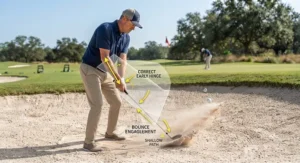
The explosion shot — sometimes called a splash shot — is the standard technique for escaping a greenside bunker, and it depends almost entirely on letting your bounce sand wedge bunker setup do the work instead of manipulating the club yourself.
Setup: Dig your feet slightly into the sand for stability and to gauge texture. Open the clubface roughly 20–30 degrees before taking your grip, which increases the effective bounce and loft. Position the ball slightly forward of center in your stance, with your weight favoring your front foot.
Swing: Aim to enter the sand about one to two inches behind the ball, not at the ball itself. Commit to a full, accelerating swing through impact — decelerating is the single most common cause of a chunked or skulled bunker shot. Let the bounce of the sole skip through the sand rather than trying to lift the ball with your hands.
First-30-days mistakes to avoid: New bounce sand wedge bunker owners commonly close the face at address (which cancels out the bounce benefit entirely), decelerate through impact out of fear of hitting it too far, or set up with the ball too far back in the stance, which steepens the attack angle and increases digging.
Maintenance tip: Rinse sand out of the grooves after every round — packed sand in the grooves reduces spin over time regardless of how good the wedge itself is.
Real-World Scenarios: Matching the Right Wedge to Your Game
The weekend warrior (15–20 handicap, plays twice a month): Budget matters, consistency matters more. The Wilson Harmonized or Cleveland CBX 2 ZipCore both offer forgiving, wide-sole performance without demanding a fitting session. Prioritize higher bounce (10°–12°) since infrequent play means less reliable contact.
The improving mid-handicapper (8–14 handicap, plays weekly, practices occasionally): This golfer benefits most from a dedicated bunker grind like the Ping Glide 4.0 E-Grind or the Mizuno T24 V-Grind, since bunkers are often the last skill gap standing between a mid-handicap and single digits.
The low-handicap shot-maker (0–7 handicap, plays and practices frequently): Versatility and feel outweigh pure forgiveness here. The Titleist Vokey SM10 or Callaway Jaws Raw W-Grind both offer the shot-shaping range this player actually uses, from tight flops to long bunker blasts.
Problem → Solution: Fixing the Most Common Bunker Mistakes
Problem: The ball skulls across the green. This almost always means the leading edge is contacting the ball or sand too early. Solution: open the face further at address and confirm your bounce angle isn’t too low for your typical attack angle — a wider sole like the Cleveland CBX 2 ZipCore can mask this tendency while you rebuild technique.
Problem: The club digs and the ball barely moves. Usually a bounce-too-low or face-too-square issue. Solution: increase bounce by 2–4 degrees or switch to a W-grind or E-grind style wedge purpose-built for sand.
Problem: Inconsistent distance control on bunker shots. Often caused by decelerating through impact. Solution: practice committing to a full swing with less speed overall, rather than a partial, tentative swing at full speed.
Problem: Wet or compact sand ruins spin. Solution: a wedge with moisture-channeling grooves, like the Mizuno T24‘s HydroFlow micro-grooves, maintains more consistent spin in damp conditions.
Problem: Buried “fried egg” lies feel impossible. Solution: close the face slightly instead of opening it, hit further behind the ball, and accept a lower, running exit rather than a high, soft one — fighting a buried lie with finesse rarely works.
Bounce Sand Wedge vs Standard Pitching Wedge: Why the Difference Matters
| Feature | Bounce Sand Wedge | Standard Pitching Wedge |
|---|---|---|
| Typical Bounce | 8°–14° | 4°–8° |
| Sole Width | Wide to moderate | Narrow |
| Loft Range | 54°–58° | 44°–48° |
| Bunker Performance | Built specifically to skim through sand | Prone to digging in soft sand |
| Best For | Greenside bunkers, soft rough | Full approach shots, firm turf |
The core difference comes down to purpose. A pitching wedge is engineered for full-swing approach shots off relatively firm turf, so it carries minimal bounce to keep the leading edge close to the ground for clean contact. A bounce sand wedge bunker club flips that priority entirely, adding sole width and bounce angle specifically so it can survive inconsistent, soft, or buried lies without digging. Using a pitching wedge in a bunker generally means fighting the club’s design rather than working with it, which is exactly why even beginner sets increasingly include a dedicated sand wedge rather than relying on the pitching wedge to cover every short-game situation.
Common Mistakes When Buying a Bounce Sand Wedge
The single biggest mistake buyers make is choosing loft without considering bounce and grind at all — treating “56-degree wedge” as a complete specification when it’s really only one-third of the picture. A close second is assuming higher price automatically means better bunker performance; as this guide shows, a $50 wedge with sensible modified bounce can outperform a $180 low-bounce blade for a golfer who struggles with contact.
Another frequent error is buying based on what a tour pro plays rather than what matches your own swing and home-course sand. Tour players often game low-bounce wedges because their attack angle and strike consistency simply don’t need the extra forgiveness — copying that spec without copying the skill level usually backfires in the bunker.
Long-Term Cost & Maintenance
| Tier | Price Range | Typical Lifespan | Value Notes |
|---|---|---|---|
| Budget | $30–$60 | 1–2 years of regular play | Grooves wear faster; fine for casual golfers |
| Mid-Range | $130–$180 | 2–3 years of regular play | Best cost-per-round for most golfers |
| Premium | $170–$200 | 2–4 years of regular play | Grooves and resale value hold up better |
A bounce sand wedge bunker club is a consumable, not a permanent purchase — grooves wear down with use regardless of price point, and most serious golfers replace wedges every one to two years to maintain consistent spin. Looking at the comparison above, mid-range wedges like the Cleveland CBX 2 ZipCore often deliver the best cost-per-round of use, since they combine reasonable durability with a price that doesn’t sting when it’s time to replace them. Premium wedges hold spin performance slightly longer thanks to more advanced groove milling, but the difference rarely justifies the extra cost for anyone playing fewer than two rounds a week.
Safety, Regulations & Groove Compliance Guide
Every wedge on this list must conform to groove regulations set by golf’s governing bodies, which matters if you play competitive or handicap-tracked rounds. Per the USGA’s rules hub on grooves, the current groove and punch-mark specifications took effect as part of the 2010 Equipment Rules, and those rules limit groove sharpness on irons, wedges, hybrids, and fairway woods with 25 degrees of loft or more. Every wedge featured in this guide, being a current 2026 model from a major manufacturer, is designed to conform to these specifications out of the box.
Practically speaking, this regulation exists to prevent excessively aggressive grooves from generating unrealistic spin out of the rough, which is part of why groove sharpness — not just depth — factors into modern wedge design. If you play in USGA-sanctioned events or maintain an official handicap, it’s worth confirming any wedge you buy, especially older or aftermarket models, remains on the USGA’s list of conforming clubs.
Frequently Asked Questions
❓ What bounce is best for a sand wedge in bunkers?
❓ Is a 56-degree wedge the same as a sand wedge?
❓ Can I use a pitching wedge in a bunker?
❓ How often should I replace my sand wedge?
❓ What's the difference between a wide sole and narrow sole wedge?
Conclusion
The right bounce sand wedge bunker setup won’t turn every trap shot into a tap-in, but it removes the club itself as a source of failure — which is more than most golfers can say about their current 56-degree. Whether that means the tour-proven versatility of the Titleist Vokey SM10, the bunker-specific grind of the Ping Glide 4.0, or the no-nonsense value of the Wilson Harmonized, the products in this guide cover every budget and skill level honestly, based on real specs and real aggregated review sentiment rather than marketing copy.
Match your bounce angle to your swing and your home course’s sand, respect the sole-width and grind decisions outlined above, and practice the explosion shot technique enough times that it becomes automatic under pressure. Bunkers stop being scary the moment the equipment stops working against you.
Recommended for You
- Super Game Improvement Lightweight Irons: 7 Best Picks for 2026
- Super Game Improvement Max Forgiveness Irons: 7 Best Picks (2026)
- Players Irons Forged Feel: 7 Best 2026 Pick
Disclaimer: This article contains affiliate links. As an Amazon Associate, I earn from qualifying purchases. If you purchase products through these links, we may earn a small commission at no additional cost to you.
✨ Found this helpful? Share it with your friends! 💬🤗
