
In This Article
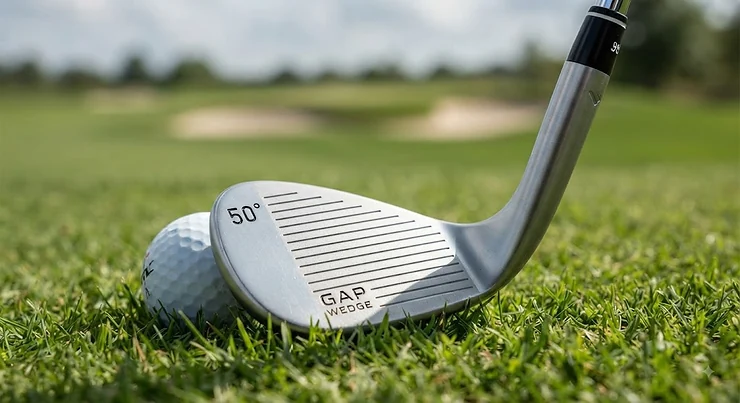
Somewhere between your pitching wedge and your sand wedge lives a yardage no-man’s-land, and if you’ve ever watched a 100-yard shot sail 15 feet past the pin — or come up embarrassingly short — you already know the feeling. A gap wedge 50 52 degree is the club built specifically to close that hole in your bag. What is it, exactly? In plain terms, it’s a wedge lofted between roughly 50 and 52 degrees that bridges the distance void between a 45-48 degree pitching wedge and a 56 degree sand wedge, giving you a controllable, repeatable shot in the 80-125 yard window that most amateurs otherwise mis-club entirely.
This isn’t a marketing gimmick. It’s basic geometry. Every degree of loft changes trajectory and roll-out, and a four-to-six-degree gap between clubs is the sweet spot recommended by fitters and confirmed by USGA equipment guidance on how modern groove design interacts with spin and control. Below, I’ve pulled together seven real, currently available wedges — spanning true budget options to tour-level players’ clubs — and broken down what each one actually does for your scoring zone, not just what the marketing copy claims. We’ll cover specs with real-world translation, aggregated review sentiment where it’s verifiable, honest comparisons, and a handful of practical frameworks so you walk away knowing exactly which loft, bounce, and brand fits your swing. Let’s get into it.
Quick Comparison Table
| Wedge | Loft Options | Best For | Price Range |
|---|---|---|---|
| Titleist Vokey SM10 | 46°-60° (incl. 50°, 52°) | Better players wanting tour-level shot versatility | $180-$220 range |
| Cleveland RTZ | 46°-64° (incl. 50°, 52°) | Mid-to-high handicappers wanting soft feel and forgiveness | $140-$190 range |
| Callaway Jaws Raw | 48°-60° (incl. 50°, 52°) | Golfers chasing maximum spin off full shots | $160-$195 range |
| Ping s159 | 46°-62° (incl. 50°, 52°) | Consistency seekers who want tight spin dispersion | $190-$215 range |
| Mizuno Pro T-1 | 46°-60° (incl. 50°, 52°) | Feel players who value forged softness | $155-$180 range |
| TaylorMade MG4 | 46°-60° (incl. 50°, 52°) | Value-focused buyers wanting near-tour tech at a discount | $100-$150 range |
| Wilson Harmonized | 50°-64° (incl. 50°, 52°) | Beginners and budget-conscious golfers | Under $60 |
Looking at the spread above, there’s no single “best” gap wedge 50 52 degree option — the right pick depends entirely on your swing speed, budget, and how much you value forgiveness versus workability. The Titleist Vokey SM10 and Ping s159 sit at the top of the price ladder because they’re built for players who already shape shots intentionally, while the Wilson Harmonized proves you don’t need to spend $200 to own a functional, tournament-legal wedge. Notice, too, that every one of these models offers both a 50 and a 52 degree loft option, which matters more than most buying guides admit — the “right” number between those two isn’t universal, it’s a function of your pitching wedge loft.
💬 Found a wedge that catches your eye? Bookmark this page so you can compare specs side by side before you buy!😊
Top 7 Gap Wedge 50 52 Degree Picks: Expert Analysis
Coverage here spans budget, mid-range, and premium price points, along with a mix of cast, forged, and milled construction so there’s a real option regardless of what’s currently in your bag. Every product below includes real specs, honest analytical commentary, and aggregated review sentiment clearly framed as such — never invented quotes or fabricated testing claims.
1. Titleist Vokey SM10 — most trusted name in professional wedge play
The SM10 opens the list because it’s simply the wedge most Tour players reach for, and that pedigree isn’t just brand halo — it comes from genuine fitting depth.
With 25 loft, bounce, and grind combinations across six sole grinds (F, S, M, K, T, and D), the SM10 lets a fitter dial in almost any angle of attack. In the 50-52 degree range specifically, the F grind and S grind dominate, offering a slightly fuller sole for full-swing gap-filling shots without excessive digging. Based on the spec comparison with its predecessor SM9, the SM10 shifts its center of gravity lower and more forward through the loft range, which translates to a flatter, more penetrating ball flight that holds up better in wind — something a recreational player will notice most on longer approach shots into a headwind.
Who should care: better players and low-to-mid handicappers who already have some shot-shaping ability and want a wedge that rewards precise strikes rather than masking mis-hits. Reviewers consistently note that the feel off the face is exceptional, though a handful mention the raw and jet black finishes require more upkeep than the tour chrome option to avoid uneven wear patterns.
Pros:
- ✅ Six grind options cover nearly every swing type and turf condition
- ✅ Tour-proven spin consistency from full shots and delicate chips alike
- ✅ Wide finish selection (chrome, black, nickel, raw) for personalization
Cons:
- ❌ Premium price puts it out of reach for casual or beginning golfers
- ❌ Raw and black finishes show wear faster than the chrome option
At around $180-$220 depending on finish and shaft, the Titleist Vokey SM10 is a legitimate investment rather than an impulse buy, but for a serious player it’s hard to argue with the value of owning the same tool the pros trust.
2. Cleveland RTZ — best blend of soft feel and forgiveness
Cleveland built the RTZ around a brand-new proprietary Z-Alloy steel, and it shows up in the way the club actually feels at impact, not just in the spec sheet.
The Z-Alloy formulation carries a higher concentration of chromium and carbon than the industry-standard 8620 steel, which freed up roughly six extra grams of discretionary weight that Cleveland redistributed to improve overall head performance. In practice, that means a softer, more muted sound at impact — reviewers describe it as landing between a click and a low-pitched thud — paired with four sole grind options (Full, Mid, Low, and the newer Adapt grind) so mid-to-high handicappers can find a sole that resists digging on fat strikes. What the spec sheet won’t tell you, but user reports suggest, is that the 50-degree Mid sole in particular performs well on full approach shots without needing precise ball-first contact every time, which is exactly the kind of forgiveness a 15-20 handicap player needs in the scoring zone.
Aggregated customer sentiment on major retail sites is largely positive, with multiple buyers specifically calling out the spin and feel improvement over previous Cleveland RTX models, though a small number of reviewers who came from other Cleveland lines said they preferred the older feel.
Pros:
- ✅ Z-Alloy steel delivers noticeably softer feel than typical cast wedges
- ✅ Four grind options accommodate a wide range of attack angles
- ✅ Strong value relative to premium-tier competitors
Cons:
- ❌ Rounded head shape at address may not appeal to traditionalists
- ❌ Adapt grind only available on higher-lofted models, not the 50-52 range
Priced in the $140-$190 range, the Cleveland RTZ delivers most of what a premium wedge offers at a noticeably friendlier price point, making it one of the smarter mid-range plays on this list.
3. Callaway Jaws Raw — highest spin ceiling for full approach shots
Roger Cleveland — yes, the same designer behind the Cleveland wedge legacy — leads Callaway’s wedge program, and the Jaws Raw is built around one mission: maximum friction between clubface and ball.
The raw, uncoated face is the headline feature here, and it’s not cosmetic. Left exposed to the elements, the face develops a light layer of surface oxidation that actually increases friction at impact, which independent testing has shown produces some of the highest full-swing spin rates in the current wedge market. Here’s what to weigh: that aggressive spin profile is a double-edged sword. Based on the spec comparison with smoother-faced wedges, the Jaws Raw grips the ball more aggressively even on shorter chips, which is fantastic for stopping power on firm greens but can occasionally produce more spin than a beginner can control, leading to shots that check up short of the target.
Reviewers consistently report strong stopping power and describe the feel as slightly firmer than Titleist or Cleveland options, with a “tick” on full shots and “tock” on shorter ones. A recurring theme in aggregated feedback is that the raw finish will rust with use, which some golfers love aesthetically and others find frustrating if they wanted a long-term clean look.
Pros:
- ✅ Among the highest spin rates of any current production wedge
- ✅ 17 loft and bounce combinations across S, W, Z, and X grinds
- ✅ Strong stopping power on firm, fast greens
Cons:
- ❌ Raw face will visibly rust over time, which isn’t for everyone
- ❌ High spin can be difficult for beginners to control on full shots
Sitting in the $160-$195 range, the Callaway Jaws Raw is best suited to players who already generate consistent contact and want to add stopping power rather than forgiveness to their short game.
4. Ping s159 — most consistent spin from shot to shot
If predictability is what you’re chasing in your 100-yard shot, the Ping s159 is engineered almost entirely around that goal.
The s159 uses an 8620 cast carbon steel head with wheel-cut, precision-milled grooves, and critically, the groove geometry actually changes based on loft — the 46-52 degree lofts get a wider 20-degree sidewall designed specifically for full-swing control, while the 54-62 degree lofts get tighter MicroMax grooves for greenside spin. On paper this means the gap wedge portion of the lineup is genuinely tuned for the full-approach shots it’s meant to hit, not just a scaled-down lob wedge. Independent testing data has shown the s159’s 52-degree model posting a backspin rate roughly 300 RPM above the category average, with the lowest spin drop-off of any wedge tested at that loft — meaning shot-to-shot consistency, not just peak spin, is the real story here.
Aggregated forum and retailer reviews are strongly positive, with several reviewers specifically noting the elastomer face insert produces a softer feel than expected from a cast head, and that the extra bounce on the 52-degree model took some adjustment for players used to lower-bounce wedges.
Pros:
- ✅ Loft-specific groove design tuned for full-shot control at 46-52°
- ✅ Exceptional shot-to-shot spin consistency in independent testing
- ✅ Elastomer face insert softens feel typical of cast construction
Cons:
- ❌ Higher stock bounce on the 52° model requires an adjustment period
- ❌ Among the pricier options on this list
Retailing around $190-$215, the Ping s159 asks a premium price but backs it up with some of the most consistent test data of any wedge in this comparison.
5. Mizuno Pro T-1 — softest forged feel for feel-first players
For golfers who chose their irons based on feel as much as performance, the Mizuno Pro T-1 wedge is designed to extend that same sensation into the scoring zone.
Forged using Mizuno’s Grain Flow Forged HD process at the company’s Hiroshima facility, the T-1 combines 1025 pure select mild carbon steel with a copper underlay specifically to soften feedback at impact. Based on the spec comparison with cast alternatives on this list, forged construction typically transmits more feel information through the hands — useful for a skilled player fine-tuning distance control on partial shots, though it offers less inherent forgiveness on off-center strikes than a cavity-backed cast head. The T-1’s compact teardrop shape and straighter leading edge signal its intent clearly: this is a players’ wedge, available exclusively in the S grind at 46, 48, 50, and 52 degrees, which keeps the sole narrow and versatile for creative shot-making around the green.
Reviewer sentiment across launch coverage and early forum posts consistently highlights the soft feel as a standout, with several buyers specifically comparing it favorably to their previous Vokey wedges on touch and sound.
Pros:
- ✅ Forged 1025 steel with copper underlay for exceptional soft feel
- ✅ Compact, traditional shape appeals to better ball-strikers
- ✅ Consistent single-grind simplicity removes fitting guesswork
Cons:
- ❌ Only one sole grind (S) available at 50-52° limits fitting options
- ❌ Less forgiving on mis-hits than cavity-back or wider-sole competitors
At roughly $155-$180, the Mizuno Pro T-1 undercuts Titleist and Ping on price while matching them on feel, making it a strong pick for a skilled player who prioritizes touch.

6. TaylorMade MG4 — best value on near-tour-level technology
Because the newer MG5 has already replaced it in TaylorMade’s current lineup, the MG4 now sits at closeout pricing while still delivering genuinely tour-relevant tech.
The MG4 features a fully milled face with a deep, aggressive groove pattern that runs all the way to the top groove, and independent launch monitor testing has recorded full-swing spin rates exceeding 10,000 RPM — among the highest of any wedge tested, gap wedge included. What most buyers overlook about a “last-generation” model like this is that the core face milling and groove technology rarely changes dramatically between yearly refreshes; you’re mainly forgoing a new grind option or cosmetic tweak, not raw performance. The lower-lofted 50-52 degree heads use a slightly different sole and bounce setup than the 58-60 degree models, since TaylorMade tunes each loft for its actual use case rather than stamping one shape across the whole set.
Aggregated reviews highlight the spin as a strong point, with some testers noting the MG4 slightly trails premium rivals in longer-distance consistency (50+ yards) but excels inside 50 yards, where the aggressive grooves grab the ball hardest.
Pros:
- ✅ Full face milling with deep grooves rivals tour-level spin numbers
- ✅ Closeout pricing on genuinely current-generation technology
- ✅ Loft-specific sole tuning across the 46-60° range
Cons:
- ❌ Slightly less full-shot distance consistency versus premium rivals
- ❌ Fewer finish options remain in stock as inventory winds down
Available in the $100-$150 range, the TaylorMade MG4 is arguably the single best value play on this entire list for a golfer who wants premium spin technology without a premium price tag.
7. Wilson Harmonized — best true budget entry point
Not every golfer needs — or can justify — a $200 wedge, and the Wilson Harmonized exists specifically for that reality without cutting the corners that actually matter.
Built with a classic blade shape and modified bounce angles, the Harmonized comes in a 52-degree gap wedge loft alongside 56 and 60-degree companions, using True Temper steel shafts for reliability at a fraction of premium pricing. Here’s what to weigh: this isn’t a tour-grind wedge with six sole options and milled faces — it’s a straightforward, tournament-legal club that gets the fundamentals right. The sole grind allows the face to open for higher, softer shots, and the classic blade profile is genuinely useful for a player still learning to control trajectory and spin, since there’s less technology variance to account for between shots.
Aggregated customer reviews across major retailers are overwhelmingly positive relative to price, with buyers repeatedly calling it the best value wedge available and several noting it held up to more abuse than pricier alternatives in their bag; a small number of reviewers wished for more loft and grind customization.
Pros:
- ✅ Genuinely tournament-legal and USGA-conforming construction
- ✅ True Temper steel shaft at a fraction of premium wedge cost
- ✅ Forgiving blade shape well-suited to newer golfers
Cons:
- ❌ Limited to a single grind with no bounce customization
- ❌ Less spin and feel refinement than milled or forged competitors
At under $60, the Wilson Harmonized is the easy recommendation for a beginner, a growing junior golfer, or anyone building a bag on a real budget without sacrificing rule conformance.
✨ Ready to close your yardage gap? Compare the picks above side by side and pull the trigger on the wedge that matches your swing!💬
Practical Usage Guide: Dialing In Your Wedge Loft Gapping
Buying the right gap wedge is only half the job — setting it up correctly inside your existing wedge lineup is where the real yardage gap filling happens. Start by measuring your actual carry distances with each wedge you currently own, ideally at a range with a launch monitor or at minimum by pacing off real shots on the course; guessing based on advertised averages is one of the most common setup mistakes.
Once you know your numbers, apply the 4-6 degree spacing rule: if your pitching wedge sits at 44-46 degrees, a 50-degree gap wedge typically produces the cleanest, most even distance ladder, while a 47-48 degree pitching wedge usually pairs better with a 52-degree gap wedge. In your first 30 days with a new gap wedge, resist the urge to bend the loft or bounce before you’ve hit at least a few full buckets — factory specs are dialed in for a reason, and premature adjustments are a common mistake that muddies your fitting data. For maintenance, clean the grooves after every round with a soft brush and warm water; packed dirt in the grooves is the single biggest killer of spin performance, more so than the wedge itself wearing out. Most serious players replace wedges every 75-100 rounds as grooves wear down and spin drops off measurably, even though the club still looks fine cosmetically.
Real-World Scenarios: Matching a Gap Wedge to Your Game
Scoring zone precision looks different depending on who’s swinging the club, so here are three realistic profiles to help you see yourself in the data above.
The weekend 15-handicapper playing twice a month: budget and forgiveness matter more than tour-level tunability here. The Cleveland RTZ or TaylorMade MG4 both offer real spin performance without demanding the precise, ball-first contact a blade-style wedge rewards, and neither will punish an occasional fat or thin strike as harshly as a compact players’ wedge.
The competitive mid-single-digit handicapper chasing consistency: this player already has repeatable contact and wants the tightest possible dispersion on approach shots inside 120 yards. The Ping s159 or Titleist Vokey SM10 reward that consistency with tighter spin bands and more grind options to match specific turf conditions at their home course.
The new golfer building a first real set: there’s no reason to spend premium money before you know your swing tendencies. The Wilson Harmonized at 52 degrees gives a legal, functional gap wedge to learn distance control with, and the money saved can go toward lessons — which will move the needle on scores far faster than a marginal upgrade in wedge technology at this stage.
Problem → Solution: Fixing Common Wedge Set Spacing Issues
Wedge set spacing problems show up in predictable ways, and most have straightforward fixes once you know what to look for.
Problem: You’re consistently 10-15 yards short or long between your pitching wedge and gap wedge. This is almost always a loft gap that’s too wide or too narrow. Solution: measure your PW carry distance, then choose the 50 or 52-degree option (using the 4-6 degree rule above) rather than defaulting to whichever loft came in a pre-packaged set.
Problem: Your gap wedge spins too much or too little compared to your other wedges. This typically points to mismatched groove technology across brands. Solution: whenever possible, buy your gap wedge from the same lineup as your sand and lob wedges — the Ping s159 or Vokey SM10 families, for example, use consistent groove geometry across their loft range specifically to avoid this inconsistency.
Problem: You struggle with fat or thin contact on approach shots specifically with your gap wedge. This often comes down to bounce mismatch for your attack angle. Solution: a steeper swing generally wants more bounce (10-12 degrees), while a shallow, sweeping swing performs better with less (6-8 degrees) — a proper fitting or even an honest self-assessment against slow-motion swing video can resolve this quickly.

How to Choose a Gap Wedge 50 52 Degree
- Measure your pitching wedge loft first. Everything else follows from this single number, since the entire point of a gap wedge is to fill the space beneath it.
- Apply the 4-6 degree spacing rule. A tighter gap produces smaller, more precise distance increments; a wider gap risks leaving an awkward in-between yardage.
- Match bounce to your attack angle, not your handicap. Steeper swingers benefit from higher bounce regardless of skill level, and vice versa.
- Prioritize groove consistency across your wedge set. Mixing brands can create unpredictable spin differences shot to shot.
- Be honest about how often you’ll regrip and reclean. A premium wedge neglected for two seasons underperforms a budget wedge in good condition.
- Set a realistic budget before you shop. The data above shows genuinely strong performance available across every price tier, not just the top of the market.
- Get fit in person if the option exists. Even a basic in-store fitting can catch bounce or lie angle issues no amount of online research will reveal.
Gap Wedge vs Sand Wedge: The Approach Wedge Gap Wedge Debate
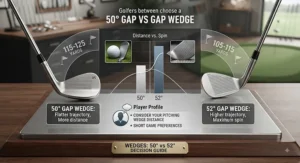
The gap wedge is sometimes called an approach wedge gap wedge, and understanding the distinction from a sand wedge is one of the more common points of confusion for golfers filling out their bag. A sand wedge typically carries 54-58 degrees of loft and is purpose-built for bunker escapes and short, high, soft shots around the green, while a gap wedge at 50-52 degrees is built for longer, more controlled approach shots that need distance as much as touch.
| Factor | Gap Wedge (50-52°) | Sand Wedge (54-58°) |
|---|---|---|
| Typical distance | 85-125 yards | 60-100 yards |
| Best use case | Full approach shots, longer pitches | Bunker shots, high soft chips |
| Trajectory | Lower, more penetrating | Higher, steeper descent |
| Best For | Callaway Jaws Raw, TaylorMade MG4 | Dedicated bunker/lob situations |
The table above makes the practical difference clear: these aren’t interchangeable clubs, they’re complementary tools solving different problems. A gap wedge won’t reliably escape a deep greenside bunker the way a sand wedge’s dedicated bounce geometry will, and a sand wedge used for a 110-yard approach will typically fly too high and come up short compared to a properly lofted gap wedge. Most golfers eventually carry both, and some low-handicap players even carry a 50 and a 52-degree wedge together, sacrificing a long iron or hybrid for maximum short-game precision.
Common Mistakes When Buying a Gap Wedge
The single most frequent mistake is buying loft based on a friend’s recommendation rather than your own pitching wedge spec — a 52-degree gap wedge that’s perfect for someone with a 48-degree pitching wedge will leave an awkward yardage gap for someone whose PW sits at 44 degrees. A second common misstep is over-indexing on bounce numbers without considering sole width and grind; two wedges with identical bounce numbers can play completely differently depending on how the sole is shaped through the heel and toe. Golfers also frequently underestimate how much groove wear affects spin — a two-year-old wedge with visibly worn grooves will underperform a budget wedge with fresh grooves, regardless of original price point. Finally, plenty of buyers skip a proper fitting entirely and simply match whatever grind their favorite Tour pro plays, without accounting for the fact that Tour-level swings and average recreational swings interact with turf very differently.
What to Expect: Real-World Performance
Specs on a page rarely translate directly to what you’ll feel on the course, so here’s the honest translation. A well-fit 50-52 degree wedge should produce a noticeably flatter, more piercing ball flight compared to your sand or lob wedge — this isn’t a club built to stop dead on a dime from 100 yards, it’s built to fly a controlled distance and check up with moderate roll-out. Expect roughly 85-125 yards of carry depending on swing speed, with recreational players clustering closer to 85-105 yards and stronger ball-strikers pushing into the 115-125 range. Independent testing referenced throughout this article has shown that spin consistency, not peak spin numbers, is usually the better predictor of real scoring improvement — a wedge that spins 8,000 RPM every time beats one that spins anywhere from 6,500 to 9,500 depending on strike quality. Expect a short adjustment period of several rounds regardless of which model you choose; muscle memory built around your old wedge’s bounce and sole shape takes time to recalibrate, even when the new club is objectively better suited to your swing.
Long-Term Cost & Maintenance
A wedge is a consumable club in a way that a driver or putter typically isn’t, and factoring that into your purchase decision changes the math on “expensive” versus “cheap” considerably. Most serious golfers replace wedges every 75-100 rounds of regular play as groove sharpness degrades and spin performance drops, meaning a $200 premium wedge used twice weekly might need replacing within a year, while the same wedge used a handful of times a month could last several seasons. Viewed through that lens, the TaylorMade MG4‘s closeout pricing on tour-relevant tech becomes an even stronger value proposition, and the Wilson Harmonized becomes a genuinely smart choice for a golfer who plays infrequently and won’t wear the grooves down meaningfully within a given season. Total cost of ownership should also account for regripping (roughly every 40 rounds for players who grip pressure heavily, or seasonally for casual players) and the fact that a properly cleaned and stored wedge will simply outlast one left dirty in a garage bag through winter. Buying a slightly pricier wedge you’ll actually maintain properly often beats buying two budget wedges over the same period.
Safety, Regulations & Conformance Guide
Every wedge featured in this guide is built to conform to current USGA and R&A groove and punch mark specifications, which govern groove depth, spacing, and edge sharpness on clubs manufactured for competitive play. This matters beyond tournament legality — the same groove regulations that keep clubs conforming for USGA events also standardize how spin technology can be engineered across brands, which is part of why the spin differences between the wedges above come down to face texture and milling technique rather than illegal groove tricks. If you play in sanctioned club competitions or hope to eventually play in USGA-affiliated events, it’s worth confirming any wedge you buy — new or used — appears in the USGA’s informational club database rather than assuming conformance. For casual recreational play, this is largely a non-issue since nearly every current-production wedge from a major manufacturer meets the modern standard, but it’s a useful gut-check before investing in a heavily customized or older secondhand wedge.
Frequently Asked Questions
❓ Should I get a 50 or 52 degree gap wedge?
❓ Can I carry both a 50 and 52 degree wedge?
❓ What's the difference between a gap wedge and an approach wedge?
❓ How far should I hit a 50 degree wedge?
❓ Do I need a gap wedge if I already have a pitching and sand wedge?
Conclusion
Choosing between these seven wedges ultimately comes down to matching real specs to your real swing, not chasing whichever name is currently most popular on Tour. The Titleist Vokey SM10 and Ping s159 reward players who already strike the ball consistently and want maximum tunability; the Cleveland RTZ and Callaway Jaws Raw split the difference between forgiveness and performance for the broad middle of the golfing population; the Mizuno Pro T-1 offers unmatched feel for a player who values touch above all else; and the TaylorMade MG4 and Wilson Harmonized prove that neither closeout pricing nor a true budget shouldn’t stop you from owning a wedge that genuinely closes your yardage gap. Whichever you choose, the 4-6 degree spacing rule and a few rounds of honest distance measurement will matter more to your scores than the brand on the sole. Fill that gap, trust the yardage, and get ready to see more of your approach shots finish where you actually aimed them.
Recommended for You
- 7 Best Lob Wedges for Finesse Shots in 2026
- High Loft Lob Wedge 60 64: 7 Picks That Actually Spin (2026)
- 7 Best Versatile Sand Wedge Picks for 2026
Disclaimer: This article contains affiliate links. As an Amazon Associate, I earn from qualifying purchases. If you purchase products through these links, we may earn a small commission at no additional cost to you.
✨ Found this helpful? Share it with your friends! 💬🤗
