
In This Article
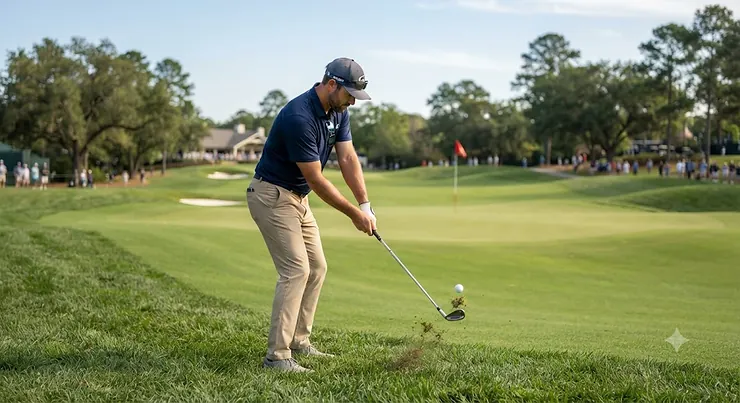
Here’s the honest truth about pitching wedge approach shots: they’re the most forgiving-looking, most quietly punishing shots in golf. A pitching wedge approach shot from 90 to 130 yards is a full-swing shot with a scoring club, which means it should be the easiest strokes-gained opportunity in your bag — and yet most mid-handicap golfers leave this club in the bag feeling more dread than confidence. What is a pitching wedge approach shot? It’s a full or three-quarter swing struck with the lowest-lofted wedge in the bag (typically 44-48 degrees) from scoring range, designed to fly a controlled distance and stop quickly near the pin. The gap between “I hit a decent shot” and “that ball is inside 15 feet” almost always comes down to two things: your technique, and whether the wedge in your hands actually matches how you deliver the club to the ball. The backspin that stops a wedge shot near the pin is produced by friction between the grooves and the ball’s cover, not by any kind of magic — which is exactly why groove condition and technique matter as much as the club you buy. This guide walks through seven real, currently available pitching wedges worth your money in 2026, plus the practical framework — grinds, bounce, groove wear, gapping — that turns approach shots from a coin flip into a repeatable scoring weapon. We researched real specs, aggregated genuine reviewer sentiment, and built in honest comparisons so you’re not just reading a rewritten spec sheet. Affiliate disclosure: this post contains Amazon affiliate links, and we may earn a commission on qualifying purchases at no extra cost to you.

Quick Comparison Table
| Wedge | Best For | Loft Range | Price Range |
|---|---|---|---|
| Titleist Vokey SM10 | Tour-level shot-shaping | 46-60° | $180-$200 range |
| Mizuno Pro T-3 | Pure feel and feedback | 45-58° | $170-$190 range |
| Cleveland RTX 6 ZipCore | Spin without a tour price | 46-58° | $150-$170 range |
| Callaway JAWS MD5 | Versatile grind options | 46-60° | $160-$180 range |
| Ping Glide 4.0 | Mid-handicap balance | 46-58° | $150-$170 range |
| Wilson Staff Model ZM | Best value sleeper | 46-56° | Under $130 |
| Cleveland CBX 2 | Maximum forgiveness | 46-58° | $120-$140 range |
Looking at the table, the split is really about attack angle and ego. Better ball-strikers who compress the ball with a descending blow get the most out of the Titleist Vokey SM10 and Mizuno Pro T-3, because their thinner soles and tighter CG reward centered, ball-first contact. Golfers who occasionally catch it heavy or thin — which is most of us — will see far more consistent carry distances from the Cleveland CBX 2 or Wilson Staff Model ZM, since both push weight to the perimeter to bail out off-center strikes.
💬 Just one click — help others make better buying decisions too!😊
Top 7 Pitching Wedges for Approach Shots: Expert Analysis
1. Titleist Vokey SM10 — the gold-standard shot-shaper
The Titleist Vokey SM10 earns its reputation the unglamorous way: consistency across an enormous range of grinds. Titleist’s TX4 groove pattern is milled with a garnet-blasted face texture, and the SM10 comes in five distinct grinds (F, S, M, D, L) so the sole interacts with turf the way your specific angle of attack demands, rather than forcing you to adapt to the club. In practice, that means a steep, digging swing and a shallow, sweeping one can both find a Vokey grind built for them, which is rare in a single model line.
Better players consistently praise the SM10’s ability to hold face angle through wet or scruffy lies, and the spin separation between full shots and partial pitches is unusually predictable. Based on the spec comparison with tour-level competitors, what stands out here isn’t raw spin numbers — several rivals post similar figures — it’s the tightness of the dispersion pattern, meaning your misses cluster instead of scattering. Reviewers consistently report that the grind options genuinely change turf interaction rather than being marketing dressing on an identical sole.
This is the pitching wedge approach shots specialist for single-digit and low-double-digit handicappers who already strike the ball fairly consistently and want the club to reward good contact rather than protect bad contact.
Pros:
- ✅ Five true grind options for real turf-condition customization
- ✅ Exceptional spin consistency between full and partial swings
- ✅ Tour-proven durability and resale value
Cons:
- ❌ Thinner sole punishes fat or thin contact more than rivals
- ❌ Premium price with no beginner-friendly wide-sole option
At around $180-$200 depending on retailer and finish, the Titleist Vokey SM10 is a premium buy, but for a ball-striker who already controls contact, the value is in shots saved, not dollars spent.

2. Mizuno Pro T-3 — best feel and feedback for shot-shapers
Mizuno built its reputation on grain-flow forged irons, and the Mizuno Pro T-3 carries that soft-feel DNA into wedge form with a compact, high-toe blade shape that shifts the center of gravity toward impact for shot-shaping creativity. The cut-muscle back design keeps mass low and central, so a clean strike produces the kind of soft, “no feedback needed” feel that better players chase.
What most buyers overlook about a blade-style wedge like this is that the smaller face isn’t a forgiveness penalty so much as a workability feature — the compact head makes it easier to open or close the face for flop shots and low runners without the sole geometry fighting you. Aggregated reviewer sentiment consistently flags the T-3 as one of the most “honest” wedges on the market: it tells you immediately when contact was off, rather than masking it with forgiveness technology.
That feedback loop is exactly what helps low-handicap players tighten their strike pattern over a season. For pitching wedge approach shots specifically, the T-3’s slightly stronger available lofts pair well against a scoring-club setup where you want a full, aggressive swing rather than a delicate touch shot.
Pros:
- ✅ Grain-flow forged construction delivers exceptional soft feel
- ✅ High-toe shape aids intentional shot-shaping and workability
- ✅ Compact blade favored by better players for creativity
Cons:
- ❌ Unforgiving on toe or heel misses compared to cavity designs
- ❌ Limited grind/bounce spread versus the largest wedge lines
Priced in the $170-$190 range, the Mizuno Pro T-3 is a feel-first purchase — check current price before buying, since Mizuno’s premium forged wedges see modest fluctuations depending on finish.
3. Cleveland RTX 6 ZipCore — tour-level spin without the tour price
The Cleveland RTX 6 ZipCore takes Cleveland’s internal weighting technology — a lightweight core positioned to lower and centralize the center of gravity — and pairs it with HydraBlade groove technology designed to channel away moisture for more consistent spin in damp, dewy morning conditions. Here’s what the spec sheet won’t tell you plainly: that lower CG doesn’t just add forgiveness, it also raises launch angle slightly on full pitching wedge approach shots, which helps mid-handicappers who tend to launch wedge shots too low and watch them run through the green.
Reviewers across major golf publications have repeatedly ranked the RTX 6 among the highest full-swing spin generators in recent testing cycles, occasionally out-spinning wedges costing considerably more. On pitch shots specifically, spin performance can vary more than on full swings — a pattern testers have flagged across nearly every wedge line, not just Cleveland’s — so it’s worth hitting a demo before committing to grind selection.
For a golfer who wants tour-level stopping power on approach shots without paying a tour-level price tag, this is one of the smartest buys on this list.
Pros:
- ✅ Internal weighting lowers CG for easier launch and forgiveness
- ✅ HydraBlade grooves maintain spin in wet, dewy conditions
- ✅ Consistently ranks among the highest full-swing spin performers
Cons:
- ❌ Pitch-shot spin can be less consistent than full-swing spin
- ❌ Fewer premium finish options than Titleist or Callaway
Expect the Cleveland RTX 6 ZipCore in the $150-$170 range, which places it squarely in the best-value-for-performance tier of this entire list.
4. Callaway JAWS MD5 — most versatile grind lineup
The Callaway JAWS MD5 leans hard into its groove geometry, with a steeper wall-angle groove design that Callaway’s own testing credits with a meaningful spin increase over its MD4 predecessor. It’s offered across five grind options and three finishes, which — combined with a wide loft spread from 46 to 60 degrees — makes it one of the most genuinely customizable wedge families a golfer can buy off the rack rather than through a custom-fitting-only channel.
What that groove wall-angle change means in practice: more aggressive edge contact with the ball’s cover, which translates to noticeably more spin on shots struck from thicker rough or slightly damp fairway lies, not just pristine range-mat conditions. Aggregated reviewer sentiment frequently highlights the MD5’s forgiveness-to-spin ratio as unusually well balanced for a groove-forward design, meaning golfers don’t have to sacrifice off-center performance to chase spin numbers.
For pitching wedge approach shots played from variable fairway conditions — the reality of most public and municipal courses — that variable-lie consistency matters more than one extra flashy spin number on a launch monitor in perfect conditions.
Pros:
- ✅ Steeper groove wall-angle adds meaningful spin from rough lies
- ✅ Five grinds and three finishes cover nearly every attack angle
- ✅ Strong forgiveness-to-spin balance for a groove-focused design
Cons:
- ❌ Aggressive grooves wear faster with heavy range-ball use
- ❌ Some grind/loft combos are retailer-specific and harder to find
At a typical $160-$180 range, the Callaway JAWS MD5 rewards golfers who play a variety of turf conditions rather than one consistent home course.
5. Ping Glide 4.0 — the mid-handicap balance point
Ping built the Glide 4.0 (and its S-series siblings) around a simple design brief: give a mid-handicap golfer both forgiveness and legitimate spin without forcing a trade-off between them. Six sole grind options let the wedge adapt to a range of attack angles, while a compact head shape avoids looking bulky or “game-improvement” behind the ball, which matters to golfers upgrading from a stock iron-set wedge for the first time.
Based on the spec comparison against pure tour blades, the Glide’s slightly wider sole and moderate bounce genuinely reduce the number of chunked or bladed approach shots for players in the 10-20 handicap range, without meaningfully sacrificing the crisp feel better players expect. Reviewers consistently note the Glide 4.0’s spin numbers land close to tour-level wedges from Vokey and Callaway on full pitching wedge approach shots specifically, even if they trail slightly on delicate short-sided chips.
That’s a smart trade-off for most golfers, since full approach shots happen far more often per round than tour-caliber flop shots. This is the wedge to hand a golfer who’s outgrown their iron-set pitching wedge but isn’t ready for an unforgiving blade.
Pros:
- ✅ Six sole grinds balance forgiveness with genuine spin
- ✅ Compact head shape avoids a bulky game-improvement look
- ✅ Full-swing spin numbers rival pricier tour-level wedges
Cons:
- ❌ Slightly behind tour blades on delicate greenside touch shots
- ❌ Grind naming conventions can confuse first-time buyers
In the $150-$170 range, the Ping Glide 4.0 is arguably the safest single recommendation on this list for the average 15-handicap golfer.

6. Wilson Staff Model ZM — the sleeper value pick
Independent 2026 wedge testing has repeatedly singled out the Wilson Staff Model ZM as a genuine surprise, with reviewers noting its deep, tight groove pattern performs competitively against the biggest names in the category at a noticeably lower price point. Wilson’s forged construction gives the ZM a soft, responsive feel that historically only showed up in wedges costing considerably more, and the groove depth appears to hold spin consistency well into a wedge’s usable life before wear sets in.
What most buyers overlook about “sleeper” equipment brands is that the manufacturing quality gap between major and secondary wedge brands has narrowed significantly in recent years, even as the marketing budgets haven’t. Aggregated reviewer sentiment describes the ZM as offering premium spin and feel “without paying a premium price,” and value-conscious testers have rated it highly on overall lab scores that weigh performance against cost.
The obvious trade-off is around resale value and finish variety — you won’t find the exotic raw or oil-can finishes that command a following among gear enthusiasts. For a golfer building their first standalone wedge purchase, or replacing a worn-out set wedge on a budget, this is the pick that delivers disproportionate performance per dollar.
Pros:
- ✅ Deep groove pattern competes with premium tour-level wedges
- ✅ Forged construction delivers surprisingly soft, responsive feel
- ✅ Outstanding performance-to-price ratio among 2026 releases
Cons:
- ❌ Fewer finish and grind options than major legacy brands
- ❌ Lower resale value if you later sell or trade the club
At under $130, the Wilson Staff Model ZM is the single best budget argument in this entire roundup — check current price, since availability can shift by retailer.
7. Cleveland CBX 2 — maximum forgiveness for developing golfers
The Cleveland CBX 2 is built for exactly the golfer this article is really written for: someone who occasionally catches a pitching wedge approach shot heavy, thin, or off the toe, and needs the club to minimize the damage. Its cavity-back design and full-face groove pattern — grooves that extend closer to the edges of the face than a traditional wedge — combine to keep ball speed and spin more stable on off-center strikes, which is precisely where higher-handicap golfers lose the most strokes.
Reviewers testing forgiving wedge options for high-handicap and beginner golfers have consistently flagged the CBX line as a club players “never have to replace” thanks to the blend of premium construction and genuine forgiveness, a rare combination in the game-improvement wedge category. Here’s what the spec sheet won’t tell you: full-face grooves aren’t just a full-swing feature — they also open up creative greenside shots (like intentionally hitting the ball higher on the face) that a traditional groove pattern would punish.
For a developing golfer still building a repeatable strike, that flexibility compounds as their game grows, rather than becoming an object they outgrow in a single season.
Pros:
- ✅ Cavity-back weighting stabilizes ball speed on mishits
- ✅ Full-face grooves add forgiveness and creative shot options
- ✅ Rated a long-term keeper even as skill level improves
Cons:
- ❌ Bulkier profile behind the ball than tour-blade competitors
- ❌ Less workability for players who intentionally shape shots
At $120-$140 range, the Cleveland CBX 2 delivers the best forgiveness-per-dollar of any wedge on this list, making it the easy recommendation for anyone new to standalone wedge shopping.
Practical Usage Guide: Dialing In Pitching Wedge Fairway Shots
Buying the right wedge solves half the problem; the other half is process. Before your first round with a new pitching wedge, spend one range session doing nothing but hitting pitching wedge fairway shots off a tight, fairway-style mat rather than a rubber tee mat, since tee mats mask exactly the kind of turf interaction you’re trying to learn. Track three numbers for ten swings: carry distance, dispersion left-right, and how many shots you catch fat versus clean. That baseline tells you more about your real yardage than any launch monitor demo ever will. In your first 30 days with a new wedge, the most common mistake is unconsciously swinging harder to “test” the new club’s distance, which skews your data and can bake in a bad habit. Instead, swing at your normal tempo and let the equipment do its job. For maintenance, wipe grooves down after every few holes with a groove brush or tee, since compacted dirt in the grooves is the single biggest silent killer of spin on pitching wedge fairway shots — more damaging, in most rounds, than actual groove wear. A simple optimization trick: mark your glove or grip with a small dot at your standard pitching wedge grip-down point, since choking down slightly on full approach shots is one of the fastest ways to tighten dispersion without changing swing mechanics.
Real-World Scenarios: Matching Golfers to a Scoring Approach Club
Consider three golfer profiles and how they should think about their scoring approach club. First, the weekend warrior who plays twice a month on a busy municipal course with inconsistent fairway conditions: this golfer benefits most from a forgiving option like the Cleveland CBX 2 or Wilson Staff Model ZM, since infrequent play means less repeatable contact, and a forgiving scoring approach club protects more strokes than a tour blade ever could. Second, the committed 10-handicapper who practices weekly and is chasing single digits: the Ping Glide 4.0 or Cleveland RTX 6 ZipCore hits the sweet spot, offering enough forgiveness to survive an off day while still rewarding the improved strike pattern that regular practice builds. Third, the low-handicap player who already shoots in the 70s and wants full creative control on approach and around the greens: the Titleist Vokey SM10 or Mizuno Pro T-3 gives that player the shot-shaping range a scoring approach club needs at that level. In each case, budget, course conditions, and frequency of play matter more than brand loyalty — a $190 tour wedge in the hands of a twice-a-month golfer often underperforms a $130 forgiving option, simply because forgiveness has more room to help an inconsistent strike than raw spin potential does.
Buyer’s Decision Framework
If you take deep divots and often strike the turf before the ball, choose a higher-bounce, cavity-back design like the Cleveland CBX 2, because the added bounce prevents the leading edge from digging in and turning a good swing into a chunked pitching wedge approach shot. If you sweep the ball cleanly with a shallow attack angle, a lower-bounce option like the Mizuno Pro T-3 lets the leading edge get under the ball on firm lies without excess bounce causing the club to skid into the ball’s equator. If your top priority is stopping the ball fast on firm, fast greens, prioritize a wedge with proven high full-swing spin numbers, such as the Cleveland RTX 6 ZipCore. If your priority is simply hitting the center of the face more often under pressure, prioritize forgiveness over spin and lean toward the Wilson Staff Model ZM or Ping Glide 4.0. And if you’re building a complete short-game system rather than a single club, match your pitching wedge’s loft to your iron set first, then build your gap and sand wedges around that number in even four-degree increments — a detail covered in depth in the section below.
How to Choose a Pitching Wedge for Approach Shots
- Check your current pitching wedge loft first. Most iron sets today run 42-48 degrees, and stronger “game-improvement” sets can push toward 41-43 degrees, which changes how you should build the rest of your wedge gapping.
- Match bounce to your typical turf conditions. Low bounce (4-6°) suits firm, tight lies; mid bounce (7-10°) works for most golfers on most courses; high bounce (10°+) protects golfers who take a steep divot on soft turf.
- Decide between a blade or cavity-back profile. Blades reward centered, ball-first contact with better feel and shot-shaping; cavity-backs protect off-center pitching wedge approach shots at a small cost to workability.
- Prioritize groove condition over groove hype. A worn-out wedge with compacted or shallow grooves will underperform a lower-priced wedge with sharp, fresh grooves almost every time.
- Test full swings, not just chips. Many demo days emphasize touch shots around a practice green, but pitching wedge approach shots live and die on full-swing consistency, so test accordingly.
- Consider how the loft fits your existing wedge system. A pitching wedge chosen in isolation can create an awkward yardage gap to your gap wedge if the numbers don’t align.
- Weigh value against how often you’ll actually play. A premium tour wedge rewards frequent practice; a forgiving mid-range option rewards occasional play more reliably.

Common Mistakes When Buying a Pitching Wedge
The single most common mistake is chasing the highest spin number on a spec sheet without accounting for how spin actually shows up differently on full pitching wedge approach shots versus delicate pitch shots — a wedge that dominates one test can quietly underperform on the other, as recent independent testing has shown even among premium tour models. The second mistake is buying a wedge loft that duplicates a club already in the bag; if your iron set’s pitching wedge is 46 degrees and you buy a “gap wedge” at 46 degrees because it looked good on a shelf, you’ve created a redundant club and a real yardage hole elsewhere. Third, golfers frequently underestimate how much groove wear affects spin over time, replacing balls and gloves far more often than the club responsible for most of their scoring shots — most instructors recommend reassessing wedges every one to two seasons of regular play. Fourth, buyers often ignore bounce entirely, focusing purely on loft and finish, even though bounce is arguably the more important spec for actual turf performance. Finally, many golfers buy based on what a tour pro plays rather than what matches their own attack angle and handicap — a tour blade in the hands of a 20-handicapper often produces worse pitching wedge approach shots than a forgiving cavity-back would.
Pitching Wedge vs Gap Wedge: Why the Right Gap Wedge Complement Means Consistent Yardages
A pitching wedge doesn’t operate alone — it’s the anchor point for the rest of your short-game system, and choosing the right gap wedge complement is what actually delivers consistent yardages from 50 to 130 yards. Here’s the logic: if your pitching wedge sits at 46 degrees, a common and well-tested progression adds a gap wedge around 50-52 degrees, a sand wedge around 54-56 degrees, and a lob wedge at 58-60 degrees, spacing each club roughly four degrees apart. Skip the gap wedge, as many amateur golfers do, and you create a 10-20 yard hole between a full pitching wedge and a controlled sand wedge swing — exactly the range where inconsistent, “in-between” shots happen most often. The practical fix isn’t complicated: once you’ve locked in your pitching wedge choice from the list above, look at the same manufacturer’s gap wedge in that model line, since matching sole grinds and groove technology across your wedge set keeps feel and turf interaction consistent as the loft changes. Golfers who build this system report far more predictable yardages under pressure, because they’re never stuck deciding between a soft full swing and an awkward, decelerated partial shot. Consistent yardages come from a complete, evenly spaced wedge system — not from any single club, no matter how good it is.
What to Expect: Real-World Performance
On paper, all seven wedges above will produce reasonable full-swing distances for their loft and your swing speed. In practice, the differences show up in specific, recognizable moments: a slightly damp Tuesday morning round where groove technology either channels away moisture or lets the ball skid; a tucked pin where forgiveness on a mis-hit determines whether you’re inside 10 feet or bailing out to the fat side of the green; a long practice season where groove wear slowly erodes spin without you noticing until a launch monitor session reveals the drop-off. Educational resources on the physics of friction and spin in golf break down exactly why clean, sharp grooves matter more than most golfers assume. What most golfers actually feel on the course isn’t a number on a spec sheet — it’s confidence standing over a 100-yard approach shot, knowing the ball will do roughly what you expect. That confidence compounds: golfers who trust their pitching wedge approach shots commit to fuller swings rather than steering the ball, and committed swings produce better contact than tentative ones almost every time.
Features That Actually Matter (And Those That Don’t)
Groove technology, bounce, and sole grind genuinely matter — they change turf interaction, spin generation, and consistency in ways you’ll feel every round. Forged versus cast construction matters somewhat, primarily for feel and feedback rather than pure performance. What matters far less than marketing suggests: exotic finishes like raw, black oxide, or tour-satin chrome, which affect glare and long-term rust resistance more than actual shot outcomes; and headcover materials, tour-van-style stampings, or co-branding with a specific pro, none of which changes ball flight. Multiple grind options only matter if you actually understand your attack angle and turf conditions well enough to choose correctly — otherwise, a simpler, well-fit standard grind will outperform a “customizable” wedge chosen at random.
Long-Term Cost & Maintenance
A pitching wedge is a wear item, not a permanent fixture, and most instructors and equipment testers recommend replacing wedges every one to two seasons of regular play, since worn grooves noticeably cost spin and control on approach shots long before the club looks visibly damaged. Total cost of ownership, then, isn’t just the sticker price — it’s the sticker price divided by the number of rounds you’ll realistically play before spin degrades meaningfully. A $130 wedge replaced every season can work out to a similar cost-per-round as a $190 wedge replaced every two seasons, which is why forgiving budget options like the Wilson Staff Model ZM hold up well in a genuine value comparison, not just an upfront price comparison. Simple maintenance — cleaning grooves after every few holes, drying the clubhead before storage, and avoiding heavy range-mat use with your gamer wedge — meaningfully extends usable spin life regardless of which model you choose.
Safety, Regulations, and Compliance Guide
Wedge shopping also touches the actual rules of golf, and it’s worth knowing them before you build out a full wedge system. Under the sport’s equipment rules, golfers are limited to 14 total clubs during a round, which means every wedge you add to a four-wedge setup is a decision to remove something else — often a fairway wood or hybrid. There’s no rule requiring a specific number of wedges; some golfers carry two, others carry four, and the right number depends entirely on how you distribute your scoring shots, a point covered well in the official rules governing golf equipment. Groove design itself is also regulated: golf’s governing bodies restrict groove depth and edge sharpness specifically to keep shots from thick rough more penal, a rule change that measurably reduced backspin from rough lies according to controlled testing, which is worth remembering the next time a groove-technology claim sounds too good to be true. For casual rounds, these rules matter less, but if you play in any club competitions or track a handicap, staying inside the 14-club limit and using conforming, non-altered grooves keeps your scores legitimate.

FAQ
❓ What loft is a pitching wedge?
❓ How far should a pitching wedge go?
❓ Should my pitching wedge match my irons?
❓ How often should I replace my pitching wedge?
❓ Do I need a gap wedge if I already have a pitching wedge?
Conclusion
Pitching wedge approach shots reward preparation more than almost any other shot in golf — the right loft, the right bounce, and grooves that haven’t quietly worn down do more for your scorecard than another year of range balls aimed at fixing swing mechanics that were never really the problem. Whether that means the tour-level precision of the Titleist Vokey SM10, the forgiving safety net of the Cleveland CBX 2, or the surprising value of the Wilson Staff Model ZM, the right choice depends on your attack angle, your course conditions, and how often you actually play — not on what looks best in a pro shop display case. Build your pitching wedge choice around a complete, evenly spaced wedge system, maintain your grooves between range sessions, and commit to full swings instead of steering the ball, and those 90-to-130-yard approach shots stop feeling like a gamble and start feeling like your best scoring opportunity of the round.
Recommended for You
- 7 Best Gap Wedges for Full Shots in 2026: Ranked & Compared
- Gap Wedge 50 52 Degree: 7 Top Picks for Precision Scoring in 2026
- 7 Best Lob Wedges for Finesse Shots in 2026
Disclaimer: This article contains affiliate links. As an Amazon Associate, I earn from qualifying purchases. If you purchase products through these links, we may earn a small commission at no additional cost to you.
✨ Found this helpful? Share it with your friends! 💬🤗
