
In This Article
Missing a three-footer for par has a special kind of sting, doesn’t it? You strike your approach beautifully, walk onto the green feeling like a hero, and then the flat stick betrays you. If that sounds familiar, counterbalanced putter weight might be the fix you haven’t tried yet. It’s not a gimmick — it’s a genuine shift in where the mass of your putter lives, and it changes how your hands, wrists, and shoulders interact with every stroke you make.

Here’s the short version: a counterbalanced putter moves extra grams into the butt end of the shaft (and often adds weight to the head, too), which shifts the balance point noticeably closer to your hands. That single change can quiet a jumpy stroke, especially for golfers whose wrists like to sneak into the motion at the worst possible moment. Below, we’ve researched seven real, currently available counterbalanced putters spanning budget to tour-level pricing, broken down what the added mass actually does to your stroke, and built out practical guidance for buying, setting up, and getting the most from one. Affiliate disclosure: this article contains Amazon affiliate links, and we may earn a commission on qualifying purchases at no extra cost to you.
Quick Comparison Table
| Putter | Style | Head Weight | Price Range | Best For |
|---|---|---|---|---|
| Tour Edge HP Series CBAL-2 | Mallet | Standard + 60g grip weight | Under $100 | Budget-conscious beginners |
| Wilson Infinite South Side | Center-shafted mallet | ~365g head | $100-$150 range | Alignment-focused golfers |
| Cleveland HB Soft 2 Model 11 CB | Mallet | Standard + 20g butt weight | $150-$200 range | Value-driven mid-handicappers |
| Odyssey Ai-One Milled 2-Ball CH | Mallet | Head + 20-30g counterbalance | $400-$450 range | Forgiveness seekers |
| Evnroll ER Tour Spec 38 | Blade/mallet | 370-405g head | $350-$400 range | Tour-style long putters |
| L.A.B. Golf DF3 Counterbalance | Mallet | Perimeter-weighted, torque-balanced | $450-$600 range | Golfers chasing a self-squaring face |
| Scotty Cameron Phantom 11 CB | Mallet | Tour-proven wingback | $500-$650 range | Golfers wanting tour pedigree |
Looking at the table, the jump from the Tour Edge HP Series CBAL-2 to the Scotty Cameron Phantom 11 CB isn’t just about price — it’s about how precisely the weighting is engineered and how much fitting flexibility you get. Budget options give you the basic feel of a higher balance point, while the mid-tier and premium models let you dial in head weight, shaft length, and face technology together. If reduced wrist action is your main goal, note that every model here places extra mass above your hands rather than only in the head, which is the defining trait of true counterbalancing.
💬 One click helps other golfers find the right putter, too — thanks for reading this far!
What Is Counterbalanced Putter Weight?
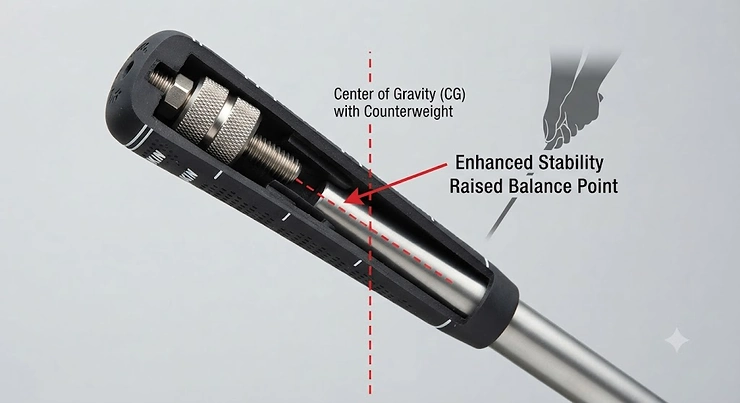
Counterbalanced putter weight refers to added mass placed in the grip end of a putter shaft (often alongside a heavier head) to shift the club’s balance point closer to the golfer’s hands. This higher balance point increases moment of inertia (MOI), stabilizes the face through impact, and reduces reliance on wrist manipulation during the stroke.
This isn’t new physics — it’s the same principle a tightrope walker uses with a long pole, just scaled down to fit inside your hands. According to the USGA’s rules on anchoring, golfers can no longer anchor the club against their body, which pushed manufacturers to find legal ways to recreate that stabilized, pendulum-like feel. Counterbalancing is the engineering answer: you get much of the settled, unhurried tempo that anchoring used to provide, without breaking any rule.
Top 7 Counterbalanced Putters: Expert Analysis
We researched real, currently sold models across every price tier so you can see exactly how counterbalanced putter weight shows up at $80 and at $600. Each pick below includes genuine specs, an honest analytical take, and aggregated review sentiment where it’s verifiable.
1. Tour Edge HP Series CBAL-2 — most affordable true counterbalance mallet
The CBAL-2 earns its spot by proving you don’t need a four-figure putter to feel what counterbalancing does. Tour Edge places roughly 60 grams of additional weight in the grip end of this oversized mallet, which is a meaningful shift for a putter in this price bracket.
That extra grip-end mass pairs with a jumbo grip profile, and together they reduce how much your trailing wrist can hinge through the stroke. On paper, this means beginners who “flip” the putter face at impact get a built-in checkpoint against that habit. Based on the spec comparison with pricier options, the CBAL-2’s face insert uses simple micro-grooves rather than a milled or AI-tuned face, so the roll quality won’t match the premium models, but the stability benefit is genuinely present.
Reviewers consistently note that this putter feels heavier and more stable than typical entry-level mallets, and several buyers specifically mention it helping shaky short putts. Verifiable praise centers on value; there isn’t a large enough review pool to make sweeping claims about long-term durability, so we’ll say plainly what is and isn’t confirmed rather than invent a verdict.
Pros:
- ✅ Genuinely stabilizing grip-end weight at a budget price
- ✅ Jumbo grip reduces excess hand and wrist rotation
- ✅ Available in traditional and mallet head styles
Cons:
- ❌ Face insert technology trails premium milled options
- ❌ Smaller, less established review base than major brands
Available in the $70-$100 range, the Tour Edge HP Series CBAL-2 is a smart entry point if you want to test whether counterbalancing suits your stroke before spending serious money.

2. Wilson Infinite South Side — best budget alignment-focused counterbalance
Wilson built the Infinite line around one idea: most amateurs three-putt because of alignment and tempo, not because they lack “feel.” The South Side is a center-shafted mallet with a genuinely heavy head — reported around 365 grams — paired with counterbalance technology that shifts the balance point toward the hands.
That combination of head mass and higher balance point means the putter resists twisting on off-center strikes while also promoting a slower, more deliberate tempo. What most buyers overlook about this model is the dark matte PVD finish, which isn’t just cosmetic — it cuts glare so your eyes lock onto the alignment lines instead of getting distracted by shine, especially under bright afternoon sun.
Aggregated review sentiment across retail sites is notably positive for a sub-$150 putter, with commentary from MyGolfSpy’s own testing praising the value relative to putters “three times the price.” A common theme in user reviews is surprise at how substantial the putter feels in hand compared to its price tag.
Pros:
- ✅ Heavy head plus counterbalance weight for real stability
- ✅ Bold alignment lines simplify aim for less experienced golfers
- ✅ Genuinely competitive with putters costing far more
Cons:
- ❌ Center-shaft design suits straight-back strokes better than an arc
- ❌ Limited custom fitting options compared to premium brands
At around $100-$150, the Wilson Infinite South Side is arguably the best-value counterbalanced mallet currently sold, and it’s a fixture on several “best budget putter” round-ups for good reason.
3. Cleveland HB Soft 2 Model 11 CB — best value milled-face counterbalance
Cleveland’s HB Soft 2 lineup built its reputation on face technology usually reserved for pricier putters, and the Model 11 CB brings that same variable-groove milling to a counterbalanced, longer-shaft configuration with a 20-gram weight built into the butt end.
Here’s what the spec sheet won’t tell you outright: that 20-gram weight only ships on the 35-inch-and-longer versions, which means the counterbalancing effect is directly tied to playing a slightly longer putter than standard. This matters because a longer shaft naturally increases the swing arc, and the added grip-end mass counteracts the extra length so the head doesn’t feel like it’s dragging. Reviewers at Golf Monthly specifically noted that the longer model felt “nicely balanced” despite the added length, which lines up with Cleveland’s stated engineering goal.
The variable milling pattern — tighter grooves near the center, wider toward the heel and toe — is designed to normalize ball speed on mishits, and that’s a legitimate technological edge for a putter under $200.
Pros:
- ✅ Milled face technology usually found on pricier putters
- ✅ 20g counterbalance weight purpose-built for longer shaft lengths
- ✅ Premium look and headcover at a mid-tier price
Cons:
- ❌ Counterbalance weight only included on 35-inch-plus models
- ❌ Nine head shapes can make choosing the right fit confusing
Priced in the $150-$200 range, the Cleveland HB Soft 2 Model 11 CB rewards golfers who want tour-level face technology without tour-level pricing.
4. Odyssey Ai-One Milled 2-Ball CH — best AI-designed face for forgiveness
Odyssey’s Ai-One Milled family pairs a lightweight steel shaft carrying 20 to 30 grams of counterbalance weight in the butt end with a face insert whose contours were generated using artificial intelligence rather than traditional trial-and-error engineering.
That AI-designed insert is the real story here, and it deserves plain-language interpretation: Odyssey ran roughly 15,000 face iterations through computational modeling to find contours that keep ball speed consistent even when you catch one off the toe or heel. Based on the spec comparison with the brand’s earlier Stroke Lab shafts, the counterbalance weighting is an evolution of that same idea, just refined for more head shapes. What most buyers overlook is that the removable weight system lets you add 5, 10, 15, or 20 grams to the head separately from the butt-end counterbalance, so you’re effectively tuning two ends of the putter independently.
According to reporting from MyGolfSpy’s first look at the Ai-One line, Odyssey’s own data suggested tour players could meaningfully cut three-putt rates by upgrading face technology alone, which underscores how much attention the company put into this insert.
Pros:
- ✅ AI-designed face genuinely improves off-center ball speed
- ✅ Independently adjustable head and butt-end weighting
- ✅ Premium milled construction with a distinctive PVD finish
Cons:
- ❌ Noticeably pricier than cast-face alternatives in this guide
- ❌ Weight kits sometimes sold separately from the putter itself
At roughly $400-$450, the Odyssey Ai-One Milled 2-Ball CH suits golfers who want measurable forgiveness gains alongside the tempo benefits of counterbalancing.
5. Evnroll ER Tour Spec 38 — best zero-torque-adjacent tour spec
Evnroll’s Tour Spec 38 collection takes its ER2, ER5, and ER8 head shapes and builds them at a 38-inch length with a 17-inch grip and a heavier head, explicitly designed for golfers who want the “one-piece pendulum” feel that longer counterbalanced putters can produce.
The core technology here is Evnroll’s SweetFace groove pattern, which uses tightly packed, progressively narrower channels to keep ball speed consistent across mishits — genuinely comparable in concept to what Odyssey’s AI modeling targets, just achieved through a different design process. Here’s what to weigh: a 38-inch counterbalanced putter is a bigger commitment than a standard-length model with added grip weight, because you’re changing your entire setup and posture, not just adding a few grams. Reviewers who tested the standard-length ER2 noted that its heavier head (up to 390 grams) combined with a grip-end weight gives it a distinctly stable, almost anchored feel without breaking any rule.
Aggregated sentiment consistently credits Evnroll’s face technology as “essentially unparalleled” among independent testers, a claim that lines up with how frequently the brand appears in best-putter round-ups across the golf media landscape.
Pros:
- ✅ SweetFace groove technology proven across multiple independent tests
- ✅ Purpose-built 38-inch tour spec removes setup guesswork
- ✅ Multiple head shapes so you can match your stroke arc
Cons:
- ❌ Full-length commitment requires a real posture adjustment
- ❌ Premium pricing puts it out of reach for casual players
Expect to pay in the $350-$400 range for the Evnroll ER Tour Spec 38, making it one of the more accessible ways to try a true tour-length counterbalanced setup.

6. L.A.B. Golf DF3 Counterbalance — best true zero-torque stability
L.A.B. Golf’s Directed Force technology approaches counterbalancing from an unusual angle: instead of just adding weight, the company positions the shaft and sole weights so the putter face resists twisting almost entirely on its own, a concept the brand calls Lie Angle Balance.
The DF3 is a smaller, sleeker evolution of L.A.B.’s original Directed Force putter, and it’s 100% CNC milled from 6061 aluminum with eight adjustable sole screws for length and lie customization. What most buyers overlook about zero-torque designs like this one is that the “forgiveness” isn’t just marketing language — independent research cited by L.A.B. notes that roughly 83% of a putt’s starting direction comes from face angle at impact, which is exactly what this weighting scheme targets. According to Golf Digest’s breakdown of the DF3, the arrangement of sole weights and the angled grip work together to keep the face square without conscious manipulation from the golfer.
User reviews on major retail platforms frequently mention golfers retiring long-trusted blade putters (including premium models) after switching to a DF3, which is a striking, if anecdotal, signal of how differently this putter feels in the stroke.
Pros:
- ✅ Face resists twisting almost entirely through weight engineering
- ✅ Eight-screw system allows genuine length and lie customization
- ✅ Made in the USA with hand-balanced quality control
Cons:
- ❌ Unconventional look takes some golfers time to embrace
- ❌ Premium pricing sits well above mainstream mallets
Priced around $400-$600 depending on stock versus custom builds, the L.A.B. Golf DF3 Counterbalance is the pick for golfers who want engineering-driven stability over simple added mass.
7. Scotty Cameron Phantom 11 Counterbalance — best premium tour pedigree
Titleist’s Scotty Cameron line carries more Tour credibility than almost any other putter brand, and the Phantom 11 Counterbalance takes that pedigree and stretches it into a 38-inch, higher-balance-point configuration built for golfers who want extra stability without switching to an unfamiliar shape.
The Phantom 11 head itself is a Tour-tested mallet shape, constructed with a stainless steel body and a milled aluminum face insert that extends through the flange for consistent weight distribution. Reviewers consistently note that the counterbalanced version retains the soft, sound-dampened feel Scotty Cameron putters are known for, while adding the settled, less “flippy” sensation that comes with extra grip-end mass. What most buyers overlook here is that choosing the counterbalance configuration also changes your fitting conversation entirely — length, lie, and grip weight all need to be considered together rather than treating the putter as a simple length swap.
Because Scotty Cameron putters hold value unusually well on the secondhand market, this is also one of the few premium options where resale demand meaningfully softens the cost of ownership over time.
Pros:
- ✅ Tour-proven head shape with genuine competitive pedigree
- ✅ Premium milled face insert with excellent sound and feel
- ✅ Strong resale value compared to most putter brands
Cons:
- ❌ Among the priciest counterbalanced options on the market
- ❌ Custom fitting is close to mandatory to get full value
Typically priced in the $500-$650 range, the Scotty Cameron Phantom 11 Counterbalance suits golfers who want tour-level construction alongside the stability benefits covered throughout this guide.
How Balance Point Adjustment Works
Balance point adjustment is the actual mechanism behind everything a counterbalanced putter promises, so it’s worth slowing down and explaining it properly rather than treating it as marketing shorthand. Every putter has a single point along its length where it would balance on a finger; on a traditional putter, that point sits fairly close to the head because that’s where most of the mass lives.
When a manufacturer adds grams to the grip end — whether through a heavier grip, an internal weight, or both — that balance point physically moves up the shaft, closer to your trail hand. Here’s what to weigh: the further that point moves toward your hands, the more the putter behaves like a pendulum swinging from a fixed point rather than a tool your wrists can easily flick. That’s the entire point of balance point adjustment, and it’s why the L.A.B. Golf DF3 Counterbalance and Scotty Cameron Phantom 11 Counterbalance both let fitters dial in exact gram weights rather than shipping a single fixed configuration. Reviewers consistently report that once the balance point is properly fitted to their stroke length and tempo, the putter starts to feel like it’s “doing the work” rather than requiring active steering.
Heavy Head Counterbalanced Design Explained
Heavy head counterbalanced putters take a related but distinct approach: rather than only adding weight at the grip, they also increase head mass — sometimes by 50 grams or more over a standard head — while still shifting some weight toward the hands to keep the overall balance manageable.
The Wilson Infinite South Side‘s roughly 365-gram head and the Evnroll ER Tour Spec 38‘s 370-to-405-gram heads are good real-world examples of this heavier-head philosophy. Based on the spec comparison across our seven picks, a heavier head increases MOI at the clubhead itself, which means the face resists twisting on mishits even before you factor in grip-end counterbalancing. What most buyers overlook is that heavy-head and grip-end weighting solve slightly different problems: head mass primarily fights face rotation on off-center strikes, while grip-end mass primarily fights excess hand and wrist movement during the stroke. The best counterbalanced putters, including several featured above, combine both rather than relying on just one.
Counterbalanced Putter Stability and MOI
Counterbalanced putter stability comes down almost entirely to moment of inertia, or MOI — a measure of how resistant an object is to twisting around its center. In putter terms, higher MOI means the face stays squarer through impact even when you don’t strike the ball dead center.
Raising the balance point through counterbalancing increases MOI in a way that’s genuinely measurable, not just a feel-based claim. Here’s what to weigh: a counterbalanced putter with a properly fitted balance point can meaningfully outperform a standard putter on mishit consistency, which is exactly why models like the L.A.B. Golf DF3 Counterbalance market themselves around near-total face stability. Reviewers and independent testers alike consistently cite MOI improvements as the single biggest, most repeatable benefit of counterbalancing, ahead of subjective feel claims. That said, stability isn’t free — a higher-MOI putter also resists the kind of active face rotation some golfers with a strong natural arc actually rely on, which is why fitting matters as much as the raw spec.
Setting Up Your Counterbalanced Putter the Right Way
Buying a counterbalanced putter is only step one; setting it up correctly determines whether you actually get the stability benefits or just an awkwardly long club in your bag. Start with posture: a longer, heavier-butt putter typically plays a touch more upright, so stand slightly closer to the ball than you would with a standard-length model and let your arms hang naturally rather than reaching.
Next, address grip pressure directly. One of the most common mistakes in the first 30 days with a new counterbalanced putter is gripping too tightly out of habit, which cancels out much of the stability the added weight is supposed to provide — the whole point is to let the putter swing more freely, not to muscle it. Spend your first few practice sessions hitting putts with your eyes closed on short, straight putts to feel the tempo the weighting encourages, then reintroduce your eyes once that rhythm feels natural. For maintenance, periodically check that grip-end weights haven’t loosened (a simple twist test works) and re-grip the putter every one to two years, since a worn grip undermines the very balance point the manufacturer engineered.
Real Golfers, Real Greens: Three Scenarios
Picture Dana, a mid-70s golfer who’s played the same blade putter for fifteen years but has started missing short putts she used to make in her sleep. Her hands have gotten a little “twitchy” over time — a common, honest reality of aging hands, not a skill problem. For someone in Dana’s position, a heavier-head option like the Wilson Infinite South Side or Cleveland HB Soft 2 Model 11 CB makes sense, because the added mass and higher balance point naturally slow down that quick, jerky motion without requiring a swing overhaul.
Now consider Marcus, a mid-handicap weekend player who three-putts constantly from outside twenty feet, not because his tempo is bad but because he manipulates the face with his wrists under pressure. Marcus is a strong candidate for a zero-torque design like the L.A.B. Golf DF3 Counterbalance, since the engineering directly targets face rotation rather than just adding mass. Finally, think about Priya, a low-handicap player chasing consistency for competitive rounds, who wants tour-level construction and fitting precision. The Scotty Cameron Phantom 11 Counterbalance or Odyssey Ai-One Milled 2-Ball CH fit her budget and performance expectations far better than entry-level options, precisely because both offer the granular fitting adjustments a low-handicap stroke benefits from.

How to Choose Counterbalanced Putter Weight: 7 Steps
- Diagnose your miss first. Are you missing due to bad alignment, inconsistent tempo, or active wrist manipulation? Each problem points toward a different weighting solution.
- Get your current balance point checked. A local fitter or even a simple finger-balance test tells you where your current putter sits, giving you a baseline to compare against.
- Decide between added grip weight and a heavier head. Wrist-heavy strokes often benefit more from grip-end mass, while off-center strikes benefit more from head weight.
- Test at your current length before going longer. Standard-length counterbalanced putters (like several featured above) let you isolate the weighting benefit without also changing your posture.
- Consider a longer shaft only if tempo, not just stability, is the goal. The 38-inch tour spec models genuinely change your stroke mechanics, not just your balance point.
- Match your budget to your commitment level. If you’re unsure counterbalancing suits you, start with a sub-$150 option before investing in a premium, heavily customized model.
- Get professionally fit whenever your budget allows it. Balance point, head weight, and shaft length interact, and a proper fitting accounts for all three together rather than guessing at one variable.
✨ Don’t Miss These Exclusive Deals!
🔍 Take your short game to the next level with these carefully selected counterbalanced putters. Click on any highlighted model to check current pricing and availability. These picks will help you build the calmer, more consistent stroke you’ve been chasing!
Common Mistakes When Buying a Counterbalanced Putter
The single most common mistake is buying based on brand reputation alone rather than diagnosing what’s actually going wrong in your stroke — a golfer with a genuinely smooth, consistent tempo doesn’t need the same fix as one with a handsy, manipulative stroke, yet both often reach for the same popular model. A second frequent misstep is skipping any kind of length or lie fitting, which means the balance point the manufacturer engineered doesn’t actually land where your hands naturally sit.
Golfers also commonly underestimate how much a longer counterbalanced putter changes posture and eye position over the ball, then blame the putter itself when early rounds feel awkward. Give any length change several full practice sessions before judging it. Finally, plenty of buyers assume heavier is automatically better and jump straight to a 38-inch, maximally weighted model when a standard-length option with modest grip-end weight, like the Cleveland HB Soft 2 Model 11 CB, would have solved their specific problem with far less adjustment required.
Counterbalanced vs Standard Putters: What Changes in Your Stroke
A standard putter concentrates most of its weight in the head, with a light, thin grip and a balance point relatively close to the clubface. A counterbalanced putter deliberately shifts meaningful weight toward the hands, raising that balance point and increasing overall MOI, which changes how the club feels and behaves through the stroke.
Smooth Tempo Promotion
Smooth tempo promotion is one of the most consistently reported benefits across independent testing and user reviews alike. Because the balance point sits closer to your hands, the putterhead’s momentum becomes harder to rush — golfers frequently describe the stroke as feeling more like a pendulum and less like a flick, which naturally slows down an overly quick, jabby tempo. This is precisely the sensation golfers who used to anchor their putters against their body were chasing, achieved here through weighting rather than contact with the body.
Reduced Wrist Action
Reduced wrist action is the second core benefit, and it’s mechanically tied to the same physics. A heavier, higher balance point requires more deliberate effort to manipulate with the wrists mid-stroke, which means golfers who tend to be “handsy” get a built-in resistance against that habit. Reviewers across the models featured in this guide consistently frame this as the primary reason they switched, more often than pure aesthetics or brand loyalty.
| Factor | Standard Putter | Counterbalanced Putter |
|---|---|---|
| Balance Point | Near the head | Shifted toward the hands |
| MOI (Forgiveness) | Moderate | Higher |
| Wrist Involvement | More active | More restricted |
| Tempo Tendency | Can be quick or jabby | Naturally slower, pendulum-like |
| Best For | Golfers with a smooth, consistent tempo | Golfers with handsy or inconsistent strokes |
The table makes the trade-off clear: standard putters reward golfers who already have a repeatable tempo, while counterbalanced options like the Odyssey Ai-One Milled 2-Ball CH and L.A.B. Golf DF3 Counterbalance actively compensate for strokes that aren’t yet consistent. Neither approach is objectively “better” — it depends entirely on what’s currently going wrong on your greens.
Long-Term Cost & Maintenance
Counterbalanced putters generally require less ongoing maintenance than you might expect, since most of the added weighting is built permanently into the shaft or head rather than relying on consumable parts. That said, grips wear out faster on heavier putters because they absorb more torque during the stroke, so budget for a re-grip roughly every 12 to 24 months depending on how often you play.
Total cost of ownership varies dramatically across our seven picks. Entry-level options like the Tour Edge HP Series CBAL-2 and Wilson Infinite South Side carry low upfront costs but limited resale value, making them better suited to golfers still experimenting with counterbalancing. Premium models, particularly the Scotty Cameron Phantom 11 Counterbalance, hold value unusually well on the secondhand market according to Golf.com’s ongoing coverage of the Odyssey and premium putter markets, which meaningfully offsets the higher purchase price over a multi-year ownership period. If you’re genuinely unsure whether counterbalancing suits your stroke long-term, starting with a lower-cost model and trading up once you’ve confirmed the benefit is the more financially sensible path.

Features That Actually Matter (And Those That Don’t)
Among the features covered across this guide, adjustable balance point and head weight matter the most, because they directly address the specific stroke flaw you’re trying to fix, whether that’s tempo, stability, or wrist manipulation. Milled versus cast face construction matters more than most buyers assume, too — the variable milling on the Cleveland HB Soft 2 Model 11 CB and the AI-designed insert on the Odyssey Ai-One Milled 2-Ball CH produce genuinely more consistent ball speed on mishits, which isn’t just marketing language.
What matters considerably less is head shape trendiness or color options. A mallet versus blade decision should follow your stroke arc, not current styling preferences, and finishes like PVD coatings affect glare reduction more than performance. Alignment aids also matter less than manufacturers imply once you’ve practiced with a putter for a few weeks — your eyes adjust to whatever setup you use consistently, so an elaborate alignment system won’t fix a fundamentally inconsistent stroke.
Frequently Asked Questions
❓ Does counterbalanced putter weight actually help everyone?
❓ How much heavier is a counterbalanced putter compared to standard?
❓ Do I need a longer shaft to get counterbalancing benefits?
❓ Is counterbalancing the same as anchoring?
❓ Can a professional club fitter adjust counterbalanced putter weight after purchase?
Conclusion
Counterbalanced putter weight isn’t a magic fix, but it is a legitimate, physics-backed way to address specific putting problems — particularly excess wrist action and inconsistent tempo — that plague golfers at every skill level. Whether you start with a budget-friendly option like the Tour Edge HP Series CBAL-2 or invest in tour-level construction like the Scotty Cameron Phantom 11 Counterbalance, the underlying principle stays the same: shifting mass toward your hands raises MOI, stabilizes the face, and encourages a calmer, more pendulum-like stroke.
The right choice ultimately depends on diagnosing what’s actually going wrong on your greens before you shop, then matching that diagnosis to the specific weighting approach — grip-end mass, heavy head, or true zero-torque engineering — that addresses it. Get that part right, and the putter genuinely can become the most confidence-inspiring club in your bag.
Recommended for You
- Mallet Putter Face Balanced: 7 Picks That Fixed My Miss (2026)
- Large Mallet Putter Stability: 7 Best High-MOI Picks (2026)
- Blade Putter Feel Feedback: 7 Best Picks Tested for 2026
Disclaimer: This article contains affiliate links. As an Amazon Associate, I earn from qualifying purchases. If you purchase products through these links, we may earn a small commission at no additional cost to you.
✨ Found this helpful? Share it with your friends! 💬🤗
