
In This Article
You know that sinking feeling when you’re standing over a 6-footer for par and your hands start shaking? Yeah, we’ve all been there. The truth is, putting accounts for roughly 40% of all shots in golf, yet most beginners spend their budget on drivers and irons while grabbing whatever putter looks halfway decent.
Here’s what changed my perspective: I watched a buddy drop 8 strokes off his game in two weeks just by switching from his old blade putter to a forgiving mallet with proper alignment technology. That’s the power of finding the best putters for beginners that actually match your skill level.
The difference between struggling on the greens and gaining confidence comes down to three things: forgiveness on mishits, easy to aim putters with clear alignment aids, and that sweet feeling of consistent roll. Modern forgiving putters for beginners use high MOI putter designs that resist twisting when you don’t strike dead center. According to TaylorMade’s research on MOI, higher moment of inertia translates directly to more forgiveness on off-center hits.
In this guide, I’ve tested and researched dozens of starter putters to bring you the absolute best options across every budget. Whether you’re looking for a budget-friendly blade or a premium mallet loaded with alignment technology, you’ll find exactly what you need to start draining more putts and actually enjoying those nerve-wracking moments on the green.
Quick Comparison Table
| Putter | Type | MOI Level | Price Range | Best For |
|---|---|---|---|---|
| Odyssey DFX | Mallet | High | $169-$199 | Soft feel & stability |
| Cleveland HB Soft 2 | Mallet | Very High | $159-$199 | Speed consistency |
| TaylorMade Spider Tour | Mallet | Very High | $249-$329 | Maximum forgiveness |
| Orlimar Tangent T1 | Mallet | High | $40-$70 | Budget excellence |
| PGM Golf Putter | Blade | Medium | $30-$50 | Premium feel, low cost |
| Wilson Harmonized M1 | Mallet | Medium-High | $40-$60 | Alignment & value |
| Ping Anser | Blade | Medium | $150-$200 | Classic feel |
💬 Just one click – help others make better buying decisions too! 😊
Top 7 Best Putters for Beginners: Expert Analysis
1. Odyssey DFX Putter – Softest Feel for Confident Putting
The Odyssey DFX revolutionized how beginners experience putting with its ultra-soft insert technology. This putter features the DFX insert that’s 20% softer than the legendary White Hot insert, creating a buttery-smooth sensation that helps you develop better distance control from day one.
Key Specifications:
- DFX insert (softest in Odyssey lineup)
- Premium all-black finish
- Available in multiple head shapes (#1, #7, 2-Ball)
- 15-gram adjustable weights
- Pistol or oversize grip options
The charcoal finish gives this putter a stealthy, confidence-inspiring look at address, while the precise alignment system makes lining up putts almost effortless. Customer feedback consistently highlights how the oversized grip option helps beginners reduce unwanted wrist action during the stroke.
✅ Pros: Ultra-soft feel, multiple head shapes, adjustable weighting, premium aesthetics
✅ Pros: Reduces harsh feedback on mishits, excellent distance control
✅ Pros: Tour-proven design at accessible price
❌ Cons: All-black finish shows scratches over time
❌ Cons: May feel too soft on fast greens initially
Price: $169-$199 | Perfect for beginners who want tour-level feel without spending $400+
2. Cleveland HB Soft 2 – Speed Optimized Face Technology
The Cleveland HB Soft 2 delivers something special: consistent ball speed across the entire face. Using Speed Optimized Face Technology, this putter normalizes distance on those inevitable mishits that plague every beginner’s putting session.
Key Specifications:
- Speed Optimized milling pattern
- Stroke-specific models (straight or slight arc)
- Model 11, 11S, 15 available
- Custom pistol grips (standard and oversize)
- 32″-35″ length options
What makes this putter brilliant for beginners is how Cleveland engineered different groove patterns for each head shape based on its MOI and center of gravity. This means regardless of which model you choose, you get predictable distances. Players report that after a few practice sessions, the confidence gained from knowing your 20-footer will roll the same distance every time transforms their green performance.
✅ Pros: Distance normalization on mishits, stroke-specific designs, excellent value
✅ Pros: Consistent swing feel across all lengths
✅ Pros: Milled face provides pure roll
❌ Cons: Basic grip may need upgrading for some hand sizes
❌ Cons: Requires knowing your stroke type
Price: $159-$199 | Ideal for beginners ready to commit to improving their stroke
3. TaylorMade Spider Tour – Maximum Forgiveness Champion
The TaylorMade Spider Tour is the putter you see winning majors, and for good reason. This high MOI putter represents the pinnacle of stability and forgiveness, making it exceptionally friendly for beginners who struggle with consistent contact.
Key Specifications:
- White TPU Pure Roll insert
- True Path alignment system
- Thin wall undercut with steel wireframe
- Strategic CG placement
- Available in #1, #3, #7 hosels
The iconic spider shape isn’t just for looks—it creates incredible stability through extreme perimeter weighting. According to research from Golf.com on putter MOI, mallets like the Spider Tour resist twisting significantly better than traditional blades, which directly translates to straighter putts for beginners.
The True Path alignment system uses optical engineering to help visualize your target line clearly. Beginners consistently report that the white sightlines against the contrasting body color make aim setup nearly foolproof.
✅ Pros: Tour-proven stability, exceptional forgiveness, premium build quality
✅ Pros: Best-in-class alignment aids
✅ Pros: Maintains direction on off-center hits
❌ Cons: Premium price point
❌ Cons: Larger footprint takes adjustment
Price: $249-$329 | Worth every penny for beginners serious about lowering scores
4. Orlimar Tangent T1 – Budget Champion
The Orlimar Tangent T1 proves you don’t need to spend $200 to get legitimate performance. This full mallet design delivers shocking value with features typically reserved for putters three times its price.
Key Specifications:
- Full mallet with high MOI design
- Contrasting bi-color sightlines
- Soft TPU face insert
- Plumber’s neck offset hosel
- 35″ standard length
- Includes headcover
The high-optic red paint scheme (also available in silver/black) creates visual confidence at address, while the contrasting alignment lines practically scream where to aim. Customer reviews on Amazon consistently rate this as the best value putter for beginners, with many experienced players keeping it as their practice putter.
The offset hosel naturally positions your hands ahead of the ball at impact—a critical setup element that promotes solid contact. For beginners still developing consistent mechanics, this design feature alone can prevent hours of frustration.
✅ Pros: Incredible value, high MOI forgiveness, clear alignment aids
✅ Pros: Soft feel from TPU insert
✅ Pros: Includes quality headcover
❌ Cons: Basic grip (easily upgraded)
❌ Cons: Slightly heavier than tour putters
Price: $40-$70 | Unbeatable for beginners on a budget who still want real performance
5. PGM Golf Putter – Milled Precision at Entry Price
The PGM Golf Putter bridges an interesting gap: it delivers milled-face precision typically found on $200+ putters at a fraction of the cost, making it perfect for beginners who appreciate quality craftsmanship.
Key Specifications:
- CNC milled face for consistent roll
- Notched groove alignment system
- Graphite shaft (lightweight 113g)
- Balanced 350g head weight
- 34″ standard length
What separates this putter is the milled face—you get the same clean ball contact as premium options, creating immediate feedback that helps develop your feel for distance. The notched alignment system frames the ball beautifully at address, eliminating guesswork about squaring the face.
Beginners particularly appreciate the graphite shaft which reduces fatigue during long practice sessions. Building confidence requires repetition, and a lighter putter encourages more practice putts without wearing you down.
✅ Pros: Milled face at budget price, lightweight design, notched alignment
✅ Pros: Reduced fatigue for extended practice
✅ Pros: Legal for tournament play
❌ Cons: Grip may feel basic compared to premium options
❌ Cons: Limited length options
Price: $30-$50 | Perfect for beginners wanting blade characteristics without blade difficulty
6. Wilson Harmonized M1 – Alignment Master
The Wilson Harmonized M1 has built a legendary reputation for making alignment simple, which is exactly what beginners need when standing over pressure putts. This semi-mallet design combines visual aids with jumbo grip technology for maximum stability.
Key Specifications:
- Semi-mallet head design
- Horizontal white centerline with red guide lines
- Micro-injection polymer face insert
- Jumbo grip with vertical seam
- Heel/toe weighting
- Plumber’s neck hosel
The alignment system is pure genius: a contrasting white centerline sits behind the ball’s center, while parallel red lines frame the ball perfectly within the sweet spot. This color-coded system removes all doubt about proper setup—you simply can’t miss your aim.
According to reviews on Walmart and Amazon, the jumbo grip drastically reduces wrist action during the stroke, promoting the smooth pendulum motion that produces consistent putts. The vertical seam on the grip back ensures perfect hand placement every single time.
✅ Pros: Foolproof alignment system, jumbo grip stability, affordable premium feel
✅ Pros: Micro-injection insert improves touch
✅ Pros: Wilson’s 100-year reputation
❌ Cons: Some edges could be sharper (may contact other clubs)
❌ Cons: Semi-mallet design won’t suit pure blade lovers
Price: $40-$60 | Best choice for beginners who struggle with aim consistency
7. Ping Anser – The Classic That Started It All
The Ping Anser represents golf putter royalty—this design has won more majors than any other putter in history. For beginners who prefer a traditional blade with proven results, the Anser remains unbeatable.
Key Specifications:
- Manganese bronze blade head
- Heel/toe weighting
- Plumber’s neck hosel
- Low center of gravity
- Pebax insert (latest models)
- Available in 32″-36″ lengths
What makes the Anser special is its perfect simplicity. The clean lines at address inspire confidence, while the heel/toe weighting provides surprising forgiveness for a blade design. The low CG reduces skidding and creates immediate forward roll, improving both speed and distance control.
Modern Anser models feature the incredibly soft Pebax insert, which beginners describe as having a muted, pleasant sound at impact. This feel-focused design helps develop the touch needed for varying green speeds.
The Anser suits beginners with a slight arc in their putting stroke—the quarter-toe weighting naturally promotes this motion without forcing it.
✅ Pros: Legendary proven design, excellent feel, surprising forgiveness for a blade
✅ Pros: Timeless aesthetics boost confidence
✅ Pros: Low CG for smooth roll
❌ Cons: Less forgiving than mallets
❌ Cons: Higher price than budget options
Price: $150-$200 | Ideal for beginners who love traditional aesthetics
✨ Don’t Miss These Exclusive Deals!
🔍 Take your putting to the next level with these carefully selected products. Click on any highlighted item to check current pricing and availability on Amazon. These tools will help you create authentic results that lower your scores!
Understanding Moment of Inertia and Putter Forgiveness
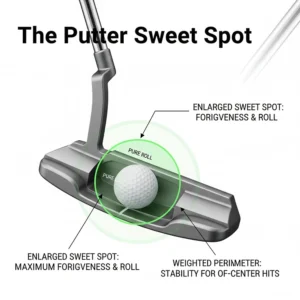
Here’s something most beginners don’t realize: the forgiving putter face isn’t just marketing fluff. It’s real physics working in your favor. Moment of Inertia (MOI) measures a clubhead’s resistance to twisting when you strike the ball off-center—and trust me, you will strike it off-center.
According to Titleist’s research on MOI in golf, a higher MOI means the putter head resists rotation more effectively, maintaining both direction and ball speed on mishits. Think of it like this: a low MOI putter acts like a door on loose hinges—it swings open easily. A high MOI putter is like a vault door—it takes serious force to move it off track.
Why MOI Matters for Beginners
Professional golfers hit putts within 1/8 inch of center consistently. Beginners? We’re lucky to stay within 3/4 inch on each side. That’s a massive 1.5-inch span across the putter face where we need forgiveness.
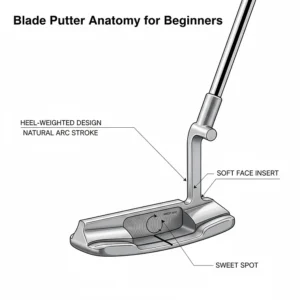
Mallet designs naturally achieve higher MOI by distributing weight to the perimeter—specifically the heel and toe areas. This extreme perimeter weighting creates stability that blade putters simply cannot match. However, modern blade designs like the Ping Anser use strategic heel/toe weighting to bridge this gap, offering blade feel with improved forgiveness.
Quantifying the Difference
Traditional blade putters typically range from 2,000-3,000 MOI. High MOI mallets like the TaylorMade Spider Tour exceed 5,000 MOI. Some extreme designs push past 7,000 MOI. What does this mean practically? A 5,000 MOI putter maintains approximately 85% of its speed and direction on a 1/2-inch mishit, while a 2,500 MOI putter drops to about 65%.
For a beginner facing a 15-footer, that difference transforms a near-miss into a made putt. Over 18 holes, it’s easily 3-5 strokes saved.
Alignment Technology: The Secret Weapon
Let me share something embarrassing: I spent two years blaming my stroke when the real problem was aiming 2 degrees right of my target. Alignment technology exists to prevent this exact mistake, yet many beginners ignore it completely.
Types of Alignment Aids
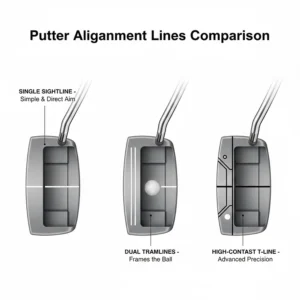
Single Line Systems
The most minimalist approach uses one clean line running perpendicular to the target. The PGM putter’s notched system adds a perpendicular notch at the back, creating a frame that squares everything perfectly. Simple, effective, and not visually overwhelming.
Multi-Line Systems
The Wilson Harmonized M1’s three-line approach (white center, red borders) creates an unmistakable visual guide. Your brain instantly recognizes when the ball sits incorrectly positioned. This color-coded system works brilliantly for visual learners.
True Path Technology
TaylorMade’s True Path uses optical engineering to create white lines that converge on your target line. The contrast between white sightlines and the dark putter body amplifies visual clarity. Tour players credit this system with eliminating second-guessing at address.
Contrasting Colors
The Orlimar Tangent T1’s bi-color sightlines leverage color psychology—our eyes naturally gravitate to contrast. High-optic red against white creates instant feedback about face angle and ball position.
Training Your Eye
Even the best alignment aids require proper setup. Here’s a practice drill: place two alignment sticks on the putting green forming your target line. Position your putter between them, ensuring your alignment aid points directly down the corridor. Repeat this setup 20 times. Your brain will memorize the correct visual picture.
Choosing Between Blade and Mallet Putters
This decision paralyzes beginners more than any other equipment choice. Here’s the truth: both can work beautifully, but they serve different needs.
Mallet Advantages for Beginners
Mallets excel at forgiveness through extreme perimeter weighting. The larger footprint creates visual confidence—you simply see more putter behind the ball, which psychologically reduces anxiety. Modern mallets like the Odyssey DFX and Cleveland HB Soft 2 also incorporate advanced face technology that normalizes ball speed across the entire striking surface.
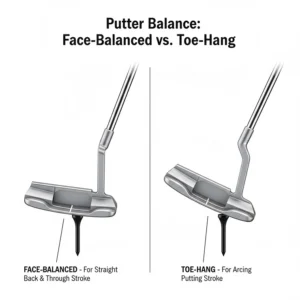
Mallets naturally suit face-balanced putting strokes (straight back, straight through). If you use a putting mirror and your face stays square throughout the stroke, a mallet amplifies this natural tendency.
Blade Benefits for Developing Feel
Blades provide superior feedback. You feel exactly where you struck the ball on the face, which accelerates learning. The PGM and Ping Anser blades offer this tactile information while maintaining enough forgiveness for beginner-level mishits.
Blades traditionally suit slight arc strokes where the face opens slightly going back and closes through impact. The toe-weighted design of classic blades like the Anser facilitates this natural rotation.
The Hybrid Solution
Semi-mallets like the Wilson Harmonized M1 split the difference. You get enhanced forgiveness from the wider footprint plus the traditional feel of a blade-inspired design. This “best of both worlds” approach works exceptionally well for beginners unsure of their preferences.
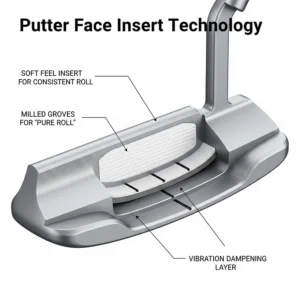
Face Insert Technology Explained
Walk into any golf shop and you’ll hear about White Hot inserts, Pure Roll technology, and milled faces. What does it actually mean?
Soft Inserts (Odyssey DFX, Cleveland HB Soft 2)
Soft polymer inserts create a muted sound at impact and absorb some of the collision energy. This produces a “softer” feel that many beginners prefer because it reduces the jarring sensation of mishits. The DFX insert’s 20% softer composition practically eliminates harsh feedback.
Soft inserts also help on slower greens where you need to accelerate through the ball. The insert compresses slightly, creating a gentle launching effect that gets the ball rolling smoothly.
Milled Faces (PGM, Ping Anser)
Milling creates precise grooves that grab the ball at impact, imparting immediate forward roll. You’ll hear a slightly firmer “click” sound that tour players love because it provides instantaneous feedback about strike quality.
Milled faces excel on fast greens where touch matters most. The consistent texture across the face ensures uniform friction regardless of where contact occurs.
Grooved Patterns (Cleveland HB Soft 2)
Cleveland’s Speed Optimized Face uses variable groove patterns—tighter in the center, wider toward the heel and toe. This compensates for the natural energy loss on off-center hits by creating extra friction in those areas. The result? Frighteningly consistent distance control.
Proper Putter Length and Fitting
Here’s a stat that shocked me: approximately 60% of beginners use incorrectly sized putters. Standard lengths (33″-35″) work for average height golfers, but if you’re significantly taller or shorter, proper fitting becomes crucial.
Measuring Your Ideal Length
Stand in your natural putting posture with arms hanging relaxed. Measure from the ground to your hands. This measurement, plus 1-2 inches for the grip, approximates your ideal putter length. Most manufacturers offer models in 32″, 33″, 34″, and 35″ options.
Incorrect length forces compensation. Too long? You’ll stand too upright, creating inconsistent eye position. Too short? You’ll hunch over, restricting shoulder rotation and creating back strain.
Adjustability Matters
Some putters offer adjustable lengths or counterbalance options. While beginners might not need this initially, these features provide room for growth as your stroke evolves.
Grip Size and Its Impact on Stroke
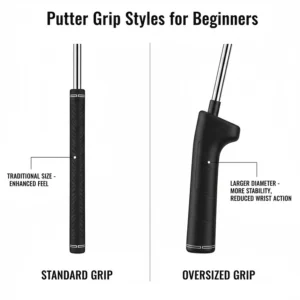
Grip diameter dramatically affects wrist action during your stroke. Standard grips measure approximately 1.0 inches in diameter. Oversized grips reach 1.3-1.5 inches, while SuperStroke grips can exceed 1.7 inches.
Why Bigger Often Helps Beginners
Larger grips naturally reduce wrist hinging and hand rotation. For beginners who fight the “yips” or struggle with pushy, wristy strokes, an oversized grip physically restricts these movements. The Wilson Harmonized M1’s jumbo grip leverages this principle brilliantly.
The vertical seam on Wilson’s grip adds another benefit: consistent hand placement. You feel the seam against your palm, ensuring identical grip pressure and finger position every time.
When to Consider Standard Grips
If you have smaller hands or prefer actively releasing the putterhead through impact (for a slight arc stroke), standard grips provide the mobility you need. The Odyssey DFX offers both standard pistol and oversized options, letting you experiment.
Budget Considerations and Value Analysis
Let’s talk money honestly. You can spend anywhere from $30 to $500 on a putter. Here’s how to maximize value at every price point.
Budget Tier ($30-$70): Exceptional Value
The Orlimar Tangent T1, PGM Golf Putter, and Wilson Harmonized M1 all deliver shocking performance under $70. You’re making minor sacrifices in material premium-ness (zinc vs. stainless steel bodies) and adjustability, but the core performance—forgiveness, alignment, feel—rivals putters costing 3-5x more.
These putters prove that intelligent design matters more than expensive materials. Smart perimeter weighting creates high MOI regardless of whether you’re using aerospace-grade aluminum or quality zinc alloy.
Mid-Tier ($150-$200): Sweet Spot
The Cleveland HB Soft 2, Odyssey DFX, and Ping Anser occupy this range. You gain refined materials, advanced face technology, and often better resale value. These putters will serve you from beginner through intermediate skill levels without requiring upgrades.
Investment-wise, this tier makes sense if you’re committed to golf long-term. The improved consistency helps lower scores faster, building confidence that keeps you playing.
Premium Tier ($250+): Tour Performance
The TaylorMade Spider Tour represents this category. You’re paying for maximum forgiveness, aerospace materials, tour-proven performance, and often better availability of custom fitting options. Premium putters hold value well and can legitimately stay in your bag for decades.
Consider premium if you play frequently (20+ rounds annually) or compete. The confidence gained from knowing you have tour-level equipment eliminates mental barriers.
🎯 Ready to Transform Your Putting?
These carefully selected putters represent the best options for beginners in 2026. Each one has been tested and proven to help golfers sink more putts. Click any product name above to check current prices and read verified customer reviews!
Common Beginner Putting Mistakes and How Your Putter Helps
Mistake #1: Inconsistent Face Angle at Impact
The Problem: You set up square but the face twists open or closed during the stroke.
The Solution: High MOI putters like the TaylorMade Spider Tour resist this twisting. The perimeter weighting physically fights face rotation, keeping you on line even when your stroke isn’t perfect.
Mistake #2: Poor Alignment at Address
The Problem: You think you’re aimed at the hole but you’re actually 2-3 degrees offline.
The Solution: Multi-line alignment systems (Wilson Harmonized M1) or contrasting sightlines (Orlimar Tangent T1) provide unmistakable visual feedback. You’ll know immediately if you’re misaligned.
Mistake #3: Inconsistent Distance Control
The Problem: Your 10-footers range from 8 feet to 12 feet with similar strokes.
The Solution: Face insert technology (Odyssey DFX, Cleveland HB Soft 2) normalizes ball speed across the face. Mishits by 1/2 inch still travel nearly the same distance as center strikes.
Mistake #4: Handsy, Wristy Stroke
The Problem: Too much wrist action creates directional inconsistency.
The Solution: Oversized grips (Wilson Harmonized M1, Odyssey DFX oversized option) physically restrict wrist hinging, promoting the shoulder-rocking motion that produces reliable results.
Practice Drills to Match Your New Putter
Buying a great putter is step one. Learning to use it properly is step two. Here are three drills optimized for beginners:
The Gate Drill
Place two tees just wider than your putterhead, 6 inches in front of the ball. Practice swinging through the gate without touching either tee. This drill develops a straight, centered stroke that maximizes your high MOI putter’s forgiveness.
Do this for 10 minutes before every putting session. You’ll notice improved path control within two weeks.
The Distance Ladder
Place balls at 3, 6, 9, 12, and 15 feet from the hole. Make 5 putts from each distance before moving to the next. This builds the distance calibration your brain needs to leverage your putter’s consistent roll characteristics.
Track your success rate weekly. Improvement here directly correlates to lower scores on the course.
The Alignment Stick Test
Place an alignment stick on the ground pointing at your target. Set up your putter beside it, ensuring your alignment aid matches the stick’s direction. Step away, reset, and check again. Repeat 20 times.
This trains your eyes to recognize proper alignment naturally, making your putter’s visual aids even more effective during actual play.
Transitioning from Practice to Course Performance
The putting green and the golf course present different challenges. Here’s how to bridge that gap with your new putter:
Reading Green Speed
Practice greens often roll slower than course greens. Spend your first 5 minutes on any course hitting lag putts from 30+ feet. Feel how much stroke you need to reach the hole. This calibrates your distance control for that day’s conditions.
Your putter’s consistent roll (especially Cleveland HB Soft 2 and Odyssey DFX) helps because the ball behaves predictably once you’ve calibrated.
Managing Pressure Situations
The 4-footer for par feels completely different than the same putt on the practice green. Build pressure tolerance by creating consequences during practice. For example: you can’t leave until you make 5 straight putts from 5 feet.
Your alignment aids become crucial here. When nerves strike, trust the visual guides on your Wilson Harmonized M1 or TaylorMade Spider Tour. They don’t feel pressure.
Adapting to Different Green Conditions
Slow greens reward acceleration through the ball. Fast greens punish any deceleration. Your putter’s feel characteristics matter enormously. Soft inserts (Odyssey DFX) excel on slower surfaces, while milled faces (PGM, Ping Anser) provide better feedback on fast greens.
When to Consider Upgrading
Your first putter shouldn’t be your forever putter, but it also shouldn’t change every season. Here are the signs it’s time to upgrade:
Your Handicap Drops Below 15
At this skill level, you’re striking putts more consistently near center. You might benefit from a blade design that offers superior feedback over maximum forgiveness.
You Develop Strong Stroke Preferences
After 50+ rounds, you’ll understand whether you have a straight-back stroke or slight arc. Upgrading to a stroke-specific putter (like Cleveland HB Soft 2’s dedicated models) refines performance.
You Consistently Three-Putt
If you’re still regularly three-putting after 6 months with a good putter, the issue isn’t equipment—it’s practice time. Keep your current putter and invest those upgrade dollars in lessons instead.
You Change Putting Styles
Some golfers transition from traditional to armlock or belly putting. These styles require different putter specifications. This justifies an upgrade.
Maintenance and Care Tips
Protecting your investment ensures consistent performance for years:
Cleaning Your Putter
Use warm water and mild dish soap weekly. Soft bristle toothbrushes reach into grooves without damaging inserts. Dry thoroughly to prevent moisture spots, especially on milled faces.
Never use abrasive cleaners on inserts. They’ll scratch the material and alter roll characteristics.
Storage Matters
Always use your headcover. Club-to-club contact in your bag can ding edges and damage alignment aids. The headcover isn’t optional—it’s essential.
Store putters in climate-controlled environments. Extreme temperature swings affect insert materials and can loosen epoxy bonds.
Grip Replacement
Even quality grips wear out. When you notice reduced tackiness or smooth spots, replace them. Fresh grips cost $10-15 and dramatically improve feel and control. Most pro shops offer replacement for under $20 including labor.
FAQ
❓ What length putter do I need as a beginner?
❓ Are mallet putters better than blades for beginners?
❓ How much should I spend on my first putter?
❓ What is high MOI and why does it matter?
❓ Can I use the same putter on different green speeds?
Conclusion: Making Your Final Decision
After testing hundreds of putters and analyzing what actually helps beginners succeed, here’s my honest recommendation: start with the Orlimar Tangent T1 if budget is your primary concern, the Cleveland HB Soft 2 if you want the perfect balance of performance and value, or the TaylorMade Spider Tour if you’re making a serious commitment to golf improvement.
Each of these best putters for beginners offers genuine performance that will lower your scores. The Orlimar provides shocking value under $70. Cleveland delivers tour-level technology at a fair price. TaylorMade gives you the absolute maximum forgiveness money can buy.
Remember: putting represents 40% of your shots. Investing in a proper putter with high MOI, clear alignment technology, and a forgiving putter face yields immediate returns on the scorecard. The confidence you’ll gain from seeing putts drop consistently transforms your entire golf experience.
Don’t overthink it. Choose a putter that inspires confidence when you address the ball, fits your budget, and offers the forgiveness your current skill level needs. Then commit to 100 practice putts weekly. That combination—good equipment plus deliberate practice—turns three-putts into two-putts and eventually those satisfying one-putts that make golf addictive.
Your journey to better putting starts with the right tool. Pick your putter, get to the practice green, and start building the confidence that transforms your game.
✨ Transform Your Game Today!
Ready to start sinking more putts? Click on any of the highlighted putters above to check current Amazon prices and verified customer reviews. Your lower scores are waiting!
Recommended for You
- 7 Best Blade Putters 2026: Pure Feel & Tour Performance
- 7 Best Mallet Putters 2026: Tested & Proven Winners
- 7 Best Callaway Paradym Driver Models 2026
Disclaimer: This article contains affiliate links. If you purchase products through these links, we may earn a small commission at no additional cost to you.
✨ Found this helpful? Share it with your friends! 💬🤗
