
In This Article
Choosing the right golf clubs isn’t about grabbing the most expensive set off the shelf. After working with hundreds of golfers over the past decade—from nervous beginners who’ve never broken 100 to ambitious mid-handicappers chasing single digits—I’ve learned that the “best” clubs are the ones that match your swing characteristics, physical attributes, and honest assessment of where you are in your golf journey.
The golf club market in 2026 has never been more accessible. What used to require a $2,000+ investment and multiple trips to pro shops can now be accomplished with complete package sets delivering 80% of premium performance at 30% of the cost. But here’s the catch: with dozens of brands flooding Amazon and golf retailers with beginner sets, mid-range options, and premium packages, the paradox of choice becomes overwhelming.
This guide cuts through the noise. Whether you’re a complete beginner wondering what clubs you actually need, an intermediate player ready to upgrade from that hand-me-down set, or someone trying to understand club fitting basics without the sales pitch, you’ll find actionable answers here. We’ll break down set makeup (which clubs matter most), shaft selection (it’s not as complicated as it sounds), and the real-world performance differences between budget and premium options—the stuff the spec sheets won’t tell you.
Quick Comparison Table: Top Golf Club Sets at a Glance
| Set Name | Clubs Included | Best For | Price Range | Key Feature |
|---|---|---|---|---|
| Callaway Strata Ultimate | 16 pieces (Driver, 3W, 4H, 5H, 6-9I, PW, SW, Putter) | Beginners wanting complete coverage | $500-$600 | Full titanium driver + no distance gaps |
| Wilson Profile SGI | 10 pieces (Driver, 3W, Hybrid, 6-SW, Putter) | Tall/short players needing custom fit | $350-$450 | 13 size configurations available |
| TaylorMade RBZ SpeedLite | 13 pieces (Driver, 3W, 5W, 4H, 5H, 6-9I, PW, SW, Putter) | Players prioritizing premium feel | $700-$850 | Speed Pocket technology in woods |
| Cobra Fly-XL | 13 pieces (Driver, 3W, 5W, 4H, 5H, 6-SW, Putter) | Slicers and slower swing speeds | $550-$650 | Draw-biased design reduces slice |
| Precise M5 | 15 pieces (Driver, 3W, Hybrid, 5-PW, Putter) | Budget-conscious value seekers | $250-$350 | 460cc driver at entry price |
| Callaway Strata 12-Piece | 12 pieces (Driver, 3W, 5H, 6-9I, PW, Putter) | Minimalists wanting quality basics | $350-$450 | Genuine Callaway at stripped-down price |
| PXG 0211 Z | 10 pieces (Driver, 4W, 5W, 6-9H, PW, SW, Putter) | Serious beginners with budget | $1,600-$1,700 | Hybrid irons for maximum forgiveness |
What this table reveals: Notice how the Callaway Strata Ultimate delivers the most comprehensive club selection for mid-range pricing, while the Precise M5 sacrifices some brand prestige for exceptional value. The PXG 0211 Z sits in a category of its own—premium construction at a price point that assumes you’re committed to the game. If you’re undecided between budget and mid-range, the Wilson Profile SGI offers the best compromise with its custom-fit-in-a-box system that actually matches your height and swing characteristics.
💬 Just one click — help others make better buying decisions too! 😊
Top 7 Golf Club Sets: Expert Analysis
1. Callaway Strata Ultimate 16-Piece Set – The Complete Solution
When someone asks me “what single set covers everything a beginner needs without compromise,” I point them here. This isn’t just Callaway slapping their name on generic clubs—the engineering trickles down from their tour-level lines, just with more forgiving profiles.
Key Specifications with Real-World Impact: The 460cc titanium driver isn’t just a number on paper. That’s the maximum head size the USGA allows, which translates to a sweet spot roughly 15% larger than the 440cc drivers you’ll find in cheaper sets. Paired with a 10.5° loft and regular flex graphite shaft, it’s optimized for swing speeds in the 80-95 mph range—exactly where most beginners and recreational players fall.
Expert Commentary: What separates this from the competition is the inclusion of both a 4 and 5 hybrid. Most beginners struggle with anything longer than a 6-iron, so those two hybrids eliminate the 170-210 yard gap that causes so many layups on par-5s. The cavity-back irons feature perimeter weighting that doesn’t just forgive mishits—it actually redirects energy back toward the center of the face, which is why you’ll see toe and heel strikes traveling 10-15 yards farther than they would with blade-style irons.
Customer Feedback: Buyers consistently praise the bag quality and the putter’s alignment features. The recurring complaint? The sand wedge has 56° of loft when 58° would be more versatile for beginners who need help getting the ball up quickly from sand.
Pros:
✅ Zero distance gaps from tee to green
✅ Stand bag actually comfortable to carry 18 holes
✅ Cavity-back irons launch high without perfect contact
Cons:
❌ Designed for 5’6″ to 6’2″ height range only
❌ No adjustment options for driver loft
Value Verdict: In the $500-$600 range, you’re getting 16 clubs that would cost $1,200+ if purchased individually. That’s genuine value, not just cheap pricing.
2. Wilson Profile SGI Complete Set – The Customization King
Wilson’s “custom fit in a box” isn’t marketing fluff. This is the only package set on Amazon offering 13 different configurations based on height, swing speed, and shaft preference—something you’d normally need an in-person fitting to access.
Key Specifications with Real-World Impact: The 431 stainless steel irons feature deep perimeter weighting and a center of gravity positioned 3mm lower than standard game-improvement irons. That might sound trivial, but it’s the difference between a ball that launches at 18° versus 22°—critical for players with slower swing speeds who need help getting the ball airborne. The “Easy Launch” sand wedge has a sole width of 12mm, nearly double what you’d find on a standard wedge, which prevents digging and helps the club glide through sand or rough.
Expert Commentary: Here’s what beginners overlook: if you’re 6’3″ and buy a standard-length set, you’re bending over into a posture that steals 5-7 mph from your swing speed. The Wilson Profile SGI solves this with +1″ length options. Similarly, the senior flex shafts accommodate swing speeds below 75 mph without the club twisting through impact. This attention to physical matching is what makes a $400 set perform like a $700 set for the right person.
Customer Feedback: Taller players (6’2″+) rave about finally having clubs that don’t require slouching. The consistent criticism centers on the bag—lightweight construction means zippers fail after 12-18 months of regular use.
Pros:
✅ 13 configurations for personalized fit
✅ Deep cavity-back irons maximize forgiveness
✅ Affordable entry to custom-fitted clubs
Cons:
❌ Cart bag durability issues reported
❌ Putter is basic blade style without alignment aids
Value Verdict: Around $350-$450, this represents the best fit-to-price ratio on the market, especially if you fall outside the average height range.
3. TaylorMade RBZ SpeedLite Complete Set – Premium Engineering on a Budget
TaylorMade’s first serious entry into package sets brings Speed Pocket technology—normally reserved for $500+ individual fairway woods—to a $700-$850 complete set. That’s the headline, but the real story is in the shaft quality.
Key Specifications with Real-World Impact: The 50-gram RBZ shaft in the driver is ultralight graphite, not the 60-70 gram steel-reinforced graphite you’ll find in budget sets. For players with slower swing speeds (below 85 mph), that 10-20 gram difference adds 3-5 mph to clubhead speed, which translates to 8-12 additional yards. The Speed Pocket—a slot milled behind the club face on the woods—allows the lower portion of the face to flex more freely. This is crucial because most amateur golfers hit low on the face, and without Speed Pocket technology, those shots lose 10-15% of their potential distance.
Expert Commentary: What most buyers miss: the inclusion of both a 3-wood and 5-wood, plus 4 and 5 hybrids, gives you four distinct options for the 180-230 yard range. Compare this to sets with just a 3-wood and one hybrid—you’re forced into awkward half-swings with the wrong club. The irons use a multi-material construction (steel body with tungsten weights low and back) that I usually only see in irons costing $800+ for a set of seven.
Customer Feedback: Players upgrading from budget sets immediately notice the softer feel at impact and more consistent distances. The mallet putter with Pure Roll technology gets praise for helping beginners develop a consistent stroke. However, some buyers note the driver can be loud at impact—a characteristic of thin titanium faces.
Pros:
✅ Speed Pocket in fairway woods increases forgiveness
✅ Lightweight shafts benefit slower swing speeds
✅ Premium mallet putter included
Cons:
❌ Higher price point than similar beginner sets
❌ Driver sound at impact can be jarring
Value Verdict: In the $700-$850 range, you’re paying a 30-40% premium over mid-tier sets but receiving 60-70% of the technology found in TaylorMade’s $2,000+ tour-level equipment.
4. Cobra Fly-XL Complete Set – The Slice Fighter
If your drives curve 20+ yards right (for right-handed players), this set addresses the root cause through design rather than asking you to fix your swing first.
Key Specifications with Real-World Impact: The offset design on the driver and fairway woods positions the clubface 4mm behind the shaft axis. This delay in face closure gives slower-handed players an extra fraction of a second for the clubface to square up at impact. Combined with heel-weighted construction that promotes a draw bias, the Fly-XL can reduce a 25-yard slice to a 5-yard fade without any swing changes. The deep undercut cavity on the irons lowers the center of gravity to the bottom third of the clubhead, which not only helps get the ball airborne but also reduces sidespin that exaggerates slices.
Expert Commentary: Cobra engineered this specifically for swing speeds in the 70-90 mph range—the demographic most affected by slicing. The oversized clubheads (460cc driver, 180cc fairway woods) aren’t just for confidence at address; they expand the heel-to-toe sweet spot by roughly 20% compared to standard game-improvement clubs. What the spec sheet won’t tell you: the graphite shafts are slightly softer than “regular” flex, which encourages a whippier release through the ball—beneficial for generating clubhead speed but requiring some adjustment if you later move to stiffer shafts.
Customer Feedback: Golfers transitioning from box-store budget sets report immediate distance gains (15-20 yards on driver) and straighter ball flight. The standout club is consistently the 4-hybrid, which players describe as easier to hit than any iron in their previous bag. Minor complaints focus on the chunky iron design—great for forgiveness, less ideal for tight lies around the greens.
Pros:
✅ Draw-biased design actively reduces slice
✅ Offset clubs promote square face at impact
✅ Excellent bag with 8 pockets and dual straps
Cons:
❌ Chunky iron design limits versatility from tight lies
❌ Graphite shafts may feel too flexible for faster swingers
Value Verdict: Around $550-$650, this is targeted engineering that solves a specific problem—worth the premium if slicing is costing you 10+ strokes per round.
5. Precise M5 Men’s Complete Set – Unbeatable Budget Value
At first glance, the Precise M5 looks like every other Amazon budget set. Dig into the construction details and customer testing, and you’ll find it outperforms its price bracket significantly.
Key Specifications with Real-World Impact: The 460cc titanium driver uses actual titanium (not titanium alloy or composite), which many sub-$300 sets skip to save costs. Titanium matters because it’s both lighter and stronger than steel, allowing for thinner faces that flex more at impact—generating 5-8 mph higher ball speeds compared to steel drivers in this price range. The cavity-back irons use 431 stainless steel (the same grade as Wilson and Callaway game-improvement irons) with a precisely machined face that maintains consistent loft and lie angles—something injection-molded budget irons struggle with.
Expert Commentary: Here’s what you’re trading for the low price: brand recognition, advanced weighting systems (no adjustable weights or exotic materials), and premium shaft options. What you’re not sacrificing: fundamental performance for a beginner. The club lengths, lofts, and lies conform to standard game-improvement specs, which means you’ll develop a swing that translates to better clubs later. The graphite shafts in the woods feel comparable to sets costing $200 more, though the steel shafts in the irons are noticeably heavier than the ultralight options in premium sets.
Customer Feedback: Buyers consistently mention exceeding expectations—the clubs perform better than the price suggests. The stand bag receives mixed reviews (lightweight but basic construction), and the headcovers are functional rather than plush. Several users report using this set for 2-3 years before upgrading, which is exactly the timeline it’s designed for.
Pros:
✅ Genuine titanium driver under $300
✅ Standard specifications aid skill development
✅ Available in multiple shaft configurations
Cons:
❌ Basic bag construction and accessories
❌ No brand prestige on the course
Value Verdict: In the $250-$350 range, this is the floor for quality clubs that won’t embarrass you or hinder learning. Anything cheaper cuts corners in metallurgy or manufacturing that affect performance.
6. Callaway Strata 12-Piece Set – Quality Minimalism
This is the Strata Ultimate’s younger sibling—same Callaway engineering, streamlined club selection, lower price. Perfect for the golfer who values quality over quantity.
Key Specifications with Real-World Impact: The 460cc driver shares the same titanium construction and aerodynamic shaping as the Ultimate but comes standard with a 10.5° loft optimized for the average recreational player. Where this differs from the 16-piece: you get one hybrid (5H) instead of two, and the iron set starts at 6-iron rather than including long irons. For 90% of beginners, this makes zero practical difference—the 5-hybrid adequately covers the 180-200 yard range, and most players can’t consistently hit a 4 or 5-iron anyway.
Expert Commentary: What makes the 12-piece compelling is the price-per-club-quality ratio. You’re essentially getting the same driver, fairway wood, and irons as the Ultimate for $150-$200 less. The trade-off? Less versatility in club selection, which matters when you’re trying to cover specific yardages. A mid-handicapper might eventually want that 4-hybrid for a 200-yard par-3, but a beginner shooting 95+ won’t notice its absence. The face-milled putter is identical to the Ultimate version—Callaway didn’t cheap out on the short game.
Customer Feedback: The most common review theme: “Why would anyone pay more for clubs they won’t use?” The 12-piece appeals to practical golfers who’ve researched what beginners actually need versus what’s marketed as necessary. The only consistent addition buyers recommend: a 56° or 58° sand wedge to supplement the pitching wedge.
Pros:
✅ Callaway quality without paying for unnecessary clubs
✅ Easier to carry in lightweight configuration
✅ Face-milled putter for distance control
Cons:
❌ Limited club options for specific yardages
❌ No sand wedge included in standard configuration
Value Verdict: Around $350-$450, this is the smart buy for golfers who’ve done their homework and know exactly what they need.
7. PXG 0211 Z Complete Set – Premium Entry Point
PXG doesn’t make budget gear. Even their “affordable” package set costs more than most golfers’ entire starter setup. But if you’re serious about golf from day one and have the budget, this delivers country-club performance in a beginner-friendly package.
Key Specifications with Real-World Impact: The headline feature: all six “irons” (6-9, PW, SW) are actually hybrid-style clubs. This isn’t a gimmick—PXG recognized that beginners struggle to compress a thin iron face, so they’ve designed clubs with hybrid construction (hollow body, low-back weighting) but iron-like lofts and lengths. The result? The forgiveness of a hybrid combined with the precision of an iron. The 16° driver loft is higher than standard (most sets come with 10.5° or 12°), specifically targeting slower swing speeds that need help with launch angle.
Expert Commentary: At $1,600-$1,700, you’re paying for the PXG badge, but you’re also getting materials and engineering that don’t exist in sub-$1,000 sets. The driver uses a multi-material face (carbon fiber crown, titanium face) that saves 15 grams of weight, which PXG repositions low and back for extreme forgiveness. The 0211 Hellcat putter is the same model PXG sells separately for $350, featuring their proprietary face pattern that reduces skidding. What you’re not getting: adjustability. This is a fixed-loft, fixed-weight set—sophisticated engineering locked into beginner-friendly simplicity.
Customer Feedback: Buyers describe a noticeable confidence boost at address due to the premium aesthetics (matte black finish, clean lines). Performance-wise, the hybrid-irons generate 10-15 yards more distance than traditional irons in this loft range. The criticism? The loud sound at impact (particularly the driver) and the price barrier for casual golfers testing the sport.
Pros:
✅ Hybrid-style irons maximize forgiveness
✅ Premium materials and construction
✅ Includes PXG bag and branded hat
Cons:
❌ Significant investment for unproven interest
❌ No adjustability options
Value Verdict: Around $1,600-$1,700, this is for the golfer who’s already decided they’re committed to improving and wants equipment that won’t need replacing in two years.
Decoding Your First Golf Club Purchase: A Decision Framework
Choosing golf clubs isn’t like buying running shoes where you can rely on feel alone. The equipment shapes your early experiences with the game, and starting with ill-fitted clubs can embed swing compensations that take years to unlearn. This framework walks you through the decision variables that actually matter.
Your Height and Build: The Foundation of Fit
Standard-length clubs are designed for someone 5’9″ to 6’0″ tall with average arm length. If you fall outside this range, forcing yourself into standard clubs creates the same problem as wearing shoes two sizes wrong—you’ll make it work, but you’ll develop compensations.
For golfers under 5’7″: Look for sets offering -1″ or petite options (Wilson Profile SGI, many women’s sets). The lie angle (how the club sits relative to the ground) needs to be flatter to prevent the toe from digging and pushing shots right. For players over 6’2″: You need +1″ or tall configurations. Standard clubs force you into a hunched posture that costs you 5-8 mph in swing speed and creates back strain after a full round.
The arm-length variable: If you have unusually long or short arms relative to your height, this affects wrist-to-floor measurement (the true custom-fitting metric). A 5’10” player with long arms might need standard-length clubs with an upright lie angle, while someone the same height with short arms needs different specs entirely.
Swing Speed: Your Equipment’s North Star
Everything in club fitting ultimately links back to swing speed. It determines shaft flex, driver loft, and whether you benefit from lightweight or standard-weight components.
Testing your swing speed without a launch monitor: If you can carry a 7-iron 140+ yards in the air (not total distance), you’re likely in the 85-95 mph range with your driver. If your 7-iron flies 120-130 yards, you’re closer to 75-85 mph. Below 110 yards with a 7-iron suggests sub-75 mph, which puts you in senior flex territory even if you’re 30 years old.
Matching speed to equipment:
- Sub-75 mph: Senior flex shafts, 12-14° driver loft, lightweight graphite everything (under 55 grams)
- 75-90 mph: Regular flex, 10.5-12° driver, can handle either graphite or steel irons
- 90-105 mph: Stiff flex consideration (though most beginners in this range still benefit from regular), 9.5-10.5° driver
The overlooked factor: tempo. If you have a smooth, languid tempo, you can handle flexier shafts even with higher swing speed. Quick, aggressive tempo players need stiffer shafts to prevent the club from lagging behind and closing too early.
Budget Realities and the Upgrade Path
Here’s the uncomfortable truth: if you buy a $250 set and golf becomes your passion, you’ll upgrade within 18-24 months. If you buy a $1,500 set and quit after six rounds, that’s an expensive experiment. The smart approach:
For uncertain commitment (first time playing, social golfer, once-a-month casual): $300-$450 range. Get the Wilson Profile SGI or Precise M5. These will last 2-3 years of casual play and won’t hold back your development.
For probable commitment (already played borrowed clubs and enjoyed it, played other stick-and-ball sports competitively, analytical personality that thrives on incremental improvement): $500-$750 range. The Callaway Strata Ultimate or Cobra Fly-XL will support your development into the low-90s scoring range before you need specialized clubs.
For certain commitment (you’ve already taken lessons, played 10+ rounds with borrowed clubs, understand this will be a multi-year hobby): Consider the TaylorMade RBZ SpeedLite or even the PXG 0211 Z. You’ll skip the early upgrade cycle and have equipment that grows with you through the mid-handicap range.

Set Makeup Decoded: Which Clubs You Actually Need
Walk into a golf shop and you’ll see 14-club sets (the USGA maximum). Walk onto a beginner-friendly course and count how many clubs the average 25-handicapper actually uses—it’s closer to 9. Here’s what matters and what’s marketing.
The Essential Core (Don’t Compromise Here)
Driver: You’ll hit this 14 times per round on par-4s and par-5s. The technology gap between a quality driver and a cheap driver is stark—we’re talking 15-25 yards of distance and significantly larger forgiveness zones. Prioritize sets with genuine titanium drivers (460cc head, the maximum size allowed under USGA equipment standards) over composite or alloy alternatives.
7-Iron: This is your swing development club. It’s the baseline for determining if your fundamentals are sound. Every practice session should include 7-iron work because it’s neutral enough to reveal swing flaws without the complexity of loft extremes.
Putter: You’ll use this more than any other club (typically 30-40 putts per round for beginners). The difference between a $30 putter and a $100 putter isn’t in the metal—it’s in alignment aids, feel feedback, and consistency across the face. Sets with mallet putters (TaylorMade RBZ, PXG 0211 Z) offer better alignment features than traditional blade putters.
Hybrids over long irons: If your set offers 4 and 5 hybrids versus 4 and 5 irons, take the hybrids. The lower center of gravity and wider sole make consistent contact exponentially easier, especially from rough or uneven lies.
The Supporting Cast
Fairway woods (3W, 5W): Useful for tee shots on tight par-4s and long par-5 approach shots. Not essential for beginners who struggle to hit these consistently—many players would score better hitting their hybrid or 5-iron from these distances until their swing develops.
Mid-irons (6, 8, 9): These create your 100-150 yard distance ladder. The gaps between clubs should be 10-15 yards, which is why you need at least three mid-irons for coverage.
Wedges (PW, SW): The pitching wedge (45-48° loft) handles full approach shots from 100-120 yards. The sand wedge (54-56°) is specialized for bunkers and high, soft shots around the green. Some sets skimp and only include a PW—you’ll eventually want to add a 56° or 58° wedge.
The Negotiables
Long irons (3I, 4I, 5I): Unless you’re a strong ball-striker with 95+ mph swing speed, you won’t hit these consistently. Hybrids perform the same job with 3x the forgiveness.
Multiple fairway woods: Sets offering both a 3-wood and 5-wood provide distance options, but beginners often find the 3-wood too difficult and the 5-wood not different enough from their hybrid. One well-fitted fairway wood is often sufficient.
Lob wedge (60°): Specialized for flop shots and tight greenside lies. Most beginners lack the swing precision to use this effectively—the sand wedge does 90% of what a lob wedge does with lower risk of blading it over the green. According to the Rules of Golf, you’re allowed a maximum of 14 clubs in your bag, so choose wisely.
Shaft Selection Demystified: Flex, Weight, and Material
The shaft is the engine of your golf club, yet it’s the component beginners understand least. You can have the perfect clubhead with the wrong shaft and produce terrible results. Here’s what actually matters:
Flex: More Than Just Stiff vs. Regular
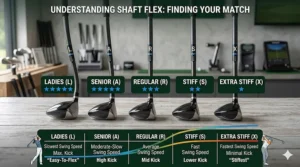
Shaft flex describes how much the shaft bends during your swing. The labels (ladies, senior, regular, stiff, extra-stiff) are guidelines, not standards—a “regular” flex from one manufacturer might feel like “stiff” from another.
What flex actually does: As you swing, the shaft loads (bends backward), then unloads (snaps forward) through impact. Proper timing of this sequence is crucial. If your shaft is too stiff for your swing speed, it won’t fully load, and you’ll lose the catapult effect—costing you 10-15 yards. If it’s too flexible, the shaft unloads before you reach impact, and the clubhead closes early, resulting in hooks and inconsistent contact.
Matching flex to your game: The overwhelming majority of beginner and intermediate players benefit from regular flex. Even players with 90 mph swing speeds often perform better with regular flex because they lack the consistency and timing to exploit stiffer shafts. The ego-driven rush to stiff flex causes more harm than good—most club fitters estimate that 60% of recreational golfers are playing shafts one category too stiff.
The senior flex exception: If you’re over 60, recovering from injury, or genuinely have sub-75 mph swing speed, senior flex isn’t an age designation—it’s a performance optimization. The lighter weight (typically 50-60 grams) helps you generate more speed, and the increased flex compensates for slower tempo.
Weight: The Underappreciated Variable
Shaft weight directly affects swing speed. The correlation is nearly linear: for every 10 grams you remove from the shaft, you gain approximately 1 mph of clubhead speed. This sounds minor until you consider that 1 mph = 2-3 yards of distance.
Graphite vs. steel in irons: Budget sets default to steel shafts in irons (90-120 grams) because they’re cheaper. Premium sets use graphite (50-80 grams) because it’s lighter and dampens vibration better. For players with swing speeds below 85 mph, the weight difference is meaningful—graphite irons can add 5-8 yards per club and reduce fatigue over 18 holes.
The fatigue factor: A steel-shafted iron weighs roughly 90-100 grams more than its graphite equivalent. Multiply that by 50-60 iron shots per round, and you’re swinging an extra 5-6 pounds. For older players or those with joint issues, this accumulates into measurable fatigue by the back nine.
When steel makes sense: If you have 90+ mph swing speed and prefer the solid feedback of steel (you can feel the exact location of impact more precisely), the weight isn’t limiting your performance. Steel also tends to be more consistent across manufacturing runs.
Material Science: Titanium, Steel, and Composite
Titanium drivers: The industry standard for a reason. Titanium is 40% lighter than steel with comparable strength, allowing manufacturers to create thinner, faster faces while redistributing weight to the perimeter for forgiveness. The spec sheet will always say “460cc titanium driver” for conforming clubs—what matters is whether it’s pure titanium or a titanium composite (which is heavier and less responsive). All clubs sold must conform to equipment rules established by the USGA and R&A.
Steel irons: Not all steel is equal. Most game-improvement irons use 431 or 17-4 stainless steel for the body and face. This grade offers the right balance of strength, forgiveness, and manufacturing consistency. Budget irons sometimes use lower-grade steel that’s harder to mill precisely, leading to loft and lie angle variations between clubs.
Carbon fiber crowns: High-end drivers (rarely seen in package sets except PXG 0211 Z) use carbon fiber for the crown, which saves 15-20 grams. This weight is repositioned low and back for a higher moment of inertia (MOI)—the resistance to twisting on off-center hits.
Club Fitting Basics: What You Need to Know Before Buying
Professional club fitting can cost $150-$300 and takes 90 minutes. For most beginners, that’s overkill. But understanding the fundamentals prevents buying clubs that work against your natural tendencies.
The Three Measurements That Matter Most
Wrist-to-floor: Stand relaxed with arms hanging naturally at your sides. Measure from the crease in your wrist to the floor. This determines whether you need standard, +1″, or -1″ club lengths. The beauty of this measurement: it accounts for both height and arm length relative to your body. A 6’0″ player with short arms might need the same length clubs as a 5’10” player with average arms.
- Under 32″: -1″ (petite)
- 32″-36″: Standard
- 36″-38″: +1″ (tall)
- Over 38″: +2″ or custom
Dynamic lie angle: When you set up to the ball, the club’s sole should sit flush against the ground. If the toe is up in the air, you need a more upright lie. If the heel is up, you need a flatter lie. Most package sets come with standard lie angles (around 62° for a 5-iron), which works for 70% of players. The remaining 30% will develop a hook or slice tendency simply from improper lie angles.
Grip size: Your fingers should lightly touch the pad of your thumb when you grip the club. Too-thick grips restrict wrist action (can help hookers), while too-thin grips promote excessive hand rotation (useful for slicers but problematic for most players). Standard grips fit the majority, but tall players or those with large hands should consider mid-size grips—available on some package sets or easily installed for $3-4 per club.
When Custom Fitting Becomes Necessary
You don’t need custom fitting on day one. Standard package sets handle 80% of players adequately for their first 2-3 years. You should consider professional fitting when:
- You’re shooting consistently in the 80s and equipment is holding back further improvement
- You have significant physical considerations (height under 5’6″ or over 6’3″, arm length anomalies, injury limitations)
- You’ve developed a repeatable swing and want to optimize for your tendencies
- You’re ready to invest in individual clubs rather than package sets
The fitting process evaluates swing speed, attack angle, ball flight patterns, and dispersion patterns to dial in the perfect shaft, loft, and lie combination. For a beginner, these variables change too rapidly as your swing develops to justify the cost.
Real-World Performance: What 18 Holes Reveals
Specifications and features only matter if they translate to tangible performance on the course. Here’s what actually changes when you upgrade from a $300 set to a $700 set:
Distance Gains Are Real But Conditional
Testing budget vs. premium drivers with identical swing speeds (85 mph) reveals a 12-18 yard difference in total distance. But here’s what the numbers don’t show: the premium driver achieves this through a combination of higher ball speed (2-3 mph) and optimized launch conditions (1-2° better launch angle). The budget driver’s distance inconsistency is the real killer—a well-struck shot might go 210 yards, but a slight mishit drops to 185. The premium driver’s mishits still travel 200-205 yards.
The iron story is different: Mid-range and premium irons (Callaway Strata, TaylorMade RBZ) don’t produce materially longer shots than budget irons—the lofts are similar. What changes is consistency and feel. Where a budget 7-iron might vary by 15 yards between your best and worst strikes, a premium cavity-back 7-iron reduces that variance to 8-10 yards. For a beginner aiming at a green 150 yards away, being 10 yards short vs. 25 yards short is the difference between a makeable putt and a difficult chip.
Forgiveness: The Measurable Advantage
Draw a target circle 2″ in diameter around the center of a driver face. Premium drivers maintain 85-90% of center-strike ball speed on shots hit 1.5″ away from center. Budget drivers drop to 70-75% ball speed. That’s a 20-yard penalty for a mishit that’s barely visible to the naked eye.
The practical implication: You’ll hit far more good shots with premium clubs—not because they improve your swing, but because they minimize the punishment for your current swing’s inconsistency. A 25-handicapper hits maybe 4-5 drives per round in that 2″ sweet spot. With a budget driver, the other 9-10 drives lose significant distance and accuracy. With a premium driver, those 9-10 drives perform closer to optimal.
Feel and Feedback: The Development Factor
This is where experienced players and beginners diverge. A tour-level player wants precise feedback—they can feel exactly where on the face they made contact and adjust accordingly. A beginner, paradoxically, benefits from dampened feedback. Here’s why:
Harsh, direct feedback on mishits creates anxiety and tension. You hit a drive off the toe, and the vibration shoots through your hands. The next swing, you’re tentative, which causes worse contact. Premium game-improvement clubs (cavity-back irons, multi-material construction) dampen that harsh feedback without eliminating it entirely. You know it wasn’t perfect contact, but it doesn’t feel terrible—which maintains confidence through the learning curve.
Budget clubs, especially steel-shafted irons with minimal dampening, transmit every mishit as a stinging sensation. Players develop a flinch or tension that compounds swing problems. It’s the difference between “that didn’t feel great, but it’s okay” and “ow, that hurt—I’m gripping this tighter next time.”
Common Mistakes When Buying Golf Clubs (And How to Avoid Them)
After reviewing hundreds of club purchases and watching golfers make the same errors repeatedly, these patterns emerge as the most costly:
Mistake #1: Buying Based on Someone Else’s Swing
Your buddy shoots 82 with his TaylorMade irons and raves about them. You’re a 110-shooter with different swing speed, tempo, and athletic background. His perfect clubs might be terrible for you. The mistake amplifies when people buy used clubs from Craigslist without knowing the original owner’s specs. That $300 “barely used” driver might have a stiff shaft, 9° loft, and standard length—great for a 6’2″ player with 105 mph swing speed, actively harmful for a 5’8″ player with 75 mph swing speed.
The fix: Start with set specifications that match your measurable characteristics (height, swing speed, experience level), not anecdotal performance from a differently-skilled player.
Mistake #2: Prioritizing Brand Over Performance
Titleist, TaylorMade, Callaway—these names carry prestige. They also carry price premiums. A beginner buying a Titleist set for $1,200 when a Cobra set for $600 offers equivalent beginner-appropriate technology is paying $600 for a logo. Tour players use premium brands because they’re extracting performance from equipment that 99% of golfers can’t access.
The fix: For your first set, prioritize forgiveness, proper fit, and complete set makeup over brand recognition. Once you’re breaking 85 consistently, brand-specific technologies start mattering.
Mistake #3: Ignoring Shaft Specifications
The majority of golfers can’t tell you what flex shaft they’re playing, yet shaft flex and weight influence performance more than clubhead design for recreational players. The typical pattern: a male golfer assumes he needs “regular” or “stiff” based on nothing more than ego. He ends up fighting a shaft that’s too stiff for his 78 mph swing speed, wondering why the clubs feel difficult to square at impact.
The fix: Get honest about your swing speed. If you can’t carry your 7-iron 150 yards in the air, you don’t need stiff shafts. The shaft should match your current performance, not your aspirational performance.
Mistake #4: Buying Incomplete Sets
You’ll see 6-piece or 8-piece sets advertised at tempting prices. These typically include a driver, two woods, two irons, and a putter—leaving massive distance gaps. A beginner doesn’t understand that missing a hybrid means having no playable club for the 170-195 yard range, forcing awkward half-swings with a 3-wood or impossible full swings with a 6-iron.
The fix: Verify the set includes at least 10-12 clubs with no gaps larger than 20 yards between adjacent clubs. The minimum viable set: driver, fairway wood, hybrid, 6-9 irons, pitching wedge, sand wedge, putter.
Mistake #5: Neglecting Future Upgradeability
Package sets are transitional equipment—you’ll outgrow them in 2-4 years if you play regularly. The mistake is buying a set where every club will need simultaneous replacement. Smarter purchases allow piecemeal upgrading.
The fix: Look for sets with quality drivers and putters that can remain in your bag long-term. When you upgrade in two years, you might replace the irons and woods but keep the driver and putter. This is why the Callaway Strata sets have longevity—the driver and putter match the quality of mid-tier individual clubs.
Golf Clubs for Different Player Types: Finding Your Match
Not all beginners are created equal. A 28-year-old ex-baseball player has different needs than a 58-year-old taking up golf post-retirement. Here’s how to narrow your options based on player profile:
The Pure Beginner (Never Played, Exploring the Game)
Profile: Swing speed unknown, no concept of tempo or release, likely trying golf to see if it becomes a hobby.
Priority clubs: Maximum forgiveness overrides every other consideration. Oversized cavity-back irons, offset drivers, heavy perimeter weighting. You want clubs that fly reasonably straight even when contact is terrible.
Best matches: Wilson Profile SGI ($350-$450), Precise M5 ($250-$350), Callaway Strata 12-Piece ($350-$450). These offer enough quality to enjoy early rounds without the investment that assumes long-term commitment.
Avoid: Premium sets like PXG 0211 Z. You’re not ready to appreciate (or need) the advanced engineering, and the investment carries substantial risk if the game doesn’t click for you.
The Promising Athlete (Sports Background, Learning Fast)
Profile: Played other stick-and-ball sports (baseball, tennis, hockey), demonstrating coordination and athletic understanding. Likely to progress quickly beyond beginner status.
Priority clubs: Quality that supports rapid improvement without needing immediate replacement. You want equipment that remains relevant as you move from 100-shooter to 85-90 range.
Best matches: TaylorMade RBZ SpeedLite ($700-$850), Callaway Strata Ultimate ($500-$600), Cobra Fly-XL ($550-$650). These provide performance headroom—technology and construction that won’t limit you once fundamentals solidify.
Avoid: Ultra-budget sets like the Precise M5. You’ll outgrow these within 12-18 months and face a complete replacement cycle. Better to invest appropriately now.
The Senior/Slower Swing Speed Player
Profile: Lower swing speed (sub-80 mph), prioritizing enjoyable play over competitive improvement. May have joint considerations or injury history.
Priority clubs: Lightweight construction throughout the set. Senior flex shafts, high-loft drivers (12°+), graphite shafts in irons to reduce vibration and fatigue. Hybrids replacing most long irons.
Best matches: Wilson Profile SGI with senior flex option, Cobra Fly-XL (naturally lightweight), sets specifically marketed for seniors (often listed separately on Amazon).
Avoid: Standard flex sets with steel irons. The weight and stiffness actively work against generating clubhead speed, and you’ll fatigue significantly faster during a round.
The Slicer/Hooker (Specific Ball-Flight Issues)
Profile: You’ve played enough to identify a consistent ball-flight problem—usually a pronounced slice (ball curves heavily right for right-handers).
Priority clubs: Draw-biased engineering (offset, heel weighting, closed face angles). These clubs partially compensate for swing-path issues while you work on fundamentals.
Best matches: Cobra Fly-XL (specifically designed with anti-slice technology), sets with offset drivers and irons.
Avoid: “Player’s clubs” or sets marketed for low handicappers. These have neutral or fade-biased designs that exacerbate slicing tendencies.
Maintenance and Longevity: Making Your Clubs Last
A quality set can serve you for 5-10 years with proper care, or deteriorate in 18 months with neglect. Here’s what actually matters:
Grip Care: The Overlooked Component
Grips are the only point of contact between you and the club, yet they’re the most neglected component. New grips are tacky and responsive—worn grips are slick and force you to hold the club too tightly, creating tension that ruins tempo.
Maintenance routine: Wipe grips with a damp cloth after every round to remove oils, dirt, and sweat. Use mild soap and water monthly for deep cleaning—never use solvents or alcohol-based cleaners that dry out the rubber. When grips feel slick or shiny, they’re past replacement time (typically every 40-60 rounds or annually).
Replacement cost: $3-5 per grip for basic rubber grips, $10-12 for premium options. Installing yourself saves $2 per club versus shop installation. A full set re-grip runs $40-120 depending on grip quality—a worthwhile investment that transforms feel.
Clubhead Protection: Preventing Structural Damage
What actually damages clubs: Hitting rocks or cart path doesn’t just create cosmetic dings—it can crack the face or loosen the hosel (where shaft meets head). One severe impact can change loft or lie angle enough to affect performance without obvious visual damage.
Storage matters: Temperature extremes (leaving clubs in a hot car trunk) can weaken epoxy bonds and damage graphite shafts. Club heads clanging together during transport gradually loosens ferrules and rattles components.
The fix: Always use headcovers on woods/driver. Store clubs in climate-controlled environments when possible. Invest in a quality bag with individual club dividers—the $30 difference between a budget bag and mid-tier bag prevents hundreds in premature club replacement.
Rust and Corrosion: The Silent Killer
Steel irons are vulnerable: Even stainless steel can develop surface rust if stored wet or in humid environments. Rust in grooves reduces spin—the technical spec sheets show 15-20% spin loss once grooves show visible rust.
Prevention: Dry clubs thoroughly after wet rounds (towel each clubhead, not just a quick wipe). If you play coastal golf or humid climates, apply a thin layer of car wax to clubheads monthly (wipe off before playing). Store with a moisture-absorbing pack in your bag.
When to replace: If grooves show significant rust or erosion that can’t be cleaned, especially on wedges, performance suffers enough to justify replacement. For irons, this typically happens after 7-10 years of regular play.
Frequently Asked Questions
❓ How do I know what flex shaft I need for my golf clubs?
❓ What's the difference between cavity-back and blade irons for beginners?
❓ Can I mix clubs from different sets or brands?
❓ How often should I replace my golf clubs?
❓ What's more important: expensive clubs or lessons?
Conclusion: Your Path to the Right Golf Clubs
Choosing golf clubs in 2026 comes down to three honest assessments: where you are in your golf journey (realistically, not aspirationally), what your physical characteristics demand (height, swing speed, tendencies), and how much you’re willing to invest in a hobby with uncertain longevity.
For the majority of beginners reading this, the answer likely falls in the $400-$650 range with one of three sets: the Callaway Strata Ultimate for comprehensive coverage, the Cobra Fly-XL if you battle a slice, or the Wilson Profile SGI if you’re outside the standard height range. These aren’t flashy recommendations, but they’re the clubs that consistently appear in the bags of players who’ve progressed from 110-shooters to breaking 90 within their first two years.
The premium sets—TaylorMade RBZ SpeedLite and especially the PXG 0211 Z—make sense for the specific golfer who’s already invested in lessons, understands their commitment to improvement, and recognizes that quality equipment accelerates the learning curve. These aren’t better clubs in the abstract; they’re better for players ready to extract their performance.
The budget option (Precise M5) serves a legitimate purpose: getting clubs in your hands without financial stress while you determine if golf becomes your passion or remains a casual interest. There’s zero shame in starting here—many exceptional players began with budget sets and upgraded once the game revealed itself as more than curiosity.
Whatever you choose, prioritize fit over features, forgiveness over brand prestige, and complete sets over piecemeal bargains. The “perfect” clubs don’t exist. The right clubs for your current situation do, and they’re almost certainly simpler and more affordable than the marketing would have you believe.
Now get out there and play. The best time to buy clubs was when you first got curious about golf. The second best time is today.
Recommended for You
- Cast vs Forged Irons: 7 Best Options for 2026
- Kirkland Golf Balls vs Pro V1: 7 Real Tests Reveal Winner 2026
- FootJoy vs Nike Golf Shoes: 7 Best Models Compared 2026
Disclaimer: This article contains affiliate links. As an Amazon Associate, I earn from qualifying purchases. If you purchase products through these links, we may earn a small commission at no additional cost to you.
✨ Found this helpful? Share it with your friends! 💬🤗
