
In This Article
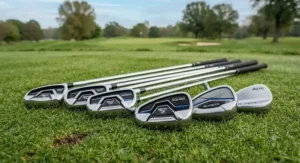
Golf has a funny way of humbling you the second you get comfortable. You strike three beautiful 7-irons in a row, feel like Rory for about four minutes, then thin the next one into a pond you didn’t even know was there. That’s exactly the itch that super game improvement max forgiveness irons are built to scratch. These clubs pack extreme perimeter weighting, wide soles, and oversized faces into a shape whose entire job description is “make bad swings look decent.” If you’re a high handicapper, a returning player, or someone who just wants more good shots per round without rebuilding your swing from scratch, this category is where 2026’s engineers have quietly done their best work. Below, I’ve researched seven real, currently available models — mixing budget, mid-range, and premium options — and broken down what the spec sheets actually mean once you’re standing over the ball on a Tuesday afternoon. What is a super game improvement max forgiveness iron? In plain terms, it’s an iron engineered with maximum moment of inertia, a low and forward center of gravity, and a wide sole so mis-hits still launch high and fly relatively straight, even on shots struck low or toward the toe.
Quick Comparison Table
| Iron | Best For | Price Range | Forgiveness Level |
|---|---|---|---|
| TaylorMade Qi Max HL | High handicappers wanting premium feel | $1,100-$1,200/set | Very High |
| Callaway Quantum Max OS | Golfers who want AI-tuned ball speed | $1,150-$1,250/set | Very High |
| Titleist T350 | Players who want max forgiveness in a sleeker head | $1,300-$1,450/set | High |
| Cobra King Max | Value-focused, faster-swinging beginners | $800-$950/set | High |
| Cleveland Launcher XL Halo | Absolute beginners, seniors, slower swings | $600-$800/set | Extreme |
| Tour Edge Hot Launch Max D | Budget buyers who still want top-tier forgiveness | $550-$700/set | Very High |
| Wilson Dynapower Max | Buyers wanting quiet feel on a budget | $650-$850/set | High |
According to Golf Digest’s Hot List testing panel, the entire super game improvement category is judged almost singularly on one mission: get the ball airborne while masking mis-hits, and every iron on this list was built with that exact brief in mind. Looking at the table, the split is clear — Cleveland Launcher XL Halo, Tour Edge Hot Launch Max D, and Wilson Dynapower Max chase maximum ease at a lower cost, while TaylorMade Qi Max HL, Callaway Quantum Max OS, and Titleist T350 layer in more refined sound, feel, and shaping options for golfers willing to pay for it. The Cobra King Max sits in the middle, offering genuinely fast ball speeds without the premium-brand price tag.
💬 Already leaning toward one? Jump to its full breakdown below and compare it side-by-side with the rest before you decide.
Top 7 Super Game Improvement Max Forgiveness Irons: Expert Analysis
Picking the right super game improvement max forgiveness irons comes down to matching the club’s design bias — launch, sound, price, or shaping — to what your actual game needs. Here’s the honest breakdown of all seven.
1. TaylorMade Qi Max HL — lightest, most forgiving high-launch build
The HL stands for “high launch,” and TaylorMade wasn’t exaggerating: this is the tallest-faced, most offset iron in the Qi lineup, purpose-built for players who struggle to get the ball off the ground. The club uses weaker lofts, a wider sole, and an ultra-lightweight component package — in graphite trims, the full set can run up to 56 grams lighter than the standard TaylorMade Qi Max, which directly translates into more clubhead speed for slower swingers. A sound stabilization bar and expanded ECHO damper material are tucked inside the head specifically to quiet the “hot” clack that hollow-body game improvement irons are notorious for. Based on the spec comparison, this is the move for golfers in the 85-95 mph swing speed range who need help launching long irons — not for faster swingers who’ll actually overshoot the intended trajectory. Reviewers on retail sites consistently describe the Qi Max HL as noticeably straighter on mis-hits compared to rival high-launch models, though a handful mention the impact sound still reads as slightly “cliquey” rather than the buttery thud of a forged players iron. That’s a fair trade for the level of forgiveness on offer here.
Pros:
- ✅ Up to 56g lighter build boosts clubhead speed for slower swings
- ✅ Sound stabilization bar meaningfully quiets hollow-body clack
- ✅ Weaker lofts and taller face genuinely rescue low, thin strikes
Cons:
- ❌ Sound still reads as sharper than premium forged competitors
- ❌ Oversized offset look may not suit golfers who prefer a compact face
The TaylorMade Qi Max HL typically runs in the $1,100-$1,200 range for a steel seven-piece set, and given the amount of genuine, measurable forgiveness engineered into the head, that price feels justified for golfers who’ve outgrown beginner sets but still need serious help.
2. Callaway Quantum Max OS — AI-optimized face for max ball speed
Callaway leaned hard into its “Next Generation AI-Optimized Face” for the Quantum Max OS, using machine-learning-shaped face contours that are supposed to match real-world impact patterns rather than a single theoretical sweet spot. Paired with a 360-degree undercut cavity and extreme perimeter weighting, the result is a genuinely oversized head engineered to flex more at impact, which in practice means faster ball speed even when you catch it low on the face. Urethane microspheres inside the cavity are Callaway’s answer to the classic “tinny” complaint lobbed at oversized irons, softening the feel toward something closer to a forged club. Here’s what to weigh: this is a confidence-first iron, with a chunky topline designed specifically to look reassuring at address for mid-to-high handicappers who get nervous over a thin blade. According to MyGolfSpy’s 2026 testing, the Quantum Max OS scored strongly across accuracy, distance, and forgiveness, though testers flagged the acoustics as a genuine point of criticism — the sound at impact wasn’t universally loved, even by golfers who liked how the club performed.
Pros:
- ✅ AI-shaped face genuinely improves ball speed on off-center strikes
- ✅ Urethane microspheres soften feel versus older oversized designs
- ✅ Oversized, confidence-inspiring look at address
Cons:
- ❌ Acoustic feedback was a repeated criticism in independent testing
- ❌ Not the ideal choice for absolute beginners per reviewer consensus
Expect to pay around $1,150-$1,250 for a steel set of the Callaway Quantum Max OS, and if raw forgiveness and ball speed matter more to you than sound, it’s one of the strongest performers in this entire roundup.
3. Titleist T350 — most compact-looking max forgiveness iron
Titleist built its reputation on sleeker, more workable irons, and the T350 is the brand’s attempt to bring that visual DNA into the super game improvement space without sacrificing the forgiveness golfers actually need. The forged L-Face design uses a multi-zone taper that increases ball speed specifically on low-face strikes — the single most common mis-hit among high handicappers — while split high-density tungsten weights sit strategically in the perimeter to maximize stability on off-center contact. What most buyers overlook about the T350 is that Titleist paired the forgiving head with its Ascending Mass shaft technology, meaning the long irons are lighter for easier launch while the short irons get progressively heavier for better control. That combination is genuinely useful and rarely discussed outside of fitting studios. On paper, this means the Titleist T350 rewards golfers who want max forgiveness but still want their bag to look like a “real” set of irons, not an oversized hybrid-adjacent club.
Pros:
- ✅ Tungsten perimeter weighting stabilizes strikes low on the face
- ✅ Ascending Mass shafts improve launch-to-control balance across the set
- ✅ More compact, premium look than most super game improvement rivals
Cons:
- ❌ Meaningfully pricier than every other iron on this list
- ❌ Less outright forgiveness than the true hybrid-style options below
At $1,300-$1,450 for a full set, the Titleist T350 is the premium pick here — worth it if you want max forgiveness that doesn’t broadcast “beginner” the moment you pull it from the bag.
4. Cobra King Max — fastest ball speed at a value price
Cobra’s King Max takes tech normally reserved for its pricier 3D-printed models and packages it into a more accessible price point. The 4-through-7 irons use a hollow body with internal foam to dampen vibration and improve feel, plus a 70-gram tungsten weight positioned low to maximize launch — a smart move for a club that also needs to stay affordable. A notably wide sole helps minimize fat shots, which, based on aggregated review sentiment, is one of the more common mis-hits among golfers who are just now stepping up from a starter set. Here’s what the spec sheet won’t tell you outright: the wide sole and hollow-body construction that make this club so forgiving on fat shots also make it a poor fit for firmer, drier turf conditions where a narrower sole would glide through more cleanly. Reviewers frequently note the King Max delivers noticeably faster ball speed than its price point suggests, which lines up with Cobra’s own internal impact-pattern testing on the face-thickness variation used across the set.
Pros:
- ✅ Genuinely fast ball speed for a sub-$1,000 iron set
- ✅ Wide sole meaningfully reduces fat-shot penalty
- ✅ Internal foam construction keeps feel softer than expected
Cons:
- ❌ Wide sole can dig or bounce awkwardly on firm, dry turf
- ❌ Less shot-shaping ability than the T350 or Qi Max HL
Priced around $800-$950 for a steel set, the Cobra King Max is the value play for golfers who want genuine speed and forgiveness without spending four figures.
5. Cleveland Launcher XL Halo — highest MOI hybrid-style iron ever built by the brand
The Launcher XL Halo isn’t really trying to be a traditional iron at all — it’s a hybrid wearing an iron’s clothing, and that’s exactly the point. Cleveland’s own data puts the 7-iron’s moment of inertia at 2,908 g-cm², the highest the company has ever produced in a hybrid-iron, achieved through a large, hollow clubhead and an AI-designed MainFrame variable face. The sole transitions from a gliderail design in the long irons to a V-shape in the short irons, which in practice means the club interacts smoothly with turf whether you’re hitting a full 6-iron or chipping a wedge from the fringe. Based on the spec comparison, this is genuinely the easiest club to launch on this entire list — but that ease comes at a cost. Reviewers at Golf Monthly noted that while the Halo is extremely playable for high handicappers, it can limit a beginner’s long-term development because it doesn’t reward — or really allow — the steeper, more compressed strike that better players eventually need to learn.
Pros:
- ✅ Highest MOI Cleveland has ever built into a hybrid-iron
- ✅ Genuinely one of the easiest clubs in golf to launch high
- ✅ Progressive sole design smooths turf interaction through the set
Cons:
- ❌ Large, hollow shape may cap shot-shaping development over time
- ❌ Least traditional-looking iron on this list at address
Running $600-$800 for a six-piece set, the Cleveland Launcher XL Halo is one of the most accessible entry points into max forgiveness golf on the market today.

6. Tour Edge Hot Launch Max D — best budget super game improvement pick
Tour Edge doesn’t get the marketing budget of the bigger brands, but the Hot Launch Max D earned real recognition in MyGolfSpy’s 2026 data-driven testing, where it was named the top super game improvement iron of the year based on a combined score across distance, accuracy, and forgiveness. The head leans into a hybrid-like profile — some testers noted it looks more like a driving iron than a traditional 7-iron — which is precisely what gives it such a low, stable center of gravity. What most buyers overlook is that a club doesn’t need flashy branding to out-perform pricier rivals on pure numbers, and that’s the story here: aggregated tester feedback described the Max D as “very consistent and balanced,” giving golfers real confidence over the ball even when the swing feels shaky. A few testers did note the visual design won’t appeal to golfers who want a traditional iron look, but nobody disputed how straight and repeatable it played.
Pros:
- ✅ Named a top super game improvement performer in 2026 independent testing
- ✅ Genuinely consistent distance and accuracy across mis-hits
- ✅ Among the most affordable full sets in this category
Cons:
- ❌ Hybrid-like head shape isn’t a traditional iron look
- ❌ Smaller aftermarket support and fitting network than major brands
At around $550-$700 for a full set, the Tour Edge Hot Launch Max D delivers a genuinely surprising amount of performance-per-dollar for beginners and budget-conscious high handicappers alike.
7. Wilson Dynapower Max — quietest impact sound in its class
Wilson’s engineering team took a specific, unglamorous problem seriously with the Dynapower Max: the harsh, tinny sound that plagues a lot of hollow-body game improvement irons. Using its first cupface construction — where the face wraps around the topline and sole — combined with added mass in the topline for stability, Wilson managed to mute unwanted vibration on strikes caught high on the face, a common mis-hit for golfers still building consistency. Weaker lofts through the set add spin to help the ball climb, which matters more than it sounds, since a flatter trajectory on mis-hits is one of the fastest ways to lose distance and accuracy at the same time. Here’s the honest take: Wilson isn’t chasing tour-level feel here, and the Dynapower Max won’t out-forgive the Cleveland Halo or out-speed the Cobra King Max, but for the price, the sound and feel improvements are a genuinely underrated selling point that doesn’t get talked about enough in this category.
Pros:
- ✅ Cupface construction noticeably quiets high-face mis-hits
- ✅ Weaker lofts help mis-hits climb rather than fly flat
- ✅ Strong value relative to the major-brand alternatives
Cons:
- ❌ Slightly behind Cobra and Cleveland on outright forgiveness numbers
- ❌ Fewer premium shaft and fitting options at retail
Expect a price range of roughly $650-$850 for a steel set, making the Wilson Dynapower Max a smart pick if quiet, controlled feel matters as much to you as raw forgiveness.
Practical Usage Guide: Getting the Most from Max Forgiveness Irons
Buying a forgiving iron is only half the equation — how you set it up and use it in your first few rounds matters just as much. Start by getting a basic lie-angle check even on off-the-rack sets; super game improvement heads are often built slightly upright at the factory, and a lie angle that’s off by even two degrees can turn a “forgiving” club into a consistent push or pull. During your first 30 days, resist the urge to swing harder just because the club feels easier to hit — the extra MOI in these heads is designed to reward a smooth, repeatable tempo, not extra effort. A common mistake is teeing the ball too low on par-3s with a 7-iron or hybrid-style club like the Cleveland Launcher XL Halo, since the wider sole wants a slightly higher approach angle than a compact blade. For maintenance, wipe grooves after every round — the deeper mid-iron grooves on clubs like the Titleist T350 lose their spin consistency faster when caked with dirt than a shallower-grooved players iron would. Finally, re-grip annually if you play more than once a week; a worn grip quietly undoes a huge chunk of the forgiveness these clubheads are built to provide.
✨ Not sure your current setup is even close to right? A quick launch-monitor session at a local fitter can confirm lie angle and shaft flex before you commit to a full set.
Real-World Scenarios: Which Player Are You?
If you’re a college student who plays twice a month on a tight budget and mostly just wants to keep the ball in play, the Tour Edge Hot Launch Max D or Wilson Dynapower Max make the most sense — both deliver real forgiveness without the four-figure price tag of the premium brands. If you’re a mid-40s golfer returning to the game after a decade away, with swing speed in the 80-90 mph range and stiffening joints making it harder to compress the ball, the Cleveland Launcher XL Halo is arguably the single easiest club on this list to get airborne consistently. If you’re a 15-handicap weekend player who’s decent off the tee but leaks strokes on approach shots and cares about how the set looks in the bag, the Titleist T350 or Callaway Quantum Max OS split the difference between forgiveness and a more grown-up appearance at address. And if you’re a faster-swinging player in the 95+ mph range who occasionally over-launches with taller-faced HL irons, the Cobra King Max offers plenty of ball speed without pushing trajectory quite as high as the TaylorMade Qi Max HL.
Problem → Solution: Common High Handicap Struggles
Most high handicappers run into the same handful of recurring issues, and specific super game improvement max forgiveness irons address each one differently. If your miss is a thin strike off the fairway, look toward irons with a lower, more forward center of gravity like the Callaway Quantum Max OS, since that design specifically boosts ball speed on low-face contact. If your miss is a fat shot that chunks turf before the ball, a wider sole like the one on the Cobra King Max or Cleveland Launcher XL Halo glides through impact rather than digging in. If you consistently struggle to get the ball airborne — especially with mid and long irons — the TaylorMade Qi Max HL‘s weaker lofts and taller face are built for exactly that problem. If harsh sound at impact is knocking your confidence (it happens more than people admit), the Wilson Dynapower Max‘s cupface construction is the quietest option here. And if your dispersion is simply too wide left-to-right, the tungsten perimeter weighting in the Titleist T350 does the most to tighten that pattern without sacrificing forgiveness.
How to Choose Super Game Improvement Max Forgiveness Irons
- Start with your typical mis-hit. A thin-strike golfer and a fat-strike golfer need genuinely different sole and face designs, not just “more forgiveness” in the abstract.
- Match loft to launch need. If you already launch the ball fine but lack distance, avoid ultra-weak-lofted HL models — they’ll fly higher than you need.
- Test the sound, not just the numbers. Launch monitor data won’t tell you if a club’s acoustic feedback is going to bother you after eighteen holes.
- Consider your realistic upgrade path. Extremely hybrid-style heads like the Cleveland Halo are easier now but may need replacing sooner as your swing improves.
- Set a real budget and stick to price ranges. Prices shift constantly, so shop by range rather than chasing an exact number you saw once online.
- Get fit for shaft weight, not just flex. A lighter shaft often adds more usable distance for slower swings than switching brands entirely.
- Weigh set makeup. Decide upfront whether you want a full iron set or a combo set blending hybrids with shorter irons for maximum forgiveness where you need it most.
Extreme Game Improvement Technology Explained
The phrase extreme game improvement technology gets thrown around a lot in marketing copy, but it typically refers to a specific cluster of engineering choices working together: perimeter weighting pushed to the physical edge of the clubhead, hollow-body or cavity-back construction that allows the face to flex more at impact, and AI-modeled face patterns tuned to real strike-location data rather than a single theoretical center. The Callaway Quantum Max OS‘s AI-optimized face and the Cleveland Launcher XL Halo‘s MainFrame variable-thickness face are both textbook examples of this approach in action. What’s genuinely new for 2026 is how much of this design work is now informed by aggregated impact data pulled from actual golfers rather than lab robots alone — companies like Ping have reportedly used data from wearable tracking systems showing high handicappers commonly need help with a draw bias, which then directly shapes where engineers place internal weighting. In plain terms, extreme game improvement technology isn’t one single feature; it’s the combined result of weight distribution, face engineering, and sole geometry all pointed at the same goal — forgiveness on shots that aren’t struck perfectly in the center.

Super Game Improvement High Handicap Guide
For golfers carrying a super game improvement high handicap situation — typically shooting in the 100s or struggling to break 90 consistently — the priority list looks different than it does for a mid-handicapper. Distance matters less than avoiding the double-digit blow-up hole, and that means forgiveness on mis-hits should outweigh shot-shaping ability every single time. Reviewers and fitters consistently point toward wider soles, taller faces, and more offset as the trio of features that most directly help this group, all three of which show up prominently on the Cleveland Launcher XL Halo and Tour Edge Hot Launch Max D. It’s also worth noting that a high handicap isn’t necessarily permanent — plenty of golfers use a genuinely max-forgiveness set for a season or two specifically to build confidence and lower scores, then transition into a more compact game improvement iron once their strike pattern tightens up. There’s no shame in that progression; it’s actually the smartest way to use this entire category.
Ultimate Forgiveness Design: What Actually Matters
When people search for ultimate forgiveness design, they’re usually picturing one dramatic feature, but real forgiveness comes from several smaller design choices stacked together. Perimeter weighting increases moment of inertia, which resists the clubhead twisting on off-center hits — that’s the single biggest factor separating a forgiving iron from a workable one. A low, forward center of gravity helps get the ball airborne without needing a steep angle of attack, which matters enormously for golfers who struggle to compress the ball. Face flex, enabled by hollow-body or undercut-cavity construction, preserves ball speed even when contact isn’t centered. And sole geometry — width, bounce, and camber — determines how forgiving the club is through actual turf interaction, not just at impact on the range mat. The Titleist T350‘s tungsten weighting and the TaylorMade Qi Max HL‘s taller face both target different pieces of this same puzzle, which is exactly why two “max forgiveness” irons can feel so different in hand.
Beginner Friendly Irons: Setting Realistic Expectations
Calling something beginner friendly irons implies a certain level of forgiveness, but it’s worth being honest about what that forgiveness can and can’t fix. These clubs will absolutely help a new golfer make more consistent contact, launch the ball higher, and avoid the worst penalty on a mis-hit — that part is well documented across independent testing. What beginner friendly irons won’t do is replace lessons, teach proper weight transfer, or fix a fundamentally flawed grip. The Cleveland Launcher XL Halo and Tour Edge Hot Launch Max D are both genuinely excellent starting points precisely because they minimize frustration during the steepest part of the learning curve, letting new players enjoy early rounds instead of getting discouraged by every mis-hit. The honest trade-off, as several reviewers have pointed out, is that extremely forgiving, hybrid-style heads can make it slightly harder to eventually learn shot-shaping — which is exactly why many instructors recommend treating a beginner-friendly set as a two-to-three-year tool rather than a permanent decision.
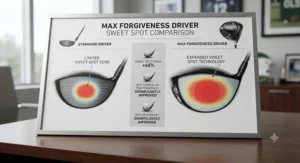
Massive Sweet Spot: The Physics Behind the Marketing
The phrase massive sweet spot gets used loosely, but it has a real engineering basis. Technically, the “sweet spot” refers to the point on the face where energy transfer to the ball is most efficient, and moment of inertia is the metric that determines how much that efficiency drops off as you move away from that point. A higher-MOI head — like the 2,908 g-cm² figure Cleveland reports for the Cleveland Launcher XL Halo‘s 7-iron — resists twisting more effectively on off-center strikes, which is what actually produces the “forgiving” feeling golfers describe as a bigger sweet spot. According to a general physics explanation of moment of inertia, resistance to rotational movement increases with mass positioned farther from the center of rotation — which is exactly why every iron in this roundup pushes weight out toward the perimeter of the head rather than concentrating it behind the center. In practical terms, a massive sweet spot doesn’t mean the club forgives every mistake equally; it means the drop-off in distance and accuracy on a mis-hit is noticeably smaller than it would be on a traditional blade or cavity-back iron.
Super Game Improvement Max Forgiveness Irons vs Traditional Alternatives
| Category | Super Game Improvement Max Forgiveness | Traditional Cavity-Back / Blade |
|---|---|---|
| Sweet Spot Size | Large, engineered via perimeter weighting | Small to moderate |
| Mis-hit Penalty | Minimal distance/accuracy loss | Significant loss on off-center hits |
| Shot Shaping | Limited | High, favored by better players |
| Best For | Beginners, high handicappers, seniors | Low handicappers, better ball-strikers |
| Typical Price Range | $550-$1,450/set | $700-$2,000+/set |
The data here isn’t close: for a golfer still building consistency, the forgiveness gap between something like the Tour Edge Hot Launch Max D and a traditional blade is enormous, especially on mis-hits struck low or toward the toe. What traditional irons offer in return is genuine shot-shaping control and — for many better players — a more satisfying, tactile feel at impact that oversized cavities can’t fully replicate. The honest takeaway is that this isn’t really a competition; it’s a matter of matching the tool to your current skill level and being willing to transition categories as your game develops.
✨ Don’t Miss These Exclusive Deals!
🔍 Take your golf game to the next level with these carefully selected super game improvement max forgiveness irons. Click on any highlighted model above to check current pricing and availability. These clubs will help you build the kind of consistent, confident rounds your scorecard has been missing!
Game Improvement Irons vs Players Irons
The gap between a super game improvement iron and a true players iron comes down to a trade-off between ease and control. Players irons, favored by low handicappers, use a compact head, minimal offset, and thinner topline — all of which allow for intentional shot shaping but punish mis-hits severely. Game improvement and super game improvement irons flip that priority entirely, sacrificing some workability in exchange for a significantly larger forgiveness window. The Callaway Quantum Max OS and Cleveland Launcher XL Halo sit at the far forgiving end of that spectrum, while something like the Titleist T350 leans slightly toward the players-iron look without giving up much forgiveness at all — which is exactly why it commands a premium price. The practical question isn’t which category is “better,” it’s which category matches how often you’re compressing the ball in the center of the face; most golfers, even mid-handicappers, are still better served by game improvement technology than they’d like to admit.
Long-Term Cost & Maintenance
Total cost of ownership on a set of super game improvement max forgiveness irons goes beyond the sticker price. Regripping every 40-60 rounds (or annually for casual players) runs roughly $60-$100 for a full set at a shop, and it meaningfully preserves the forgiveness these clubs are engineered to deliver — a worn grip forces tighter grip pressure, which reduces the face flex that’s doing so much of the forgiveness work in irons like the TaylorMade Qi Max HL. Groove maintenance is largely free but easy to neglect; dirty grooves reduce spin consistency, which matters more on the deeper-grooved mid-irons found on the Titleist T350. Budget buyers should also factor in that lower-cost sets like the Wilson Dynapower Max or Tour Edge Hot Launch Max D typically have a smaller resale market than major-brand names, so the effective cost-per-year may land closer together than the upfront price suggests. Viewed over a three-to-five-year window, the real differentiator isn’t brand prestige — it’s how well the club continues fitting your evolving swing speed and strike pattern.
Safety, Fitting, and Buying Considerations
Beyond performance, a few practical factors matter before you buy. Always confirm lie angle and shaft length fit your height and posture — an ill-fitting club, forgiving or not, can contribute to inconsistent strikes and unnecessary strain over a full round. Left-handed golfers should double-check availability early, since super game improvement models like the Cobra King Max and Wilson Dynapower Max sometimes have more limited left-handed inventory than their right-handed counterparts. If you’re buying used or from a marketplace listing, verify the shaft flex and grip size match your fitting numbers rather than assuming a standard build will work — a mismatch can quietly cancel out much of the forgiveness benefit you paid for. Finally, always check current retailer listings for availability and condition rather than relying on older reviews, since golf equipment lineups refresh annually and older models can disappear from shelves with little notice.

Frequently Asked Questions
❓ What are super game improvement max forgiveness irons?
❓ Are super game improvement irons good for beginners?
❓ How much do super game improvement irons cost?
❓ Do super game improvement irons hurt shot shaping?
❓ When should I upgrade from super game improvement irons?
Conclusion
There’s no single “best” pick among these seven — the right super game improvement max forgiveness irons depend entirely on your swing speed, budget, and how much you care about how the set looks in your bag. If raw forgiveness and price matter most, the Cleveland Launcher XL Halo and Tour Edge Hot Launch Max D are hard to beat. If you want major-brand tech and don’t mind paying for it, the TaylorMade Qi Max HL and Callaway Quantum Max OS deliver genuinely impressive engineering. And if you want forgiveness without the club looking like a hybrid, the Titleist T350 threads that needle better than anything else on this list. Whichever direction you go, remember that forgiveness is a tool for building consistency — not a permanent substitute for practice, fitting, and time on the range. Buy the club that removes the most frustration from your current game, and let your scorecard tell you when it’s time to graduate to something else.
✨ Ready to Stop Fighting Your Irons?
🚴♂️ Compare current pricing on any of these seven super game improvement max forgiveness irons above, and pick the one built around your actual miss — not just the one with the flashiest name. Your next round could be the one where the mis-hits finally stop costing you strokes!
Recommended for You
- Players Irons Forged Feel: 7 Best 2026 Pick
- Tour Players Irons Compact: 7 Best Picks for 2026 Precision
- 7 Best Offset Game Improvement Irons in 2026
Disclaimer: This article contains affiliate links. As an Amazon Associate, I earn from qualifying purchases. If you purchase products through these links, we may earn a small commission at no additional cost to you.
✨ Found this helpful? Share it with your friends! 💬🤗
