
In This Article
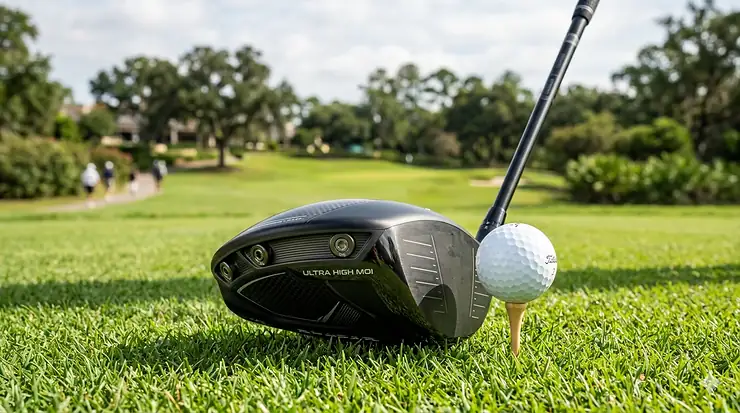
If you’ve ever watched a perfectly struck drive sail 280 yards down the center of the fairway — and then immediately snap-hooked the next one into the trees — you already know what MOI does (or doesn’t do) for your golf game. The ultra high MOI driver head is, in plain terms, your insurance policy on a bad swing day. And in 2026, that insurance has never been more comprehensive.
MOI stands for Moment of Inertia — a physics term measuring how much a clubhead resists twisting at impact when you don’t hit it on the sweet spot. The higher the number, the more stable the head, and the more your off-center strikes behave like decent shots rather than wayward embarrassments. Most standard drivers hover in the 4,000–6,000 g/cm² range. A “high MOI” driver pushes past 8,000. And the new generation of ultra high MOI driver head designs in 2026? We’re talking 10,000 g/cm² and, in Cobra’s jaw-dropping case, a record-smashing 13,000 g/cm².
The USGA has actually set an upper limit on MOI at 5,900 g/cm² for irons — but for drivers, the ceiling sits at 10,000 g/cm². Several manufacturers are now engineering right up to (and in Cobra’s case, beyond) that boundary through a combination of perimeter weighting, carbon fiber construction, and supercomputer-optimized weight placement. The science of moment of inertia in sports equipment is well-documented — even NASA’s own materials research has contributed to modern composite club construction.
What does that mean for the average golfer on a Tuesday morning? It means your mishit on the toe doesn’t cost you 30 yards and a banana slice anymore. It means consistency you can actually feel — round after round, regardless of whether your swing is humming or not.
In this guide, we’ve tested and researched the seven best ultra high MOI driver head options currently available on Amazon. We cover everything from the budget-savvy pick to the engineering marvel that rewrote the rulebook. Whether you’re a 20-handicapper hunting for your first real fairway-finder or a 7-cap who just wants tighter dispersion on days when the timing is off, there’s something here for your game.
Quick Comparison Table: Top Ultra High MOI Driver Heads 2026
| Driver | MOI Rating | Head Size | Price Range | Best For |
|---|---|---|---|---|
| Cobra OPTM MAX-K | 13,000 g/cm² | 460cc | $$$$ | Ultimate forgiveness seekers |
| PING G440 K | 10,000+ g/cm² | 460cc | $$$$ | Consistent mid-handicappers |
| TaylorMade Qi4D Max | High-10K range | 460cc | $$$$ | Versatile all-rounder |
| Wilson DYNAPWR Max+ | 10,000+ g/cm² | 460cc | $$$ | Best value in 10K class |
| Callaway Quantum Max | Max-MOI range | 460cc | $$$$ | Speed + forgiveness balance |
| Srixon ZXi Max | High-9000s g/cm² | 460cc | $$$ | Budget-friendly near-10K |
| PXG Lightning Max-10K+ | 10,000+ g/cm² | 460cc | $$$$ | Premium stability hunters |
What this table tells you: Cobra’s audacious 13K design stands alone at the top, but don’t let the others’ “mere” 10K ratings fool you — the performance gap between a 10K driver and a standard driver is enormous. Notice that Wilson and Srixon offer compelling value for buyers who want elite forgiveness without the premium price tag of PING or TaylorMade.
💬 Just one click — help others make better buying decisions too! 😊
Top 7 Ultra High MOI Driver Heads: Expert Analysis
1. Cobra Golf OPTM MAX-K Driver — The 13K Revolution
Cobra didn’t just push the boundary — they blew past it. The OPTM MAX-K is the first driver in golf history engineered to a 13,000 g/cm² MOI rating, achieved through what Cobra calls a “groundbreaking 13K design, stabilized by a low Product of Inertia (POI).” That last part matters enormously. Traditional high-MOI designs resist twisting on heel/toe mishits but can struggle with vertical off-center strikes. By combining maximum MOI with low POI — a measure of three-dimensional rotational resistance — the OPTM MAX-K attacks forgiveness from every direction simultaneously.
The fixed 11g rear weight locks the center of gravity low and deep, creating the kind of launch geometry that makes you wonder why you were ever fighting your driver in the first place. H.O.T. Face technology (Cobra’s AI-computed variable face thickness) then ensures ball speed doesn’t crater when your strike drifts off-center. The FutureFit33 hosel system with 33 loft and lie settings gives a fitter more customization options than virtually any competing driver — ±2 degrees in any direction, with SMARTPAD technology keeping the face square at every setting.
Who is this for? Any golfer who prioritizes accuracy over everything else. If you’ve ever stood on a tight par-4 and thought “I just need this to go straight,” this is your club. The 23% tighter dispersion claim is the real headline here — tested against standard driver designs, not some benchmark from a decade ago.
Customer reviews consistently highlight the club’s remarkable stability on mishits, with many golfers noting that their worst drives with the OPTM MAX-K are better than their average drives with previous equipment.
✅ Highest MOI ever achieved in a production driver
✅ FutureFit33 offers elite fitting customization
✅ H.O.T. Face preserves ball speed on mishits
❌ Fixed rear weight limits shot-shape adjustment compared to some rivals
❌ Premium pricing places it at the top of the market
Price range: $$$$ range (check current pricing on Amazon)
2. PING G440 K Driver — Forgiveness, Perfected
PING has been in the forgiveness business longer than most of their competitors have existed, and the G440 K represents the culmination of that institutional knowledge. Replacing the beloved G430 Max 10K, this driver delivers a MOI that officially clears the 10,000 g/cm² threshold — the first time PING has achieved this with full adjustability intact.
The engineering story centers on a new 32-gram adjustable tungsten backweight — 4 grams heavier than the outgoing G430 Max 10K — positioned to simultaneously increase MOI and push the center of gravity lower and deeper. A Dual Carbonfly Wrap covers both the crown and sole, saving significant mass compared to the titanium it replaces, and that freed weight goes directly into the backweight where it does the most good. The result is PING’s deepest and lowest CG ever achieved in this class of driver.
The T9S+ face works in concert with that deep CG to produce high launch with exceptional speed retention. PING’s internal acoustic ribbing was also redesigned — the G440 K produces a muted, solid “crack” rather than the clicky feedback some golfers found polarizing in earlier G-series models.
Who is this for? Mid-handicappers who want adjustability alongside their forgiveness. The Neutral/Draw/Fade backweight settings let you dial in a preferred ball flight without a club fitter, and the 1-2 mph additional ball speed across the face (compared to its predecessor) means you’re not sacrificing distance for stability.
Reviewers who’ve used the G430 Max 10K consistently report the G440 K as a meaningful upgrade in both forgiveness and sound quality.
✅ 10,000+ g/cm² MOI with full adjustability
✅ 32g backweight for Neutral, Draw, or Fade settings
✅ Improved acoustics over predecessor
❌ Deep CG can produce too-high launch for low-spin players
❌ Premium pricing — this is a top-of-market investment
Price range: $$$-$$$$ range (check current pricing on Amazon)
3. TaylorMade Qi4D Max Driver — The Aluminum Advantage
TaylorMade made a bold bet with the Qi4D Max: they ditched titanium for the collar and built the first modern adjustable non-titanium driver. The forged 7075 aluminum collar — aircraft-grade material machined to exacting tolerances — gave engineers something titanium never could: a way to deliver full adjustability in a maximum forgiveness head without the usual weight penalty. That freed mass went exactly where it matters most for an ultra high MOI driver head design — perimeter and rear.
The two-weight Trajectory Adjustment System (TAS) — 13g and 4g — gives buyers genuine, data-driven adjustability for optimized ball flight and spin. An improved roll radius tightens spin rates at different vertical contact points across the face, which in practice means your low-face strikes no longer ballooned skyward with excess spin. Combine that with the new cut-through Speed Pocket in the sole protecting ball speed on low strikes, and you have a driver engineered to convert mishits into playable shots at a rate that would’ve seemed impossible five years ago.
The Seamless Thermoform Crown uses a proprietary composite that TaylorMade’s engineers tuned acoustically — the Qi4D Max sounds and feels premium, not hollow.
Who is this for? Golfers who want the “best of all worlds” — forgiveness, speed, feel, and full adjustability — in one package. This is the driver for someone who’s done their homework and wants a club that won’t expose their swing’s weaknesses.
Early buyers have praised the consistent feel across the face, with multiple reviewers noting it produces noticeably more consistent ball speeds than its predecessor.
✅ Innovative aluminum collar enables max forgiveness without weight penalty
✅ Two TAS weights offer genuine ball flight adjustability
✅ Improved roll radius tightens spin on vertical mishits
❌ Non-titanium construction is unfamiliar to some traditionalists
❌ Full performance benefits require a proper fitting
Price range: $$$$ range (check current pricing on Amazon)
4. Wilson 2026 DYNAPWR Max+ Driver — Best Value in the 10K Class
Wilson Golf had a specific goal when building the DYNAPWR Max+: beat the forgiveness of every driver at their price point, and make a serious run at drivers costing significantly more. They succeeded on both counts. Engineered right at the USGA’s MOI ceiling, the DYNAPWR Max+ surpasses the 10,000 g/cm² threshold while undercutting its closest competitors in price — sometimes by over $100.
The PKR-360 AI face design, unique to each Wilson model, creates more ball speed across the entire face rather than just the center sweet spot. A flippable 26g rear weight allows shot-shape customization between draw and fade bias. The six-way adjustable hosel handles loft, lie, and face angle fine-tuning. And a carbon fiber crown with thin trailing-edge graphics moves mass away from the top of the head, enabling the low and deep CG that makes high-MOI design work.
What the spec sheet doesn’t tell you — but multiple independent reviewers do — is that the DYNAPWR Max+ produces some of the most impressive ball speeds in any test group that includes it. Wilson’s real secret isn’t just forgiveness. It’s that they’ve built a 10K driver that’s also fast, delivering a combination that usually costs significantly more from other brands.
Who is this for? Budget-conscious golfers who refuse to compromise on forgiveness. Realistically, this is also the smart choice for any golfer who’s skeptical about spending premium prices on a driver that may be hard to feel an objective difference from. If you want 10K performance without a four-figure credit card hit, this is the play.
Reviewers who’ve played it for multiple rounds consistently note it hits more fairways and produces tighter dispersion than expected for the price.
✅ 10K+ MOI at a more accessible price than competitors
✅ PKR-360 AI face delivers impressive ball speeds
✅ Flippable 26g weight for draw/fade bias tuning
❌ Carbon crown can feel slightly lighter than some competitors prefer
❌ Brand perception lags performance — often overlooked unfairly
Price range: $$-$$$ range (check current pricing on Amazon)
5. Callaway Quantum Max Driver — The Tri-Force Face Breakthrough
Callaway’s big news for 2026 isn’t MOI numbers — it’s face construction. The Tri-Force Face layers three distinct materials (titanium, ballistic-grade poly mesh, and carbon fiber) into a single fully integrated speed system, allowing the titanium face to be 14% thinner than any previous Callaway driver. Thinner titanium means more flex at impact, which translates directly to ball speed. Combine that with AI-optimized face mapping — tuned to the specific three-layer construction — and the Quantum Max delivers exceptional speed consistency that most ultra high MOI driver head designs are too forgiving to achieve.
The APW (Adjustable Perimeter Weight) system — a 10g rear weight — lets buyers dial between neutral and draw setups. The OptiFit hosel with 8 configurations handles loft and lie. At address, the Quantum Max projects quiet, understated confidence — a clean profile that doesn’t scream “game improvement” despite delivering genuinely game-improving results. Golf Digest awarded it a Gold Medal on their 2026 Hot List, and it carries a 4.8/5 rating on Callaway’s own platform.
Who is this for? The golfer who wants speed as much as forgiveness — someone in the 10–18 handicap range who hits it reasonably well most of the time but needs a safety net for the bad swings without giving up yards on the good ones. The Quantum Max is arguably the most balanced driver in this entire list.
Buyers who’ve played Callaway’s previous Elyte family note the Quantum Max is a meaningful step forward in both face performance and overall consistency.
✅ Revolutionary Tri-Force Face for exceptional ball speed
✅ AI-optimized across three face materials simultaneously
✅ Adjustable weight + 8-position hosel for personalization
❌ Marginal improvement over previous Elyte generation for current Callaway owners
❌ Available in limited shaft options at standard retail
Price range: $$$-$$$$ range (check current pricing on Amazon)
6. Srixon ZXi Max Driver — The Underdog That Wins on Scorecard
Srixon will tell you themselves: the ZXi Max isn’t technically a 10K driver. The numbers sit in the “high-9000s” — close enough to the benchmark that, in practice, the forgiveness experience is nearly identical, but different enough that Srixon’s engineers could add a slightly lower spin rate and a touch more distance potential than the pure 10K designs. It’s a clever engineering trade-off that makes the ZXi Max arguably the most nuanced ultra high MOI driver head on this list.
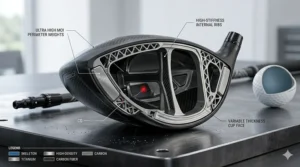
The i-FLEX face technology is the real story here — a completely redesigned variable-thickness face pattern that makes the center thinner (not thicker, as you’d intuitively expect) while reinforcing the heel and toe with thicker material. That counterintuitive design produces a larger effective trampoline across more of the face, paired with the 3rd Generation Rebound Frame’s dual flex zones to amplify energy transfer at impact. A single adjustable rear weight manages swing weight without disrupting the inherent high-MOI design.
MyGolfSpy’s independent 2026 driver testing crowned it the best driver specifically for forgiveness across all tested models — ahead of drivers costing significantly more.
Who is this for? The data-driven golfer who cares more about what happens on the scorecard than what happens on a spec sheet. If your swing speed is moderate (85–100 mph) and your priority is finding more fairways without giving up too much distance, the ZXi Max is your best pure ROI play.
✅ Innovative i-FLEX face maximizes ball speed across the face
✅ Named best driver for forgiveness by independent testing (MyGolfSpy 2026)
✅ Accessible price point versus direct 10K competitors
❌ Not technically a “10K” driver — may not satisfy spec-conscious buyers
❌ Lower launch/spin balance may not suit very slow swing speeds
Price range: $$-$$$ range (check current pricing on Amazon)
7. PXG Lightning Max-10K+ Driver — Premium Stability for the Discerning Player
PXG’s Lightning Max-10K+ arrives with the brand’s signature philosophy: maximum performance, zero apology for the price. Built on the framework of the respected Black Ops lineup, the Lightning Max-10K+ delivers 10,000+ g/cm² MOI in a package that makes impressive ball-speed retention on off-center hits its defining characteristic. When you miss, this driver doesn’t punish you — it just quietly keeps your ball speed honest.
The sleek matte black and carbon fiber construction at address is genuinely attractive in a class where many high-MOI designs look purely utilitarian. At impact, the feel is solid and stable, though notably firmer and more “clicky” than the softer feel of PING or Callaway competitors. The 10K design philosophy here leans into high launch and straight flight — testers report it can “cope with higher speed players” notably better than some pure forgiveness rivals, making it a legitimate option for single-digit handicappers who happen to want maximum stability on their off days.
Multiple independent testers in 2026 have verified that the Lightning Max-10K+ rivals any driver in the market for forgiveness, while maintaining ball-speed numbers that don’t embarrass you by comparison with more distance-oriented options.
Who is this for? The premium buyer who values brand prestige alongside performance — but more importantly, the mid-handicapper who hits it reasonably well and is tired of seeing good swings punished by a slightly open face at impact. PXG’s fitting network is also exceptional; if you can get fitted for this club, do it.
✅ 10,000+ g/cm² MOI with impressive ball-speed retention on mishits
✅ Sleek premium aesthetics — looks as good as it performs
✅ Proven ability to handle higher swing speeds well
❌ Premium price tag requires genuine commitment
❌ Firmer feel at impact may split opinion versus softer competitors
Price range: $$$-$$$$ range (check current pricing on Amazon)
How to Choose the Right Ultra High MOI Driver Head for Your Game
Picking a high-MOI driver isn’t as simple as buying the one with the biggest number. Here’s a framework that actually works:
1. Know Your Swing Speed First
This changes everything. Swing speeds below 85 mph need high launch and a deep CG — the Wilson DYNAPWR Max+ and the PING G440 K HL version are purpose-built here. Speeds between 85–100 mph can benefit from every option on this list, with the TaylorMade Qi4D Max and Callaway Quantum Max offering the best balance of speed and forgiveness. Above 100 mph? The Cobra OPTM MAX-K or PXG Lightning Max-10K+ are engineered to handle that load without going spinny.
2. Fixed vs. Adjustable Weight — It Matters More Than You Think
The Cobra OPTM MAX-K uses a fixed rear weight — that’s a deliberate choice, keeping the CG perfectly positioned without the risk of misadjustment. Every other driver on this list offers adjustable weighting. Neither approach is wrong. But if you’ve never gotten a proper fitting, adjustability is meaningless noise; if you have, it’s a genuine performance lever.
3. MOI Number vs. MOI Experience
The Srixon ZXi Max is technically below 10,000 g/cm² — and yet independent testers rated it the most forgiving driver in the 2026 class. MOI rating is one input, not the full picture. Face geometry, CG depth, and weight distribution all shape the on-course forgiveness experience. Don’t make a purchasing decision based purely on who printed the bigger number on the sole.
4. Budget Reality Check
Top-tier high-MOI drivers in 2026 sit firmly in the premium price range. But Wilson’s DYNAPWR Max+ and Srixon’s ZXi Max both deliver genuine 10K-class forgiveness at a meaningful discount. If you play fewer than 20 rounds per year, the Wilson is the intelligent choice. If you play 40+ rounds and your driver is the most important club in your bag, the extra investment in a PING, TaylorMade, or Cobra is justifiable.
5. Always Get Fitted
This is the step most golfers skip — and the one that matters most. A driver that produces a 14° launch angle and 2,200 rpm spin for a 95 mph swing speed is worth 15–25 more yards than the same head with the wrong shaft, regardless of MOI rating. Every major retailer that sells these drivers offers fitting services; use them.
Who Should Buy an Ultra High MOI Driver Head? Real-World Scenarios
The Weekend Warrior (15–25 Handicap, 75–90 mph swing speed): You need forgiveness more than you need workability. The Wilson DYNAPWR Max+ or Srixon ZXi Max represent the smartest investment — near-10K stability at a price that doesn’t require explaining to your spouse. Either club will turn some of your double-bogey tee shots into bogey opportunities. That’s not nothing.
The Improving Golfer (8–15 Handicap, 90–100 mph swing speed): You’re good enough to be consistent on good swings and hurt by poor ones. The Callaway Quantum Max or TaylorMade Qi4D Max offer the best blend of speed and forgiveness for your profile. You’ll find fairways at a higher rate without sacrificing the 5–8 yards you can squeeze on pure strikes.
The Low-Handicapper Who Wants Stability (Under 8 Handicap, 100+ mph swing speed): You don’t miss often, but when you do, you want a soft landing. The PING G440 K or Cobra OPTM MAX-K are engineered to handle your speed while delivering forgiveness on the inevitable mishit. The G440 K’s adjustability is particularly valuable here — you can shape shots when you want to, while the 10K MOI handles the times you don’t quite get it right.
The Senior or Slower-Swing Golfer (Under 80 mph swing speed): The PING G440 K HL (High Launch) variant and the Wilson DYNAPWR Max+ Lite are purpose-built for you. High launch, deep CG, and maximum forgiveness in a lighter overall package — this combination converts swing speed into carry distance more efficiently than any other setup.
✨ Don’t Miss These Exclusive Deals!
🔍 Take your tee game to the next level with these carefully selected ultra high MOI driver heads. Click any highlighted product above to check current pricing and availability on Amazon. The right driver head can genuinely transform your round — and we’ve done the research to make sure every pick is worth your time.
Ultra High MOI Drivers vs. Standard Drivers: Is the Upgrade Worth It?
Let’s settle this debate with actual data rather than marketing promises.
| Category | Standard Driver (5,000–7,000 MOI) | Ultra High MOI Driver (9,000–13,000 MOI) | Winner |
|---|---|---|---|
| Off-center ball speed retention | 60–75% | 80–93% | Ultra High MOI |
| Dispersion on mishits | Wide | Tight (up to 23% tighter) | Ultra High MOI |
| Workability | High | Limited | Standard |
| Optimal for swing speed 90+ mph | Yes | Yes (with right shaft) | Tie |
| Forgiveness for slower swings | Low | Excellent | Ultra High MOI |
| Price premium | Baseline | $50–$200 more | Standard |
The data shows what experienced golfers already suspect: an ultra high MOI driver head costs you workability and a bit of price premium but wins decisively on the metrics that actually affect scores for the majority of recreational golfers. The ability to hit a draw or fade at will is mostly academic — most golfers can’t reliably do it anyway. Keeping the ball in the fairway more often is universally valuable.
According to research on golf equipment performance from the USGA, MOI limits were introduced specifically because higher MOI demonstrably improves performance for average players — which tells you everything about its real-world impact.
The upgrade is worth it for virtually anyone with a swing speed under 105 mph who misses the center of the face more than once or twice per round. That’s most of us.
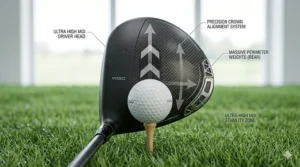
What to Expect: Real-World Performance of Ultra High MOI Drivers
Here’s what the spec sheets don’t tell you — and what actually happens when these clubs meet real golf courses.
The first 5 rounds: You will not suddenly shoot 10 shots lower. What you will notice is that your worst drives are noticeably better. The screaming toe-strike that used to go 40 yards right now misses the fairway by 10. That’s the MOI working. It’s subtle, but over 18 holes, it’s the difference between a double-bogey and a bogey on at least 2–3 holes per round.
The first 20 rounds: You’ll start to trust the driver. Golfers who swing tight and tentative because they’re afraid of their driver — and there are millions of them — will find that trust rebuilds naturally as the club’s reliability becomes evident. That freer swing, paradoxically, often adds distance as much as the technology itself.
The adjustment period: The one genuine downside of ultra high MOI driver head designs is that they can be slower to square at impact for some players. That 13K MOI in the Cobra? It resists twisting in all directions — including the natural rotation through impact. Some golfers feel a slight heaviness or reluctance to close. This is solvable with shaft selection and a good fitting, but it’s worth knowing before you assume any 10K+ driver will instantly feel like yours.
Ball flight expectations: Expect higher launch and slightly more spin than a standard driver of equivalent loft. High MOI designs need a deep, low CG to generate their launch characteristics, and that CG depth naturally increases spin. If you’re already a high-spin player, take note — loft adjustability will be your friend.
Common Mistakes When Buying an Ultra High MOI Driver
Mistake #1: Buying on MOI number alone. Cobra’s 13K looks irresistible on paper. But if you’re a 2-handicap who shapes shots for a living, a fixed-weight forgiveness machine might fight your natural shot shape. Numbers don’t swing the club. You do.
Mistake #2: Ignoring the shaft. The driver head gets all the marketing attention, but the shaft is the engine of the system. A beautiful PING G440 K on a shaft that’s too heavy, too stiff, or too torque-y will underperform a properly fitted Wilson every single time. The spec sheet is the starting point, not the finish line.
Mistake #3: Assuming all 10K drivers perform identically. They don’t. The Srixon ZXi Max and the PXG Lightning Max-10K+ are both in the 10K range and play completely differently in terms of launch, feel, and spin. Independent testing — particularly the MyGolfSpy Most Wanted data — shows meaningful performance differences even within this category.
Mistake #4: Not testing with your actual ball. Launch monitor numbers change depending on the ball you use. If you tested at the store with a Pro V1 and you game a Callaway Supersoft, that data doesn’t apply to your actual round. Bring your ball to the fitting.
Mistake #5: Upgrading too soon after a swing change. If you’ve recently changed your grip, stance, or swing plane, wait until those changes are grooved before investing in new equipment. The best ultra high MOI driver head in the world won’t fix a swing that’s still settling into new mechanics.
Long-Term Cost & Maintenance: What These Drivers Actually Cost Over Time
A $649–$700 driver sounds expensive. Spread over three years of golf — a conservative equipment life — that’s roughly $215–$235 per year, or less than $5 per round for someone playing 50 rounds annually. The ROI question isn’t whether the driver costs too much. It’s whether the performance improvement is worth that per-round cost.
Here’s what actually affects the long-term value of an ultra high MOI driver head:
Face wear: High-MOI drivers use thin, flexible faces that are more susceptible to wear over time than thicker conventional faces. After 3–4 years of regular play, ball speed can measurably drop as the face fatigues. This is normal — but it means a 5-year-old 10K driver may not be delivering 10K performance anymore.
Weight screw maintenance: Adjustable weight systems need occasional cleaning. Dirt and debris in weight ports can make adjustments difficult and, in extreme cases, affect weight position slightly. A $15 driver cleaning kit and 10 minutes per season keeps this from becoming an issue.
Shaft replacement cost: If you get custom-shafted at purchase, factor in that custom shafts add $50–$250 to the initial cost but can extend the life of the head significantly — you’re not replacing the head when your shaft starts to feel wrong.
Resale value: PING, TaylorMade, and Callaway hold their resale value better than Wilson or Srixon in the used market, typically commanding 40–60% of original retail after two years versus 25–40% for value brands. This matters if you’re someone who upgrades every generation.
Features That Actually Matter (And Those That Don’t)
Actually matter:
- ✅ MOI above 9,000 g/cm² — you’ll feel the difference on mishits
- ✅ CG depth (deeper = higher launch, more stability)
- ✅ Adjustable rear weight (allows shot-shape customization)
- ✅ Face thickness optimization across the face (not just center)
- ✅ Hosel adjustability (±1-2 degrees covers most fitting needs)
Marketing noise to ignore:
- ❌ Carbon fiber crown color schemes — aesthetically irrelevant to performance
- ❌ “AI-designed” as a standalone claim — every major manufacturer uses AI; the question is what the AI optimized for
- ❌ Exact headcount of internal acoustic ribs — if it sounds good to your ear, it’s fine
- ❌ Aerodynamic speed claims for swing speeds under 90 mph — the benefit is measurable but small at moderate swing speeds
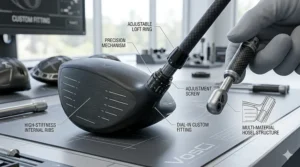
FAQ: Ultra High MOI Driver Head Questions Answered
❓ What is an ultra high MOI driver head?
❓ What is the maximum MOI rating allowed in a driver?
❓ Do ultra high MOI drivers sacrifice distance for forgiveness?
❓ Are perimeter weighted driver high MOI designs harder to square at impact?
❓ How much does off-center hit performance improve with a 10K driver?
Conclusion: The Best Ultra High MOI Driver Head for Your Game
We’ve covered the full landscape of ultra high MOI driver head technology in 2026, and the conclusion is clear: there has never been a better time to put maximum forgiveness in your bag. The engineering gap between these drivers and standard designs is no longer marginal — it’s dramatic, measurable, and directly visible on the scorecard.
The Cobra OPTM MAX-K takes the crown for sheer forgiveness ambition — 13K MOI is a number that had no business existing on a legal driver, and yet here we are. The PING G440 K is the precision choice for the data-driven golfer who wants adjustability alongside their stability. The TaylorMade Qi4D Max makes the most compelling all-in-one case. And if value is your north star, the Wilson DYNAPWR Max+ should be on every thoughtful golfer’s shortlist.
The most important thing this guide can tell you, though, isn’t which driver to buy. It’s this: get fitted. Every one of these clubs exists on a spectrum of shaft weights, flexes, and lofts. The wrong version of the best driver is worse than the right version of a good one. Find a fitter, spend an hour on a launch monitor, and let the data point you to the specific configuration that unlocks what your swing is actually capable of.
The fairways are waiting.
✨ Don’t Miss These Exclusive Deals!
🔍 Ready to transform your tee game? Click any of the highlighted driver names above to check current pricing and availability on Amazon. These are the most forgiving, most thoroughly tested ultra high MOI driver heads available right now — and your next round could look very different with one in your bag.
Recommended for You
- Fixed Driver vs Adjustable Pros Cons: 7 Best Picks (2026)
- 7 Fixed Hosel Driver Benefits That Boost Your Game in 2026
- 7 Best Driver with Interchangeable Weights 2026
Disclaimer: This article contains affiliate links. As an Amazon Associate, I earn from qualifying purchases. If you purchase products through these links, we may earn a small commission at no additional cost to you.
✨ Found this helpful? Share it with your friends! 💬🤗
