
In This Article
You’ve done it. We’ve all done it. You stand over a drive on a tight par-4, try to steer it, and catch one off the heel. The club twists in your hands like a wet towel, the ball dribbles 200 yards into the rough, and your playing partners shoot each other that sympathetic glance. It’s a demoralizing sequence. And here’s what makes it worse — it’s completely avoidable with the right equipment.

That’s where a high MOI driver off center hits technology rewrites the entire equation.
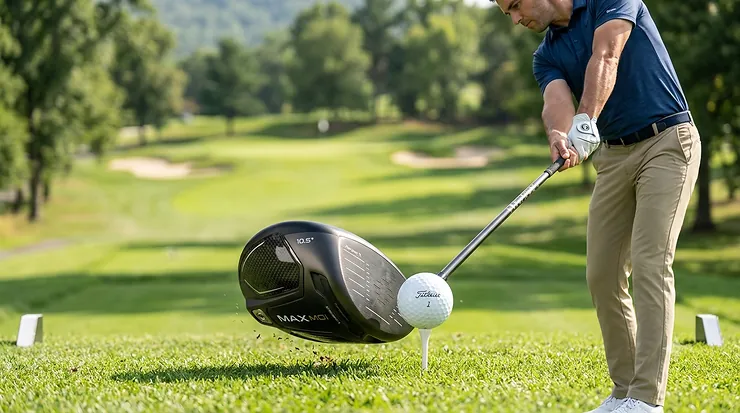
MOI — moment of inertia — is the physics term for how resistant a rotating object is to changing its spin axis. Applied to a driver head, it describes how much the face resists twisting when you catch it heel, toe, high, or low. Higher MOI means the face stays squarer longer through impact, which translates directly to straighter ball flight and better ball speed preservation on those inevitable off-center strikes. According to the USGA Equipment Standards, the legal maximum for a single axis is 5,900 g·cm², but modern engineering now pushes combined MOI — measuring both heel-to-toe and face-to-back — past the 10,000 g·cm² threshold.
What does that mean in your hands? A heel strike that used to fly into the right rough now stays in play. A thin contact that used to balloon and fall short now carries 15 yards farther. For the golfer averaging 80-85 strokes per round, a forgiving driver high moment inertia design doesn’t just save the occasional bad shot — it recalibrates what a “bad shot” even is.
This guide identifies the 7 best high MOI driver off center hits options currently available on Amazon in 2026, ranked by real-world forgiveness, sweet spot expansion, and practical value. We’ve dug into independent testing data, launch monitor numbers, and genuine user feedback to separate the science from the marketing copy.
Quick Comparison Table: 7 Best High MOI Drivers at a Glance
| Driver | MOI Level | Price Range | Best For |
|---|---|---|---|
| Ping G430 MAX 10K | 10,000+ g·cm² combined | $350–$450 | Pure max forgiveness + value |
| TaylorMade Qi4D Max | 10K-class, adjustable CG | $500–$600 | Spin control + forgiveness blend |
| Callaway Quantum Max D | High, draw-biased | $400–$550 | Slice correction + heel forgiveness |
| Ping G440 Max | Very high (deepest CG ever) | $500–$600 | Speed + forgiveness balance |
| Cobra DS-Adapt MAX-K | 10,000 g·cm² combined | $500–$600 | Max adjustability + 10K MOI |
| Wilson 2026 DYNAPWR Max+ | ~10K g·cm² combined | $300–$400 | Best budget 10K-class driver |
| Mizuno JPX One | Elite tier, feel-focused | $400–$500 | Premium feel + serious forgiveness |
The table tells a clean story. The Ping G430 MAX 10K and Wilson DYNAPWR Max+ are the clear calls for buyers who want documented 10K forgiveness without paying a premium for adjustability features they may never use. TaylorMade and Cobra reward golfers who need the ability to tune CG position as their game evolves. The Callaway Quantum Max D stands alone if your primary miss is a slice — it’s the only driver here that actively corrects heel strikes rather than simply forgiving them.
💬 Just one click — help others make better buying decisions too!😊
Top 7 High MOI Drivers for Off Center Hits — Expert Analysis
1. Ping G430 MAX 10K Driver
The Ping G430 MAX 10K is the benchmark. Every other driver on this list is measured against it in some way, and that’s not accidental — it was the driver that redefined what consumers expected from a forgiving driver high moment inertia design when it launched, and in 2026 the falling price makes it one of the most compelling purchases in golf.
The 10,000 g·cm² combined MOI was achieved through three deliberate engineering decisions: a fixed rear backweight (every gram committed to MOI, none sacrificed for adjustability), a massive Carbonfly Wrap carbon crown that saves weight from the top of the head, and the largest head profile in the G430 lineup. That fixed backweight is the key detail most buyers overlook. Brands that offer adjustable rear weights always trade some MOI for the ability to move. Ping said no to that deal, and the consistency data vindicates the call.
On-course, the G430 MAX 10K launches high with relatively low spin — a combination that produces carry distance even on slight miss-hits. MyGolfSpy’s independent testing ranked it second overall in 2025, with testers specifically calling out its composure on low-face and toe strikes. That’s the exact miss pattern that destroys round scores for 10-20 handicappers.
This is the driver for the golfer who wants maximum heel toe forgiveness without fuss. No weight ports to fiddle with. No settings to overthink on the first tee. Just pick it up and trust it.
Pros:
✅ Documented 10,000+ combined MOI — the originator of the benchmark
✅ Outstanding ball speed retention on toe and heel misses
✅ Excellent value as newer models push prices into the $350–$450 range
❌ Fixed backweight means no shot-shape adjustment
❌ Large head profile may feel imposing for players transitioning from compact designs
Price range: around $350–$450 | Best-in-class forgiveness per dollar spent.

2. TaylorMade Qi4D Max Driver
TaylorMade built the Qi4D Max around a single fascinating engineering insight: titanium doesn’t have to be the answer. This is the brand’s first modern, adjustable max-forgiveness driver built with a forged 7075 aluminum collar — not titanium — and that material switch is the reason it can deliver both elite MOI numbers and genuine CG tunability in the same package.
Aluminum, when properly engineered, allows for more aggressive collar geometry. Engineers freed up discretionary mass and pushed it deep into the rear of the head, then kept the Trajectory Adjustment System (TAS) by using two interchangeable weights: 13g and 4g. Shift the heavier weight to the back for maximum forgiveness and higher launch. Move it forward for lower spin and more distance. That’s a meaningful choice for golfers whose swing speeds or ball-flight tendencies shift between seasons or swing changes.
The new roll radius design — tuned specifically on the Qi4D Max — tightens spin rates at different vertical contact points. Translation: when you catch it slightly high or slightly low on the face, the MOI keeps the club face square while the roll radius prevents the erratic spin spikes that typically cost you distance and accuracy. It’s a two-system approach to off-center performance that no other driver in this lineup offers.
Best for: Mid-handicappers who spin too much with traditional high-MOI designs, or anyone who values CG tunability.
Pros:
✅ Two-weight TAS system enables real CG adjustment for different ball flights
✅ Improved roll radius controls spin vertically, not just heel-to-toe
✅ Non-titanium collar enables MOI performance without sacrificing adjustability
❌ Higher price tier for the engineering complexity involved
❌ Impact feel differs from traditional titanium — some traditionalists notice it
Price range: $500–$600 | Premium forgiveness with genuine shot-shaping capability.
3. Callaway Quantum Max D Driver
The Callaway Quantum Max D driver was built for one golfer type: the person whose natural miss is a slice, who dreads tight left-to-right fairways, and who has tried every tip in the book without lasting improvement. Callaway’s answer isn’t to give you more forgiveness on your slice — it’s to load the driver’s center of gravity toward the heel so that off-center contact actively promotes a draw rather than amplifying a fade.
The headline technology is the Tri-Force Face: a three-layer composite of ultra-thin high-strength titanium, Poly Mesh, and Carbon Fiber that creates what Callaway calls a “fully integrated speed system.” The practical benefit is face flex that extends far beyond the center of the face — into the heel and toe zones where recreational golfers actually tend to strike the ball. Ai-optimized face mapping tuned each zone individually using real impact pattern data from a library of player swings. The result in testing: consistently fast ball speeds even on contact patterns that would have been near-disasters in older driver technology.
Testing for 2026 showed the Quantum Max D producing its most impressive forgiveness on heel strikes specifically — exactly the contact pattern most associated with over-the-top, slicer swings. If you’ve ever been told you hit it off the heel, this driver corrects both the direction problem (draw bias) and the distance problem (Tri-Force Face speed) simultaneously.
Best for: Chronic slicers, high handicappers, and players who consistently miss right with their driver.
Pros:
✅ Draw-bias weighting corrects heel strikes rather than just forgiving them
✅ Tri-Force Face preserves ball speed even at perimeter impact zones
✅ AI face mapping tuned to real player impact patterns
❌ Unsuitable for players whose miss is already a hook or pull
❌ Limited neutral-bias adjustment if your ball flight is genuinely inconsistent
Price range: $400–$550 | The most targeted forgiveness solution for slicers.
4. Ping G440 Max Driver
If the G430 MAX 10K is the legend, the Ping G440 Max is the heir that quietly does more — it just doesn’t shout about it. Ping achieved this upgrade through Free-Hosel Technology, which strips weight from a section of the hosel entirely and redistributes it lower into the head. The result is the deepest CG in any Ping driver to date, sitting closer to the face’s force line for faster ball speed, better spin optimization, and a notably higher launch trajectory.
The G440 Max’s face is simultaneously thinner and hotter than its predecessor. Ping also extended the standard shaft length to 46 inches — a quarter-inch longer than the G430 was configured — and that’s a bigger deal than it sounds. Every additional half-inch of shaft length generates roughly 1-2 mph of potential clubhead speed at impact. When your driver is already giving you maximum MOI working against twisting on mishits, those additional miles-per-hour compound into real, measurable distance gains on every shot in the bag, not just the center strikes.
The three-position adjustable backweight gives draw, neutral, and fade options that the G430 10K simply never offered. That’s a meaningful addition for players who’ve graduated from pure forgiveness and want some shot-shape control without sacrificing the stability Ping is legendary for.
Best for: Golfers ready to step up from the G430 who want the full Ping forgiveness package plus tangible ball speed improvement.
Pros:
✅ Deepest CG in Ping history for better spin characteristics and launch
✅ 46-inch standard shaft creates additional swing speed potential
✅ Three-position adjustable backweight offers shot-shaping flexibility
❌ Peak combined MOI is slightly below the dedicated G430 MAX 10K
❌ The lightweight, clicky impact sensation isn’t for everyone
Price range: $500–$600 | The most complete forgiveness-plus-speed package Ping has ever built.
5. Cobra DS-Adapt MAX-K Driver
The Cobra DS-Adapt MAX-K is what happens when the engineers decide that 10,000 MOI and 33-way adjustability should both exist in the same driver. Every other 10K driver on this list sacrifices something to hit that MOI number. Cobra said — no, actually, let’s keep the most comprehensive hosel adjustability system in golf and still hit 10K. They pulled it off.
FutureFit33 allows independent adjustment of both loft and lie by ±2° in either direction — 33 unique settings in total. The SMARTPAD technology ensures the face angle stays square regardless of which setting you’ve chosen, which means you can optimize your ball flight without accidentally opening or closing the face. This level of tunability is what fitting sessions at a premium brand cart are designed around. Having it built into the driver means you can refine on your own, without booking a studio appointment every time your swing changes.
On MOI, the MAX-K achieves the full 10,000 g·cm² combined at 9° and 10.5° through a combination of an external fixed rear weight and an internal rear weight pad, pushing the CG as low and far back as physics allows. The H.O.T. Face (Highly Optimized Topology) insert is larger here than on other Cobra drivers, improving face flex across a wider zone. Golf Sidekick reviewers noted near-center contact “feels almost like a center strike” — and in MyGolfSpy’s high-swing-speed category, the DS-Adapt MAX-K actually led the distance rankings. Maximum MOI rarely pairs with maximum distance. Here it does.
Best for: Golfers who want the ultimate high-MOI driver for consistency with professional-grade fitting flexibility built in.
Pros:
✅ FutureFit33 delivers 33 independent loft and lie settings
✅ Full 10,000 MOI at 9° and 10.5° lofts
✅ Led distance testing in high-swing-speed category
❌ 12° loft drops to 9,800 MOI (still elite, but not the headline number)
❌ Premium price point reflects the advanced engineering involved
Price range: $500–$600 | Maximum adjustability meets maximum MOI in one club.

6. Wilson 2026 DYNAPWR Max+ Driver
Let’s be direct: the Wilson 2026 DYNAPWR Max+ is the driver that makes every golfer who’s been putting off the switch to a high MOI design because of price completely run out of excuses. Wilson built this to genuinely compete with the Ping G430 MAX 10K on forgiveness metrics at a price point roughly $100–$150 lower. And from what independent testing shows, they got very, very close.
The 26g flippable rear weight is the engineering detail that makes this driver stand out at its price tier. Flip it one orientation for a draw-bias setup; flip it to the other for a neutral flight. That’s not a gimmick — that’s the kind of practical adjustability brands typically charge a premium for. Optimized bulge and roll refinements tighten spin consistency on off-center hits, and dispersion data shows meaningfully tighter patterns on heel and toe strikes versus the previous DYNAPWR generation.
What the spec sheet can’t capture: the DYNAPWR Max+ sounds and feels significantly better than its price suggests. It’s not the premium crack of a Ping or Cobra, but it’s far removed from the hollow, plasticky feel that used to define budget drivers. Golfers on a strict budget no longer have to accept second-tier forgiveness. The gap has legitimately closed.
Best for: Budget-conscious golfers, seniors on fixed incomes, beginners, and anyone who wants 10K-class twist resistance impact performance without the premium price.
Pros:
✅ ~10K MOI performance at the lowest price point on this list
✅ 26g flippable weight for easy draw/neutral adjustment
✅ Meaningfully improved spin consistency over previous DYNAPWR models
❌ Build quality and impact feel don’t match premium-tier drivers
❌ Fewer shaft and specification options than established premium brands
Price range: $300–$400 | The value champion of the high MOI driver for consistency category.
7. Mizuno JPX One Driver
Every driver on this list has led with numbers: MOI ratings, ball speed data, dispersion charts. The Mizuno JPX One earns its place here by asking a different question. What if forgiveness also felt genuinely good?
Mizuno spent decades perfecting the sensory experience of their metalwoods, and the JPX One carries that DNA into the high-MOI category. The head profile is large and confidence-inspiring at address — one of those setups where you look down and the anxiety just… dissipates. The ball flight is straight and penetrating rather than balloony, which matters enormously for golfers in windier climates or who play links-style courses where high-spinning drives become liabilities. Mizuno’s characteristic “solid but responsive” impact sensation is present and accounted for, a world away from the muted or clicky experiences offered by some competitors in this category.
In 2026 testing, the JPX One earned one of the highest forgiveness rankings evaluated, with reviewers specifically praising its performance and feel package together. It’s not the absolute highest-MOI driver on this list. But for the feel-obsessed golfer — and those golfers absolutely exist and should not be embarrassed about it — the Mizuno delivers a quality of experience that no other max-forgiveness design can quite match at this price.
Best for: Feel-focused mid-handicappers, golfers transitioning from muscleback irons who want feedback, and players who simply value the sensory dimension of a driver.
Pros:
✅ Premium impact feel and sound quality — best in the high-MOI category
✅ Confidence-inspiring head profile that builds trust at address
✅ Elite-tier forgiveness with exceptional ball flight characteristics
❌ Not the absolute peak MOI number relative to Ping or Cobra’s 10K offerings
❌ Mizuno’s smaller retail footprint means fewer fitting center options
Price range: $400–$500 | The feel golfer’s choice in the forgiving driver category.
How High MOI Driver Off Center Hits Technology Actually Works — A Usage Guide
Understanding the physics turns you into a smarter buyer and a more confident player. Here’s what actually happens when you make off-center contact, and why it matters for every driver you’ll ever buy.
The twisting problem. When a driver face makes contact away from the center of gravity — which is essentially every shot that isn’t perfectly centered — angular momentum is created. The face wants to rotate open on toe strikes and closed on heel strikes. Standard drivers with moderate MOI fight this rotation but ultimately lose, which is why you feel that familiar twist in your hands and watch the ball curve off target.
How high MOI corrects it. Moment of inertia, in physical terms, is a body’s resistance to angular acceleration. A higher MOI means the head requires more force to twist — so the same off-center hit that would have rotated a standard driver face 3–4° might only rotate a 10K driver face 1–2°. That seemingly small difference produces a dramatically different ball flight: the face stays squarer, loft is preserved, ball speed is maintained, and the shot ends up in play rather than in trouble.
What this means practically. Before buying, understand where you typically miss. Pure heel/toe mis-hitters get maximum benefit from the highest combined MOI numbers (Ping G430 10K, Cobra MAX-K, Wilson DYNAPWR Max+). Golfers who also miss vertically — catching it high or low on the face — benefit more from models with improved roll radius design, like the TaylorMade Qi4D Max, which addresses that vertical axis specifically.
Optimization tip after purchase. Once you’ve got a high MOI driver in your hands, resist the temptation to overswing. The biggest squandering of MOI technology is trying to hit the ball too hard. Smooth, tempo-controlled swings keep contact more consistently centered, and a centered strike on a 10K driver is genuinely elite-level distance. Let the technology amplify your good contact; don’t force it to save your worst contact.
Which Golfer Profile Are You? Matching Forgiveness to Real-World Needs
Not every high MOI driver off center hits scenario is the same. Here’s how three realistic player profiles map to specific drivers on this list:
The Struggling Weekend Warrior (15–25 handicap). You play once a week, miss the sweet spot often, and lose 20–30 yards on your bad drives. The ball typically goes right. Budget is real. For you, the Wilson 2026 DYNAPWR Max+ is the honest call — ~10K MOI without the $600 price tag. If budget allows, the Callaway Quantum Max D adds draw-bias technology that actively fights your slice pattern rather than just surviving it.
The Improving Golfer (8–15 handicap). You’ve got the fundamentals, but consistency off the tee is still the gap between you and breaking 80 regularly. You want forgiveness, but you also don’t want a club that’s so bias-heavy it limits your shot repertoire. The Ping G440 Max or TaylorMade Qi4D Max are your drivers — both deliver elite MOI with enough CG tunability to grow with your improving game.
The Experienced Player Who Hates Ugly Misses (5–10 handicap, moderate swing speed). You hit it fairly well most of the time, but your bad misses are more costly because you play tighter courses and tighter lies. You also care about how a driver feels. The Mizuno JPX One or Cobra DS-Adapt MAX-K deserve serious consideration. Both deliver elite forgiveness. The Mizuno wins on feel. The Cobra wins on adjustability.
The Senior Golfer (any handicap, slower swing speed). Swing speed is declining and you need every yard. The most stable driver head design for slower speeds is the one that also has the lightest stock shaft and longest standard length. The Ping G440 Max with its 46-inch shaft and ALTA CB Blue gets the nod here, with the Wilson DYNAPWR Max+ as the budget alternative that loses very little in forgiveness performance.
✨ Don’t Miss These Exclusive Deals!
🔍 Take your game to the next level with these carefully selected high MOI drivers. Click on any highlighted product to check current pricing and availability on Amazon. These clubs will genuinely change how you experience driving — fewer punishing misses, more fairways, lower scores.

The Problem → Solution Guide: Diagnosing Your Tee Box Disaster
Most off-center hit problems aren’t random — they follow patterns. Here’s how to match your specific miss type to the right technology fix:
Problem: Ball consistently goes right (slice/fade). Your heel is likely making first contact or your face is open at impact. Solution: Callaway Quantum Max D, specifically. The draw-bias heel weighting corrects this structurally. If budget is a constraint, the Wilson DYNAPWR Max+ with the weight in draw position is the next best call.
Problem: Occasional big miss in either direction, no consistent pattern. You’re making inconsistent contact — sometimes heel, sometimes toe, sometimes center. This is the purest case for maximum combined MOI. The Ping G430 MAX 10K’s fixed backweight and massive MOI number gives you the widest net. When you can’t predict where you’ll catch it, you need the driver that forgives everything equally.
Problem: Solid contact, but losing distance on drives that feel “pure.” You’re possibly making off-center contact higher or lower on the face than you realize — vertical mis-hits are less visible but equally damaging to distance. The TaylorMade Qi4D Max addresses this specifically with its improved roll radius tuning. A fitting session on a launch monitor will confirm it; look for whether your carry distance drops on shots hit above or below your average strike height.
Problem: Good drives feel great, but bad drives feel catastrophic. The gap between your best drives and worst drives is too wide. This typically points to a standard-MOI driver that rewards good contact perfectly but has no cushion for error. Any driver on this list will compress that gap — but for the fastest improvement, get fit for the Cobra DS-Adapt MAX-K, where you can dial in both loft and lie specifically to your swing path and attack angle.
How to Choose the Right High MOI Driver for Consistency
Shopping for a high MOI driver for consistency sounds straightforward until you realize every brand claims theirs is “the most forgiving.” Here’s a practical framework for cutting through the noise:
Step 1: Start with your swing speed. Swing speeds below 85 mph benefit from higher-launch, lighter-shaft configurations. The Wilson DYNAPWR Max+ and Ping G440 Max (with its 46-inch shaft) are engineered for this. Speeds above 100 mph can extract more from the Cobra DS-Adapt MAX-K’s speed-focused head design.
Step 2: Identify your primary miss direction. Consistent right-miss: prioritize draw-bias tech (Callaway Quantum Max D). Inconsistent misses: prioritize raw MOI (Ping G430 MAX 10K or Cobra MAX-K). No strong miss direction: any driver on this list will serve you, so let budget and feel preferences decide.
Step 3: Decide whether adjustability matters to your game. If your swing is still actively changing (you’re taking lessons, improving rapidly), a TAS-weighted or FutureFit33-equipped driver gives you the ability to tune as your ball flight evolves. If your swing is stable and you just want forgiveness, skip adjustability and put that money toward pure MOI.
Step 4: Test on a launch monitor, not just on the range. According to Golf Digest’s 2026 Hot List testing methodology, feel and perceived distance often mislead buyers. A launch monitor reveals actual ball speed, spin rate, and dispersion — the real numbers that determine how well a driver performs for your swing specifically.
Step 5: Factor in total cost of ownership. A $600 driver that genuinely saves you four strokes per round by keeping more balls in play is a better investment than a $300 driver that only saves you two. Do the math against your expected round frequency and what each saved stroke is worth to your game satisfaction.

Features That Actually Matter (And Those That Don’t)
Matters a lot: Combined MOI number (10K is the current benchmark for serious forgiveness), CG position relative to your swing speed, face thickness and material, standard shaft length and weight, and adjustability range if your game is still developing.
Matters somewhat: Head size and shape (larger = higher MOI but some players dislike the look), sound at impact (pure preference, but affects confidence), and finish quality (affects long-term durability).
Largely marketing noise: “AI-designed” as a standalone claim without explaining what the AI actually optimized — every brand uses computational modeling now. “Longest driver ever” claims without independent test data to back them up. Specific color schemes and limited editions that command price premiums with no performance benefit.
The key question to ask about any feature: does it change the numbers on a launch monitor? If yes, it matters. If the only evidence is a lifestyle photo and a marketing paragraph, it doesn’t.
Long-Term Value: Is a Premium High MOI Driver Worth the Investment?
A $550 driver is a lot of money. Let’s do the math honestly.
If you play 30 rounds per year and hit 14 drives per round, that’s 420 drives annually. If a high MOI driver for consistency keeps just 8 additional drives per round in the fairway versus your current equipment — a conservative estimate based on dispersion data — you’re gaining roughly 240 more fairways hit per year. Each fairway hit, at a typical mid-handicap level, saves approximately 0.3 strokes compared to driving into rough or trees. That’s 72 strokes saved over a season, which is the difference between being a 14-handicap and being a 9-handicap on some scorecards.
Divided over 3 years of use, a $550 driver costs $183 per year, or about $6 per round. The performance return — more fairways, lower scores, more enjoyment — far exceeds that cost for any golfer who plays regularly. Compare this to the typical approach of buying a new driver every year chasing distance gains that rarely materialize: you’d be far better served by investing once in a genuinely high-MOI design and keeping it for 3–4 years.
One practical note on maintenance: high MOI drivers require no special care beyond standard driver upkeep. Keep the face clean (dirt in the grooves affects spin; use a tee to clear any debris), replace the grip every 1–2 seasons, and avoid letting the headcover trap moisture. A quality driver kept clean and stored properly should deliver consistent performance for 5+ years. The technology doesn’t degrade — it’s physics, not chemistry.
High MOI Driver vs Standard Driver: What the Real Data Actually Shows
The “just hit it better” crowd will tell you that a forgiving driver is a crutch. The data disagrees, and it disagrees loudly.
In MyGolfSpy’s 2025 driver testing across more than 400,000 data points, the gap in total distance between the best-performing and worst-performing drivers on center strikes was roughly 10–12 yards. On off-center strikes — the kind that happen on a significant percentage of real-world drives — that gap expanded to 25–30 yards and dispersion increased dramatically in standard-MOI drivers. On 10K MOI designs, the off-center performance gap shrank to nearly match center-strike performance. That’s the real story: high MOI technology doesn’t just marginally improve bad shots. It fundamentally compresses the performance variance between your best and worst drives.
A standard driver penalizes toe strikes with 15–20 yards of distance loss and significant rightward curve. A 10K MOI driver reduces that penalty to 8–10 yards with minimal curve — the difference between being in the rough versus the fairway, or in the fairway versus on the green. For context, the average recreational golfer hits fewer than 45% of fairways in regulation. That means more than half of all drives are already playing from disadvantaged positions. High MOI doesn’t just save your score on individual holes — it structurally improves your entire scoring model by putting more balls in favorable positions.
Sweet Spot Expansion vs Twist Resistance: Understanding the Difference
These two terms get used interchangeably in golf marketing copy, but they describe related-but-distinct phenomena — and understanding the distinction makes you a sharper buyer.
Sweet spot expansion refers to engineering the face so that the area of peak performance extends farther from the geometric center. This is achieved primarily through variable face thickness — thicker sections in less-responsive zones, thinner sections at the perimeter — so that face flex is more uniform across a wider area. Callaway’s Tri-Force Face and TaylorMade’s improved roll radius address sweet spot expansion directly.
Twist resistance (what MOI specifically measures) is about the head’s rotational stability. Even with a perfectly uniform face, if the head rotates open on toe contact, the effective loft and face angle change at impact, compromising your shot regardless of ball speed. High MOI eliminates or reduces this rotation. That’s why the Ping G430 MAX 10K, which achieves 10,000 g·cm² through pure mass distribution engineering, delivers such consistent off-center results — the face doesn’t get the chance to twist away from target.
The best high MOI driver off center hits designs now address both simultaneously. The TaylorMade Qi4D Max’s roll radius tuning targets sweet spot expansion; its high combined MOI addresses twist resistance. The Callaway Quantum Max D’s Tri-Force Face expands the responsive zone; its draw-bias weighting adds a directional correction layer on top. Knowing which problem your current driver fails you on most — face flex at the edges, or head rotation — helps you choose the right solution.
Common Mistakes When Buying a Forgiving Driver High Moment Inertia
Buying the wrong max-forgiveness driver is remarkably common, and the errors tend to cluster around a few recurring patterns:
Buying on feel alone. Impact feel is deeply seductive — we all want a driver that sounds and feels incredible. But feel is not forgiveness. Some of the least forgiving drivers in independent testing have the best feel profiles. Always verify with data before making the decision.
Ignoring shaft specs. The most forgiving driver head in the world loses a significant percentage of its benefit when paired with the wrong shaft. A shaft that’s too stiff reduces launch angle and increases spin for slower swingers; too light and you lose accuracy. At minimum, get the stock shaft fitted to your tempo and swing speed.
Assuming all “10K MOI” claims are equal. The 10K benchmark has become marketing shorthand, and not every brand measures it the same way. Combined MOI (both axes) is meaningfully different from single-axis MOI. Look for independent testing data from sources like MyGolfSpy or Golf Digest’s Hot List rather than relying solely on brand materials.
Buying last year’s model without checking why. The price drops on prior-year models are genuinely attractive — the Ping G430 MAX 10K at $350–$450 is exceptional value. But make sure the prior-year model was actually good, not just older. Read the independent reviews before buying on price alone.
High MOI Drivers for Seniors and Slower Swing Speed Players
Slower swing speeds interact with high MOI technology differently than faster swings, and this is one of the most underappreciated distinctions in equipment advice.
At swing speeds below 85 mph, the priority shifts from pure MOI number to launch optimization. A driver can have a 10,000 g·cm² combined MOI but if it’s tuned for low spin — which suits faster swingers — a slower swinger will lose carry distance badly because the ball doesn’t stay in the air long enough. The sweet spot expansion and twist resistance impact benefits of 10K MOI still apply, but they need to be paired with the right launch characteristics.
For seniors, the Ping G440 Max earns top marks because the 46-inch standard shaft (with a lightweight ALTA CB Blue 50g stock shaft) actively boosts swing speed potential. The TaylorMade Qi4D Max Lite variant (also available on Amazon) takes a different approach — a non-titanium head that’s lighter overall, letting slower swingers move it faster while keeping MOI benefits. The Wilson DYNAPWR Max+ also comes in a Lite configuration specifically designed for players who need an easier-to-swing head weight.
The bottom line for seniors: prioritize shaft weight and length alongside MOI number. A 50g shaft in a 46-inch driver generating 1-2 extra mph of clubhead speed will outperform a 70g shaft in a technically higher-MOI driver, because ball speed is the ultimate determinant of distance — and you need the speed first for the MOI to be useful.

FAQ About High MOI Drivers for Off Center Hits
❓ What is a high MOI driver off center hits and why does it matter?
❓ What is the most stable driver head design for reducing off-center losses?
❓ Does a forgiving driver high moment inertia really help with a slice?
❓ Is heel toe forgiveness more important than vertical forgiveness?
❓ How much twist resistance impact difference does 10K MOI make versus a standard driver?
Conclusion: The Science Is Clear — Your Mis-Hits Don’t Have to Hurt Like They Do
Here’s the fundamental truth that justifies every word in this guide: golf is hard. Hitting the exact center of a driver face traveling at 90–100 mph with a clubhead the size of a small fist while trying to reproduce a consistent swing plane is genuinely difficult. The best players in the world don’t always find the sweet spot. What they have — and what you deserve access to — is equipment engineered to make those inevitable off-center strikes survivable.
A high MOI driver off center hits solution doesn’t make you a better swinger. It makes your bad swings less costly. That’s not a small thing. That’s the difference between a 15-handicap round and a 12-handicap round. It’s the difference between feeling helpless on a tight driving hole and feeling like you have a weapon in your hands.
The Ping G430 MAX 10K remains the standard-bearer for pure forgiveness value, especially now that prices have softened. The TaylorMade Qi4D Max is the premium choice for players who need both forgiveness and CG flexibility. The Callaway Quantum Max D is the targeted solution for slicers. The Wilson DYNAPWR Max+ is the honest value play. And the Mizuno JPX One is the driver you buy when forgiveness and feel need to coexist in the same club.
Whatever you choose from this list: stop underestimating how much the right equipment matters. Your scorecard will tell you the difference after just a few rounds.
✨ Ready to Stop Punishing Yourself for Every Off-Center Hit?
🔍 Check current pricing and availability on any of the 7 drivers above by clicking their highlighted names. Every Amazon listing is updated in real time — these clubs are in stock now and ready to transform your tee game.
Recommended for You
- 7 Best Ultra High MOI Driver Heads for Forgiveness in 2026
- Fixed Driver vs Adjustable Pros Cons: 7 Best Picks (2026)
- 7 Fixed Hosel Driver Benefits That Boost Your Game in 2026
Disclaimer: This article contains affiliate links. As an Amazon Associate, I earn from qualifying purchases. If you purchase products through these links, we may earn a small commission at no additional cost to you.
✨ Found this helpful? Share it with your friends! 💬🤗
