
In This Article
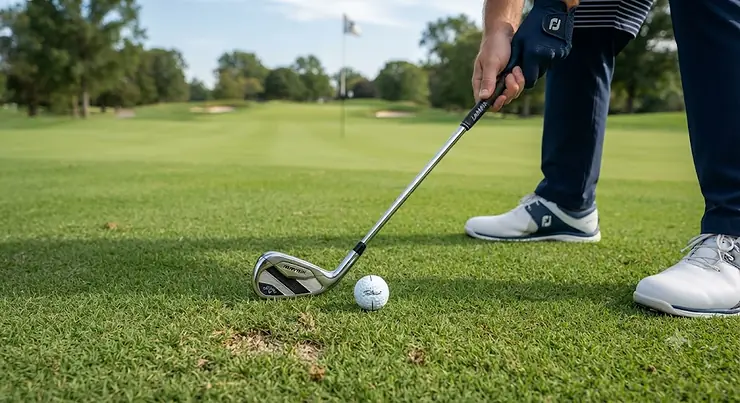
Here’s a confession every mid-handicapper has made at least once: you stood on the tee, made a swing that felt perfectly fine, and watched the ball start left before curving so far right it nearly landed in the neighboring fairway. If that sounds familiar, offset game improvement irons were basically invented for you. They’re not a gimmick and they’re not a shortcut around practice — they’re a legitimate piece of engineering that buys your hands a few extra milliseconds to square the clubface before impact.

That small delay is the whole story. A touch more offset moves the leading edge of the clubhead slightly behind the shaft’s hosel, which gives golfers with an open face at impact a fighting chance at a square strike instead of a glancing, sidespin-loaded one. Combine that with the wider soles, lower centers of gravity, and forgiving faces that define this category, and you get a set of clubs built to turn “playable” into “actually enjoyable.” In this guide, we researched real 2026 offset game improvement irons, compared their specs and aggregated review sentiment, and broke down exactly who should buy which model — no fluff, no fabricated hands-on stories, just honest analysis you can use before you swipe your card.
Quick Comparison Table
| Category | Model | Best For |
|---|---|---|
| Best Overall | TaylorMade Qi Max HL | Golfers who want max forgiveness with genuine tour-adjacent tech |
| Best for a Severe Slice | Tour Edge Exotics X725 | Players who consistently miss right and need heavy correction |
| Best Budget Pick | Wilson Dynapower Max | Cost-conscious buyers who still want a wide, forgiving sole |
| Best Feel & Sound | Mizuno JPX 925 Hot Metal | Golfers who care about acoustics as much as forgiveness |
| Best Premium Distance | PXG 0311 XP GEN8 | Players who want max forgiveness without sacrificing shelf appeal |
Looking at this table, the pattern that jumps out is that price doesn’t map neatly to forgiveness — the Tour Edge Exotics X725 is one of the most slice-fighting sets on this list and it’s also among the least expensive. Meanwhile, the PXG 0311 XP GEN8 proves that a premium price tag can still deliver serious forgiveness if you’re willing to pay for the fit-and-finish. If your priority is simply “stop slicing and start scoring,” don’t assume the priciest set is automatically the most forgiving one.
💬 Just one click — help others make better buying decisions too!😊
Top 7 Offset Game Improvement Irons: Expert Analysis
Choosing from a crowded field of offset game improvement irons means weighing forgiveness, distance, feel, and price against your own swing tendencies. We researched budget, mid-range, and premium sets — plus a few lesser-known alternatives — so you can see where each one actually earns its keep.
1. TaylorMade Qi Max HL — highest launch in the TaylorMade lineup
The Qi Max HL leans into its “High Launch” name by pairing weaker lofts with more offset than the standard Qi Max, specifically to help slower or steeper swingers get the ball airborne without effort. Specs-wise, offset tapers from roughly 5.8mm in the 4-iron down to 2.9mm in the pitching wedge, and the set uses FLTD CG positioning along with a Speed Pocket in the longer irons to keep ball speed high even on strikes caught low on the face. That combination matters in practice: TaylorMade’s own face-flex testing found up to a 30% reduction in side spin on off-center hits, which is exactly the kind of number that should matter to a golfer chasing straighter, more predictable ball flight.
Based on the spec comparison with its siblings in this list, the TaylorMade Qi Max HL is best suited to golfers with swing speeds in the 85-95 mph range who want forgiveness without looking like they gave up on the game entirely. Reviewers consistently report exceptional feel for a cast iron and genuinely high, soft-landing trajectories, though several also note that the loft gapping between the stronger long irons and weaker short irons can leave awkward yardage gaps if you don’t get properly fit.
Pros:
- ✅ Face tech measurably cuts side spin on mishits
- ✅ Easy, high launch even on shallow strikes
- ✅ Surprisingly soft, premium feel for a cast iron
Cons:
- ❌ Loft gapping can create yardage overlaps
- ❌ Aesthetics lean chunky compared to sleeker rivals
Set pricing runs in the $1,000-$1,200 range for a steel 7-piece configuration (check current price for graphite upcharges), and given the forgiveness-per-dollar on offer here, that’s a fair value verdict for a mid-to-high handicapper.
2. Callaway Elyte X — most offset in the Elyte family for max confidence
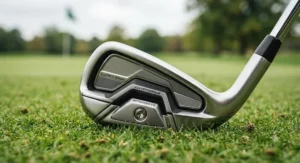
Callaway’s Elyte X sits at the forgiveness-first end of the four-model Elyte lineup, built with an oversized profile, a thicker topline, and noticeably more offset than the standard Elyte iron. The Ai10x face — with ten times the control points of the previous Ai Smart Face — is designed to keep ball speed consistent even when contact strays toward the heel or toe, while the Tri Sole design and urethane microsphere fill work together to soften the sound at impact. In practical terms, that extra offset and sole width translate to a wider forgiveness window than you’d get from Callaway’s more compact GI models.
What most buyers overlook about this model is that the extra offset isn’t just cosmetic reassurance — it’s genuinely shifting where the CG sits relative to the face, which is what helps square a slicing swing path. Reviewers consistently describe the Elyte X as long and easy to launch, calling out the improved sound and feel over Callaway’s previous Paradym and Ai Smoke generations, while a common critique in aggregated feedback is that the head size can look a little large to golfers coming from more compact irons.
Pros:
- ✅ Oversized profile adds real forgiveness margin
- ✅ Ai10x face keeps ball speed consistent off-center
- ✅ Noticeably improved sound versus prior generations
Cons:
- ❌ Head size may look bulky to some eyes
- ❌ Strong lofts can create distance-gapping issues
Expect to pay in the $900-$1,100 range for a steel 7-piece set at the time of research, which puts it squarely mid-pack for a name-brand offset game improvement iron with this level of tech packed in.
3. Mizuno JPX 925 Hot Metal — best sound and feel in this category
Mizuno’s reputation for feel didn’t happen by accident, and the JPX 925 Hot Metal continues that streak while still qualifying as a genuine offset game improvement iron. The standard Hot Metal head carries more offset and a wider sole than its Pro sibling, plus a 30% thinner Contour Ellipse Face designed to preserve ball speed across a larger hitting area. Add tungsten weighting positioned low in the 4-7 irons and Mizuno’s Acoustic Sound Ribs, and you get a set engineered to launch high while still sounding — and feeling — like a Mizuno.
Here’s what to weigh if you’re torn between this and the Hot Metal Pro: the standard model’s extra offset and wider sole genuinely help golfers who need turf-interaction forgiveness on mishits, while the Pro trades that help for a more compact, better-player look. Reviewers consistently note the Hot Metal’s sound and feel as best-in-class for a cast game improvement iron, though a handful of aggregated critiques mention the visual styling — particularly the contrasting face panel — as a step down from the previous 923 generation.
Pros:
- ✅ Industry-leading sound and feel for a cast iron
- ✅ Wide sole aids turf interaction on fat strikes
- ✅ Strong ball speed retention across the face
Cons:
- ❌ Styling divides opinion versus the prior generation
- ❌ Less workable than the Hot Metal Pro model
Pricing sits around the mid-$1,000s for a steel 7-piece set (roughly $150 per club at the time of research), putting it in direct competition with the Callaway Elyte X on price while offering a distinctly different feel profile.
4. PXG 0311 XP GEN8 — largest head and most offset in the PXG lineup
PXG built its reputation on premium materials and custom fitting, and the 0311 XP GEN8 is the most forgiving expression of that philosophy — the largest head, the thickest topline, and the most offset of the three GEN8 models. Under the hood, a Dual Perimeter Weighting System shifts roughly 11 grams of mass to the perimeter for a genuine MOI increase over the previous generation, while QuantumCOR polymer and an ultra-thin maraging steel face work together to maximize ball speed and soften feel. On paper, this means a golfer who mishits toward the heel or toe should see far less distance and directional penalty than with a smaller-headed iron.
Based on the spec comparison against the P and T models in the same family, the XP is clearly the pick for mid-to-high handicappers, while lower-handicap players are steered toward the more compact siblings. Aggregated testing from independent equipment reviewers has found the 0311 XP GEN8 to be among the longest options in its category — nearly two yards ahead of the next closest competitor in one widely cited test — though the same testing also flagged accuracy dispersion as a relative weak point without a proper custom fitting.
Pros:
- ✅ Dual Perimeter Weighting meaningfully boosts MOI
- ✅ Longest carry distance among tested competitors
- ✅ Premium forged feel despite the larger head
Cons:
- ❌ Off-the-rack accuracy trails the distance numbers
- ❌ Custom fitting adds cost and complexity
Because every PXG iron is custom-built, exact set pricing varies by shaft and configuration, but expect a steel 7-piece build to land in a premium range well above the mass-market names on this list — call it the top end of the market, and budget accordingly.
5. Cleveland Halo XL Full-Face — most hybrid-like profile for max forgiveness
If you want the visual reassurance of a hybrid without actually carrying hybrids in every slot of your bag, the Halo XL Full-Face is built for exactly that mindset. Full-face grooves extend the hitting area all the way into the high toe and low heel, paired with Cleveland’s MainFrame Face technology and a three-part sole system — a Glide Rail in the long irons, a V-shaped sole through the middle irons, and a three-tiered sole in the wedges — all designed to keep the club from digging regardless of attack angle. The extra offset baked into this hybrid-style shape is there specifically to frame the ball and delay face rotation for slicers.
Reviewers consistently note that this is among the easiest irons to launch high on the market, with independent testing on a launch monitor finding above-average spin and strong carry numbers even on strikes that weren’t perfectly centered. What most buyers overlook is that the unconventional look is doing real functional work — golfers in their 60s and 70s with reduced swing speed have specifically praised how forgiving mishits feel compared to more traditional-looking game improvement irons, even if the matte-black cavity design isn’t going to win any beauty contests.
Pros:
- ✅ Full-face grooves widen the effective hitting area
- ✅ Three-sole system adapts to different attack angles
- ✅ Exceptionally easy to launch for slower swings
Cons:
- ❌ Unconventional hybrid-style looks won’t suit traditionalists
- ❌ Less workable than a standard-profile iron
A steel 7-piece set (4-PW plus SW) runs around $899.99, with graphite bumping that to roughly $999.99 — a genuinely reasonable price range for the forgiveness on offer here.
6. Tour Edge Exotics X725 — most slice-fighting offset in this lineup
Tour Edge markets the X725 as an “ironwood” design, and the label fits: this is the shallowest-faced, most offset-heavy set in our lineup, engineered specifically around the idea that fat strikes, right misses, and low ball flight are the three most common problems recreational golfers face. A 3D Diamond variable-thickness face adds insurance on mishits, while the CG sits lower and deeper than in Tour Edge’s own E725 model, and the topline runs 2-3mm thicker with 1-2mm more offset than that sibling to further inspire confidence at address.
The spec sheet won’t tell you this, but user reports suggest the internal weighting also promotes a gentle draw bias — useful if your natural shot shape has been fighting you toward the right side of the fairway for years. Reviewers consistently describe the X725 as delivering high launch, high spin, and remarkable consistency, explicitly recommending it for recreational players over better-ball-strikers or anyone with tour-level swing speed, since the shallow face and heavy offset trade away workability entirely in exchange for forgiveness.
Pros:
- ✅ Most aggressive offset for serious slice-fighters
- ✅ Shallow face design helps get the ball airborne
- ✅ Strong value relative to forgiveness delivered
Cons:
- ❌ Unconventional “ironwood” looks aren’t for traditionalists
- ❌ Too much draw bias for players who already hook it
At around $779.99 for a steel 5-PW set — and roughly $115 per club individually — the X725 is one of the more affordable ways to get serious slice correction offset in a name-brand iron.
7. Wilson Dynapower Max — widest sole and most affordable option here
Wilson doesn’t get the marketing budget of the bigger brands, but the Dynapower Max quietly delivers one of the widest soles and most forgiving profiles in this entire roundup, at a price point that undercuts nearly everything else on this list. A wide sole and significantly weaker lofts than the standard Dynapower iron help get the ball flying higher for slower swingers, while a supportive rear frame and an internal channel behind the face allow it to flex for extra ball speed on off-center strikes. The added offset is more pronounced here than on some rivals, which independent testers have flagged both as a pro (extra slice insurance) and a con (some golfers find it visually distracting).
Reviewers consistently note tight, consistent dispersion as this iron’s calling card — testers found it kept returning to the “same window” shot after shot, which is a meaningfully different kind of forgiveness than pure distance. Based on the spec comparison with pricier alternatives here, this is the one to consider if your swing speed has dropped with age or you’re simply not ready to spend four figures to find out whether offset irons work for your game.
Pros:
- ✅ Widest sole in this lineup for turf forgiveness
- ✅ Tight shot dispersion in independent testing
- ✅ Most affordable entry point on this list
Cons:
- ❌ Thick topline and offset look pronounced at address
- ❌ Resale value trails the bigger equipment brands
Full sets have historically landed in the $600-$800 range for steel shafts, making this the clear budget champion among real, current offset game improvement irons.
Top 7 Offset Game Improvement Irons Compared
| Model | Offset Level | Price Range (Steel, 7-pc) | Best For |
|---|---|---|---|
| TaylorMade Qi Max HL | High | $1,000-$1,200 | All-around forgiveness with feel |
| Callaway Elyte X | High | $900-$1,100 | Confidence-inspiring, easy launch |
| Mizuno JPX 925 Hot Metal | Moderate-High | ~$1,000-$1,150 | Sound and feel purists |
| PXG 0311 XP GEN8 | Highest in family | Premium (custom-fit) | Distance plus premium finish |
| Cleveland Halo XL Full-Face | Very High | $899-$999 | Max forgiveness, hybrid-style |
| Tour Edge Exotics X725 | Highest overall | $779.99 (5-PW) | Severe slice correction on a budget |
| Wilson Dynapower Max | High | $600-$800 | Budget-conscious wide-sole buyers |
Scanning this table, the value story is clear: the Tour Edge Exotics X725 and Wilson Dynapower Max both deliver aggressive offset at prices well under the premium brands, while the PXG 0311 XP GEN8 justifies its cost with materials and fitting precision rather than raw forgiveness alone. If budget is your main constraint, start with the bottom two rows before working your way up.
✨ Don’t Miss These Exclusive Deals!
🔍 Take your short game — and your scorecard — to the next level with these carefully selected offset game improvement irons. Click on any highlighted model to check current pricing and availability. These sets will help you build the straighter, more confident ball flight your foursome will actually notice!
Setting Up Your Offset Irons for Success
Buying the right head is only half the job — how you set these irons up in the first 30 days determines whether you actually see the forgiveness they’re capable of. Start with a lie-angle check before you ever hit a shot in anger: offset irons with a thicker topline and wider sole are more sensitive to lie than compact blades, and a lie angle that’s even 2 degrees off can turn a well-struck shot into a push or a pull that mimics the very slice you bought these clubs to fix.
Once you’re on the course, resist the urge to overswing just because the head looks like it can take a beating. Game improvement heads are forgiving on strike location, not on tempo — a rushed transition will still open the face regardless of how much offset is built in. For maintenance, groove cleaning matters more here than on a blade, since full-face and wide-groove designs like the Cleveland Halo XL Full-Face lose spin consistency fastest when dirt packs into the channels; a soft brush after every round is enough to keep that from happening. Finally, don’t chase a stiffer shaft than your swing speed calls for just because it “feels more premium” — a shaft that’s too stiff kills the very launch and forgiveness these offset designs are built to deliver.
Real-World Scenarios: Which Offset Iron Fits Your Game
If you’re a 22-handicap golfer playing twice a month with a swing speed hovering around 80 mph and a slice that’s cost you the same three strokes a round for years, the Wilson Dynapower Max or Tour Edge Exotics X725 make the most sense — both are priced to let you test whether offset irons straighter shots actually happen for your swing before you commit serious money to the category.
If you’re a returning golfer in your 60s who used to carry a single-digit handicap but has lost 15 mph of swing speed to age or injury, the Cleveland Halo XL Full-Face or the Mizuno JPX 925 Hot Metal are worth demoing — both are engineered to get the ball airborne with minimal effort while still respecting a golfer who remembers what a well-struck shot feels like.
And if you’re a mid-handicap player with a growing budget who wants forgiveness without looking like you gave up on the game, the TaylorMade Qi Max HL or Callaway Elyte X thread that needle nicely, pairing genuine forgiveness with a profile that doesn’t scream “beginner” at address.
Problem → Solution: Using Offset as a Game Improvement Irons Slice Fix
Slicing isn’t one problem — it’s usually two or three compounding ones, and offset design addresses exactly the piece that’s mechanical rather than muscular. Here’s how the most common iron-buying problems map to real solutions in this category.
Problem: An open clubface at impact. This is the single biggest contributor to a slice, and it’s precisely what offset is built to counteract — by positioning the leading edge slightly behind the hosel, offset gives your hands a fraction more time to rotate the face square before it meets the ball. For background on why an open face at impact matters so much, see this breakdown of the biomechanical causes of a slice from a national golf instruction network.
Problem: Fat or thin contact from a wide sole mismatch. A too-narrow sole digs into the turf on a steep angle of attack; wide sole game improvement designs like the Cleveland Halo XL Full-Face and Tour Edge Exotics X725 glide through impact instead, which is a genuinely different fix than offset alone.
Problem: Low, weak ball flight that dies short of the green. Weaker lofts paired with more offset — the exact combination in the TaylorMade Qi Max HL — solve this by getting the ball up faster without you needing to manufacture extra loft with your hands.
Problem: Inconsistent distance on mishits. This is a face-technology problem more than an offset problem, and it’s where perimeter weighting and MOI increases — like PXG’s Dual Perimeter Weighting System — do the heavy lifting.
What Is Offset in Golf Irons?
Offset is the distance the leading edge of a clubhead sits behind the front of the hosel and shaft, measured in millimeters, and it’s one of the defining features of any offset game improvement iron. More offset delays the point at which the face naturally squares itself during the swing, giving golfers who tend to leave the face open at impact extra time to correct before contact — which is why offset design has become the default anti-slice technology built into nearly every modern game improvement iron. For a general primer on how clubhead design elements like offset fit into the broader anatomy of a golf club, Wikipedia’s overview of golf club design and construction is a useful starting point.

How to Choose Offset Game Improvement Irons
- Identify your actual miss. If your bad shots consistently start left of target and curve further left, heavy offset can overcorrect into a hook — you likely want a moderate-offset set like the Mizuno JPX 925 Hot Metal Pro instead of a maximum-offset design.
- Match sole width to your typical attack angle. Steeper swingers benefit more from a wide sole game improvement design that resists digging, while shallower swingers can use a slightly narrower sole without losing forgiveness.
- Get your lie angle checked before you buy, not after. A quick static or dynamic lie check at a fitting bay costs little and prevents a mismatch that offset alone can’t fix.
- Set a realistic budget band and stick to it. As our comparisons show, forgiveness doesn’t scale linearly with price — the mid-tier and budget options here hold their own against premium names.
- Prioritize feel if you’re playing 18 holes at a time. A harsh-feeling iron becomes fatiguing over a full round, so weight sound and feel alongside pure forgiveness numbers.
- Consider combo sets. Many golfers benefit from a forgiving long-iron/hybrid setup paired with slightly less offset in the scoring clubs, where precision matters more than raw forgiveness.
- Demo before you buy whenever possible. Impact tape or spray on the face during a demo session shows you exactly how forgiving a given head really is for your specific swing.
Price Range & Value Snapshot
| Model | Approx. Price Range | Value Verdict |
|---|---|---|
| Wilson Dynapower Max | $600-$800 | Best cost-per-forgiveness ratio |
| Tour Edge Exotics X725 | $779.99 | Excellent value for aggressive slice-fighters |
| Cleveland Halo XL Full-Face | $899-$999 | Strong value for max-forgiveness seekers |
| Callaway Elyte X | $900-$1,100 | Fair value with brand-name tech |
| Mizuno JPX 925 Hot Metal | ~$1,000-$1,150 | Justified by best-in-class feel |
| TaylorMade Qi Max HL | $1,000-$1,200 | Strong value at the top of mass-market pricing |
| PXG 0311 XP GEN8 | Premium (custom) | Pay for materials and fitting, not just forgiveness |
Reading this table alongside the earlier comparisons, a clear tier structure emerges: three genuinely budget-friendly options, three mid-tier name-brand sets clustered within about $250 of each other, and one true premium outlier in PXG. Unless feel or brand loyalty is driving your decision, the mid-tier cluster is where most 15-25 handicappers will find their best return on investment.
Common Mistakes When Buying Game Improvement Irons
The most common mistake is buying based on looks alone — a sleek, compact head might photograph better in a golf bag, but if your miss is a slice, you’re working against yourself by choosing minimal offset. A close second is skipping a proper fitting because it feels unnecessary for a “forgiving” iron; ironically, offset-heavy designs are more lie-angle sensitive than blades, not less, because more mass sits further from the shaft’s centerline.
Another frequent misstep is chasing a stiffer shaft flex than swing speed justifies, which blunts the launch and forgiveness these heads are built to deliver — this is a mistake we’ve seen flagged repeatedly in aggregated buyer feedback across several models on this list. Finally, many golfers buy a full set of one model when a blended setup — forgiving long irons paired with a slightly more compact scoring set — would actually serve their game better, particularly for players whose miss pattern changes as the club gets shorter.
Offset Irons vs Traditional Players Irons: Straighter Ball Flight Compared
Straighter Ball Flight, By the Numbers
Independent, peer-reviewed research on golf swing mechanics backs up what offset design is trying to solve mechanically. A biomechanical analysis of golf swing motion published in a peer-reviewed journal found measurable differences in body rotation and clubface timing between slicing and straight-flight swings — exactly the kind of face-timing gap that additional offset is engineered to help close. That’s a meaningfully different mechanism than a traditional players iron, which is built around minimal offset and a compact head specifically for golfers who already square the face consistently.
Why Game Improvement Irons Straighter Shots Beat Blades for Most Golfers
| Feature | Offset Game Improvement Irons | Traditional Players Irons |
|---|---|---|
| Offset | Moderate to high | Minimal to none |
| Sole width | Wide, forgiving on fat strikes | Narrow, requires precise strike |
| Forgiveness on mishits | High — larger effective hitting area | Lower — smaller sweet spot |
| Workability | Limited shot-shaping control | High — favored by low handicappers |
| Best for | 10-25+ handicap golfers | Single-digit handicappers and better |
The takeaway from this table is straightforward: traditional players irons ask you to bring precision the club won’t provide, while offset game improvement irons build a margin for error directly into the head. That trade-off is exactly why most mid-to-high handicappers report straighter, more consistent ball flight after switching, even though they give up some shot-shaping ability in return.
Features That Actually Matter (And Those That Don’t)
What actually matters: wide sole game improvement designs that resist digging on steep attack angles, perimeter weighting that genuinely raises MOI (not just marketing language claiming “max forgiveness”), and a lie angle that’s been checked against your actual swing rather than assumed off a chart. These three factors, based on the spec comparisons throughout this guide, do more real work than any single flashy feature.
What matters less than the marketing suggests: exact offset measured to a tenth of a millimeter (the difference between 4mm and 5mm offset is far less important than getting fit for the right overall category), and cosmetic touches like paint fill or badge design, which affect resale appeal but nothing about how the ball flies. As for so-called anti-slice technology, it’s rarely one single feature — it’s the combined effect of offset, a lower/deeper center of gravity, and face flex working together, so don’t expect any single “slice-fixing” gimmick to outperform a well-fit set built around these fundamentals.
Are Offset Irons Legal? Safety, Regulations & Handicap Considerations
Yes — offset is fully within the Rules of Golf, and virtually every major manufacturer’s game improvement line, including every model in this guide, is designed to conform. The governing bodies do regulate clubs for conformance to prevent artificial performance advantages, and golfers who want to double-check a specific head can consult the USGA’s Equipment Rules FAQ for details on how conformance testing works. From a handicap standpoint, switching to more forgiving offset irons won’t get you disqualified from anything — if anything, more consistent ball-striking simply produces a handicap index that better reflects your actual scoring ability over time.
Frequently Asked Questions
❓ Do offset irons really fix a slice?
❓ How much offset do game improvement irons have?
❓ Are offset irons legal for tournament play?
❓ What handicap should switch to offset irons?
❓ Do offset irons look bad at address?
Conclusion
Offset game improvement irons aren’t a magic fix, but they’re one of the most honest pieces of equipment engineering in golf — a design choice that directly targets the mechanical root of a slice rather than papering over it with marketing. Whether you land on the value-focused Wilson Dynapower Max, the slice-fighting Tour Edge Exotics X725, or the premium-feel PXG 0311 XP GEN8, the right choice comes down to matching offset level, sole width, and price to your actual miss pattern rather than chasing whichever set looks best in a magazine ad.
Get properly fit, be honest about your typical ball flight, and don’t be afraid to start at the more affordable end of this list before working your way up — plenty of golfers find all the forgiveness they need well before they hit PXG-level pricing. Straighter shots and a little more confidence at address are well within reach this season.
Recommended for You
- Max Game Improvement Irons 2026: 7 Top Picks Ranked
- 7 Best Forged Muscle Back Blades in 2026: Tour Blades Ranked
- Muscle Back Irons Workability: 7 Best Blades to Try in 2026
Disclaimer: This article contains affiliate links. As an Amazon Associate, I earn from qualifying purchases. If you purchase products through these links, we may earn a small commission at no additional cost to you.
✨ Found this helpful? Share it with your friends! 💬🤗
