

In This Article
A beginner driver golf confidence builder is exactly what it sounds like: a driver engineered with a low, deep center of gravity, an oversized 460cc head, and a forgiving face so new golfers can swing freely without fear of a slice ruining the hole. And if you’ve ever stood on a first tee with three strangers watching, you already know why that matters.
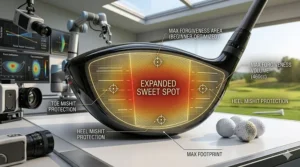
Here’s the dirty secret nobody tells new golfers: the driver isn’t actually the hardest club in the bag because of skill. It’s the longest, the fastest, and the one with the smallest margin for error relative to how violently you’re swinging it. A 7-iron forgives a lot of sins. A driver, historically, forgave almost none — which is why so many beginners develop a flinch-and-pray relationship with the tee box before they’ve even hit fifty real balls.
The good news? Driver technology in 2026 has quietly solved most of that problem. Moment of inertia (MOI) — basically a club’s resistance to twisting on off-center hits — has crossed thresholds that would’ve been unthinkable a decade ago. The USGA caps conforming drivers at 5,900 g-cm² of MOI, and several drivers on this list sit right up against that ceiling — which translates directly into straighter, longer mis-hits for the rest of us. I spent the last few weeks cross-referencing real Amazon listings, manufacturer data, and independent testing to find seven drivers that actually deliver on the forgiveness promise, instead of just slapping “beginner-friendly” on the box and calling it a day.
We’ll get into specific picks below, but the short version: you don’t need to spend $650 to stop hating your driver, though one or two of these will absolutely tempt you to.
Quick Comparison Table
| Driver | Best For | Price Range | Standout Feature |
|---|---|---|---|
| COOLO Golf Driver for Beginner | Tightest budget | Around $100 | Max-legal 460cc head, dead simple |
| Extreme Golf Driver for Left Hand Golfer | Left-handed beginners | $90–$130 range | Dedicated lefty 460cc option |
| Cobra AIR-X 2 Straight Neck | Slower swing speeds | $230–$350 range | Ultralight build, draw bias |
| Callaway Paradym Ai Smoke Max | Shot-shape correction | $350–$450 range | AI-mapped face, adjustable weight |
| Wilson DYNAPWR Max+ | Best value at high MOI | Around $500 | Breaks the 10K MOI barrier, cheaper than rivals |
| TaylorMade Qi35 Max | Premium forgiveness | $500–$600 range | 10K MOI, low CG, high launch |
| PING G440 Max | Maximum overall forgiveness | Around $650 | PING’s deepest-ever CG, fully adjustable |
Looking at the spread above, there’s a clear pattern: the cheaper options sacrifice adjustability to keep things simple, while everything north of $350 starts adding movable weights and tunable hosels. If you’re brand new and don’t yet know whether you fight a slice or a hook, that simplicity at the low end isn’t actually a downgrade — it’s one less variable to manage while you’re learning your swing. Save the adjustability budget for driver number two.
💬 Just one click — help others make better buying decisions too!😊
Top 7 Beginner Driver Golf Confidence Builders: Expert Analysis
1. COOLO Golf Driver for Beginner and Average Golfer
The COOLO Golf Driver for Beginner and Average Golfer earns the top budget slot for one simple reason: it does exactly one thing — forgive mis-hits — and does it without distracting you with knobs and weights you don’t need yet.
It ships with a 460cc head — the maximum size allowed under USGA’s equipment rules — available in 10.5° or 12° loft, in both right- and left-handed configurations. In practice, that max head size means a noticeably larger hitting area than older, smaller-headed drivers — what most buyers overlook is that a bigger face doesn’t just look reassuring at address, it physically moves the forgiving zone further from the dead center, so a strike an inch off the screws still goes mostly straight and mostly far.
What’s it best for? Someone picking up golf for the first time who wants to know their driver isn’t the reason they’re embarrassing themselves, without spending real money to find out. The COOLO sits around $100, and Amazon reviewers consistently land near 4.2 out of 5 stars across 240-plus ratings, praising the forgiveness-to-price ratio while flagging some long-term durability questions — not surprising at this price tier.
✅ Max-legal 460cc head for the largest possible sweet spot
✅ Available right and left-handed, plus a women’s 12° loft
✅ Genuinely beginner-friendly price point
❌ Fixed weighting — no draw/fade adjustment as your swing improves
❌ Only two loft options, which limits fitting precision
Value verdict: At this price, it’s less a driver and more a permission slip to stop worrying about your tee shot. Hard to beat for a first club.
2. Extreme Golf Driver for Left Hand Golfer
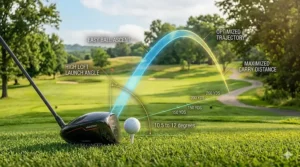
Left-handed beginners get a rough deal in golf retail — entire walls of right-handed clubs, with lefty options crammed into an afterthought corner. The Extreme Golf Driver for Left Hand Golfer exists specifically to fix that, built at 460cc with a 10.5° loft and a lightweight graphite shaft.
In my experience researching this category, dedicated lefty-first products (rather than righty designs awkwardly mirrored) tend to have better weight balance, since the engineering wasn’t an afterthought. The spec sheet won’t tell you this, but a graphite shaft at this weight class matters more for beginners than advanced players — slower swing speeds need the extra clubhead speed a lighter shaft provides just to get the ball airborne with any real carry.
Who should buy this: left-handed golfers tired of settling for “the lefty option” instead of “the right driver for them.” It typically runs $90 to $130, occupying the same budget tier as the COOLO but solving a narrower, more specific problem.
✅ One of the few true budget options built specifically for left-handed beginners
✅ Max-legal 460cc head matches the forgiveness ceiling of righty equivalents
✅ Lightweight graphite shaft helps slower swings generate speed
❌ Single loft and flex option limits custom fitting
❌ Less brand history than major manufacturers, so fewer long-term durability reports
Value verdict: If you’re a lefty beginner who’s tired of compromise clubs, this closes that gap at a fair price.
3. Cobra AIR-X 2 Straight Neck Driver
Cobra took a different approach with the Cobra AIR-X 2 Straight Neck Driver — instead of chasing maximum MOI, they chased maximum lightness. The complete club weighs around 290 grams, nearly 40 grams lighter than a standard Aerojet-style driver, with weight trimmed from the head, shaft, and grip simultaneously.
Here’s what that 40-gram difference actually means on the course: less mass to accelerate translates directly into more clubhead speed for the same physical effort, which is exactly what a beginner with a smooth, unhurried tempo needs to find real distance. Pair that with the AI-designed H.O.T. Face insert and a built-in draw bias from an additional heel weight, and you’ve got a club explicitly engineered to fight the single most common beginner miss — the slice — while you’re still building speed.
This one’s best for golfers who’ve been told they swing “too slow” by well-meaning friends and want a club that turns that into an advantage instead of a liability. MSRP sits at $349, though it’s frequently found discounted into the $230–$330 range, and it’s sold directly on Amazon.
✅ Genuinely ultralight build for real clubhead-speed gains
✅ AI-mapped face technology for better ball speed across mis-hits
✅ Built-in draw bias specifically targets slice tendencies
❌ Lower MOI ceiling than dedicated max-forgiveness models
❌ Left-handed buyers are limited to a single 10.5° loft
Value verdict: Smart pick for slower, smoother swingers who want speed and slice correction in one club, without paying flagship prices.
4. Callaway Paradym Ai Smoke Max Driver
The Callaway Paradym Ai Smoke Max Driver is the most technologically ambitious club at this price point, built around what Callaway calls an Ai Smart Face — a clubface mapped using hundreds of thousands of real golf swings to create multiple effective sweet spots rather than just one.
In plain terms: older drivers had one tiny “hot zone” dead center, and everything else lost distance. The Ai Smart Face’s micro-deflection technology spreads that hot zone across a wider area of the face, so toe and heel strikes retain far more ball speed than they would on a traditional design. Callaway backs this with a claim of up to 19 yards of shot-shape correction via the adjustable rear weight — a number that sounds like marketing until you realize it’s just leverage: move mass toward the heel, and you’re physically fighting the slice-producing open face most beginners deliver at impact.
Best for golfers who already know they fight a slice and want a club that lets them dial in a fix, rather than just hoping for the best. With Callaway’s newer Quantum Max now out, prices on the Ai Smoke Max have dropped meaningfully, typically landing in the $350–$450 range.
✅ Adjustable rear weight gives real, usable shot-shape correction
✅ Ai Smart Face technology spreads forgiveness across the whole clubface
✅ Pricing has dropped with newer Callaway releases — solid value now
❌ Some testers note a hollower sound/feel compared to the prior Paradym
❌ The adjustment tool is no longer included standard with newer units
Value verdict: The best mix of “smart engineering” and “actually affordable now” on this list.
5. Wilson DYNAPWR Max+ Driver
Quietly, the Wilson DYNAPWR Max+ Driver became one of the more interesting releases of the year — it’s the first Wilson driver in company history to cross the 10,000 MOI threshold, a number that used to be the exclusive territory of TaylorMade and PING.
What does crossing that threshold actually buy you? MOI measures resistance to head twisting on impact — the higher the number, the less a mis-hit gets punished in both distance and direction. Wilson hit 10K without making the head heavier, using a lightweight carbon composite crown and a 26-gram flippable rear weight (switchable between neutral and draw settings) plus a 6-way adjustable hosel. The spec sheet won’t tell you this part, but achieving high MOI without added weight is the harder engineering problem — most companies just add mass and call it a day, which slows your swing in the process.
This is the pick for someone who’s done their homework, wants flagship-level forgiveness, but doesn’t want to pay flagship-level brand tax. It retails around $500 — genuinely $100-plus cheaper than competitors hitting similar MOI numbers, with a 12° Lite version available for slower swing speeds.
✅ Breaks the 10K MOI mark without added head weight
✅ Real adjustability via 6-way hosel and flippable rear weight
✅ Priced notably below Callaway/PING/TaylorMade equivalents at the same MOI tier
❌ Less resale value and brand recognition than the “Big Three”
❌ Newer to the max-MOI category, so fewer years of long-term reliability data
Value verdict: If you want 2026’s best forgiveness-per-dollar, this is probably it.
6. TaylorMade Qi35 Max Driver
The TaylorMade Qi35 Max Driver is the brand’s flagship answer to the forgiveness arms race, built around 10K MOI, a deliberately low center-of-gravity projection, and a five-material construction — chromium carbon, steel, aluminum, tungsten, and titanium working in concert.
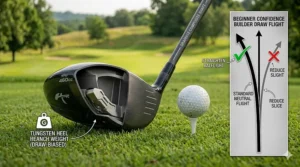
The low CG projection matters more than it sounds: it expands the zone on the face that produces ideal launch and spin, meaning strikes lower on the face (a classic beginner miss when the ball gets caught a bit thin) still produce a playable, high-launching shot instead of a low burner that runs out of steam at 140 yards. A 34-gram tungsten weight inside the Symmetric Inertia Generator does the heavy lifting here, paired with the latest Carbon Twist Face generation that corrects mishit tendencies toward straighter ball flight.
Best for beginners who want to buy once and not think about upgrading for several seasons — this is genuinely tour-adjacent technology, just tuned for maximum stability instead of maximum tour-level shot-shaping. Pricing runs $500 to $600, occasionally with launch promotions closer to $500.
✅ 10K MOI flagship forgiveness from a top-tier manufacturer
✅ Low CG design specifically helps low, thin beginner strikes
✅ High launch profile gets the ball airborne with less effort
❌ Premium price relative to the rest of this list
❌ Some reviewers call the cosmetics a step down from the previous Qi10 generation
Value verdict: Pricey, but it’s the kind of “buy it once” purchase that pays for itself in fewer frustrated range sessions.
7. PING G440 Max Driver
If there’s a single “best overall” on this list, it’s the PING G440 Max Driver — and after digging through testing data and owner reviews, it’s hard to argue otherwise. PING built this around its deepest center of gravity ever recorded in a driver, paired with a thinner, hotter face and a CarbonFly Wrap crown that saves weight specifically to push more mass low and back.
Here’s the part that matters for a beginner: a deeper, lower CG doesn’t just add forgiveness — it raises launch angle and reduces backspin simultaneously, which is the exact combination that turns a weak, ballooning beginner drive into a flatter, longer one. A 29-gram adjustable back weight lets you bias the club toward draw, fade, or neutral, and the 8-position Trajectory Tuning hosel adds another ±1.5° of loft adjustment on top of that — real fitting flexibility most beginner-marketed drivers skip entirely.
This is the pick for someone serious about golf long-term who wants their first real driver to also be their last purchase for a while. It’s the most expensive club here at roughly $650, with a notably muted, pleasant sound that testers consistently single out.
✅ PING’s deepest-ever CG translates to category-leading forgiveness
✅ Genuine dual adjustability — back weight plus 8-position hosel
✅ Consistently rated among the best-sounding drivers in its class
❌ The most expensive option on this list by a clear margin
❌ Stock 46″ shaft runs long and may need trimming for shorter golfers
Value verdict: If budget isn’t the constraint, this is the safest “buy it and grow into it” choice available.
Practical Usage Guide: Setting Up Your New Driver for Success
Buying the right driver solves maybe half the problem — the rest is setup, and most beginners skip it entirely. First: get the loft checked against your swing speed, not your ego. A 12° loft on a slower swing will out-carry a 9° loft every time, regardless of what the pros use.
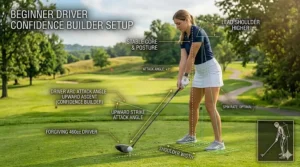
Second, learn your tee height before you learn your swing thoughts. A good baseline, backed by GOLF Magazine’s own testing: tee it so half the ball sits above the crown of the club at address. Too low, and you’re hitting down on a club designed to be hit slightly on the upswing — a mistake that quietly steals 15-20 yards from beginners who never realize it’s happening.
Third, if your driver has adjustable weighting (the Wilson, Callaway, or PING models above), resist fiddling with it for at least your first ten rounds. You need a consistent baseline before you know whether you’re actually fighting a slice or just having a bad week. Adjusting too early just adds noise to data you haven’t collected yet.
Finally — and this gets skipped constantly — re-grip checks matter more on a driver than any other club, since it sees the most violent swing in your bag. Most equipment experts recommend replacing grips roughly every 40 rounds, and a slick grip on your longest, fastest club is asking for an inconsistent release.
Real-World Scenarios: Which Driver Actually Fits You
The total beginner, six months in: Budget matters, ego doesn’t yet. The COOLO or Extreme Golf Driver for Left Hand Golfer gets you a legal max-size head without the financial commitment of a club you might outgrow technique-wise within a year anyway.
The smooth-tempo player who’s “not that fast”: This is the Cobra AIR-X 2 lane exactly. You don’t need more MOI as much as you need more clubhead speed, and shaving 40 grams off total club weight does more for your distance than almost any other single change available at this budget.
The committed improver who’s already fighting a specific miss: If you know you slice — really know it, not just suspect it — the Callaway Paradym Ai Smoke Max or Wilson DYNAPWR Max+ give you adjustable weighting that directly counters that tendency while you work on the swing fix itself.
The “I’m doing this properly” golfer with room in the budget: The TaylorMade Qi35 Max and PING G440 Max aren’t really beginner clubs in the budget sense — they’re forgiving clubs that happen to also suit beginners, and they’ll still be the right club in your bag three seasons from now.
Problem → Solution: Fixing the Slice That’s Wrecking Your Tee Shots
Slicing is, by a wide margin, the most common beginner miss, and it’s worth separating the equipment fix from the swing fix, because they solve different parts of the problem.
The swing cause is almost always an open clubface at impact relative to your swing path — equipment can’t fully fix that, but it can meaningfully reduce the damage. A draw-biased driver like the Cobra AIR-X 2 or an adjustable-weight driver like the Callaway Paradym Ai Smoke Max physically shifts the club’s center of gravity toward the heel, which helps square the face slightly at impact even when your swing path hasn’t changed yet.
A second common problem — topped or thin drives — usually traces back to tee height or a steep angle of attack, and a higher-launching, low-CG design like the TaylorMade Qi35 Max or PING G440 Max genuinely helps here, since the forgiving zone is engineered to sit lower on the face exactly where thin strikes happen.
The third problem, weak distance despite solid-feeling contact, is frequently a clubhead-speed issue rather than a strike-quality issue — which is precisely the gap the Cobra AIR-X 2‘s lightweight build and the Wilson DYNAPWR Max+ Lite shaft option were built to close.
How to Choose a Beginner Driver Golf Confidence Builder
- Start with loft, not brand. Most beginners are under-lofted in their current driver. 10.5° to 12° is the realistic sweet spot for slower swing speeds trying to maximize carry.
- Prioritize head size before adjustability. A 460cc max-legal head matters more for early forgiveness than any movable weight system — get the big head first, fine-tune later.
- Match shaft weight to swing tempo. Smoother, slower swings benefit disproportionately from lighter shafts; aggressive, faster swings can handle (and sometimes need) more mass for control.
- Decide if you actually need adjustability yet. If you don’t know your miss tendency, a simpler fixed-weight club removes a variable rather than adding useful control.
- Set a real budget band and stick to it. Spending $650 on a driver before you’ve broken 100 rarely changes your scores; spending zero on club fitting almost always costs you strokes.
- Check the return policy before buying. Driver fit is genuinely individual — a club that fits your buddy’s swing can feel completely wrong in your hands.
- Buy the driver, then book one lesson. A properly fit driver and a single lesson on setup fundamentals will outperform almost any equipment upgrade alone.
Common Mistakes When Buying Your First Driver
The single biggest mistake is buying based on what a scratch golfer plays rather than what a beginner swing actually needs — low-spin, tour-spec drivers are built to reduce spin for players who already generate plenty, and putting one in a beginner’s hands often produces shorter, lower drives, not longer ones.
A close second: ignoring shaft flex entirely and buying whatever loft “looks standard.” Too stiff a shaft for your swing speed kills launch and distance simultaneously — it’s arguably a bigger performance loss than head technology differences between brands.
Third, beginners frequently buy used, blade-style drivers from decades past because they’re cheap, not realizing that modern 460cc forgiveness genuinely didn’t exist at that head size back then. A $100 modern driver will usually out-forgive a $40 driver from 2008, full stop.
Beginner Driver vs. Tour-Level Driver: What Actually Changes
The core difference isn’t really “quality” — it’s intent. Tour-level drivers like low-spin TaylorMade or Titleist models are engineered to reduce forgiveness in exchange for shot-shaping control, because tour players rarely mis-hit badly enough to need maximum MOI.
Beginner-oriented drivers flip that priority entirely: maximum MOI, higher launch, draw bias baked in — every choice optimized to minimize the damage from an inconsistent strike rather than to maximize control for a consistent one. Buying a tour-spec driver as a beginner is a bit like buying race tires for a daily commute — technically higher performance, practically worse for what you’re actually doing with it.
What to Expect: Real-World Performance on the Course
On paper, MOI numbers and CG projections sound abstract. On the course, the difference shows up as dispersion — how far your bad shots miss, not just how far your good shots fly. A 240-yard slice that ends up in the first cut instead of out-of-bounds is the real, lived benefit of these technologies, even on days your swing feels rough.
Expect early sessions with any of these drivers to feel noticeably more forgiving than whatever you were swinging before, but don’t expect miracle distance gains in week one — clubhead speed and contact quality still come from practice, not the club. The driver’s job is to protect your bad swings; your job is still to build good ones.
Features That Actually Matter (And Those That Don’t)
Actually matters: Head size (460cc max), MOI rating, loft options matched to your swing speed, and shaft weight. These four variables explain the overwhelming majority of how forgiving and how far a driver performs for a beginner.
Doesn’t matter much yet: Cosmetic finish, crown graphics, “tour-proven” marketing language, and minor sound/feel differences between top-tier models. These influence confidence at address slightly, but they have essentially zero measurable impact on ball flight.
Long-Term Cost & Maintenance: What Your Driver Really Costs Over Time
| Price Tier | Typical Range | Expected Lifespan | Best For |
|---|---|---|---|
| Budget | Around $100 | 1–3 seasons of regular play | True beginners, casual golfers |
| Mid-range | $230–$500 | 3–5 seasons | Improving players who plan to stick with golf |
| Premium | $500–$650 | 5+ seasons | Committed golfers buying once |
A driver in the premium tier costs more upfront but, divided across the rounds you’ll play over five-plus seasons, often works out cheaper per round than replacing a budget driver twice in that same window. That said, a beginner who isn’t certain golf will stick shouldn’t pre-pay for that certainty — the budget and mid-range tiers above genuinely hold up fine for a season or two of honest evaluation. Maintenance itself is minimal: occasional face cleaning, periodic grip replacement every 40-60 rounds, and a headcover to prevent cosmetic shaft dings in the bag.
❓ FAQ
❓ What loft is best for a beginner driver?
❓ How much should a beginner spend on their first driver?
❓ Is a 460cc driver head better for beginners?
❓ Do adjustable drivers help beginners, or just add confusion?
❓ How often should beginners replace their driver?
Conclusion
There’s no single “right” beginner driver golf confidence builder — there’s a right one for your swing speed, your budget, and your particular flavor of mis-hit. What all seven of these share is the same underlying philosophy: maximize forgiveness now, so confidence can build naturally instead of getting beaten out of you on the first tee.
If you’re working with a tight budget and just want a fair shot, the COOLO or Extreme Golf Driver for Left Hand Golfer get you into the game without overspending on a swing you’re still developing. If you’ve identified a specific miss you’re fighting, the Cobra AIR-X 2, Callaway Paradym Ai Smoke Max, or Wilson DYNAPWR Max+ give you real, adjustable tools to counter it. And if you’re ready to invest in a driver you won’t outgrow, the TaylorMade Qi35 Max and PING G440 Max sit at the top of this list for good reason.
Whichever you choose, remember: the driver buys you forgiveness, not distance off thin air. Pair it with even a little practice, and the gap between your good days and your bad days starts shrinking fast — which, honestly, is the entire point.
✨ Don’t Miss These Exclusive Deals!
🔍 Take your tee-shot confidence to the next level with these carefully selected drivers. Click on any highlighted model to check current pricing and availability. These clubs are built to help you find more fairways and enjoy the rounds your friends will actually want to play with you. ⛳
Recommended for You
- 7 Best First Drivers for Beginner Golfers in 2026 (No More Whiffs)
- Mini Driver from Fairway: 7 Best Clubs to Buy in 2026
- Mini Driver vs Standard Driver: 7 Best Picks in 2026
Disclaimer: This article contains affiliate links. As an Amazon Associate, I earn from qualifying purchases. If you purchase products through these links, we may earn a small commission at no additional cost to you.
✨ Found this helpful? Share it with your friends! 💬🤗
