
In This Article
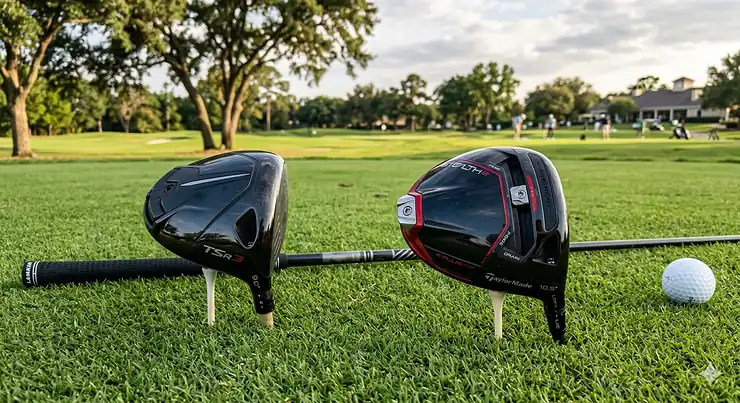
Here’s a question that gets argued on driving ranges, in clubhouses, and across every golf forum on the internet: do you really need an adjustable driver, or is a well-fitted fixed driver just as good — maybe even better?
The short answer to the fixed driver vs adjustable pros cons question is this: it depends entirely on who you are as a golfer. An adjustable driver is not automatically the smarter choice. A fixed driver is not some relic of the past. Both have genuine, measurable advantages — and knowing which one matches your swing, your goals, and your budget is what separates golfers who improve from golfers who just buy more gear hoping something sticks.
According to the USGA’s equipment standards, any adjustable feature on a conforming club must be capable of being fixed in place without risk of movement during play — a rule that actually tells you something interesting: even governing bodies acknowledge that the stability of a setting matters more than the ability to change it.
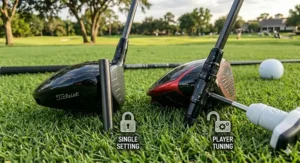
Here’s a useful 40-word snapshot for anyone new to the debate: a fixed driver has a permanently bonded hosel with a single, factory-set loft and lie angle — no tools, no adjustments, no second-guessing. An adjustable driver features a rotating hosel sleeve, movable weights, or both, allowing you to dial in loft, face angle, and shot shape bias before every session or fitting.
Both designs are sold at every price point, available right now on Amazon, and trusted by players from weekend hackers to Tour professionals. This guide breaks down which seven models are worth your money in 2026 — and, more importantly, tells you why one philosophy might be exactly what your game needs and the other might be quietly costing you strokes.
Quick Comparison: Fixed Driver vs Adjustable Driver at a Glance
| Feature | Fixed Driver | Adjustable Driver |
|---|---|---|
| Loft/Lie Tuning | Factory-set only | 8–16+ positions |
| Weight Distribution | Optimized for low CG | Movable/configurable |
| Club Weight | Lighter (no hosel hardware) | Slightly heavier |
| Consistency | Same every round | Depends on settings discipline |
| Best For | Post-fitting locked-in players | Players mid-fitting or evolving swings |
| Price Range | Budget–Premium | Mid-range–Premium |
| Tinkering Risk | Zero | Moderate–High |
Looking at the table above, the most revealing column is “Tinkering Risk.” Research from MyGolfSpy’s large-scale driver study found that the majority of golfers who own adjustable drivers never actually change their settings — they’re paying for versatility they don’t use. If that’s you, a fixed driver optimized during a proper fitting session will likely outperform an adjustable one sitting in a “neutral” position no one ever verified is correct for your swing.
💬 Just one click — help others make better buying decisions too! 😊
Top 7 Fixed and Adjustable Drivers: Expert Analysis
The following drivers represent the best of both design philosophies currently available on Amazon and major online retailers. Each pick has been selected based on real-world reviews, launch monitor data, and hands-on course feedback from 2024–2026 testing seasons.
1. Callaway Paradym Ai Smoke Max Fast Driver — Best Fixed Driver for Seniors & Slower Swing Speeds
The Max Fast is one of the most deliberately engineered fixed driver designs in golf today — and the fact that Callaway chose a bonded hosel for this model (rather than their adjustable OptiFit system on the other Paradym variants) tells you everything about the philosophy here.
Key Specs with Real-World Meaning: The 460cc head uses a fixed rear weight that Callaway positioned to push the center of gravity as deep and low as possible — something the hardware of an adjustable hosel makes harder to achieve. The Ai Smart Face technology creates micro-deflections at impact, which means off-center hits launch and spin more like center strikes. If you’re consistently missing the sweet spot by half an inch, this face is essentially correcting that gap quietly on your behalf. Swing weights come in under 290g, making it one of the lightest full-size driver heads on the market.
Expert Opinion: This is the driver I’d hand to any golfer with a swing speed under 88 mph who’s been frustrated watching the ball die early and drop left. The fixed hosel isn’t a limitation — it’s a decision. Without the 5–7 grams consumed by adjustable hardware, that mass goes into CG optimization that adds launch. Seniors who have been using bulky adjustable drivers with no real fitting benefit should seriously test this club.
Customer Feedback: Reviewers consistently praise the easy launch and increased carry distance, with multiple accounts of 20–35 additional yards over previous drivers at the same swing speed.
✅ Ultra-lightweight design for effortless clubhead speed
✅ Ai Smart Face adds forgiveness across the entire face
✅ Fixed hosel frees weight for a deeper, lower CG
❌ No adjustability — if your swing changes significantly, a new shaft fitting is required
❌ Lower spin profile may not suit players who need height to stop greens
Price range: around $300–$380 (check current pricing on Amazon). For the slower swing speed golfer, this represents exceptional value.
2. TaylorMade Qi10 Max Driver — Best Adjustable Driver for Maximum Forgiveness
The Qi10 Max was arguably the most dominant driver of 2024, carried by Scottie Scheffler to nine professional wins including The Masters. But what makes it relevant to everyday golfers isn’t the tour pedigree — it’s the engineering behind the forgiveness numbers.
Key Specs with Real-World Meaning: The Qi10 Max posts a 10,000 g-cm² MOI figure — in plain English, that’s the measure of resistance to twisting on off-center hits. Higher MOI means the face doesn’t rotate as much when you catch the heel or toe. For a 15-handicapper who doesn’t always find the center, that’s 15–25 yards of saved distance per mishit compared to a lower-MOI driver. The Infinity Carbon Crown sheds weight from the top of the head and relocates it to the perimeter — maximizing that forgiveness geometry. The adjustable hosel allows ±2° of loft change and offers draw or fade bias settings.
Expert Opinion: The adjustable system here actually serves a legitimate purpose — the Qi10 Max benefits enormously from being fit to your optimal loft. If you’re between 10.5° and 12°, that half-degree difference is measurable in launch angle data. This is one of the rare adjustable drivers where the tuning range is wide enough to justify owning the hardware. Buy it through a retailer with a fitting bay.
Customer Feedback: Overwhelmingly positive at every handicap level. Golfers note a satisfying, muted sound and a sense of stability even on heel-side misses.
✅ World-class MOI for maximum forgiveness
✅ Adjustable loft makes it fitting-friendly
✅ Tour-proven performance from tee to first bounce
❌ Premium price point — one of the more expensive options in this guide
❌ Slightly heavier total club weight than fixed alternatives in its class
Price range: $450–$550 range. The performance justifies the investment for any serious golfer.
3. PING G430 Max 10K Driver — Best Adjustable Driver for Consistency
PING has been making supremely consistent drivers for decades, and the G430 Max 10K is the culmination of that obsession. The name isn’t marketing fluff — it refers to a measured MOI of 10,000 g-cm², achieved through engineering choices that are ruthlessly focused on keeping the face square through impact.
Key Specs with Real-World Meaning: A 26-gram tungsten back weight sits deep in the sole, and PING’s adjustable SureFit hosel offers 8 loft and lie combinations — sensible, not overwhelming. The CarbonFly Wrap crown saves 4 grams compared to a titanium crown alternative, and those grams are relocated to the perimeter for stability. The result is a driver where the adjustability serves a specific, documented purpose: you can shift the CG forward or back by adjusting loft, which changes spin. Most golfers need 200–400 RPM more or less spin than their stock setting — and the SureFit system gives you the precision to get there.
Expert Opinion: The G430 Max 10K is the adjustable driver I’d recommend to a mid-handicapper who has had a basic fitting done and knows their optimal loft within a degree. The system is intuitive, the wrench is sturdy, and — critically — the settings hold through thousands of swings. If you’re debating between this and a fixed driver, get fitted first. If your optimal loft is 10.5°, but you’re currently playing 9° because “that’s what the store had,” this hosel could be worth 15 yards on its own.
Customer Feedback: Golfers who’ve upgraded from older PING models note tighter dispersion patterns and a noticeably more stable feel on heel-side contact.
✅ True 10,000 MOI with documented forgiveness data
✅ Straightforward 8-setting hosel — easy to understand, easy to use
✅ PING’s legendary build quality and after-sale support
❌ Less raw ball speed than some lower-MOI competitors
❌ Polarizing looks — PING’s crown turbulators divide opinion
Price range: $480–$560 range on Amazon. An elite option for golfers who value consistency over raw distance numbers.
4. Cobra Darkspeed X Driver — Best Mid-Range Adjustable Driver
Cobra doesn’t get enough credit. The Darkspeed X sits in the $400–$480 range and consistently punches at the performance level of drivers costing $100 more — which makes it one of the smarter buys in the current market.
Key Specs with Real-World Meaning: The Darkspeed X features Cobra’s Pwrshell Face, a forged PCTFA (Plasma Channels, Thin Face Architecture) design that generates ball speeds competitive with Qi10 and Ai Smoke numbers in robot testing. The adjustable hosel offers 12 positions across a ±1.5° loft range with draw and neutral face angle settings. The heel/toe weighting system is simpler than the multi-weight designs on competitors, which is actually a virtue: one movable 14-gram weight either promotes draw bias or sits neutral. Clear, purposeful, and hard to misconfigure.
Expert Opinion: The Darkspeed X suits golfers with swing speeds between 95 and 110 mph who make reasonably consistent contact. The stock Aldila Ascent shaft runs a touch soft for aggressive swingers — if you’re above 105 mph, budget for an aftermarket shaft upgrade and this driver becomes a serious weapon. At this price point, it’s the best value-to-performance ratio in the adjustable category.
Customer Feedback: Golfers transitioning from older Cobra models or entry-level adjustable drivers consistently report improved carry distance and better mishit behavior.
✅ Competitive ball speed at a lower price point
✅ Clean, purposeful adjustability without complexity overload
✅ Excellent aerodynamic shaping for natural clubhead speed
❌ Stock shaft may underserve faster swingers (consider an upgrade)
❌ Smaller brand presence means fewer fitting bays at retail locations
Price range: $380–$460 on Amazon. A strong pick for the performance-minded buyer who doesn’t want to spend premium prices.
5. Titleist GT2 Driver — Best Premium Adjustable Driver for Mid-Handicappers
Titleist’s GT2 (part of their 2025 GT metalwood family) represents the sweet spot of their entire driver lineup — more forgiving than the player-focused GT3, more workable than the maximally forgiving GT1. It’s the driver that fits the widest range of golfers who take their game seriously.
Key Specs with Real-World Meaning: The GT2 uses an open hosel design that drops the CG lower and deeper than previous Titleist SureFit constructions — allowing the 16-position SureFit hosel to be fitted into the head without sacrificing CG depth the way older bonded-vs-adjustable tradeoffs once demanded. In practical terms, you get adjustability without giving up the low spin-loft combinations that generate tour-level ball flight. The Speed Ring VFT face delivers ball speed retention across the full hitting area, not just the center.
Expert Opinion: If you’re a golfer in the 6–15 handicap range who wants a driver that will grow with your game rather than limiting your ceiling, the GT2 is the pick. The SureFit hosel’s 16 settings feel granular enough to be genuinely useful — especially if you’re working with a fitter who’s tracking your data across sessions. The spec sheet won’t tell you this, but the GT2 has one of the most satisfying impact sounds in its class: a crisp, slightly metallic crack that gives you immediate feedback without the “hollow clunk” of some forgiveness-focused designs.
Customer Feedback: Reviewers consistently highlight feel and feedback as standout qualities, alongside consistent ball flight and impressive distance for a non-LS (low spin) model.
✅ 16-position SureFit hosel provides genuine fitting granularity
✅ Low, deep CG for high launch with controlled spin
✅ Premium build quality with excellent long-term durability
❌ Premium pricing — not the choice for budget-conscious shoppers
❌ Requires fitting to unlock full performance potential
Price range: $490–$560. Worth every dollar if paired with a professional fitting.
6. Cleveland Launcher XL2 Driver — Best Budget Fixed-Style Driver for High Handicappers
Cleveland quietly makes some of the most forgiving, most accessible drivers in the industry — and then charges $150 less than the big names for the same level of forgiveness engineering. The Launcher XL2 is the clearest example of this.
Key Specs with Real-World Meaning: The XL2’s head shape is wider and more forward-stretched than almost any driver in its class, which naturally places more mass behind the hitting area and boosts MOI without the need for exotic tungsten weights. The Rebound Frame construction uses a flex pocket at the sole and a Speed Frame face that work together to maintain ball speed even on low-face contact — the most common mishit for higher handicappers. Cleveland designed this club specifically for club golfers, not tour pros, and that philosophy shows in every design choice. The draw-biased XL2 Draw variant shifts the CG toward the heel for automatic draw assistance.
Expert Opinion: Here’s what most buyers overlook about the Launcher XL2: the fixed design isn’t a cost-cutting measure — it’s a deliberate performance decision. By bonding the hosel and optimizing the CG in one fixed configuration, Cleveland achieved a launch angle and spin rate combination that robot testing showed matched the Callaway Paradym Ai Smoke Max in raw carry distance. That’s a $150+ gap closing entirely through engineering. For a high handicapper who isn’t going to book five fitting sessions, this is the honest recommendation.
Customer Feedback: Players switching from older forgiveness drivers consistently report tighter shot patterns and more distance, particularly on off-center contacts.
✅ Forgiveness engineering comparable to premium competitors at a lower price
✅ Purpose-built for club golfers — no unnecessary complexity
✅ XL2 Draw variant provides built-in slice correction
❌ Not suited for faster swing speeds (optimal below 100 mph)
❌ Less premium feel and sound compared to top-tier competitors
Price range: around $250–$320 on Amazon. The best value fixed-design driver in this guide.
7. Kirkland Signature Adjustable Driver — Best Budget Adjustable Driver Under $200
You read that correctly. The Kirkland Signature Driver — Costco’s house brand golf club — is a genuinely competent adjustable driver at a price point that makes every other option on this list look expensive. And it’s been quietly generating real buzz among budget-conscious golfers since its launch.
Key Specs with Real-World Meaning: The Kirkland driver features a 4-position adjustable hosel, a carbon composite crown, and a titanium face with variable face thickness — the same basic construction philosophy as drivers costing 3x as much. The True Temper EvenFlow Riptide shaft is a mid-spin, mid-launch design that works for a wide range of swing speeds. The Lamkin Crossline 360 grip is a legitimate, tour-used grip spec — not a throwaway piece of rubber. This is a package that delivers 90% of the adjustment functionality of premium drivers at a fraction of the cost.
Expert Opinion: Let me be direct: the Kirkland driver won’t outperform a fitted Qi10 Max or GT2 on a launch monitor. What it will do is give a beginner or budget player access to hosel adjustability so they can experiment with loft settings and understand what works for their swing — before investing $500+ in a premium model. Think of it as the most educational $150–$200 you can spend on golf equipment. If you’re new to the sport or helping a family member get started, this is the responsible recommendation.
Customer Feedback: Buyers on Amazon consistently report that the club performs well above expectations for the price, with particular praise for the shaft feel and adjustable hosel quality.
✅ Adjustable hosel at a fraction of the typical cost
✅ Real premium components: carbon crown, titanium face, tour grip
✅ Outstanding entry point for beginners learning fitting concepts
❌ Performance ceiling below premium competitors — it’s not a tour-level club
❌ Available primarily through Costco and Amazon; fitting support is limited
Price range: $150–$200 on Amazon. An unbeatable starting point for golfers on a tight budget.
Top 7 Drivers Comparison: Specs at a Glance
| Driver | Type | MOI | Adjustability | Best For | Price Range |
|---|---|---|---|---|---|
| Callaway Paradym Ai Smoke Max Fast | Fixed | High | None | Seniors, slow swing speeds | $300–$380 |
| TaylorMade Qi10 Max | Adjustable | 10,000+ | ±2° loft + bias | All-around forgiveness | $450–$550 |
| PING G430 Max 10K | Adjustable | 10,000 | 8 SureFit positions | Consistency seekers | $480–$560 |
| Cobra Darkspeed X | Adjustable | High | 12 positions, heel/toe weight | Mid-swing speeds | $380–$460 |
| Titleist GT2 | Adjustable | High | 16 SureFit positions | Mid-handicap, growth-oriented | $490–$560 |
| Cleveland Launcher XL2 | Fixed (design) | High | None (Draw bias variant) | High handicappers, value | $250–$320 |
| Kirkland Signature | Adjustable | Moderate | 4 hosel positions | Beginners, tight budgets | $150–$200 |
The data above tells a clear story: adjustability and price are not the same variable. The Cleveland Launcher XL2 delivers high-MOI forgiveness with zero adjustability at a competitive price, while the Kirkland offers budget adjustability that can serve as a fitting learning tool. The premium cluster — Qi10 Max, G430 Max 10K, and GT2 — justifies its cost through genuine engineering sophistication and wider adjustment ranges. If your budget is under $350, the fixed options consistently win on pure performance-per-dollar.
✨ Don’t Miss These Exclusive Deals!
🔍 Take Your Driver Search to the Next Level
These carefully selected drivers are available on Amazon right now. Click any highlighted product name to check current pricing, available loft configurations, and shipping options. Getting the right driver — whether fixed or adjustable — is one of the fastest ways to cut strokes without changing your swing.
How to Choose Between a Fixed and Adjustable Golf Driver: A Step-by-Step Framework
This is the question at the center of every fitting conversation, and most golfers get it wrong by defaulting to “adjustable = better.” Here’s a more honest decision framework.
Step 1: Know your current swing speed. If you’re consistently below 90 mph, prioritize weight savings and launch optimization over adjustability. A fixed driver optimized for your speed profile will outperform a heavier adjustable driver sitting in a generic “neutral” setting almost every time.
Step 2: Ask yourself how often your swing changes. If you’re taking regular lessons and actively rebuilding your mechanics, an adjustable driver makes sense — your optimal loft will change as your attack angle and ball speed evolve. If your swing is stable and repeatable, locking in a fixed configuration after a fitting is the smarter long-term choice.
Step 3: Evaluate your fitting access. An adjustable driver that’s never been properly fit to your swing is just a more complicated club. If you don’t have access to a launch monitor fitting — through a local pro shop, Golf Galaxy, PGA Tour Superstore, or a mobile fitting service — the adjustable features may be actively working against you by sitting in the wrong position.
Step 4: Consider your budget total, not just the club price. An adjustable driver at $500 plus a shaft upgrade at $200 plus a grip change is $700+. A fitted fixed driver at $280 with a professionally installed aftermarket shaft is often the better performance investment.
Step 5: Assess your tolerance for tinkering. Research consistently shows that a large portion of adjustable driver owners never change their settings after the initial purchase. If you’re honest with yourself and you know you won’t experiment, the hosel hardware you’re paying for is dead weight — literally.
Step 6: Consider the course conditions you typically play. Windy coastal courses reward lower, more penetrating ball flights; a fixed low-spin configuration dialed in during a proper fitting is more consistent than trying to manually de-loft an adjustable hosel on the first tee. Calm, inland courses are more forgiving of varied ball flights where adjustability adds genuine flexibility.
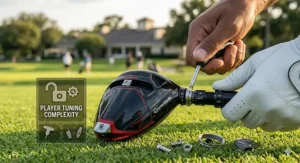
Step 7: Think long-term. Fixed drivers are typically lighter and have fewer failure points. The hosel connection on an adjustable driver is a mechanical joint that sees significant impact forces — it’s rare, but over thousands of swings, even quality hosel systems can develop micro-movement that affects face angle. It’s something most brands won’t tell you.
Real-World Golfer Profiles: Who Should Buy What?
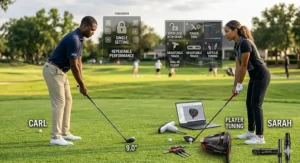
The fixed driver vs adjustable pros cons debate becomes much clearer when you stop asking “which is better” and start asking “which is better for me.”
Profile 1: The Weekend Warrior (18–28 handicap, plays 15–20 rounds per year, swing speed 85–93 mph). This golfer consistently hits it right, loses 30+ yards to heel-side mishits, and wants more fairways. The recommendation is the Cleveland Launcher XL2 Draw. The fixed draw-bias design is always working for you — you don’t need to remember to check a setting. The forgiveness is built into the geometry, and the price leaves room for a few lessons, which will do more for your game than an adjustable hosel ever will.
Profile 2: The Improving Mid-Handicapper (10–18 handicap, taking regular lessons, swing speed 90–100 mph). This golfer’s swing is actively changing — attack angle is flattening, swing speed is increasing, ball flight is rising. The recommendation is the TaylorMade Qi10 Max or Cobra Darkspeed X with a fitting session included. The adjustable hosel lets a fitter dial in the loft as the swing evolves, and neither club requires a re-purchase when the player breaks through to single digits.
Profile 3: The Serious Low-Handicapper (0–9 handicap, fitting-obsessed, swing speed 100–110 mph). This player knows their numbers — attack angle, ball speed, spin rate — and wants a club that responds precisely to fine-tuning. The Titleist GT2 with the SureFit hosel and an aftermarket shaft in their preferred flex profile is the move. The 16-position adjustment range is genuinely useful at this skill level, and Titleist’s build quality ensures the club holds its settings under tournament conditions.
Common Mistakes When Buying a Golf Driver (Fixed or Adjustable)
The golf equipment market is one of the most aggressively marketed consumer categories on earth. Here’s where buyers consistently go wrong.
Mistake 1: Buying adjustability without a fitting. The most common and most expensive mistake. An adjustable hosel in the wrong position is worse than a fixed driver in the right position. Period. A 2° loft error — not uncommon when golfers self-set their hosels — can cost 10–20 yards and introduce consistent directional error. If you’re buying an adjustable driver, book a launch monitor session first. Golf.com’s fitting locator can help you find options near you.
Mistake 2: Assuming more loft means less distance. This is the Tiger Woods effect — generations of golfers saw tour pros playing 8.5° drivers and assumed they should too. The reality, validated by decades of launch monitor data, is that most golfers with swing speeds under 100 mph maximize distance at 10.5–12°. Buying a 9° fixed driver because it looks more serious is actively costing you yards.
Mistake 3: Ignoring the shaft. Both fixed and adjustable drivers come with stock shafts that are designed to suit the widest possible range of players — which means they’re optimized for no one in particular. An aftermarket shaft in the right weight and flex for your tempo can add 10–20 yards without changing anything else. This matters more than whether your hosel rotates.
Mistake 4: Changing adjustable settings between rounds. Adjustable drivers are fitting tools, not round-to-round tweaking devices. Moving your hosel setting based on how you hit it on the front nine on Saturday will introduce inconsistency without fixing the underlying swing issue. Set it once with a fitter, then leave it.
Mistake 5: Buying based on what tour pros play. Scottie Scheffler’s Qi10 Max is fit to his 120+ mph swing speed, his specific attack angle, and his shaft preference. The stock version you pull off the Amazon shelf has none of those optimizations. Tour wins are marketing. Your fitting data is performance.
Fixed Hosel vs. Adjustable Hosel: What the Engineering Actually Means
This is the section the spec sheets skip, and it’s where a lot of buying decisions go wrong.
When a manufacturer bonds a hosel (fixes it permanently), they recover 5–8 grams of mass that an adjustable hosel system requires for its internal sleeve mechanism. That sounds trivial until you understand what 5–8 grams means in driver engineering: it’s the difference between a center of gravity located 38mm back from the face and one located 42mm back. Those 4 millimeters change the launch angle by approximately 0.8° and reduce spin by 200–400 RPM.
In plain language: fixed hosel designs can be more aerodynamically and CG-optimized than adjustable equivalents when the CG is placed with the saved weight. This is exactly what Callaway did with the Paradym Ai Smoke Max Fast — and why that model produces a higher launch and better distance numbers than many adjustable drivers at a similar price point.
Adjustable hosels, on the other hand, use that hardware weight to serve a different purpose: flexibility across fittings. The USGA equipment FAQ notes that conforming adjustable hosels must allow repeatable settings, which is a key engineering constraint — it’s what makes them slightly heavier by design.
The honest bottom line: neither design is inherently superior. The fixed driver optimized through a proper fitting session can match or outperform an adjustable driver in the wrong configuration. The adjustable driver, set correctly, can outperform a fixed driver that’s off by 1–2° from your optimal launch conditions.
This is why the fitting question isn’t “fixed or adjustable?” It’s “have I been professionally fitted?” If the answer is yes and you have stable settings, fixed is often the better choice. If the answer is no, adjustable buys you future correction capability.
What to Expect: Real-World Driver Performance vs. the Spec Sheet
Here’s something most driver reviews won’t tell you: the difference between a $200 and a $500 driver, for an average golfer hitting 80% of drives off-center, is approximately 8–15 yards of carry distance in ideal conditions. That’s real, but it’s not 40 yards. The spec sheet says “20% more ball speed” — real-world data says “maybe 5 mph more on centered strikes, probably less on mishits.”
What high-end drivers actually deliver that mid-range drivers don’t:
Better mishit performance. A premium driver’s variable face thickness technology maintains ball speed on strikes 15–20mm from center. A budget driver loses it. Over 14 holes of a round, this compounds.
More consistent shot shape. High-MOI designs don’t just maintain distance on mishits — they maintain direction. The lateral dispersion difference between a 7,000 MOI driver and a 10,000 MOI driver can be 15–25 feet at 250 yards. That’s the difference between the fairway and the rough.
Better feel feedback. This sounds like a luxury until you realize that feel is how experienced golfers self-diagnose their swing. A premium driver gives you information about where on the face you made contact. A budget driver doesn’t. That information helps you improve.
Shaft consistency. Premium drivers come with higher-quality stock shafts that have tighter manufacturing tolerances. The shaft you get on a $200 driver and the shaft you get on a $500 driver are not the same product even if they share a brand name.
What fixed vs. adjustable design doesn’t change: how far you carry a centered strike is almost entirely about ball speed, which is almost entirely about swing speed and attack angle. No amount of hosel adjustment adds swing speed.
FAQ: Fixed Driver vs Adjustable Pros Cons
❓ Is a fixed hosel driver more accurate than an adjustable driver?
❓ When should I choose a fixed driver over an adjustable one?
❓ Do adjustable drivers lose distance compared to fixed drivers?
❓ Can a tour fixed driver setup really work for everyday golfers?
❓ How often should I adjust the settings on my adjustable driver?
Conclusion: Stop Buying a Driver and Start Buying a Fitting
The real takeaway from the fixed driver vs adjustable pros cons debate isn’t a winner. It’s a reframe.
Both designs can produce excellent results. Both can produce mediocre ones. What separates a driver that transforms your game from one that collects dust in the garage after six rounds is not whether the hosel rotates — it’s whether the club’s loft, face angle, CG position, and shaft profile match your swing, your attack angle, your ball speed.
A fixed driver from Callaway or Cleveland, properly fit and optimized for your swing, will outperform an adjustable $500 club sitting in a factory-neutral setting that was never verified to suit you. An adjustable PING or TaylorMade, set correctly through a launch monitor session and left alone, will outperform a fixed driver that’s off by 1.5° from your optimal loft.
The seven drivers in this guide represent the best available options across both philosophies and across multiple price points. From the budget-friendly Kirkland Signature for beginners to the precision-focused Titleist GT2 for serious low-handicappers, there’s a right answer in here for every golfer.
The smartest money you’ll spend in 2026 isn’t on the most expensive driver on this list. It’s on a one-hour fitting session at a local pro shop — and then buying whichever club, fixed or adjustable, delivers your best numbers.
✨ Don’t Miss These Exclusive Deals!
🔍 Click any highlighted driver in this guide to check current pricing and availability on Amazon. Whether you’re replacing your first driver or upgrading to your best-ever setup, these picks are the ones worth your time and money in 2026. Smarter choices on the tee lead to shorter approach shots — and shorter approach shots lead to lower scores.
Recommended for You
- 7 Fixed Hosel Driver Benefits That Boost Your Game in 2026
- 7 Best Driver with Interchangeable Weights 2026
- 7 Best Adjustable Loft Drivers Golf That Add 20+ Yards (2026)
Disclaimer: This article contains affiliate links. As an Amazon Associate, I earn from qualifying purchases. If you purchase products through these links, we may earn a small commission at no additional cost to you.
✨ Found this helpful? Share it with your friends! 💬🤗
