
In This Article
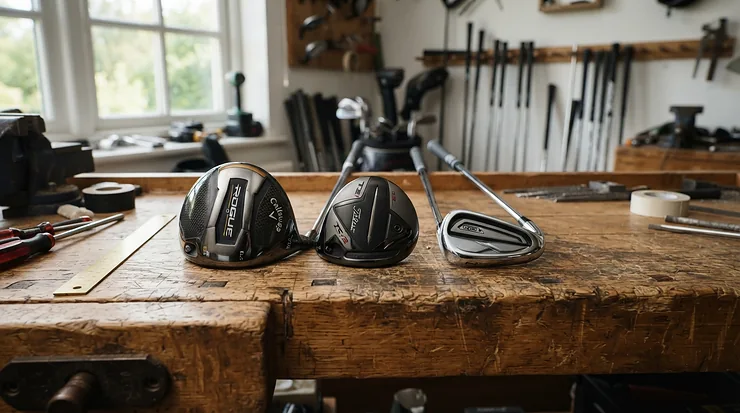
What are right-handed golf wedges? They are the high-lofted irons in your bag (pitching, gap, sand and lob) built for golfers who swing right-handed. Their job is to launch the ball high, land it softly and stop it quickly from roughly 120 yards and in. Together they handle most of the shots that decide a round.
Here’s the uncomfortable math. Your wedges probably touch the ball more often than your driver and fairway woods combined. Yet most of us buy them like we’re grabbing a spare phone charger: whatever’s on the shelf, whatever’s cheapest, done. That’s a mistake. The wedge is a precision instrument disguised as a hunk of steel.
The wedge family grew out of the old niblick, and today’s models are far more specialized. A modern wedge has a loft, a bounce angle, a sole grind, a groove pattern and a head shape. Each one changes how the club meets turf and ball.
In this guide I’ve pulled together real specs, genuine editorial and reader-poll findings, and honest analysis of seven real wedges. I haven’t tested them myself, so none of this comes from hands-on use. I’ll also walk through wedge bounce and grind, standard-handed wedge lofts, fitting for tall players, and how hybrids fit into a senior golfer’s bag. Prices below are ranges at the time of research, so check current pricing before you buy.
Quick Comparison Table: Right-Handed Golf Wedges at a Glance
| Wedge | Best For | Key Feature | Price Range |
|---|---|---|---|
| Titleist Vokey SM10 | Players who want grind choice | 6 grinds, 46°–62° options | $150–$200 range |
| Callaway Opus | Spin-hungry better players | Tour-validated head shapes | $180–$230 range |
| Mizuno T24 | Feel-first players | Forged player’s shape | $160–$200 range |
| Cleveland RTX 6 ZipCore | Value and forgiveness | 10° mid bounce, UltiZip grooves | $130–$170 range |
| Cleveland CBX 4 ZipCore | Mid-to-high handicappers | Cavity-back forgiveness | $150–$180 range |
| Callaway MD5 Jaws | Versatile all-rounders | S and W grind options | $130–$170 range |
| Wilson Harmonized | Tight budgets | Budget-tier entry point | Budget tier, check current price |
Look at the table in terms of trade-offs, not winners. The Titleist Vokey SM10 wins on customization, but you pay for it. The Cleveland RTX 6 ZipCore costs noticeably less and still earned Golf Digest Hot List Gold in 2023 and 2024. If your ball-striking is still a work in progress, the Cleveland CBX 4 ZipCore buys you a bigger margin for error than any blade here.
💬 Just one click — help others make better buying decisions too!😊
Top 7 Right-Handed Golf Wedges: Expert Analysis
1. Titleist Vokey SM10 — widest grind menu in golf
The headline here is choice. The Titleist Vokey SM10 line spans 27 loft-and-bounce options from 46° to 62°, six grinds and three finishes, per Golf Digest’s Hot List listing, where it earned a Gold rating.
Every spec carries a practical meaning. A 56° S grind with 10° of bounce is the neutral, square-faced choice for players who want one wedge that behaves on most turf. The heat-treated grooves matter because spin is mostly a groove-edge story, and that edge needs to survive a few seasons of sand and rough. Based on the spec comparison, this is a wedge for the golfer who’s willing to learn their own angle of attack and match a sole to it.
Reviewers keep naming it the best overall option. In one GolfWRX reader poll, it drew roughly 40 percent of the vote, far ahead of anything else listed. Worth knowing: Titleist has since released the SM11, which leads the 2026 PGA Tour win count according to Golf.com. That makes the SM10 a smart buy, since previous-generation models often get cheaper while staying excellent.
Pros:
- ✅ Deepest grind and loft selection available
- ✅ Heat-treated grooves hold spin longer
- ✅ Strong resale and tour pedigree
Cons:
- ❌ Premium pricing for the full lineup
- ❌ Grind choice can overwhelm beginners
Price range: roughly $150–$200 depending on finish and loft. The value is excellent if you’ll use the grind options and fair if you won’t.
2. Callaway Opus — most aggressive spin tech from Callaway
Callaway positions the Callaway Opus as its most ambitious wedge technology to date, and the PGA Tour has noticed. According to Golf.com’s 2026 winningest-wedge report, Opus SP lob wedges in the 08C grind were in the bag for two tour wins.
What does that tell you? Tour validation matters for head shapes and sole interaction, because pros are notoriously fussy about both. The 08C is a lower-bounce, heel-and-toe-relieved lob grind, which suits players who open the face for flops and tight lies. If your short game revolves around creativity, that’s the point of this wedge. If your typical lie is a fluffy fairway and your typical miss is a chunk, a higher-bounce option is the saner path.
One 2026 roundup gave it the top overall editorial spot, praising the tour-level spin technology. That’s one opinion rather than a consensus, so weigh it with the others. I couldn’t verify a large pool of user reviews for this model, so I’m not pretending to summarize one.
Pros:
- ✅ Tour-validated head shapes and grinds
- ✅ Wide loft range with multiple bounces
- ✅ Spin-focused face technology
Cons:
- ❌ Priced near the top of the category
- ❌ Low-bounce grinds punish steep swings
Price range: around $180–$230. Pay it if you want edge-of-the-envelope spin and know your sole needs.
3. Mizuno T24 — the feel-first player’s wedge
The Mizuno T24 earned the “best feel” tag in a 2026 used-wedge roundup, and it’s easy to see why Mizuno fans keep coming back. This is a player’s blade-style wedge with compact lines and a soft strike sensation.
Feel is subjective, but the practical result isn’t: soft feedback helps you learn distance control on partial shots. When a wedge communicates exactly where on the face you struck the ball, you adjust faster. That’s the case for a Mizuno T24 in the hands of a patient practice-green regular. The flip side? Smaller heads mean less forgiveness on off-center strikes. Based on the head shape alone, it rewards solid contact and penalizes sloppy contact.
The honest read from reviewers is that Mizuno wedges are admired for feel and refinement, with fewer headline-grabbing technologies. I couldn’t confirm a large verified review set specific to this model, so treat the feel praise as editorial opinion. If you’re also eyeing wedge bounce and grind customization, check which options your retailer actually stocks, since Mizuno’s selection is narrower than Titleist’s.
Pros:
- ✅ Exceptional soft feel on partial shots
- ✅ Clean, compact player’s profile
- ✅ Forged-wedge reputation for consistency
Cons:
- ❌ Less forgiving on mishits
- ❌ Narrower grind options than Vokey
Price range: around $160–$200. A lovely wedge for golfers who already strike it well.
4. Cleveland RTX 6 ZipCore — spin and forgiveness without the premium bill
The Cleveland RTX 6 ZipCore is the value story of the category. It was a Golf Digest Hot List Gold winner in 2023 and 2024, and roundups repeatedly describe it as one of the better wedge bargains.
ZipCore moves mass toward the perimeter by using a low-density core. Translation: a higher moment of inertia, so toe and heel strikes lose less distance and direction than they would with a traditional blade. Pair that with UltiZip grooves and a HydraZip face treatment aimed at wet conditions, and you get consistent spin on days when your lies aren’t perfect. A 56° with 10° of bounce is the middle-of-the-road choice that suits neutral swingers.
Reviewers consistently highlight spin for the money and a more forgiving feel than a traditional blade shape. One reviewer calls the 50° the wedge they’d hand a 15-handicap partner. I’d frame it as the safest buy on this list for most mid-handicappers.
Pros:
- ✅ Strong spin at a modest price
- ✅ Forgiving ZipCore perimeter weighting
- ✅ Available in standard right-hand configurations
Cons:
- ❌ Fewer grind options than Vokey or Opus
- ❌ Less refined feel than forged blades
Price range: around $130–$170. Excellent value.
5. Cleveland CBX 4 ZipCore — cavity-back comfort for higher handicaps
Not every golfer wants a blade staring up from the turf. The Cleveland CBX 4 ZipCore is a cavity-back design that earned Golf Digest Hot List Gold status, and the cavity is the point: weight behind the face and around the perimeter makes thin shots fly closer to target.
What does that mean on the course? Imagine a pitch from 50 yards that you catch a hair thin. With a blade, that’s a skidding line drive over the green. With a Cleveland CBX 4 ZipCore, the head resists twisting and the ball lands closer to the pin. The wider sole also tends to glide through turf rather than dig, which helps players who hit down steeply.
The trade-off is subtle. Cavity-backs offer less workability, so flops and fancy half-shots take more effort. For a golfer chasing consistency rather than artistry, that’s usually a bargain. Reviewers consistently note the forgiveness and easy turf interaction. I couldn’t confirm a statistically meaningful review sample, so read that as editorial consensus.
Pros:
- ✅ Big forgiveness boost on thin and fat strikes
- ✅ Wide sole glides through turf
- ✅ Familiar look at address for iron players
Cons:
- ❌ Less shot-shaping versatility
- ❌ Bulkier head than blade wedges
Price range: around $150–$180. A genuine confidence booster for mid-to-high handicappers.

6. Callaway MD5 Jaws — a versatile groove-focused all-rounder
The Callaway MD5 Jaws builds on Roger Cleveland’s design heritage and leans on its JAWS groove technology. Listings show S and W grind options, and one common configuration is a 58° with 12° of bounce.
Pay attention to that bounce number. Twelve degrees of bounce in a sand-wedge-style loft is a quiet superpower for soft bunkers and fluffy rough. The sole lets the club bounce through sand instead of burying its leading edge. The W grind, as the name suggests, widens the sole and adds forgiveness. If your home course has soft turf and puffy sand, this is a very sensible configuration.
For a more neutral player, I’d lean toward the S grind for versatility. What the spec sheet won’t tell you is how the grooves behave in your specific conditions. Wet grass and cheap range balls will change spin more than any marketing term. I couldn’t verify a large pool of owner reviews for this model, so I’m leaving sentiment out rather than guessing.
Pros:
- ✅ Multiple grind choices for different swings
- ✅ High-bounce options suit soft conditions
- ✅ Respected design lineage
Cons:
- ❌ Fewer finish options than Vokey
- ❌ Grind chart takes homework to decode
Price range: roughly $130–$170. Strong mid-priced versatility.
7. Wilson Harmonized — the budget-conscious starting point
Every list needs a wallet-friendly option, and the Wilson Harmonized fills that role. One 2026 roundup placed it third overall as its budget pick for golfers who want a capable wedge without the premium price tag.
Here’s where I’ll be upfront: detailed independent spec data was thin compared with the other six wedges, so I’m not going to invent grooves or head-weight numbers. What I can say is that a budget wedge’s value is judged by three things: loft accuracy, bounce that matches your turf, and conforming grooves. Check all three before buying, and confirm the loft stamped on the head matches the loft you ordered.
Who should consider it? Beginners filling a gap in their set, golfers replacing a worn-out sand wedge, or anyone who plays a few times a month and doesn’t need tour-level spin. The cost savings can fund a proper lesson, which usually helps your scores more than a fancier wedge.
Pros:
- ✅ Lowest cost of entry on this list
- ✅ Good fit for casual play
- ✅ Frees budget for lessons or fitting
Cons:
- ❌ Less verified performance data available
- ❌ Fewer grind and finish options
Price range: budget tier, often under the premium wedges by a wide margin. Check current price, and treat it as a smart first wedge.
How to Choose Right-Handed Golf Wedges
Here’s how to pick right-handed golf wedges without drowning in specs.
- Start with your iron set’s pitching wedge loft. Many modern sets have a pitching wedge of 44°–48°. Everything else builds from there.
- Gap your lofts four to six degrees apart. Equal spacing means each wedge covers a distinct distance with no awkward in-between yardage.
- Match bounce to your swing. Steeper diggers need more bounce, and shallow sweepers need less.
- Consider your typical course conditions. Soft turf and fluffy sand want higher bounce, and firm tight lies want lower.
- Choose a head shape that fits your skill level. Cavity-backs forgive, and blades reward precision.
- Check groove conformity. Your wedge must meet current Rules of Golf if you play competitively.
- Hit before you buy. A fitting session beats any spec-sheet guess.
Based on the spec comparison, steps 1 and 2 matter most and cost nothing. They just require you to look at your own bag.

Wedge Bounce and Grind: Decoding the Sole
Bounce is the angle between the leading edge and the lowest point of the sole. Think of it as the wedge’s anti-dig insurance. Titleist’s own explanation defines low bounce as roughly 4°–6°, mid bounce as about 7°–10°, and high bounce as 10° and up.
Grind is different: it’s the shaping of the sole, with material removed from the heel, toe or trailing edge. Retail guides summarize common Vokey grinds this way: F is all-purpose, S is a neutral mid-bounce choice, M suits face manipulators, K and D offer high bounce for soft conditions, and T is a low-bounce specialist.
Here’s the practical point. Bounce numbers are relative. A “low-bounce” sand wedge may carry more bounce than a “high-bounce” lob wedge, because the ranges shift with loft. And a grind that makes it easy to open the face effectively reduces the bounce you see at address.
So how do you decide? Steep swing plus soft turf equals more bounce. Shallow swing plus firm turf equals less. Neutral swing and mixed courses equal mid bounce, the safest default for most golfers. Understanding wedge bounce and grind won’t fix your swing, but it stops your equipment from fighting it.
Standard-Handed Wedge Lofts: Building Your Gapping
Standard-handed wedge lofts follow a consistent pattern, which makes planning your set easier. Typical ranges are:
- Pitching wedge: 44°–48°
- Gap wedge: 50°–52°
- Sand wedge: 54°–56°
- Lob wedge: 58°–62°
A widely repeated rule is to separate wedges by about four degrees. If your pitching wedge is 48°, a 52°, 56° and 60° setup creates even steps. Retail guides generally recommend that spacing, though some golfers prefer five or six degrees if they carry fewer wedges.
Now the catch: modern iron sets have strengthened lofts, so a “pitching wedge” can be as strong as 44° or lower. That leaves a large gap down to a 56° sand wedge. If you skip the middle, you’ll find a 25-yard hole in your yardages.
The fix is simple. Check the stamped loft of your pitching wedge, then fill the gap, and consider that standard-handed wedge lofts in right-handed models come in even-numbered steps, so most golfers can dial in precise spacing. Standard-handed wedge lofts also interact with bounce, since the pitching wedge typically carries very little bounce, often only 2° or 3°. Plan accordingly.
Right-Handed Golf Clubs for Tall Players: Fitting Your Wedges
If you’re tall, it’s tempting to assume you need longer clubs across the board. The reality is messier. Fitters report that height alone doesn’t dictate length. In one example discussed by Plugged In Golf and Club Champion, a 6’8″ former NBA player played irons only a half inch over standard length.
What matters more is your posture and wrist-to-floor measurement. Two 6’3″ golfers can need completely different specs because one stands tall and the other bends heavily from the hips. Lie angle, the angle between shaft and ground at address, is the crucial variable. Tall players commonly benefit from a more upright lie, and an incorrect lie will push shots left or right even on a good swing.
For right-handed golf clubs for tall players, wedges deserve extra attention. You hit them with steeper, more precise contact, so a lie angle that’s off by two degrees can cost you real accuracy from 80 yards. If a wedge is too flat at impact, the toe lifts and the ball tends to fly right.
My advice: get a dynamic lie-board session for your wedges specifically. Many shops can bend forged wedges a degree or two. Cast models, like some game-improvement designs, may bend less readily, so ask first.
Right-Handed Hybrid Clubs for Seniors: The Wedge-Friendly Partner
Why talk hybrids in a wedge article? Because a good short game and an easy long game work together. Right-handed hybrid clubs for seniors replace hard-to-hit long irons with something that launches high and lands softly, so you reach more greens in regulation and face more wedge shots with a good lie.
Here’s the typical logic, reasoned from equipment design rather than from any single study. As swing speed drops with age, long irons often fail to get airborne. Hybrids put weight low and back in a wider head, which raises launch and adds forgiveness on mishits. Lighter graphite shafts can help swing speed and reduce strain on joints.
Suggested loft ranges vary, but many guides group hybrids in the 20°–25° and 25°–30° bands. One practical wrinkle: the USGA’s conforming-club database includes hybrids with lofts of 25° or higher, so if you play in competitions where groove conformity is enforced, check yours.
When shopping for right-handed hybrid clubs for seniors, prioritize a flex that matches your actual swing speed, a head size you feel confident over, and a loft that fills the gap above your longest iron. Then get fitted. A hybrid gapped properly above a well-chosen 50° wedge gives you a simpler, friendlier bag.
Features That Actually Matter (And Those That Don’t)
Marketing departments love adjectives. Your short game cares about four things: loft accuracy, bounce, grind and head shape. Everything else is seasoning.
| Feature | Matters? | Why |
|---|---|---|
| Correct loft gapping | ✅ Absolutely | Controls distance steps |
| Bounce and grind fit | ✅ Absolutely | Controls turf interaction |
| Head shape (blade vs. cavity) | ✅ Important | Controls forgiveness |
| Finish (chrome vs. raw) | ⚠️ Minor | Raw rusts for feel, chrome lasts |
| Groove marketing names | ⚠️ Minor | All must conform to rules |
Compared with traditional set-matched wedges, specialty right-handed golf wedges give you control over bounce and grind that a matched pitching wedge simply doesn’t offer. The matched wedge is convenient and cheaper. The specialty wedge is tuned to your turf and swing.
Looking at the table, the first two rows deserve your money and attention. The finish row is mostly aesthetics: raw finishes like those on certain Titleist Vokey SM10 variants rust deliberately to reduce glare, while chrome finishes look better longer. If you’re deciding between a Cleveland RTX 6 ZipCore and a premium blade, spend the difference on a fitting rather than a fancier name.

Practical Usage Guide: Your First 30 Days With New Wedges
New wedges aren’t magic. They need a break-in period for your brain, not the clubs.
Week 1: Learn your yardages. Take each wedge to a range or a launch monitor and hit ten balls with three swing lengths: hip-high, chest-high and full. Write the carry distances down. This “clock system” turns three clubs into nine reliable shots.
Week 2: Learn the bounce. Chip from a bare lie and a fluffy lie. Notice how the sole slides or digs. If the leading edge catches in firm turf, your bounce may be too high for your swing. If it skids thinly, try a lower-bounce option.
Week 3: Practice sand. Open the face slightly, aim behind the ball, and let the sole thump the sand. If you’re using a high-bounce wedge like some Callaway MD5 Jaws options, trust it. It’s designed to glide.
Week 4: Play the course. Use every wedge in real conditions. Track what you hit and where you miss.
Common first-month mistakes include forcing a lob wedge on every shot, ignoring lie angle, and cleaning grooves only once a season. Brush them after each round. Clean grooves hold spin, and that’s free performance.
Real-World Scenarios: Matching Wedges to Players
Instead of abstract advice, here are three illustrative player profiles. They’re composites, not real testimonials.
Profile 1: The weekend 18-handicap on a soft, parkland course. Budget is moderate, shots are inconsistent and the turf is lush. The Cleveland CBX 4 ZipCore or Cleveland RTX 6 ZipCore makes sense here, since forgiveness and mid-to-high bounce cover the usual misses. Spend leftover cash on lessons.
Profile 2: The single-digit player who loves finesse shots. Firm, tight lies and a love for flops point toward the Titleist Vokey SM10 or Callaway Opus in a lower-bounce lob grind. This player knows their angle of attack and wants control.
Profile 3: The retiree in a mixed-conditions league. Swing speed has softened. Hybrids replace long irons, a Callaway MD5 Jaws with generous bounce handles bunkers, and a Wilson Harmonized gap wedge keeps costs sensible.
The lesson: match the wedge to your course and swing, then check the loft before buying. A 12° bounce lob wedge on a hardpan municipal course is a quiet recipe for bladed shots.
✨ Don’t Miss These Exclusive Deals!
🔍 Take your short game to the next level with these carefully selected wedges. Click on any highlighted product to check current pricing and availability. These clubs will help you hit the soft, controlled shots you’ve been chasing!
Problem → Solution Guide for Common Wedge Headaches
Problem: You chunk wedge shots. Likely culprit: too little bounce for a steep swing, or a poor setup. Solution: try a higher-bounce option like some Cleveland RTX 6 ZipCore configurations, and move the ball slightly back of center with weight on the lead foot.
Problem: You blade or thin chips. Likely culprit: too much bounce on firm turf. Solution: a lower-bounce grind such as the Callaway Opus 08C style, plus a narrower stance so you strike the ball first.
Problem: The ball won’t stop on greens. Likely culprit: worn or dirty grooves. Solution: clean grooves after every round, and replace wedges after a couple of seasons of heavy use.
Problem: Shots fly consistently right or left. Likely culprit: lie angle. Solution: a lie-board fitting, especially for taller players.
Problem: Big yardage gaps between wedges. Likely culprit: strong set lofts. Solution: re-gap with a 50°–52° wedge, ideally a Titleist Vokey SM10 in a 50° loft or a Mizuno T24 if feel is your priority.
Most wedge problems are really fit problems. Fixing equipment mismatch is cheaper than rebuilding a swing.
Long-Term Cost & Maintenance of Right-Handed Golf Wedges
Wedges wear out faster than any other club. Grooves are the engine of spin, and they erode against sand, turf and thousands of impacts. A weekend golfer might notice spin dropping after a season or two, while a heavy practicer may see it sooner.
| Option | Price Range | Value Verdict |
|---|---|---|
| Wilson Harmonized | Budget tier | Smart if you play occasionally |
| Cleveland RTX 6 ZipCore | $130–$170 | Best value for most players |
| Callaway MD5 Jaws | $130–$170 | Strong mid-range versatility |
| Titleist Vokey SM10 | $150–$200 | Premium, resale-friendly |
| Callaway Opus | $180–$230 | Priciest, best for spin chasers |
Total cost of ownership matters more than sticker price. If you replace a $130 wedge every two seasons, you spend about the same per round as someone who buys a $200 wedge and replaces it every three. Previous-generation models, including the Titleist Vokey SM10 now that the SM11 is out, often drop in price while keeping the same performance.
Looking at that table, the sweet spot for most players is the middle: the Cleveland RTX 6 ZipCore or Callaway MD5 Jaws. Premium models earn their keep only if you’ll exploit the grind options. Maintenance is simple: a soft brush, warm water and a groove tool used gently. Avoid harsh cleaners on raw finishes.
Groove Rules and Conformance: What Every Buyer Should Know
If you only play casually, this section may feel like homework, but it protects you in tournaments. In 2008, the USGA and R&A announced rule revisions on groove cross-sectional area and edge sharpness, which took effect January 1, 2010. The USGA’s own Q&A explains the conditions and how players can check club conformity.
Here’s what matters for you. Clubs manufactured on or after January 1, 2010 are required to conform to the revised groove rules. That covers essentially every new wedge on this list. The headline risk is older used wedges, since clubs made before 2010 may have been legal under old rules but not under the newer ones in certain competitions.
If you’re buying used, check the model against the USGA’s informational club database before assuming it’s fine for a club championship. For recreational rounds, conforming status rarely matters, but it’s a good habit.
Safety isn’t a major issue with wedges, but one note: when practicing sand or flop shots, give playing partners plenty of room. High-lofted shots can slip off the face unexpectedly.

Frequently Asked Questions
❓ How many right-handed golf wedges should I carry?
❓ What bounce is best for beginners?
❓ Are expensive right-handed golf wedges worth it?
❓ How often should I replace my wedges?
❓ Do tall golfers need special wedges?
Conclusion
Let’s land this plane. Right-handed golf wedges are small purchases with outsized effects, and the smartest buyers think in terms of fit rather than brand. Start with your lofts and gap them evenly. Pick a bounce that suits your swing and turf. Choose a head shape that matches your ball-striking, then hit the wedge before you buy it.
If you want versatility and don’t mind paying, the Titleist Vokey SM10 is the benchmark. For spin chasers, the Callaway Opus is worth a look. Feel-first players should try the Mizuno T24, and value hunters will find a lot to like in the Cleveland RTX 6 ZipCore. Higher handicappers can lean on the Cleveland CBX 4 ZipCore, the Callaway MD5 Jaws suits soft conditions, and the Wilson Harmonized is a sensible budget entry. Pair any of them with proper fitting, especially if you’re tall, and consider adding hybrids if long irons are giving you trouble.
You won’t turn into a tour pro overnight. But a well-fitted wedge turns “ugh” into “okay, that’s close,” and over 18 holes that’s the difference between a frustrating round and a satisfying one.
✨ Ready to sharpen your short game?
🏌️♂️ Click any highlighted wedge above to check current pricing and availability, and give your scorecard the upgrade it deserves!
Recommended for You
- Right-Handed Junior Golf Clubs: 7 Best Proven Sets For 2026
- Right-Handed Golf Driver: 7 Best Forgiving Picks For 2026
- Left-Handed Golf Clubs For Women: 7 Best Picks & Pitfalls 2026
Disclaimer: This article contains affiliate links. As an Amazon Associate, I earn from qualifying purchases. If you purchase products through these links, we may earn a small commission at no additional cost to you.
✨ Found this helpful? Share it with your friends! 💬🤗
