
In This Article
You’re standing over a 6-footer that could save your round, your palms are sweating, and that three-putt from the last hole is replaying in your mind. Sound familiar? If you’re a high handicapper, putting can feel like the most frustrating part of golf – but it doesn’t have to be.
Here’s the truth nobody talks about: roughly 40% of your strokes happen on the green. For someone shooting in the 90s, that’s about 36 putts per round. The difference between shooting 95 and breaking 90 often comes down to making just 3-4 more putts per round. That’s where the right putter becomes your secret weapon.
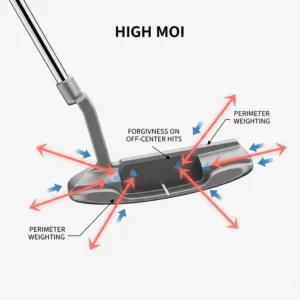
Traditional blade putters might look elegant, but they’re absolutely unforgiving when you miss the center of the face – which high handicappers do constantly. What you need is a putter engineered specifically for forgiveness, one that keeps the ball rolling toward the hole even when your stroke isn’t perfect. The game improvement putters in this guide feature high MOI designs, alignment aids that actually work, and consistent distance control technology.
After researching dozens of putters and analyzing feedback from thousands of golfers, I’ve identified seven exceptional options that will transform your putting game. Whether you’re on a budget or ready to invest in premium performance, there’s a perfect match here for you.
Quick Comparison Table
| Putter | Type | MOI | Best For | Price Range |
|---|---|---|---|---|
| Odyssey Ai-ONE 2-Ball | Mallet | High | Alignment & Feel | $300-$350 |
| TaylorMade Spider Tour | Mallet | Very High | Stability & Forgiveness | $249-$449 |
| Cleveland HB Soft | Various | Medium-High | Budget Seekers | $149-$199 |
| Wilson Infinite | Mallet/Blade | High | Value & Counter-Balance | $129-$149 |
| Ping Fetch | Mallet | High | Ball Retrieval & Stability | $199-$227 |
| Cobra King 3D Agera | Mallet | Extreme | Maximum Forgiveness | $279-$349 |
| Odyssey White Hot Pro | Various | Medium | Classic Feel | $179-$229 |
💬 Just one click – help others make better buying decisions too! 😊
Top 7 Putters for High Handicappers: Expert Analysis
1. Odyssey Ai-ONE 2-Ball DB – The Intelligent Choice
The Odyssey Ai-ONE 2-Ball DB isn’t just another pretty face on the green – it’s a putting revolution powered by artificial intelligence. Callaway’s engineers used supercomputing to design the insert topology, creating contours that normalize ball speed across the entire face.
Key Specifications:
- AI-designed aluminum backing with White Hot urethane insert
- Double-bend face-balanced shaft (perfect for straight-back strokes)
- Stroke Lab steel shaft with counter-balance weighting
- Navy blue PVD finish
Price: $299-$349
The two-ball alignment system has been iconic for two decades because it simply works. You’re not guessing where the face is pointing – those balls frame your target perfectly. High handicappers consistently report feeling more confident over 10-footers with this visual aid.
Customer feedback highlights the incredible consistency on mis-hits. One reviewer mentioned dropping his three-putt percentage from 28% to 18% in just three weeks. The grooved White Hot urethane promotes immediate forward roll rather than skidding, which means more predictable distances.
✅ Pros:
- Best-in-class distance control on off-center hits
- Legendary alignment system instills confidence
- Soft yet responsive feel
❌ Cons:
- Premium price point
- Face-balanced design requires straight stroke
Target Golfer: Mid-to-high handicappers who struggle with distance control and need bulletproof alignment.
2. TaylorMade Spider Tour – Tour-Proven Stability
When Tommy Fleetwood and other tour professionals trust the TaylorMade Spider Tour under pressure, you know it delivers. This is one of the highest MOI putters you can buy, offering stability that forgives even your worst contact.
Key Specifications:
- Pure Roll White TPU insert with 45° grooves
- Thin-wall undercut with steel wireframe
- True Path Alignment system
- Multiple weight configurations available
Price: $249-$349 (standard models), $449-$499 (5K-ZT versions)
The Spider’s distinctive design isn’t just for looks – that perimeter weighting creates a moment of inertia that makes toe and heel hits feel remarkably similar to center strikes. The True Path alignment helps you visualize the line to the hole with optical clarity.
Golfers consistently praise the Spider’s ability to maintain direction on off-center putts. The Pure Roll insert produces excellent topspin, helping putts hold their line even on bumpy greens. The sound at impact is crisp without being harsh.
✅ Pros:
- Exceptional stability prevents twisting
- Tour-proven performance and reliability
- Outstanding forgiveness on mishits
❌ Cons:
- Large footprint may intimidate some players
- Premium pricing on newest models
Target Golfer: High handicappers who miss the center regularly and need maximum stability for confidence.
3. Cleveland Huntington Beach Soft – Budget Champion
The Cleveland Huntington Beach Soft delivers Scotty Cameron-level craftsmanship at a fraction of the price. Made from the same 304 stainless steel used in putters costing $400+, this lineup punches way above its weight class.
Key Specifications:
- Speed Optimized Face Technology (SOFT)
- 304 stainless steel construction
- Diamond CNC milling pattern
- Multiple head shapes (#1 blade, #11 mallet, etc.)
Price: $149-$199
Cleveland’s SOFT technology normalizes ball speed across the face, meaning your 3-footer that catches the toe won’t come up short. The diamond milling increases friction for pure roll and surprisingly soft feel. The gray PVD finish eliminates glare – a godsend for those with light-sensitive eyes.
Amazon reviewers consistently call this the best value in golf. One customer noted switching from his old Cleveland and immediately seeing improved distance control. The Lamkin grip provides excellent feedback without being oversized.
✅ Pros:
- Exceptional value for premium materials
- Consistent speed control technology
- Anti-glare finish
❌ Cons:
- Not as high MOI as oversized mallets
- Limited shaft options
Target Golfer: Budget-conscious high handicappers who want quality without the premium price tag.
4. Wilson Infinite Buckingham – The Counter-Balance Solution
The Wilson Infinite Buckingham brings professional-level counter-balance technology to everyday golfers. That 104-gram grip isn’t a gimmick – it fundamentally changes how the putter swings, promoting a smoother, more controlled stroke.
Key Specifications:
- Counter-balanced design with heavy grip
- Double-milled face pattern
- Ultra-dark PVD matte finish
- Multiple head shapes available
Price: $129-$149
Counter-balance putters move the balance point closer to your hands, which naturally slows down and smooths your tempo. For high handicappers who tend to get “jabby” with short putts, this design promotes a rhythmic stroke that produces better results.
The Buckingham mallet provides excellent alignment with three contrasting white lines. The double-milled face creates consistent roll regardless of where you strike the ball. Named after Chicago landmarks, the Infinite series offers nine different head shapes to match your stroke type.
✅ Pros:
- Counter-balance improves tempo and rhythm
- Outstanding value at $129
- Dark finish reduces distractions
❌ Cons:
- Heavy grip takes adjustment
- Limited availability in stores
Target Golfer: High handicappers with quick, jerky strokes who need help with tempo and consistency.
5. Ping Fetch – The Back-Saving Innovation
The Ping Fetch solves a problem every golfer faces while delivering exceptional putting performance. That ball-sized cutout in the sole isn’t just clever – it strategically redistributes weight to the perimeter for higher MOI and forgiveness.
Key Specifications:
- Dual-density PEBAX face insert
- Strategic sole cutout for ball retrieval
- Ball-width alignment lines
- Raw blast glare-reducing finish
Price: $199-$227
The PEBAX insert delivers different feels depending on putt length – soft on delicate short putts, stable on longer lag attempts. This dual-density technology helps high handicappers develop better touch around the green.
Golfers rave about the retrieval feature, especially those with back or knee issues. Beyond the convenience factor, customers report the Fetch’s compact profile makes it easier to aim than bulkier mallets. The double-bend hosel suits straight-back, straight-through strokes perfectly.
✅ Pros:
- No more bending to retrieve balls
- High MOI from perimeter weighting
- Versatile feel for various distances
❌ Cons:
- Face-balanced only
- Unique look requires adjustment
Target Golfer: High handicappers with physical limitations who want ergonomic design plus performance.
6. Cobra King 3D Printed Agera – The Future Is Here
The Cobra King 3D Printed Agera represents a quantum leap in putter technology. That intricate 3D-printed lattice structure isn’t just eye-catching – it enables weight distribution impossible with traditional manufacturing.
Key Specifications:
- 3D-printed nylon lattice cartridge
- SIK Descending Loft Technology (DLT)
- Multi-material construction (steel, aluminum, tungsten)
- Interchangeable weights
Price: $279-$349
SIK’s Descending Loft Technology uses four descending lofts (4°, 3°, 2°, 1°) across the face. Whether you press forward at impact or add loft, every putt launches consistently. This solves a major issue for high handicappers whose impact conditions vary wildly.
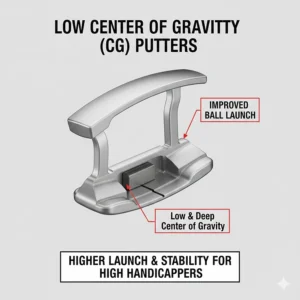
The 3D-printed lattice allows engineers to maximize MOI while maintaining a reasonable head size. Reviewers describe feeling almost nothing through the hands on impact – pure stability. The black aluminum insert delivers solid feel without harshness.
✅ Pros:
- Highest MOI in its class
- Launch consistency regardless of strike
- Customizable weighting
❌ Cons:
- Futuristic looks aren’t traditional
- Somewhat loud impact sound
Target Golfer: Tech-forward high handicappers who want maximum forgiveness and consistent launch.
7. Odyssey White Hot Pro 2.0 Seven Bird – The Classic Evolved
The Odyssey White Hot Pro 2.0 Seven Bird updates a legend. The White Hot insert has won more tour events than any other putter technology, and this mallet version brings that proven performance with high-handicapper-friendly forgiveness.
Key Specifications:
- Classic White Hot insert
- Three-line alignment on milled finish
- Cavity back mallet design
- PVD finish
Price: $179-$229
The Seven Bird’s cavity back distributes mass for superb stability at impact. This promotes consistent topspin and smooth roll that high handicappers desperately need. The evenly distributed mass helps you square the face at contact, starting more putts on your intended line.
The White Hot insert provides that soft, slightly muted feel tour players love. It helps soften the blow on longer putts while maintaining responsiveness on short ones. The amplified sound gives positive feedback without being excessive.
✅ Pros:
- Tour-proven White Hot insert technology
- Excellent balance of feel and forgiveness
- Multiple length options
❌ Cons:
- Not as high MOI as newer designs
- Mid-range pricing
Target Golfer: Traditional-minded high handicappers who want proven technology with mallet forgiveness.
Understanding Putter Forgiveness: The Science Behind the Magic
Let’s talk about something that will change how you think about putters forever: Moment of Inertia (MOI).
MOI measures a putter’s resistance to twisting when you miss the center of the face. According to research from The GolfWorks, high handicap golfers (18+) have impact points that vary by about 3/4 inch on either side of center – that’s a 1.5-inch span across the face!
The MOI Advantage
TaylorMade’s engineering team explains that a clubhead with high MOI resists twisting more than one with low MOI. Less twisting means more energy transfers to the ball, maintaining both speed and direction on off-center hits.
Traditional blade putters typically measure 2,000-5,000 MOI. Modern mallet putters designed for high handicappers can exceed 7,000 MOI – nearly double the forgiveness. The Cobra King 3D Agera, for instance, achieves over 6,400 MOI through its innovative 3D-printed structure.
Why Mallets Dominate for High Handicappers
Mallet putters achieve higher MOI by distributing weight to the perimeter, far from the center of gravity. This perimeter weighting is why you’ll see tungsten weights in the heel and toe of most game improvement putters.
According to research published in the MDPI journal, minimizing center of gravity depth while maximizing MOI results in more consistent launch direction and distance control – exactly what high handicappers need.
How to Choose Putters for High Handicappers
Selecting the right putter requires understanding these seven critical factors:
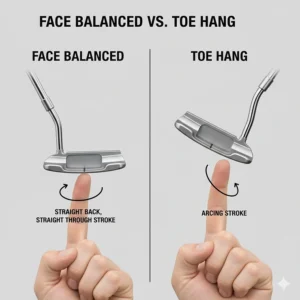
1. Determine Your Stroke Type
Stand naturally over a ball and make several practice strokes. Does your putter swing straight back and through, or does it naturally arc inside to inside?
- Straight-back stroke: Face-balanced putters (double-bend shaft, center-shafted)
- Arcing stroke: Toe-hang putters (plumber’s neck hosel, slant neck)
2. Prioritize Forgiveness Over Feel
As a high handicapper, your #1 priority should be keeping mishits close to your target line. High MOI mallets with perimeter weighting will transform your consistency, even if they don’t provide blade-style feedback.
3. Alignment Aids Are Your Friend
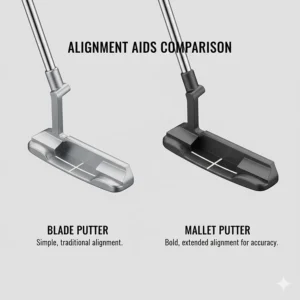
Don’t underestimate the power of visual alignment. The Odyssey 2-Ball’s design isn’t popular by accident – those balls help you aim correctly. Three-line systems like on the Wilson Infinite work equally well for many golfers.
4. Consider Putter Length
The standard 35-inch putter isn’t right for everyone. Too long, and you’ll hunch over with eyes inside the ball. Too short, and you’ll strain your back. Get fitted to find your ideal length.
5. Understand Face Inserts
Soft inserts (White Hot urethane, PEBAX) provide feel and help with distance control. Aluminum inserts offer firmer feedback. For most high handicappers, softer inserts help develop better touch.
6. Weight and Balance Matter
Counter-balanced putters with heavier grips slow down your tempo naturally. Standard weight putters work if your tempo is already smooth. Experiment to find what promotes your most rhythmic stroke.
7. Don’t Ignore Your Budget
Great putters exist at every price point. The Cleveland Huntington Beach Soft at $149 offers performance rivaling putters costing $400. Invest wisely, but don’t assume expensive equals better for your game.
Mallet vs Blade: Which Is Right for You?
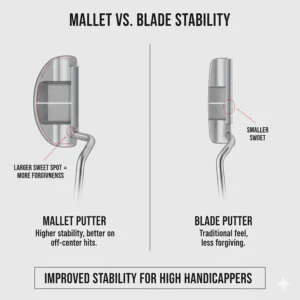
The mallet versus blade debate has a clear answer for most high handicappers: choose the mallet.
Why Mallets Win for High Handicappers
Mallets distribute weight around the perimeter, creating higher MOI. That oversized head provides:
- Visual confidence: The larger footprint frames the ball beautifully
- Forgiveness: Toe and heel hits maintain direction better
- Alignment help: More real estate for alignment aids
- Stability: Reduced twisting on off-center contact
Research shows high handicappers miss the sweet spot on 75-80% of putts. Every one of those mis-hits benefits from mallet forgiveness.
When Blades Make Sense
Some high handicappers perform better with blades if they have:
- A natural arcing stroke with significant face rotation
- Strong preference for traditional aesthetics
- Desire for maximum feedback on strike location
- Consistent contact patterns (rare for high handicappers)
The Mid-Mallet Compromise
Putters like the Odyssey White Hot Pro 2.0 Seven Bird offer the best of both worlds – more compact than oversized mallets but significantly more forgiving than blades. This category works well for improving players transitioning from high to mid handicap.
Face Insert Technology Explained
Modern putter inserts do far more than just soften feel. Understanding these technologies helps you make informed choices.
White Hot Urethane (Odyssey)
The legendary White Hot insert combines soft urethane with grooves that promote immediate forward roll. Tour players and amateurs love the soft yet responsive feel. Consistency across the face makes it ideal for high handicappers.
PEBAX Inserts (Ping)
Ping’s dual-density PEBAX delivers soft feel on short putts while maintaining stability on longer rolls. The varying firmness helps develop better distance control across different putt lengths.
Pure Roll TPU (TaylorMade)
The white TPU insert blends Surlyn and aluminum with 45° grooves. This promotes optimal forward roll and better overall roll characteristics. The white color creates visual symmetry with alignment aids.
SIK Descending Loft Technology (Cobra)
SIK’s four-plane face design compensates for varying shaft angles at impact. Whether you press forward or add loft, the descending lofts (4°, 3°, 2°, 1°) normalize launch conditions. Game-changing for inconsistent strikers.
Speed Optimized Face Technology (Cleveland)
Cleveland’s SOFT technology normalizes ball speed across the face using precision milling patterns. Off-center hits maintain similar speeds to center strikes, drastically improving distance control.
Counter-Balance Technology: A Game-Changer for Tempo
Counter-balanced putters like the Wilson Infinite series move the balance point closer to your hands by adding weight to the grip end. This seemingly simple change produces profound results.
How Counter-Balance Helps
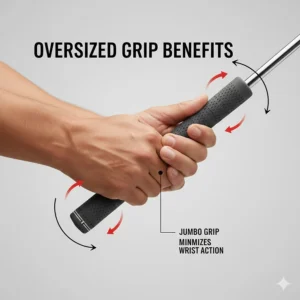
Traditional putters balance near the head. When you swing them, acceleration happens quickly – sometimes too quickly for high handicappers with jerky strokes. Counter-balanced putters feel more head-heavy relative to your hands, which:
- Smooths tempo: The heavier grip naturally slows your backswing and through-stroke
- Reduces wrist action: Added grip weight minimizes excessive hand manipulation
- Improves consistency: A rhythmic stroke produces more predictable results
- Enhances control: You feel more connected to the putter throughout the motion
Who Benefits Most
Counter-balanced putters transform results for golfers who:
- Rush short putts and “stab” at the ball
- Struggle with consistent tempo
- Have active hands and wrists
- Experience the “yips” or nervous jitters
Adjustment Period
Expect 2-3 rounds to adapt. The heavier grip feels unusual initially, but most golfers report improved rhythm after adjustment. Practice on your carpet at home to accelerate adaptation.
Price Ranges & Value Analysis
| Price Category | What You Get | Best Options |
|---|---|---|
| Budget ($129-$149) | Solid materials, proven designs, limited customization | Wilson Infinite, Cleveland HB Soft |
| Mid-Range ($199-$279) | Premium materials, advanced inserts, better aesthetics | Ping Fetch, Odyssey White Hot Pro |
| Premium ($299-$449) | Cutting-edge technology, AI design, tour-level performance | Odyssey Ai-ONE, TaylorMade Spider, Cobra 3D Agera |
Where to Invest Your Money
Best Overall Value: Cleveland Huntington Beach Soft delivers 304 stainless steel, CNC milling, and SOFT technology for under $150. This represents exceptional value.
Best Performance-to-Price: Wilson Infinite at $129 includes counter-balance technology, double-milled face, and premium finish. Hard to beat for budget-conscious golfers.
Worth the Premium: Odyssey Ai-ONE 2-Ball justifies $349 with AI-designed insert topology that genuinely improves performance. The technology works.
Technology Leader: Cobra King 3D Agera’s 3D-printed construction and SIK face technology at $279-$349 represents the future. Maximum forgiveness for serious improvement.
Alignment Systems That Actually Work
Alignment is where most high handicappers lose strokes. You can have a perfect stroke, but if you’re aimed wrong, the ball won’t go in.
Two-Ball System (Odyssey)
The most iconic alignment aid in golf. Two circular discs frame the ball perfectly, making it nearly impossible to misalign. Your subconscious locks onto those circles automatically.
Triple-Track (Odyssey, Some Models)
Three parallel lines with varying thickness create an optical channel. The lines must flow uninterrupted from putter to ball for proper alignment. Highly effective.
True Path (TaylorMade Spider)
Optically-engineered system uses contrasting colors and geometric patterns to help visualize the line to the hole. Makes aim easier and faster.
Three-Line System (Wilson Infinite, Others)
Central line flanked by two parallel lines. Simple but remarkably effective. Works for golfers who prefer clean, understated alignment aids.
Ball-Width Cavity (Ping)
The Ping Scottsdale series uses a ball-width insert matching a ball-width cavity. This creates natural alignment with perpendicular visual cues for squaring the face.
Common Putting Mistakes High Handicappers Make
Avoid these pitfalls that sabotage even the best equipment:
1. Gripping Too Tightly
Death grip restricts natural wrist hinge and creates tension. Hold your putter like you’re holding a bird – firm enough it can’t fly away, gentle enough not to hurt it.
2. Looking Up Too Soon
Peeking to see where the ball went before impact causes your shoulders to open, pushing putts right. Focus on hearing the ball drop rather than watching it.
3. Decelerating Through Impact
Slowing down through the ball creates inconsistent contact. Maintain acceleration through impact for pure strikes and consistent speed.
4. Poor Setup Fundamentals
Eyes should be over (or slightly inside) the ball, shoulders square to your line. Many high handicappers set up with eyes too far inside, promoting pulls.
5. Ignoring Break
High handicappers often under-read break, especially on faster greens. Start putts outside the hole on breaking putts – gravity will bring them back.
6. Inconsistent Tempo
Varying your stroke speed from putt to putt destroys distance control. Develop a consistent rhythm – three seconds back, three seconds through works for most golfers.
7. Wrong Putter Length
Using a standard 35-inch putter when you need 33 or 34 inches creates posture issues that multiply errors. Get fitted properly.
Practice Drills to Lower Your Putts Per Round
The Gate Drill
Place two tees 2 inches apart about 3 feet from the hole. Practice stroking putts through the gate without touching the tees. This builds both path and face control.
Distance Control Ladder
Place balls at 3, 6, 9, 12, and 15 feet. Hole the 3-footer, then work through each distance. Miss one? Start over. This builds pressure and consistency.
One-Hand Putting
Practice with just your lead hand (left for righties). This eliminates excessive wrist action and promotes a shoulder-driven stroke.
Circle Drill
Place 8 balls in a circle 6 feet from the hole. Make all 8 consecutively before leaving practice green. This simulates pressure and builds confidence.
Long Putt Lag
Practice 30-40 footers focusing solely on speed, not line. Try to stop every putt within 3 feet of the hole. This prevents three-putts.
Maintenance Tips for Maximum Longevity
Clean Your Putter Face Weekly
Dirt and debris in grooves reduce friction and alter roll characteristics. Use a soft brush with warm, soapy water. Dry immediately with microfiber cloth.
Inspect Your Grip Monthly
Worn, slick grips destroy feel and control. Replace annually for casual players, every 6 months for frequent players. Clean with damp cloth between replacements.
Check Alignment Aids
Paint and alignment marks can fade or chip. Use a fine-tip paint pen to touch up lines, maintaining crisp visuals.
Store Properly
Keep your putter in a head cover when not in use. Avoid leaving clubs in hot car trunks where extreme temperatures can affect inserts and adhesives.
Professional Check-Up Annually
Take your putter to a qualified club fitter yearly. They’ll check loft, lie angle, and overall condition. Minor adjustments can dramatically improve performance.
FAQ
❓ What is the most forgiving putter for high handicappers?
❓ Should high handicappers use mallet or blade putters?
❓ How much should I spend on a putter as a high handicapper?
❓ What putter length should high handicappers use?
❓ Do expensive putters really make a difference for high handicappers?
Conclusion: Making the Right Choice for Your Game
Choosing the right putter transforms your entire golf experience. Those frustrating three-putts become confident two-putts. That 6-footer you normally dread becomes makeable. Your scores drop, your confidence soars, and golf becomes fun again.
Remember the fundamentals: high handicappers need maximum forgiveness through high MOI designs, clear alignment aids that work intuitively, and consistent distance control technology. Whether you invest in the budget-friendly Wilson Infinite at $129 or splurge on the technology-packed Cobra King 3D Agera at $349, prioritize forgiveness over everything else.
My top recommendation for most high handicappers is the Cleveland Huntington Beach Soft. It delivers premium materials, SOFT face technology, and excellent forgiveness at just $149 – exceptional value that performs like putters costing three times more.
For golfers seeking maximum forgiveness regardless of budget, the Cobra King 3D Printed Agera represents the cutting edge. That 3D-printed lattice structure and SIK Descending Loft Technology eliminate variables other putters can’t touch.
Budget-conscious players should strongly consider the Wilson Infinite Buckingham. At $129, the counter-balance technology naturally smooths your stroke while the double-milled face provides consistency across the entire surface.
Don’t let putting sabotage your rounds any longer. Invest in one of these seven proven putters, practice the drills outlined above, and watch your scores plummet. The hole isn’t shrinking – you’re just finally using equipment designed for your skill level.
Recommended for You
- 7 Best Putters for Beginners 2026: Easy Aim & High MOI
- 7 Best Blade Putters 2026: Pure Feel & Tour Performance
- 7 Best Mallet Putters 2026: Tested & Proven Winners
Disclaimer: This article contains affiliate links. If you purchase products through these links, we may earn a small commission at no additional cost to you.
✨ Found this helpful? Share it with your friends! 💬🤗
