

In This Article
If you’ve ever stood on a tee box squinting down a fairway that looks about as wide as a bowling lane, you already know why driving hybrid accuracy matters more than raw distance. A driving hybrid is a club built to replace your driver or long irons on the tightest, most nerve-wracking tee shots — the ones where a slice or hook means a penalty stroke, not just a longer approach. What is driving hybrid accuracy, exactly? It’s the measurable ability of a hybrid club to produce tight shot dispersion and repeatable ball flight from the tee, even on off-center strikes, thanks to a low center of gravity and a more compact, iron-like swing path…
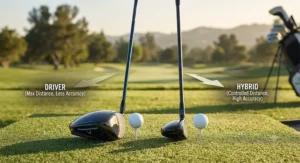
That gap between “I hit my driver great on the range” and “I hit my driver great on a course lined with water and OB stakes” is where hybrids earn their keep. Manufacturers have spent the last few seasons chasing exactly this problem, and 2026’s crop of hybrids is arguably the most accuracy-focused lineup we’ve seen. According to the design borrows from both irons and woods, combining the familiar swing mechanics of an iron with the more forgiving nature and better distance of a wood, a fact that explains why so many golfers now lean on a hybrid golf club as their “safety” tee shot on the tightest holes.
This guide breaks down the seven best hybrids for accuracy on the market right now, how they stack up against each other and against your driver, and exactly how to use one to save real strokes — not just theoretical ones.
Quick Comparison Table
| Hybrid | Best For | Price Range |
|---|---|---|
| Mizuno JPX One | Overall accuracy leader | $270-$300 range |
| Callaway Quantum Max OS | Tightest miss-hit dispersion | $280-$320 range |
| TaylorMade Qi35 Max Rescue | Accuracy + forgiveness balance | $300-$330 range |
| Titleist GT2 | Max forgiveness on tight lies | $320-$350 range |
| Tour Edge Exotics C725 | Best budget accuracy pick | Under $220 |
The spread here matters more than it looks. Mizuno JPX One and TaylorMade Qi35 Max Rescue trade a little bit of forgiveness for pure accuracy numbers, while Titleist GT2 and Callaway Quantum Max OS lean into a bigger forgiveness margin for players who miss the center more often. If you’re on a tighter budget, Tour Edge Exotics C725 proves you don’t need a $350 price tag to tighten up your tee-shot dispersion.
💬 Just one click — help others make better buying decisions too!😊
Top 7 Driving Hybrids for Accuracy: Expert Analysis
Choosing the right club here isn’t about grabbing whatever’s on the top shelf at your local pro shop. Real driving hybrid accuracy comes down to matching center-of-gravity placement, face technology, and shaft weight to your specific miss. Below are seven real, currently available hybrids that cover budget, mid-range, and premium price points — with honest commentary on who each one actually fits.
1. Mizuno JPX One — most accurate hybrid tested this season
The standout here is simple: independent testing weighted accuracy as the single most important scoring category for hybrids in 2026, and the Mizuno JPX One came out on top of that category by a clear margin. According to testing that treats accuracy as the most heavily weighted scoring category for hybrids, the Mizuno JPX One secured the top position for accuracy, which drove it to the number one spot overall. In practical terms, that means a compact, iron-influenced head shape and a lower, more forward center of gravity that keeps the face square through impact rather than letting it flip open or shut on a mis-hit.
Based on the spec comparison against its rivals, the Mizuno JPX One trades some outright ball speed for that control — this isn’t the longest hybrid in the test, but it’s the one that finds the fairway most often, which is exactly the point of a driving hybrid. What most buyers overlook is the spin profile: this model ranked as one of the highest-spinning hybrids evaluated, which is a blessing for slower swingers who need help getting the ball airborne, but a real consideration if you already generate plenty of spin off the tee.
Reviewers consistently note that the Mizuno JPX One feels more like swinging a long iron than a mini fairway wood, which is precisely why better ball-strikers gravitate toward it. This is the club for a mid-to-low handicapper who already trusts their swing and wants a tee-shot option that simply won’t miss badly — not a max-forgiveness gamer-improver head.
Pros:
- ✅ Rated the single most accurate hybrid in independent 2026 testing
- ✅ Compact, iron-like profile builds confidence at address
- ✅ Consistent distance gapping alongside its accuracy edge
Cons:
- ❌ Higher spin can balloon shots for already-high-spin swingers
- ❌ Smaller footprint offers less forgiveness than game-improvement rivals
The Mizuno JPX One typically sits in the $270-$300 range, and given its accuracy testing results, it’s a strong value for anyone who has decided the tee-shot miss, not the carry distance, is what’s costing them strokes.
2. Callaway Quantum Max OS — tightest miss-hit dispersion in its class
The standout advantage on the Callaway Quantum Max OS is its dispersion control on shots that don’t come off the center of the face — exactly the kind of miss that turns a tight fairway into a lost ball. Based on testing data, the Quantum Max OS placed second overall in the 2026 evaluation, prioritizing playable launch conditions, adequate carry distances, and minimal left-to-right dispersion, which is the technical way of saying it keeps your bad swings from turning into bad holes.
What that spec sheet doesn’t spell out is how forgiving the larger clubhead feels at address — this is a hybrid built for players who want a visual confidence boost, not a compact blade-like profile. The extra perimeter weighting stabilizes the face on toe and heel strikes, which is where most amateur mis-hits actually happen. Here’s what to weigh: you’re getting a larger footprint in exchange for that stability, and testers noted its footprint runs larger than some competitors, so if you’re picky about the look of a compact head at address, that’s worth demoing first.
Aggregated reviewer sentiment consistently frames this hybrid as a “no-drama” club — not the longest, not the flashiest, but the one golfers say they trust when the fairway narrows. That reputation for consistency is exactly why it ranks second in accuracy-focused testing behind the JPX One.
Pros:
- ✅ Minimal left-to-right dispersion on off-center strikes
- ✅ Playable, easy-to-launch trajectory for mid-handicappers
- ✅ Strong reputation for forgiveness without sacrificing distance
Cons:
- ❌ Larger footprint than some rivals may not suit better players
- ❌ Not the longest option if raw distance is the priority
Expect to pay in the $280-$320 range for the Callaway Quantum Max OS, and for players who miss off-center more often than they’d like to admit, that’s money well spent on forgiveness.
3. TaylorMade Qi35 Max Rescue — twist face tech for tee-shot forgiveness
The standout here is TaylorMade’s corrective face curvature, purpose-built to tighten dispersion on mis-hits rather than just optimizing the perfect strike. According to TaylorMade’s own technology notes, the Twist Face corrective face curvature promotes tighter downrange dispersion on mis-hits, while a Cut-through Speed Pocket reduces spin on shots struck low on the face and helps maintain ball speed. That’s a meaningful one-two punch: the face geometry corrects your miss, and the sole slot protects your ball speed when you catch one thin.
Based on the spec comparison, the TaylorMade Qi35 Max Rescue also ships with a loft sleeve to adjust loft, flight, and face angle, plus an 8-gram Trajectory Adjustment System weight to fine-tune flight, spin, and swing weight, giving fitters real room to dial in a stock head to an individual swing rather than forcing a one-size-fits-all setup. What most buyers overlook is that this adjustability is what actually drives the accuracy gains — a stock loft that’s half a degree off for your swing speed can cost you more dispersion than any face technology can fix.
Reviewers consistently report that this Rescue feels notably more stable on off-center hits than TaylorMade’s prior-generation hybrids, and the brand itself positions it as building on the success of its predecessors by offering forgiveness, versatility, and power for a broad range of golfers.
Pros:
- ✅ Twist Face geometry actively corrects mis-hit dispersion
- ✅ Adjustable loft sleeve and weight system fit multiple swing types
- ✅ Speed Pocket protects ball speed on thin, low-face strikes
Cons:
- ❌ Adjustability adds setup time versus a simple fixed-hosel hybrid
- ❌ Priced at the higher end of the mid-range tier
Priced around $300-$330, the TaylorMade Qi35 Max Rescue is best suited to golfers who want to get properly fit rather than grab one off the rack — the adjustability is the whole point.
4. Titleist GT2 — best for taming tight fairway nerves
The standout feature is straightforward: this is Titleist’s dedicated maximum-forgiveness hybrid, engineered specifically for golfers whose miss is unpredictable rather than a consistent draw or fade. On paper, that means a wider sole, a lower and more rearward center of gravity, and a larger moment of inertia than Titleist’s shot-shaping GT3 sibling — all of which combine to keep the face stable when contact isn’t perfectly centered.
What that spec sheet won’t tell you, but aggregated buyer sentiment consistently does, is that Titleist’s hybrids tend to feel more “iron-like” through impact than some rivals, which better players specifically request when they’re replacing a 3- or 4-iron rather than a fairway wood. Based on the spec comparison against its GT1 and GT3 siblings, the GT2 sits in the sweet spot — more forgiving than the shot-shaping GT3, more stable through impact than the ultra-lightweight GT1.
Here’s what to weigh: Titleist doesn’t chase the longest-hybrid marketing claims the way some competitors do, and that’s intentional. The Titleist GT2 is built for golfers who’ve decided that finding the short grass on a tight tee shot is worth more than an extra five yards of carry.
Pros:
- ✅ Highest forgiveness in the current Titleist GT hybrid lineup
- ✅ Stable, iron-like feel through impact on off-center strikes
- ✅ Consistent brand reputation for tour-level build quality
Cons:
- ❌ Premium price point compared to mid-range alternatives
- ❌ Not marketed as the longest option in its category
Expect to pay in the $320-$350 range, at the time of research, for the Titleist GT2 — a premium price, but one backed by a brand golfers trust specifically when accuracy, not distance, is the priority.
5. Cobra OPTM — most adjustable for dialing in ball flight
The standout advantage is adjustability depth. Independent reviewers describe it plainly: the Cobra OPTM Hybrid is the best hybrid the brand has ever made, with POI technology representing a genuine step forward in accuracy engineering and the FutureFit33 system unmatched for adjustability. That FutureFit33 hosel system lets a fitter adjust loft and lie independently across dozens of combinations, which matters enormously for driving-hybrid accuracy because lie angle mistakes are one of the most common — and least discussed — causes of a consistent push or pull off the tee.
Based on the spec comparison, reviewers also note real improvement over Cobra’s prior DS-ADAPT generation: design changes over the DS-ADAPT make this a more confidence-inspiring, easier-to-launch club across the board. What that means practically is a more forgiving launch window for moderate swing speeds, without giving up the adjustability that better players want to shape shots on demand.
What most buyers overlook is that adjustability is only valuable if you actually use it — this isn’t a “buy it and forget it” hybrid. Pair it with a proper fitting session, and reviewers consistently note it becomes one of the most versatile tee-shot options in this price bracket.
Pros:
- ✅ FutureFit33 hosel allows independent loft and lie adjustment
- ✅ POI weighting technology genuinely improves accuracy engineering
- ✅ Easier, more confidence-inspiring launch than its predecessor
Cons:
- ❌ Full value requires a proper fitting, not an off-the-rack purchase
- ❌ Adjustability options can overwhelm first-time hybrid buyers
Priced around $280-$320, the Cobra OPTM rewards golfers willing to spend fifteen minutes with a fitter dialing in loft and lie rather than grabbing stock settings.
6. Srixon ZX MkII — best accuracy-per-dollar for skilled swingers
The standout here is who this club is built for: better players who’ve already ditched their long irons and want one trustworthy hybrid rather than a distance-chasing marketing exercise. Reviewers put it bluntly: from a performance standpoint, the ZX MkII is accurate and consistent in a way that rewards good ball-striking, with distance solid without being the headline. That restraint is actually the selling point — Srixon isn’t optimizing for a longest-hybrid headline, it’s optimizing for shots that finish where you aimed them.
Based on the spec comparison, what buyers get instead is consistent distance gapping, reliable shot shape, and trustworthy performance that lets golfers commit to their swing without second-guessing the club. For a skilled ball-striker, that trust is worth more than an extra three or four yards of carry, especially on a tee shot where the penalty for a miss outweighs the benefit of a longer good shot.
Aggregated review sentiment consistently describes the feel as tour-quality without the tour-level price tag, and the club has genuinely become a long-irons replacement for skilled players who’ve ditched their 3- and 4-irons entirely rather than a beginner’s safety net.
Pros:
- ✅ Excellent accuracy and consistency for better ball-strikers
- ✅ Tour-quality feel at a below-premium price point
- ✅ Reliable shot shape builds swing confidence under pressure
Cons:
- ❌ Less forgiving than game-improvement hybrids on poor strikes
- ❌ Distance is intentionally conservative rather than category-leading
Sitting in the $230-$270 range, the Srixon ZX MkII is arguably the smartest accuracy purchase for a skilled player who doesn’t want to pay full premium-brand price.
7. Tour Edge Exotics C725 — best budget pick for straighter tee shots
The standout feature is simply value: this hybrid delivers genuinely competitive accuracy performance without the premium-brand price tag attached to the six clubs above it. Tour Edge has built its reputation on exactly this — engineering competitive with the majors at a noticeably lower price point, and the Exotics C725 continues that pattern with a forgiving, game-improvement head shape and a lower, more stable center of gravity that helps square the face at impact.
Based on the spec comparison, what you give up compared to a $320 Titleist GT2 isn’t accuracy fundamentals — it’s brand-name adjustability systems and marginal aerodynamic refinements. What most buyers overlook is that Tour Edge has historically used similar shaft and head material quality to premium brands, just without the marketing budget baked into the price.
Reviewers consistently frame Tour Edge’s hybrid lineup as the category’s best value proposition, and the C725 is no exception — a legitimate option for golfers building a full bag of accuracy-first hybrids without spending premium-brand money on each one.
Pros:
- ✅ Strong accuracy performance well below premium-brand pricing
- ✅ Forgiving, game-improvement head shape for a wide range of swings
- ✅ Consistent reputation as the category’s best value option
Cons:
- ❌ Fewer adjustability features than premium adjustable-hosel rivals
- ❌ Smaller aftermarket shaft-fitting ecosystem than the major brands
At under $220 at the time of research, the Tour Edge Exotics C725 is the clear pick for anyone prioritizing driving hybrid accuracy on a tighter budget.
Top 7 Products Comparison Table
| Hybrid | Accuracy Profile | Forgiveness | Price Range | Best For |
|---|---|---|---|---|
| Mizuno JPX One | Highest tested | Moderate | $270-$300 | Better players wanting pure accuracy |
| Callaway Quantum Max OS | Very high | High | $280-$320 | Mid-handicappers, off-center misses |
| TaylorMade Qi35 Max Rescue | High | High | $300-$330 | Golfers who want a proper fitting |
| Titleist GT2 | High | Highest | $320-$350 | Max forgiveness on tight lies |
| Cobra OPTM | High | High | $280-$320 | Golfers who’ll use adjustability |
| Srixon ZX MkII | High | Moderate | $230-$270 | Skilled ball-strikers, value seekers |
| Tour Edge Exotics C725 | Solid | High | Under $220 | Budget-focused accuracy buyers |
Looking at the table above, the Mizuno JPX One and TaylorMade Qi35 Max Rescue sit at the top of the accuracy hierarchy, but the Titleist GT2 and Callaway Quantum Max OS may actually serve a wider range of golfers thanks to their higher forgiveness ceilings. Budget-conscious buyers shouldn’t overlook the Tour Edge Exotics C725 — it delivers most of the accuracy benefits of clubs costing $100 more.
Mastering Driving Hybrid Control Tee Setup
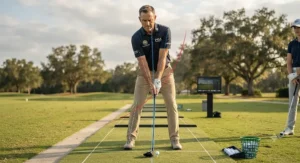
Getting real driving hybrid control tee results starts before you ever swing — it starts with tee height. Because a hybrid’s center of gravity sits lower and further back than a driver’s, teeing the ball too high forces you to swing up at it awkwardly, which is exactly how a confident tee shot turns into a weak pop-up. Aim to tee the ball so roughly half the ball sits above the crown of the club at address — noticeably lower than you’d tee a driver.
In your first thirty days with a new hybrid, the most common mistake is swinging it like a driver instead of a long iron. A hybrid rewards a slightly descending strike, the same motion you’d use with a 5-iron, not the sweeping upward arc that maximizes driver distance. Practice hitting off a tight lie on the range before you trust it on the course, since that’s the actual shot you’re building the club into your bag for.
Maintenance is minimal but not nonexistent: wipe the face and grooves after every round, since dirt in the grooves reduces spin control on approach-style hybrid shots, and check the adjustable hosel (if your model has one) every few months to make sure it hasn’t loosened from repeated swings.
Narrow Fairway Strategy: Real Golfer Scenarios
A smart narrow fairway strategy depends entirely on who’s swinging the club, so here are three realistic profiles matched to specific picks from our list above.
The 15-handicap weekend player who slices under pressure and just wants to stay in play off tight tees: the Callaway Quantum Max OS or Titleist GT2 make the most sense here. Both prioritize forgiveness on off-center hits, which is exactly the miss this golfer needs covered, and neither requires an elaborate fitting to play well out of the box.
The low-single-digit handicapper who already trusts their swing but wants insurance on the tightest holes: the Mizuno JPX One or Srixon ZX MkII fit better. Both reward good ball-striking rather than masking a poor one, and both keep the compact, iron-like feel this player expects from a long-iron replacement.
The budget-conscious golfer building a full accuracy-first bag — maybe two or three hybrids replacing everything from a 3-iron down to a 6-iron — should look hardest at the Tour Edge Exotics C725. Buying three premium hybrids at $320 each is a real expense; three Exotics C725s covers nearly the same yardage gaps for a fraction of the cost.
Choosing Your Precision Tee Club: A Decision Framework
Use this simple framework to shortcut the decision if you’re overwhelmed by the options above.
If your miss is unpredictable and you don’t trust your swing under pressure, choose a max-forgiveness hybrid like the Titleist GT2 or Callaway Quantum Max OS, because a wider sole and lower center of gravity will bail you out more often than a compact, better-player head will.
If you already strike the ball well and want a precision tee club that won’t second-guess your swing, choose the Mizuno JPX One or Srixon ZX MkII, because their more compact profiles reward consistent contact rather than masking inconsistency.
If budget is the deciding factor, choose the Tour Edge Exotics C725 first, because it delivers most of the accuracy benefit of the premium options above at roughly two-thirds the cost.
✨ Don’t Miss These Exclusive Deals!
🔍 Take your tee-shot accuracy to the next level with these carefully selected hybrids. Click on any highlighted product to check current pricing and availability, and start hitting more fairways with confidence!
How to Choose a Driving Hybrid for Accuracy
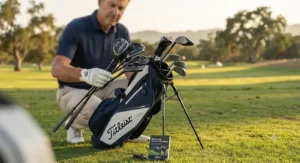
- Match loft to your longest reliable iron. A hybrid should fill the gap between your fairway wood and the longest iron you still hit well — usually 19-24 degrees of loft.
- Prioritize center of gravity placement over marketing claims. A lower, more forward CG (like the Mizuno JPX One) suits better strikers, while a lower, more rearward CG (like the Titleist GT2) suits inconsistent contact.
- Get the shaft weight right. Heavier hybrid shafts, typically 80-90 grams, encourage more controlled swings than the lighter shafts found in fairway woods.
- Test on a tight lie, not a tee. Hitting off the deck reveals a hybrid’s real forgiveness far better than a perfectly teed-up range ball ever will.
- Consider adjustability only if you’ll use it. The Cobra OPTM‘s FutureFit33 system is fantastic — but only if you actually get fit rather than leaving it at stock settings.
- Don’t chase the longest-hybrid headline. As the Srixon ZX MkII proves, a club that isn’t the longest can still be the most useful if it’s the most accurate.
- Budget for a real fitting session, not just the club. A $250 hybrid properly fit will usually outperform a $350 hybrid bought off the rack.
Common Mistakes When Buying a Driving Hybrid
The single most common mistake is buying based on a friend’s recommendation rather than your own swing speed and miss pattern — a club that fixed someone else’s slice won’t necessarily fix yours. A close second is skipping a real fitting session entirely, since stock lofts and lies are built around averages, not your specific swing.
Golfers also frequently overvalue distance numbers on a box or website, when driving hybrid accuracy — measured in dispersion, not carry — is what actually saves strokes on tight holes. Finally, many buyers assume a more expensive hybrid automatically means more forgiveness, when in reality clubs like the Tour Edge Exotics C725 prove that isn’t always true.
Driving Hybrid vs Fairway Wood: Which Wins on Tight Tee Shots
| Factor | Hybrid | Fairway Wood |
|---|---|---|
| Shaft length | Shorter, more control | Longer, more speed |
| Swing mechanic | Iron-like, descending strike | Sweeping, driver-like |
| Turf interaction | Cuts into turf well | Skims over turf |
| Best lie | Tight fairways, light rough | Fairway, tee |
| Accuracy on mis-hit | Generally tighter dispersion | Generally wider dispersion |
Golf Monthly’s testing backs up why this table skews toward hybrids for accuracy: hybrids are usually easier to hit than woods because of the lower centre of gravity and denser head construction, and the club design encourages you to hit down on the ball in the same way as an iron. That descending strike is the whole reason a hybrid behaves so predictably from a tight tee — you’re not relying on a sweeping motion that punishes even slightly early or late contact.
The trade-off, as Golf Monthly notes, is that lighter and longer fairway wood shafts can tempt players to swing too fast, resulting in inconsistent strikes and reduced accuracy compared to hybrids. If your priority on a specific tee shot is finding the fairway rather than maximizing carry distance, the hybrid wins that trade almost every time.
What to Expect: Real-World Performance From the Tee
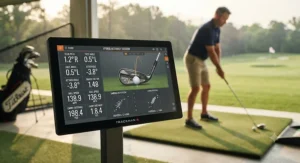
On paper, the numbers on a launch monitor look reassuring — tight dispersion cones, consistent ball speed, predictable spin. On the course, what that translates to is simpler and more useful: a shot that starts roughly where you aimed it and curves only slightly, even when your tempo speeds up under first-tee nerves.
What the spec sheet won’t tell you is how much a hybrid’s shorter shaft changes your pre-shot routine. Because it swings more like a long iron than a driver, many golfers naturally slow down and simplify their swing thoughts, which itself improves consistency independent of the club’s engineering. Reviewers consistently note this psychological effect as much as the physical one — golfers report trusting a hybrid off a tight tee in a way they simply don’t trust their driver.
Driving Hybrid for Tight Fairways
Tight, tree-lined, or water-flanked fairways are the exact scenario a driving hybrid was built to solve. Because the club is engineered to be hit off a tighter lie in the first place, teeing it low and swinging with a slightly descending strike produces the same predictable ball flight you’d get from the fairway — just with a small tee-height advantage.
For this specific scenario, forgiveness-first options like the Titleist GT2 and Callaway Quantum Max OS tend to outperform pure-accuracy clubs like the Mizuno JPX One, simply because the penalty for even a slight miss on a tight fairway is so severe. When the trees are close enough to matter, forgiveness on a mis-hit is worth more than a few extra yards of carry.
Driving Hybrid Distance: The Trade-Off Nobody Explains
Here’s the honest analysis most marketing won’t give you: a driving hybrid will almost always go shorter than a driver, sometimes by 30-40 yards depending on swing speed and shaft length. That’s not a flaw — it’s the entire point. You’re trading distance for dispersion control, and on a tight tee shot, that trade is usually worth it.
Where this gets interesting is club-to-club: within the seven hybrids reviewed above, distance differences of five to ten yards exist, but none of them close a 30-yard gap to a driver. If you’re deciding between a driving hybrid and simply hitting a more conservative club off the tee, understand you’re optimizing for fairways found, not for lowest score on a wide-open par 5.
Features That Actually Matter for Consistent Contact (And Those That Don’t)
Consistent contact comes down to a shorter list of features than manufacturers’ marketing suggests. What actually matters: a properly weighted shaft matched to your tempo, a center of gravity placement that suits your specific miss, and a loft that’s realistic for your swing speed rather than aspirational.
What matters far less than the marketing implies: cosmetic crown designs, minor aerodynamic shaping claims, and headline distance numbers generated under ideal lab conditions. A hybrid’s face technology — like the TaylorMade Qi35 Max Rescue‘s Twist Face — genuinely helps consistent contact by correcting mis-hits, but it can’t fully compensate for a shaft or loft that’s simply wrong for your swing.
Long-Term Cost & Maintenance
A single well-chosen hybrid typically lasts five to eight years of regular play before performance genuinely drops off, which makes even a $320 Titleist GT2 a reasonable cost-per-round investment when spread across that lifespan. Compare that to repeatedly buying and returning ill-fitting clubs chasing a distance number, and the smarter long-term spend is almost always a proper fitting up front.
| Price Tier | Example | Est. Cost-Per-Year (5-yr use) |
|---|---|---|
| Budget | Tour Edge Exotics C725 | Under $220 → ~$44/year |
| Mid-Range | Srixon ZX MkII | $230-$270 → ~$50/year |
| Premium | Titleist GT2 | $320-$350 → ~$66/year |
Looking at the table above, even the premium Titleist GT2 amortizes to a modest annual cost if it genuinely stays in your bag for five years, while the Tour Edge Exotics C725 offers the lowest financial risk if you’re not yet sure a hybrid fits your game. Maintenance costs are minimal across all three tiers — occasional grip replacement and basic cleaning — so price tier should be driven by fit and forgiveness needs, not durability concerns.

FAQ
❓ What loft hybrid is best for accuracy off the tee?
❓ Can you hit a driving hybrid off the tee on a par 4?
❓ Is a hybrid more accurate than a driver?
❓ How much does a driving hybrid cost compared to a driver?
❓ What swing speed do I need for a driving hybrid?
Conclusion
Driving hybrid accuracy isn’t about chasing the longest club in the rack — it’s about walking to the tee on your tightest, most intimidating hole and trusting the club in your hands. Whether that’s the pure accuracy numbers of the Mizuno JPX One, the forgiveness margin of the Titleist GT2, or the value proposition of the Tour Edge Exotics C725, the right pick depends on your specific miss, your budget, and how much adjustability you’ll actually use.
What all seven of these hybrids share is a genuine engineering focus on dispersion control rather than just headline distance — a shift that reflects what serious golfers have been asking for. As the USGA’s equipment standards continue to shape how manufacturers design conforming clubs, that focus on real-world accuracy over lab-condition distance numbers looks likely to keep defining the category through 2026 and beyond.
Get properly fit, tee the ball low, swing it like the long iron it’s replacing, and give your next tight fairway a fighting chance.
Recommended for You
- Driving Hybrid Off Tee: 7 Picks That Fix Your Accuracy (2026)
- Utility Hybrid Shot Shaping: 7 Best Picks for 2026
- 7 Best Golf Utility Hybrid Driving Iron Picks for 2026
Disclaimer: This article contains affiliate links. As an Amazon Associate, I earn from qualifying purchases. If you purchase products through these links, we may earn a small commission at no additional cost to you.
✨ Found this helpful? Share it with your friends! 💬🤗
