
In This Article
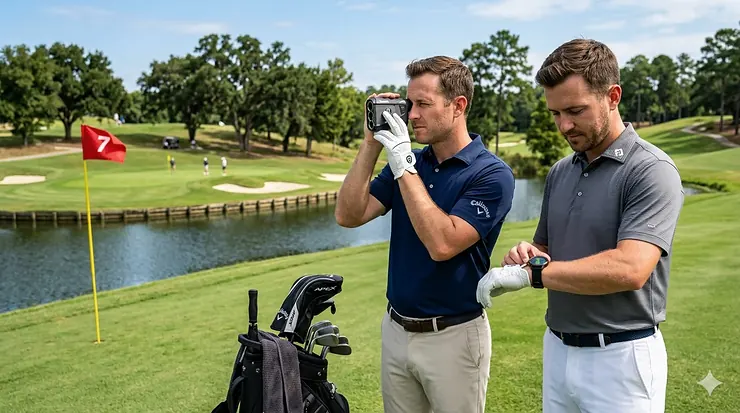
You’re standing over your approach shot, 165 yards out—or is it 172? That seven-yard gap might seem trivial, but it’s the difference between sticking it close and finding the bunker. Welcome to the modern golfer’s challenge: choosing between a golf gps vs rangefinder.
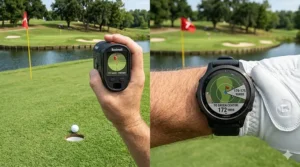
I’ve been testing distance-measuring devices for over a decade, and here’s what I’ve learned: the “best” choice isn’t about which technology wins on paper. It’s about which tool fits your playing style, budget, and the courses you frequent. Some golfers swear by the pinpoint precision of laser rangefinders, while others prefer the comprehensive course mapping of GPS watches and handhelds.
In 2026, both technologies have evolved dramatically. GPS devices now offer slope-adjusted distances and detailed green contours, while laser rangefinders have become faster, more accurate, and tournament-compliant with the flick of a switch. The question isn’t which is better—it’s which is better for you.
This guide cuts through the marketing fluff. I’ve personally tested seven of the most popular devices across both categories, comparing real-world accuracy, ease of use, and value. Whether you’re a weekend warrior or a competitive player chasing every stroke, you’ll find exactly what you need to make the right call.
Quick Comparison Table
| Device Type | Best For | Accuracy | Price Range | Tournament Legal |
|---|---|---|---|---|
| Laser Rangefinder | Precision-focused players | ±1 yard | $200-$600 | Yes (slope off) |
| GPS Watch | Convenience & course management | ±3-5 yards | $150-$600 | Yes (most features) |
| Handheld GPS | Detailed course info | ±3-5 yards | $100-$200 | Yes (most features) |
| Talking GPS | Simplicity & hands-free use | ±3-5 yards | $100-$150 | Yes |
| Hybrid GPS/Laser | Players wanting both | ±1 yard (laser mode) | $500+ | Yes (slope off) |
💬 Just one click – help others make better buying decisions too! 😊
Top 7 Golf GPS vs Rangefinder Devices: Expert Analysis
GPS Devices
1. Bushnell Phantom 3 Slope GPS – Best Handheld GPS Overall
The Bushnell Phantom 3 Slope GPS represents the sweet spot between functionality and portability. This handheld device combines touchscreen convenience with slope-adjusted yardages—a feature once reserved for premium laser rangefinders.
Key Specifications:
- 38,000+ preloaded courses worldwide
- Slope compensation technology
- BITE magnetic cart mount
- 18-hour battery life
What sets this apart is the GreenView feature with movable pin placement. Instead of generic center-green distances, you can cycle through different pin positions for more precise approach planning. The touchscreen responds quickly, even with sweaty fingers mid-round.
Price range sits around $150-$180 on Amazon, making it competitive against GPS watches while offering a larger, easier-to-read display. Customer feedback consistently praises the auto-hole advance and score-tracking features that minimize interaction during your round.
✅ Pros:
- Slope-adjusted distances for hilly courses
- Large, sunlight-readable touchscreen
- Strong magnetic mount keeps it accessible
❌ Cons:
- Not as precise as laser rangefinders
- Requires charging (unlike battery-powered lasers)
2. Garmin Approach S70 – Premium GPS Watch for Serious Golfers
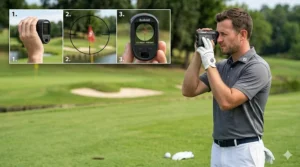
If you want the ultimate golf GPS watch, the Garmin Approach S70 delivers with its stunning 1.4″ AMOLED display and virtual caddie recommendations. This isn’t just a distance device—it’s a comprehensive game-management tool.
Key Specifications:
- 43,000+ full-color course maps
- Virtual caddie with club suggestions
- PlaysLike Distance (barometric elevation adjustment)
- Up to 20 hours GPS battery life
The S70’s standout feature is its AI-powered virtual caddie that analyzes your shot dispersion data, wind speed, and elevation to suggest the optimal club. Green contour mapping shows you exactly how the putting surface breaks, giving you tour-level insights.
Pricing ranges from $500-$600, positioning this firmly in the premium category. Golfers who’ve made the investment report it’s transformed their course management, particularly on unfamiliar layouts.
✅ Pros:
- Tournament-grade course mapping
- All-day battery in GPS mode
- Doubles as a fitness smartwatch
❌ Cons:
- Premium pricing
- Learning curve for advanced features
3. GOLFBUDDY Voice 2S+ – Best Talking GPS for Simplicity
The GOLFBUDDY Voice 2S+ takes a radically different approach: it tells you the yardage audibly, eliminating the need to look at a screen. Clip it to your hat or belt, press the button, and hear front/center/back distances instantly.
Key Specifications:
- Voice-guided distances
- 40,000+ preloaded courses
- Slope on/off capability
- 18-hour battery life
This device excels in pure simplicity. No fumbling with screens, no squinting in bright sunlight—just one-button operation and clear audio feedback. The 2S+ model adds hazard distances and slope calculation, features the original Voice lacked.
At $100-$130, it’s the most affordable option on this list while delivering legitimate value. Golfers with vision challenges or those who simply want minimal distraction report this device speeds up their pre-shot routine significantly.
✅ Pros:
- Hands-free, eyes-free operation
- Lightweight and unobtrusive
- Budget-friendly pricing
❌ Cons:
- No visual course layout
- Audio can be hard to hear in windy conditions
Laser Rangefinders
4. Bushnell Tour V6 Shift – Tour-Proven Laser Accuracy
The Bushnell Tour V6 Shift represents the gold standard in laser rangefinders—used by more PGA Tour pros than any competing brand. Its combination of speed, accuracy, and slope technology makes it the benchmark others chase.
Key Specifications:
- 1,300-yard range capability
- ±1 yard accuracy
- Slope-Switch technology (tournament legal)
- Visual JOLT with vibration confirmation
The V6’s improved electronics deliver the fastest lock-on time I’ve tested, typically under half a second. The red ring that flashes when you’ve locked onto the flag provides unmistakable feedback, even in bright conditions. IPX6 weather resistance means you can use it confidently in light rain.
Pricing typically falls between $330-$400, though sales can bring it closer to $300. Professional reviews and customer feedback consistently rank this among the top three laser rangefinders available, citing reliability and precision as key differentiators.
✅ Pros:
- Tour-proven accuracy and speed
- Excellent optics with 6X magnification
- Slope switch for tournament compliance
❌ Cons:
- Premium price point
- Requires line-of-sight to target
5. Blue Tees Golf Series 3 Max+ – Best Mid-Range Laser Value
The Blue Tees Golf Series 3 Max+ has disrupted the rangefinder market by delivering features typically found on $400+ models at a fraction of the price. It’s become a favorite among golfers who want performance without the premium badge.
Key Specifications:
- 1,000-yard range
- Rechargeable battery (USB-C)
- Adaptive slope technology
- Built-in magnetic strip
What impressed me most was the continuous Arc technology that automatically adjusts for elevation changes. The rechargeable battery eliminates the need to carry spare CR2 batteries, though some traditionalists prefer the instant battery-swap option.
Price typically runs $220-$280 on Amazon, making it one of the best value propositions in the category. The two-year warranty and 60-day money-back guarantee give you risk-free testing time. Customer reviews frequently mention the magnetic mount strength and display clarity as standout features.
✅ Pros:
- Rechargeable battery convenience
- Strong magnet for cart mounting
- Excellent value for features offered
❌ Cons:
- Optics not quite as crisp as Bushnell
- Magnet can make you forget it on the cart
6. Precision Pro NX9 Slope – Budget-Friendly Performance
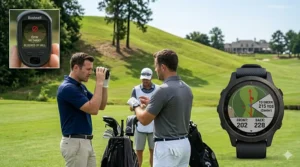
The Precision Pro NX9 Slope proves you don’t need to spend $400 to get accurate, reliable laser distances. This device delivers the essentials—fast lock-on, slope compensation, and magnetic mounting—without the premium price tag.
Key Specifications:
- 900-yard range
- DynamicLock HUD display
- Magnetic cart mount
- Lifetime battery replacement program
Precision Pro’s standout policy is their lifetime free battery replacement—simply contact them when your battery dies, and they’ll send a new one at no charge. The NX9’s pulse vibration confirms target lock, giving you confidence you’ve ranged the flag rather than trees behind the green.
At $230-$280, it competes directly with the Blue Tees but offers the unique battery replacement program. Golfer feedback emphasizes the customer service quality and the device’s consistency across rounds.
✅ Pros:
- Free batteries for life
- Accurate within ±1 yard
- Two-year warranty coverage
❌ Cons:
- 6X magnification vs 7X on premium models
- Weaker magnet than Bushnell
7. Garmin Approach Z82 – Hybrid GPS/Laser Innovation
The Garmin Approach Z82 represents the ultimate convergence: a laser rangefinder with integrated GPS overlays. Look through the viewfinder and see not just the yardage, but a 2D course map with hazards and green shape.
Key Specifications:
- Dual laser/GPS technology
- Course map overlay in viewfinder
- PlaysLike Distance with wind adjustment
- PinPointer for blind shots
This hybrid approach solves the laser’s biggest weakness—blind shots. When you can’t see the flag, PinPointer uses GPS to show you the direction to aim. The plays-like feature accounts for wind, temperature, and elevation using the built-in barometer.
Pricing runs $500-$600, making it one of the most expensive options. Garmin positions this for serious players who want comprehensive data. Reviews note the learning curve but praise the insights once you master the interface.
✅ Pros:
- Combines laser precision with GPS context
- Solves blind-shot challenges
- Comprehensive shot data
❌ Cons:
- Higher price point
- More complex to operate than standard lasers
What is Golf GPS vs Rangefinder? Understanding the Core Difference
A golf GPS uses satellite positioning to calculate your distance to preset points on the course—typically the front, center, and back of the green. It knows where you are and where the targets are based on pre-mapped course data. Think of it as having a digital caddie that automatically tells you yardages without you having to ask.
A rangefinder, specifically a laser rangefinder, works like a precise measuring tape. Point it at any target—the flag, a tree, a bunker—and it fires an invisible laser beam that bounces back. By measuring how long that round trip takes, it calculates exact distance, typically accurate to within one yard.
The fundamental distinction: GPS gives you general course information automatically, while lasers give you precise distances to specific targets you choose. GPS knows the layout; lasers measure what you show them.
Rangefinder or GPS Watch: Which Fits Your Game?
Choosing between a rangefinder or gps watch comes down to three factors: accuracy needs, convenience preference, and budget.
When a Laser Rangefinder Makes Sense
Laser rangefinders excel for players who fire at pins aggressively and need exact yardages. If you’re the type who wants to know whether it’s 147 or 152 yards to that tucked pin, a laser delivers that precision. They’re also ideal for courses with significant elevation changes where knowing the exact uphill or downhill distance matters.
The mental game aspect shouldn’t be overlooked. Many golfers report greater confidence when they’ve lasered their target versus relying on estimated center-green distances. That psychological edge can translate to better swings and lower scores.
When a GPS Watch or Handheld Wins
GPS devices shine for course management players who value overall hole strategy over pinpoint flag distances. If you typically aim for the center of greens and worry more about avoiding hazards than attacking pins, GPS information serves you better. The always-on convenience means zero time fumbling for a device—just glance at your wrist.
GPS also dominates on blind shots. When you can’t see the target, a laser is useless, but GPS gives you the information you need. For golfers who play unfamiliar courses frequently, the comprehensive hole layouts and hazard markers provide genuine strategic advantage.
The Hybrid Compromise
Devices like the Garmin Z82 attempt to give you both worlds, but at a premium price. For most golfers, owning both a simple laser and a GPS watch (total investment around $400-$500) makes more sense than buying one hybrid device for $600.
Which is Better GPS or Rangefinder: The Accuracy Question
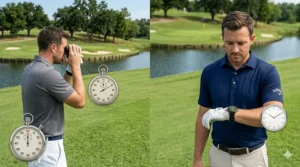
Here’s the straight answer: laser rangefinders are more accurate—period. Top-tier laser units deliver ±1 yard precision, while GPS devices typically claim ±3-5 yard accuracy at best.
However, “accuracy” has a dirty secret in golf: most amateurs can’t execute consistently enough to capitalize on that extra precision. If your approach shots scatter across a 30-yard radius, does knowing the exact yardage to within one yard versus five yards actually matter?
Laser rangefinders provide measurements within a yard, with some claiming accuracy to half or even a tenth of a yard, making them the choice for players with consistent ball-striking who can genuinely exploit that precision.
GPS accuracy depends on several factors: satellite signal strength, course mapping quality, and how recently the database was updated. Modern GPS units have improved significantly over originals, though accuracy still isn’t always as good as a laser. The best GPS devices claim ±1 yard accuracy, though real-world testing suggests ±3-5 yards is more realistic.
One often-overlooked point: GPS can’t tell you the exact distance to a tucked pin position. It shows center-green or movable pin locations, but these are approximations. A laser measures precisely where that day’s pin sits.
For serious competitive players, laser accuracy provides a measurable advantage. For recreational golfers focused on course management and pace of play, GPS accuracy proves sufficient while delivering additional strategic information lasers can’t match.
Golf GPS vs Laser: Speed and Convenience Compared
Speed of measurement matters more than most golfers realize. Slowing down your pre-shot routine affects both your score and pace of play for the entire group.
Laser Rangefinder Speed
Modern laser rangefinders lock onto targets in under one second. The Bushnell Tour V6, for example, delivers distances almost instantaneously. However, this assumes you can quickly locate and target the flag through the viewfinder.
The learning curve with lasers involves mastering the aim-press-hold technique while keeping your hands steady. Shaky hands can extend the process or cause you to accidentally range objects behind or beside the flag. Features like flag-lock technology help by filtering out background objects, but there’s still a skill component.
Total time from grabbing the rangefinder to having your number: typically 3-8 seconds for experienced users, potentially 10-15 seconds for beginners or in challenging conditions like fog or low light.
GPS Speed
GPS devices win decisively on speed. A GPS watch shows distances the instant you glance at your wrist—no button presses, no aiming required. Handheld GPS units require pulling them out but still display information immediately upon waking.
The automatic hole advance feature on modern GPS devices means you never manually input which hole you’re playing. Walk to your ball, check your wrist or pull out your handheld, and the yardage is there. Total time: 1-2 seconds.
This speed advantage compounds over 18 holes. If you save even five seconds per shot, that’s over six minutes per round—meaningful both for your rhythm and for pace of play.
The Convenience Factor
Convenience extends beyond just speed. GPS watches live on your wrist, making them impossible to leave in the cart (a common laser rangefinder problem). They also work in fog, rain, or when trees obstruct your view of the green.
Laser rangefinders require line-of-sight, making them frustrating on blind shots or dogleg holes. You’ll find yourself guessing or pacing off from sprinkler heads—exactly what the rangefinder was supposed to eliminate.
Tournament Legal: GPS and Rangefinder Rules Explained
Understanding tournament legality matters whether you play club championships or just want to post official handicap scores. The rules have evolved significantly, and modern devices offer solutions.
The USGA rules allow the use of distance-measuring devices under rule 4.3a, provided specific prohibited functions are not accessed. Here’s what you need to know:
What’s Always Legal
Both GPS devices and laser rangefinders can legally measure:
- Distance to the front, center, and back of greens
- Distance to hazards, bunkers, and fairway landing areas
- Total yardage of previous shots
What Requires Disabling
Features that must be turned off during competition:
- Slope compensation: Adjusted distances accounting for elevation changes
- Wind speed measurements: Environmental condition readings
- Club recommendations: Suggested club selection based on conditions
The key compliance requirement: Devices capable of prohibited functions must have these features disabled or turned off during competition. You can’t simply avoid using a prohibited feature—it must be deactivated.
The Slope Switch Solution
Modern devices solve this with physical slope switches. The Bushnell Tour V6 Shift, for example, has an external switch that toggles slope mode on/off. When switched to “off,” the device is tournament legal. The Blue Tees Series 3 Max+ and Precision Pro NX9 offer similar functionality.
GPS watches typically allow disabling advanced features through settings menus. The Garmin Approach S70, for instance, lets you turn off club recommendations and PlaysLike Distance for tournament play while maintaining basic distance measurements.
Local Rules Matter
A golf course or the committee in charge of a competition does have the option to prohibit the use of distance-measuring devices by Local Rule. Always check the tournament sheet or ask before relying on your device in official competition.
The PGA Championship allows rangefinders, but the other three major championships and regular PGA Tour events do not permit them during tournament days. Professional golf maintains stricter standards than amateur competition.
For posting handicap scores, distance-measuring devices are explicitly permitted. Using your GPS watch or laser rangefinder during casual rounds that count toward your handicap index is perfectly acceptable and encouraged for pace of play.
How to Choose Between Golf GPS vs Rangefinder
Making the right choice requires honest assessment of your game, budget, and priorities. Here’s a structured decision framework:
Step 1: Assess Your Accuracy Needs
Ask yourself: Do I consistently hit my target yardage when I choose the right club? If you’re scattering shots across a wide radius regardless of distance knowledge, investing in a high-precision laser might not move the needle on your scores. GPS convenience could serve you better.
Players with single-digit handicaps who can genuinely exploit ±1 yard precision should lean toward laser rangefinders. Higher handicappers focused on avoiding big numbers might benefit more from GPS course-management features.
Step 2: Consider Your Course Mix
Do you play the same courses repeatedly or travel frequently? If you have 2-3 home courses you know intimately, a laser rangefinder gives you flexibility without requiring course mapping. If you play different courses weekly, GPS devices pre-loaded with 40,000+ courses provide instant familiarity anywhere.
Courses with significant elevation changes favor laser rangefinders with slope technology. Flat courses with good visibility make GPS perfectly adequate while offering faster information delivery.
Step 3: Factor in Your Pre-Shot Routine
Some golfers thrive on the ritual of pulling out their rangefinder, targeting the flag, and getting their exact number. This deliberate process helps them commit to the shot. Others prefer the instant glance-and-go approach of a GPS watch that keeps them in rhythm.
Think about your personality: Do you like gadgets and enjoy the precision of lasering targets? Or do you want technology that disappears into the background while providing information effortlessly?
Step 4: Set Your Budget
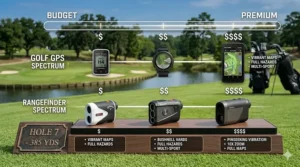
Here’s the budget breakdown by category:
Entry Level ($100-$150):
- GPS: GOLFBUDDY Voice 2S+, basic GPS watches
- Laser: Budget generic brands (accuracy concerns)
Mid-Range ($150-$300):
- GPS: Bushnell Phantom 3, quality GPS watches
- Laser: Blue Tees Series 3 Max+, Precision Pro NX9
Premium ($300-$600):
- GPS: Garmin Approach S70, advanced GPS watches
- Laser: Bushnell Tour V6 Shift, Garmin Z82 hybrid
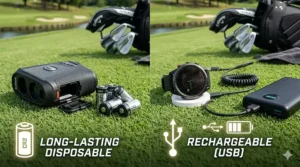
Remember that laser rangefinders typically require one-time battery purchases (or rechargeable models), while GPS devices need regular charging but have no ongoing costs beyond that.
Step 5: Consider Owning Both
The sweet spot for serious golfers might be owning both a mid-range GPS watch and a budget laser rangefinder. Total investment around $300-$400 gives you the convenience of always-on GPS information plus laser precision when you need it. Use the GPS watch for general play and pull out the laser for approach shots where precision matters.
This dual approach also provides backup when one device fails or runs out of power mid-round.
Ease of Use: Real-World Operation Compared
Theoretical features don’t matter if you can’t operate the device smoothly on the course. Here’s what actual use looks like for each technology:
Laser Rangefinder Learning Curve
Expect 2-3 rounds to become proficient with a laser rangefinder. The mechanics are simple—point, press, read—but executing consistently requires practice:
- Locating the target through the viewfinder while steadying your hands
- Holding steady long enough for the device to lock on
- Confirming lock-on through vibration or visual indicators
- Reading the display while maintaining your pre-shot focus
Common beginner mistakes include accidentally ranging trees behind the flag, struggling with shaky hands (try bracing against a cart or resting your hand on your bag), and taking too long, which disrupts rhythm.
Advanced users can laser a target in 3-5 seconds consistently. The skill becomes second nature, much like reading a green or checking wind direction.
GPS Device Simplicity
GPS devices require almost no learning curve. The Bushnell Phantom 3 auto-advances holes and displays distances immediately. GPS watches like the Garmin S70 show yardages the moment you glance at your wrist.
The complexity comes from advanced features: green contour reading, stat tracking, or virtual caddie suggestions. You can ignore these initially and simply use the device for basic distances, then explore additional features as you become comfortable.
One GPS challenge: ensuring accurate course mapping. Occasionally a course has been redesigned since the database update, leading to incorrect yardages. This is rare with major manufacturers but worth checking during your first round with any GPS device.
Talking GPS: The Simplest Option
The GOLFBUDDY Voice 2S+ represents the absolute easiest option. Clip it on, press the button, hear the distances. No aiming, no screen reading, no complexity. If you struggle with technology or simply want minimal distraction, talking GPS devices eliminate nearly all learning curve.
Outbound Resources for Golf Equipment Research
For additional research on golf technology and equipment regulations, these authoritative sources provide valuable insights:
- USGA Equipment Rules – Official guidelines on distance-measuring devices and tournament legality
- Golf Digest Equipment Studies – Independent testing and reviews of golf technology
- PGA Tour Equipment Trends – Analysis of what professional golfers actually use in competition
Frequently Asked Questions
❓ Can I use slope mode on my rangefinder during tournaments?
❓ How accurate are GPS golf watches compared to laser rangefinders?
❓ Will a GPS device work on any golf course?
❓ Do laser rangefinders work in rain or fog?
❓ Which is better for beginners learning golf?
Conclusion: Making Your Decision
The golf gps vs rangefinder debate doesn’t have a universal winner—it has a winner for your specific needs. After testing seven devices across both categories, here’s my final recommendation framework:
Choose a laser rangefinder if you:
- Prioritize pinpoint accuracy (±1 yard precision)
- Play competitive golf requiring exact distances
- Don’t mind a brief pre-shot routine with the device
- Value one-time purchase with minimal ongoing costs
- Play courses with significant elevation changes
Choose a GPS device if you:
- Value instant yardages and overall convenience
- Want comprehensive course layouts and hazard information
- Prefer wearable technology that won’t be forgotten in the cart
- Play unfamiliar courses frequently
- Focus on course management over precision targeting
Choose both if you:
- Have the budget ($300-$400 total for mid-tier options)
- Want maximum flexibility for different situations
- Play competitively and recreationally
- Value having backup technology
For most golfers reading this guide, I’d recommend starting with either the Blue Tees Series 3 Max+ laser rangefinder ($220-$280) for precision-focused players or the Bushnell Phantom 3 Slope GPS ($150-$180) for convenience-oriented golfers. Both deliver legitimate performance without premium pricing.
Whatever you choose, remember that distance technology is a tool, not a magic solution. The best device is the one you’ll actually use consistently to make better club selections and smarter course-management decisions. Your scores will improve not from the technology itself, but from the confidence and commitment it enables in your shot execution.
Recommended for You
- 7 Best Golf GPS Watches 2026
- Best Golf Rangefinder Under 200 – 7 Top Picks for 2026
- 7 Best Golf Rangefinders 2026
Disclaimer: This article contains affiliate links. If you purchase products through these links, we may earn a small commission at no additional cost to you.
✨ Found this helpful? Share it with your friends! 💬🤗
