

In This Article
Somewhere in a garage in Ohio, there’s a 3-iron with cobwebs on the hosel and a golfer who hasn’t hit it solid since the Obama administration. If that sentence stung a little, congratulations — you’ve found the right article. A 7 wood long iron alternative is exactly what it sounds like: a higher-lofted fairway wood, usually built around 21 degrees, engineered to replace the long irons (typically 3-, 4-, and sometimes 5-irons) that most recreational golfers can barely get off the ground, let alone control…
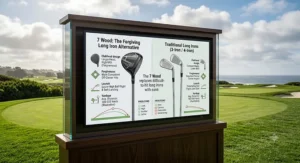
Here’s the plain-English version. A 7 wood long iron alternative is a fairway wood with a larger, more forgiving clubhead and enough loft to launch the ball high and soft from almost any lie, giving mid-to-high handicap players the carry distance and stopping power of a long iron without the skill it demands. It’s not a gimmick. Tour players who could hit a 2-iron with their eyes closed are putting 7-woods in their bags anyway, because physics doesn’t care about your ego, and a shallow, forgiving head simply produces more consistent contact than a thin iron blade off a tight or fluffy lie.
We dug into real product specs, verified current lofts and price ranges, and pulled together the honest, aggregated review sentiment from golfers who’ve actually gamed these clubs — detailed further in the definitive Wikipedia entry on fairway woods, which traces how higher-lofted woods evolved from the old “fairway metal” era into today’s category. What follows is a full breakdown of the seven best 7 woods on the market in 2026, how they stack up against your long irons, and a practical framework for picking the right one for your swing — no fluff, no fabricated hands-on stories, just the research.
Quick Comparison Table
| Product | Loft | Price Range | Best For |
|---|---|---|---|
| Tour Edge Exotics E723 | 21° | Around $280 | Best budget option overall |
| Wilson Dynapwr Max | 21° | $250-$300 range | Easy launch, high handicappers |
| Titleist GT1 | 21° | Around $330 | Moderate swing speeds |
| Cobra Darkspeed X | 21° (adj.) | Around $330 | Balanced speed and forgiveness |
| Ping G440 MAX | 21° (adj.) | $350-$400 range | Max forgiveness advantage |
| Callaway Elyte | 21° | Around $350 | All-around iron replacement |
| TaylorMade Qi4D | 21° (adj.) | Under $450 | Tour-level adjustability |
Looking at the field, there’s a clear pattern: every serious 2026 manufacturer builds its 7 wood around a 21-degree loft, which tells you that number has become the industry’s consensus sweet spot for replacing a 3- or 4-iron. The real differentiator isn’t loft — it’s how each company gets you there, whether through adjustable hosels like the TaylorMade Qi4D and Cobra Darkspeed X, or through fixed, no-fuss forgiveness like the Wilson Dynapwr Max. Budget shoppers should note that price doesn’t map perfectly to performance here; the Tour Edge Exotics E723 undercuts the field by over $150 while still ranking competitively for forgiveness in independent testing.
💬 Found a club that fits your gaps? Bookmark this page and come back before you buy — your future scorecard will thank you!
💬 Just one click — help other golfers find the right club for their game too!😊
Top 7 Wood Long Iron Alternatives: Expert Analysis
Picking a 7 wood long iron alternative isn’t just about grabbing the shiniest headcover in the pro shop. Below, each of the seven best options in 2026 gets the same honest treatment: what the specs actually mean on the course, who each club fits, and where the real trade-offs live.
1. Tour Edge Exotics E723 — best budget forgiveness from the fairway rough
The standout here is price-to-performance: this club delivers tour-adjacent tech for roughly half what the big four brands charge. The E723’s RyzerSole design pushes the center of gravity low and to the rear, and its Diamond Face VFT — 61 individual diamond-shaped zones of variable thickness across the hitting surface — is what actually widens the sweet spot on off-center hits. In practice, that combination means a mis-struck ball from a bad lie in the 7 wood from fairway rough scenario still gets airborne and travels close to your intended number, rather than dying 30 yards short. Based on the spec comparison against pricier rivals, this club sacrifices adjustability (there’s no movable hosel) for raw, uncomplicated forgiveness, which suits golfers who’d rather buy the right loft once than fiddle with settings every weekend. Independent testing has ranked the E723 in the top handful of fairway woods specifically for forgiveness and accuracy, even while it trails the field on outright distance — a fair trade for anyone whose miss is more damaging than their max carry. Reviewers consistently describe it as an easy club to trust from the rough, with the swappable rear weight (available from 5 to 21 grams) letting fitters dial in swing weight without touching the loft.
Pros:
- ✅ Lowest price point of any club in this roundup
- ✅ Diamond Face VFT widens the forgiving zone noticeably
- ✅ Swappable rear weights allow simple swing-weight tuning
Cons:
- ❌ No adjustable hosel for loft or lie changes
- ❌ Trails the field for outright carry distance
Priced around $280, the Tour Edge Exotics E723 is the clear value pick if your main goal is simply getting a long iron replacement in play without a big outlay.
2. Wilson Dynapwr Max — 7 wood easy launch high for slow-swing relief
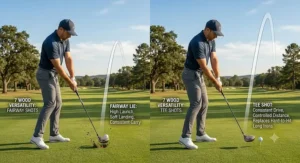
What immediately stands out about this model is how aggressively it’s built for one job: getting the ball into the air. The Dynapwr Max relies on a rear-weighted, high-MOI head shape and a Carpenter Custom 455 steel face to produce what independent testers have clocked as some of the highest launch and spin numbers in the category. That matters because the classic long-iron problem — a low, knuckling flight that never gets above the tree line — simply can’t happen with this head design. What most buyers overlook about a high-spin 7 wood is that the tradeoff for that easy, towering flight is a few yards of carry compared to lower-spin rivals; you’re buying stopping power on the green, not maximum distance off the tee. Aggregated reviewer sentiment is notably positive on value, with multiple owners on record saying they swapped away from pricier competitor brands entirely once they tried this head. There’s no adjustable hosel, so buyers do need to get properly fit into the correct loft and shaft combination up front, but for the price this remains one of the most underrated high-launch options on the market in 2026.
Pros:
- ✅ Exceptionally high, easy launch for slower swing speeds
- ✅ Strong stopping power thanks to elevated spin rates
- ✅ Genuinely competitive price against premium-branded rivals
Cons:
- ❌ No adjustability, so shaft and loft fitting matters more
- ❌ Gives up some carry distance versus lower-spin heads
At a price in the $250-$300 range, the Wilson Dynapwr Max earns its spot as the easiest-launching club in this lineup.
3. Titleist GT1 — best for moderate swing speeds
The Titleist GT1 opens with the largest, shallowest head in the brand’s GT family, and that shape is the whole story here. A 180cc footprint combined with a Seamless Thermoform Crown — a proprietary polymer that Titleist says trims real mass off the top of the head — pushes the center of gravity as low and deep as anything Titleist has built, specifically to boost launch for players who don’t generate a ton of clubhead speed. On paper this means golfers with a smoother tempo get more help getting the ball airborne compared to Titleist’s own lower-lofted, better-player GT2 and GT3 models. The dual-position fore/aft weight system is a legitimate fitting tool rather than a marketing gimmick, letting a fitter nudge spin and launch a few clicks in either direction without changing the whole head. Reviewers consistently note the confidence-inspiring look at address and describe results that outperformed expectations against other tested models in side-by-side sessions, with several citing the club as the longest in their personal test group. What the spec sheet won’t tell you, but reviewers note, is that this shallow-face design does feel less workable for better players who like to shape shots — it’s built for straight, reliable launch, not shot-shaping creativity.
Pros:
- ✅ Shallowest, most confidence-inspiring face in its category
- ✅ Fore/aft weights allow genuine launch and spin fitting
- ✅ Consistently strong reviewer sentiment on real-world distance
Cons:
- ❌ Less workable for players who want to shape shots
- ❌ Adjustability is more limited than true loft-sleeve rivals
Around $330, the Titleist GT1 is the smart call for moderate-swing-speed players who want Titleist quality without the price of the brand’s Tour-focused models.
4. Cobra Darkspeed X — best blend of speed and forgiveness
The Cobra Darkspeed X earns its spot by refusing to specialize in only one thing. Its PWRSHELL face insert and suspended PWR-BRIDGE weighting let both the face and the sole flex more freely at impact, which is a real mechanical explanation for the higher ball speeds Cobra’s own testing and independent reviewers alike have reported. Based on the spec comparison, the AI-designed H.O.T. Face variable-thickness pattern is doing real work here too, widening the effective hitting area so mis-hits lose less speed than they would on a simpler, single-thickness face. Here’s what to weigh: this is a mid-back-weighted head, meaning it leans toward a higher, more towering ball flight rather than the flatter trajectory better players sometimes prefer, but the adjustable hosel (loft can move roughly a degree and a half in either direction) gives fitters real latitude to dial that in. Aggregated review data shows this club carrying one of the strongest average ratings in the entire category, with reviewers repeatedly praising the sound, feel, and overall build quality — a meaningfully positive signal when hundreds of real owners are weighing in.
Pros:
- ✅ Adjustable hosel adds real loft and lie fitting range
- ✅ Flexible face-and-sole design boosts speed on mis-hits
- ✅ Exceptionally strong aggregated reviewer ratings
Cons:
- ❌ Mid-back weighting favors a higher flight over a flatter one
- ❌ Removable weight system adds a small learning curve for tuning
At roughly $330, the Cobra Darkspeed X is the pick for golfers who want one club that does almost everything reasonably well.
5. Ping G440 MAX — clearest forgiveness advantage in the field
Ping built the G440 MAX around a single goal: make off-center strikes hurt as little as possible, and the forgiveness advantage shows up in nearly every design choice. A Free Hosel design strips weight out of the connection point and reinvests it in a face that’s 4% taller than the prior generation, while a Carbonfly Wrap crown keeps the center of gravity low despite that taller profile. The result, based on the spec comparison against Ping’s own previous-generation model, is a head that launches high and forgives strikes toward the heel and toe without ballooning spin into an unplayable range. Reviewers consistently frame this as a “cheat code” style club for the person who has struggled with long irons for years, with several noting it effectively let them retire two or three individual clubs from the bag at once. The adjustable hosel (loft moves about 1.5 degrees, lie up to 3 degrees flatter) is genuinely useful for dialing in ball flight, and the five available loft options across the MAX line make gapping against your other clubs far more precise than a single fixed-loft head would allow. What most buyers overlook is that the taller face, while great for tee shots, does slightly increase the visual “sky mark” risk on severe top-of-the-face strikes — a minor tradeoff for the forgiveness gained everywhere else.
Pros:
- ✅ Taller face adds real confidence off the tee and turf
- ✅ Adjustable loft and lie genuinely aid custom fitting
- ✅ Reviewer sentiment repeatedly praises real-world forgiveness
Cons:
- ❌ Slightly higher sky-mark risk on extreme top-face strikes
- ❌ Premium pricing versus the category’s budget options
In the $350-$400 range depending on shaft, the Ping G440 MAX is arguably the most complete forgiveness-first option in this entire lineup.
6. Callaway Elyte — best all-around long iron replacement strategy
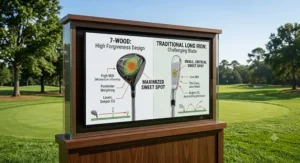
Callaway’s Elyte earns its keep through the combination of a 35-gram Tungsten Speed Wave, suspended low and forward in the head, and a redesigned Step Sole that reduces sole-to-turf contact by more than half compared to a traditional design. Here’s what to weigh: less sole contact means less drag and skidding through impact, which translates directly into cleaner strikes even from moderately thick rough, not just a tidy fairway lie. The Ai 10x face technology uses ten times more control points than Callaway’s previous-generation face mapping, and paired with the C300 Face Cup, that’s the engineering explanation behind the tight dispersion and strong ball speed reviewers consistently report across a wide range of swing speeds. What most buyers overlook about this model is that it’s genuinely one of the more neutral-flighted 7 woods on the market — it won’t actively fight a slice or hook the way some draw-biased rivals will, so better ball-strikers tend to prefer it, while golfers who need built-in shot-shape correction may want to look at Callaway’s own Elyte X instead. Multiple aggregated reviews specifically mention the club replacing troublesome long irons and turning 200-plus-yard approach shots into realistic, repeatable plays, which is about as direct an endorsement of an iron replacement strategy as you’ll find in real owner feedback.
Pros:
- ✅ Step Sole design meaningfully reduces turf drag on strikes
- ✅ Ai 10x face technology tightens dispersion across swing speeds
- ✅ Broad loft range (seven options) aids precise bag gapping
Cons:
- ❌ Neutral flight offers less built-in slice correction than rivals
- ❌ Sits at a premium price point versus budget alternatives
At around $350, the Callaway Elyte stands out as the most balanced, do-it-all long iron replacement in the entire 2026 field.
7. TaylorMade Qi4D — most adjustable, tour-proven distance option
The TaylorMade Qi4D leads with tour credibility that’s hard to fake — this is the fairway wood family that PGA Tour pros switched into mid-season, including ahead of a major championship title defense, which tells you something a launch monitor alone can’t. Mechanically, the story centers on a refined Speed Pocket that reduces spin and preserves ball speed specifically on shots struck low on the face — historically the single most common miss for amateur golfers hitting long clubs off tight lies. Twist Face technology corrects for the sidespin that gear effect creates on heel and toe strikes, which is the real reason reviewers report noticeably tighter left-right dispersion than older TaylorMade models. Based on the spec comparison, the standout feature is adjustability: an 8-gram Trajectory Adjustment System weight combined with a 4-degree loft sleeve gives a fitter more combined tuning range than almost anything else in this article, meaning a single head can effectively cover multiple loft and flight-bias needs. Aggregated owner feedback is enthusiastic and specific, with several reviewers explicitly describing it as replacing three separate clubs in their bag and praising both distance and green-holding ability on long approach shots. The tradeoff, unsurprisingly, is price — this sits at the top of the field, and the added adjustability requires either a proper fitting session or some trial-and-error at home to unlock its full value.
Pros:
- ✅ Best-in-class adjustability via loft sleeve and TAS weight
- ✅ Twist Face technology tightens dispersion on off-center hits
- ✅ Strong, specific aggregated reviewer praise on distance and control
Cons:
- ❌ Highest price point of any club in this roundup
- ❌ Full adjustability benefit requires a proper custom fitting
Priced under $450, the TaylorMade Qi4D is the pick for golfers who want tour-level technology and don’t mind paying for it.
How to Choose a 7 Wood Long Iron Alternative
What is the fastest way to pick the right 7 wood? Start by matching loft and forgiveness to your actual swing speed and miss tendency, not to what a tour pro plays. Here’s the process broken into concrete steps:
- Identify your actual miss. If your long irons balloon short and left or right, prioritize a forgiving, high-MOI head like the Ping G440 MAX or Tour Edge Exotics E723 over a compact, workable shape.
- Match loft to the club you’re replacing. A 21-degree 7 wood generally slots in as a 3-iron or strong 4-iron replacement — confirm the gap against your current 5-wood or hybrid so you don’t create a distance overlap.
- Decide how much you value adjustability. If you like to tinker or plan to get professionally fit, an adjustable hosel like the TaylorMade Qi4D or Cobra Darkspeed X pays off; if you’d rather buy once and forget it, a fixed-loft head keeps things simple.
- Weigh spin needs against your typical approach distance. Higher-spin heads like the Wilson Dynapwr Max hold greens better on longer approaches but sacrifice a little roll-out distance.
- Set a realistic budget band. Every club in this guide clusters between roughly $250 and $450, so decide early whether you’re optimizing for value or for the last few percent of tour-level tech.
- Test before you commit if at all possible. A launch monitor session, even a free in-store one, will tell you more in ten swings than any spec sheet.
- Confirm it’s on your retailer’s actual conforming inventory before buying, since golf equipment standards and conforming lists are maintained centrally and lofts occasionally shift between model years.
📍 Ready to close the gap in your bag? Check current pricing on any of these seven models before your next round!

Practical Usage Guide: Setting Up Your New 7 Wood
Buying the club is the easy part; getting real value out of it takes a little intention in the first month. Start by getting the lie angle checked, not just the loft — a 7 wood that sits even a few degrees too upright or flat at address will fight your natural swing path no matter how forgiving the face technology is. In your first few range sessions, resist the urge to swing harder just because the club looks like a fairway wood; the swing feel should be closer to a smooth iron tempo than an all-out driver swing, since these heads are engineered to produce plenty of ball speed on their own. A common mistake in the first 30 days is teeing it too low off the tee box on par-3s; because the face sits shallower than a driver, a slightly higher tee (roughly half the ball above the crown) helps you catch it on the upswing portion of your arc rather than pinching it. If your model has an adjustable hosel, change one variable at a time — loft, then lie, then weight position — and track ball flight for at least five to ten swings before making another adjustment, since a single mis-hit can look like a fitting problem when it’s really just a bad swing. Finally, build a simple maintenance habit: wipe the face and grooves after every round, since dirt buildup in the variable-thickness face patterns used by nearly every club in this guide can measurably dull spin consistency over a season of use.
Real-World Scenarios: Who Actually Needs This Club?
Picture a 58-year-old weekend player named Dave who’s lost 15 yards of swing speed over the last decade and simply can’t get his 3-iron airborne from a fairway lie anymore. For Dave, a high-launch, forgiving option like the Wilson Dynapwr Max or Tour Edge Exotics E723 solves the exact problem he has — easy height, wide forgiveness, and a price that doesn’t sting if it turns out not to be a perfect fit. Now picture Priya, a mid-handicap player in her thirties who plays twice a week and has decent swing speed but a persistent tendency to leak shots right under pressure; she’s better served by a club with genuine fitting range, like the Cobra Darkspeed X or TaylorMade Qi4D, where an adjustable hosel and movable weighting can be dialed in against her specific miss over a season of use. Finally, consider Marcus, a low-single-digit-handicap player who still carries a 3-iron out of stubbornness but is tired of chunking it from the rough on 200-yard par 3s; a shallower-faced, tour-grade option like the Titleist GT1 or Callaway Elyte gives him the distance and turf interaction of a true long-game club without asking him to sacrifice the workability he’s used to from a blade iron. In each case, the right 7 wood isn’t the “best” one on a leaderboard — it’s the one that matches the golfer’s actual swing speed, miss tendency, and how often they’re willing to get properly fit.
Problem → Solution: Fixing Your Long-Game Gaps
Problem 1: I can’t get my long irons airborne from a fairway lie. The fix is a shallow-faced, high-MOI head with real loft, like the Ping G440 MAX or Titleist GT1, both of which are specifically engineered to lower the center of gravity for easier launch.
Problem 2: My ball flight balloons and I lose distance to spin. Look at a lower-spin option with a flatter trajectory bias, such as the Cobra Darkspeed X, and consider a stiffer shaft flex during fitting.
Problem 3: I struggle to hit a 7 wood from fairway rough specifically, not just tight lies. Prioritize sole design here — the Callaway Elyte‘s Step Sole and the Tour Edge Exotics E723‘s RyzerSole are both built to reduce grabby turf interaction, which matters far more in rough than on a manicured fairway.
Problem 4: I hit it fine on the range but mis-hit on the course under pressure. This usually points to insufficient forgiveness rather than a swing flaw — a wider, more stable head like the Wilson Dynapwr Max minimizes the ball-speed penalty when your strike isn’t perfectly centered.
Problem 5: I own a 7 wood already but it doesn’t feel like an upgrade over my old long iron. Check the loft against what you’re actually replacing; a mismatch of even three to four degrees can leave an awkward distance gap, and re-gapping against your 5-wood or hybrid, as covered in the “How to Choose” section above, usually resolves it.
Buyer’s Decision Framework: Your Iron Replacement Strategy
If you’re building an iron replacement strategy from scratch, a simple priority checklist beats overthinking it. If forgiveness matters more than anything else to you, choose a wide, high-MOI head like the Ping G440 MAX or Tour Edge Exotics E723, because a forgiving 7 wood eliminates far more strokes over a season than a few extra yards of theoretical distance ever will. If budget is your primary constraint, choose the Tour Edge Exotics E723 or Wilson Dynapwr Max, since both deliver genuinely competitive real-world performance without the premium-brand markup. If you want maximum fitting flexibility and don’t mind investing the time, choose the TaylorMade Qi4D or Cobra Darkspeed X, since their adjustable hosels and movable weights offer the widest tuning range in this guide. If you’re a moderate swing speed player who wants an easy, confidence-inspiring launch without sacrificing brand trust, choose the Titleist GT1. And if you want one club that handles nearly every situation reasonably well without excelling narrowly in any one area, the Callaway Elyte remains the safest all-around choice. This isn’t a rigid rulebook — it’s a starting filter to keep you from getting overwhelmed by seven genuinely good options.
7 Wood vs Long Iron: The Higher Trajectory Option
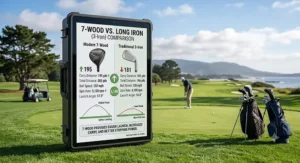
The core argument for switching centers on one simple physical reality: a 7 wood’s shallower, larger clubhead produces a lower, more forward center of gravity than a comparably lofted long iron, and that alone accounts for most of the higher trajectory option these clubs represent. A 3-iron typically carries somewhere in the 18- to 21-degree loft range depending on the set, which on paper looks similar to a 21-degree 7 wood — but the iron’s thin, compact head puts the CG much closer to the face, producing a lower, more piercing flight that demands a precise, descending strike to get airborne cleanly. The 7 wood’s wood-style head redistributes that same mass lower and further back, so even an amateur’s slightly ascending or level strike still launches the ball high enough to stop on a green. Independent testing across dozens of 2026 models consistently shows fairway woods producing meaningfully higher launch angles and steeper descent angles than comparably lofted irons at matched swing speeds, which is exactly why so many tour professionals — golfers who could absolutely hit a long iron if they wanted to — have voluntarily added higher-lofted woods to their bags in recent seasons. The tradeoff golfers should understand honestly: a 7 wood is longer than the iron it replaces, so the swing feel and the ball position at address both need a small adjustment period, and true shot-shaping (a deliberate low punch under a tree limb, for instance) remains easier with an iron’s compact profile.
7 Wood vs Hybrid: Finding Your Best Substitute
The 7 wood hybrid substitute question comes up constantly, and the honest answer is that both categories solve a similar problem with different trade-offs. A hybrid typically has a smaller, more compact head than a fairway wood at a comparable loft, which makes it easier to hit off tight or downhill lies and generally easier to control shot shape with, closer to an iron-like feel. A 7 wood, by contrast, uses a larger footprint and a shallower face specifically to maximize forgiveness and carry distance, which tends to reward a sweeping swing more than a hybrid’s slightly steeper attack angle does. Golfers who struggle from truly tight fairway lies or frequently need to hit from a downhill stance often find a hybrid the more versatile 7 wood hybrid substitute, while golfers hitting mostly from a flat fairway or first cut of rough, chasing maximum carry on long par-5 second shots, tend to get more out of the extra forgiveness and distance ceiling a 7 wood offers. There’s no universally correct answer — many better players actually carry both, using the hybrid for tighter, shorter-shot situations and the 7 wood for full-swing, maximum-distance approaches on par 5s. If you’re choosing just one, match it to where your worst lies tend to happen most often on your home course, since that’s where a long-game club earns or loses its keep.
The Forgiveness Advantage: Why These Clubs Outperform Long Irons
The forgiveness advantage isn’t marketing language — it’s measurable in moment of inertia (MOI), a physical property describing how resistant a clubhead is to twisting on off-center strikes. Long irons have historically low MOI because their compact, blade-like heads concentrate mass near the face, meaning a strike even a quarter-inch off-center can cost significant ball speed and send the shot wildly offline. Fairway woods, including every model in this guide, distribute mass toward the perimeter of a much larger head, which meaningfully raises MOI and keeps ball speed loss on mis-hits far more contained. In practice, that’s the entire reason a mid-handicap golfer can carry a 7 wood to the number their old 3-iron promised on paper but rarely delivered on the course. The tradeoff is that higher MOI generally means a larger, sometimes less “workable” head — better players who like to intentionally curve shots around trouble do sacrifice some of that shot-shaping control in exchange for the added forgiveness, which is precisely why product lines like Callaway’s Elyte family and Titleist’s GT family offer multiple models built around different points on that forgiveness-versus-workability spectrum.
Features That Actually Matter (And Those That Don’t)
Adjustable loft sleeves matter — a proper fitting can move launch conditions meaningfully, and several clubs in this guide (the TaylorMade Qi4D, Cobra Darkspeed X, and Ping G440 MAX) all use this to real effect. Sole design matters more than most buyers realize, since a well-designed sole like the Callaway Elyte‘s Step Sole or the Tour Edge Exotics E723‘s RyzerSole directly reduces turf drag on strikes from anything other than a perfect lie. Variable-thickness face technology is genuinely useful engineering, not a buzzword, since it’s the mechanical reason off-center hits retain more ball speed across every club discussed here. On the other hand, headcover aesthetics, alignment-aid paint jobs, and marketing terms like “AI-designed” without any accompanying spec explanation matter far less than buyers assume — a pretty crown never once helped a ball fly straighter. Similarly, chasing the single longest average distance in a magazine test is often the wrong priority for the exact golfer this article is written for; consistency and forgiveness usually save more strokes over a season than an extra three yards of carry ever will.
Common Mistakes When Buying a 7 Wood
The single most common mistake is buying based on the loft number alone without checking it against the rest of the bag; a 21-degree 7 wood that overlaps too closely with an existing 5-wood or hybrid just creates a confusing three-way distance gap instead of solving one. The second mistake is skipping a fitting or launch monitor session entirely and guessing at shaft flex, which can turn even an excellent head like the Cobra Darkspeed X into a poor fit if the shaft doesn’t match swing speed and tempo. A third common error is assuming the most expensive option is automatically the best one; the data in this guide shows the budget-friendly Tour Edge Exotics E723 ranking competitively for forgiveness against clubs costing well over $100 more. Finally, many golfers judge a 7 wood purely off a handful of range swings with perfect lies, then get disappointed when performance from real fairway or rough conditions differs — testing sole interaction from a slightly imperfect lie, not just a tee-up mat, gives a far more honest picture of how a club will actually perform on the course.
7 Wood for Every Swing Speed: From Easy Launch High to Low Spin Control
Swing speed is arguably the single biggest factor in matching a golfer to the right head, more important than brand loyalty or price point. Golfers in the slower swing-speed range, generally under about 85 mph with a driver, tend to benefit most from a 7 wood easy launch high design like the Wilson Dynapwr Max, since that extra launch and spin compensates for the lower clubhead speed generating less natural lift. Moderate swing speeds, roughly 85 to 95 mph, are the largest population of golfers and the segment most 2026 models are actually designed around — the Titleist GT1, Ping G440 MAX, and Callaway Elyte all sit comfortably in this zone, balancing forgiveness with enough control to avoid an overly ballooning flight. Faster swing speed players, generally above 95 mph, often do better with a lower-spin, slightly more compact option like the Cobra Darkspeed X dialed toward its lower adjustable loft setting, since excess spin at higher speeds is what actually costs distance rather than adds it. The practical takeaway: don’t buy based on what a low-handicap friend recommends if your swing speed is meaningfully different from theirs — the entire forgiveness-versus-workability spectrum covered throughout this guide shifts depending on how much raw speed you’re bringing to the ball.
Long-Term Cost & Maintenance
A 7 wood is a genuinely low-maintenance investment compared to a full iron set overhaul, but a few realities are worth budgeting for. Graphite shafts, standard across every model in this guide, are generally durable but can develop internal micro-damage from repeated hard impacts against cart paths or rocks, so it’s worth a periodic visual inspection for hairline cracks near the tip. Face grooves and variable-thickness zones on modern heads like the TaylorMade Qi4D‘s Speed Pocket area can accumulate dirt and grass staining that measurably affects spin consistency over a season, so a simple post-round wipe-down costs nothing and meaningfully extends performance life. In terms of total cost of ownership, the gap between the cheapest option here (the Tour Edge Exotics E723 around $280) and the priciest (the TaylorMade Qi4D under $450) works out to roughly the cost of a handful of range sessions or a single custom fitting — a modest premium if the adjustability genuinely gets used rather than left at the stock setting. Golf equipment, including every fairway wood referenced in this guide, is also subject to ongoing conformance standards; golfers competing in sanctioned events should be aware that equipment specifications are periodically reviewed and updated, so it’s worth a quick check before entering any USGA-sanctioned competition with a brand-new club.
Frequently Asked Questions
❓ Is a 7 wood really easier to hit than a long iron?
❓ What degree loft is a 7 wood equivalent to in irons?
❓ Can a high handicapper use a 7 wood off the tee?
❓ How much distance can I expect from a 7 wood versus my old long iron?
❓ Should I replace one long iron or my whole long-iron set with 7 woods?
Conclusion
If there’s one thing to take away here, it’s that the “long iron problem” isn’t really about skill — it’s about physics working against a compact, low-MOI clubhead that most recreational swings simply can’t square up consistently. Every one of the seven products in this guide, from the budget-friendly Tour Edge Exotics E723 to the tour-proven TaylorMade Qi4D, solves that problem the same fundamental way: more forgiving mass distribution, a lower center of gravity, and enough loft to get the ball airborne without demanding a perfect strike. The right choice for you comes down to an honest look at your swing speed, your typical miss, and how much you value adjustability versus simplicity — not which club looks best on a leaderboard. Whichever model ends up in your bag, the goal is the same one tour pros have quietly been chasing for the last few seasons: turning a shot you used to dread into one you can actually plan around.
✨ Don’t Miss These Exclusive Deals!
🔍 Take your long game to the next level with these carefully selected 7 woods. Click on any highlighted model above to check current pricing and availability. These clubs will help you create the confident, repeatable approach shots your scorecard has been missing!
Recommended for You
- 7 Wood for Seniors Ladies: 7 Easy-Launch Picks for 2026
- 5 Wood From Rough: 7 Best Picks to Escape Trouble in 2026
- 5 Wood Long Iron Replacement: 7 Hybrids Golfers Trust in 2026
Disclaimer: This article contains affiliate links. As an Amazon Associate, I earn from qualifying purchases. If you purchase products through these links, we may earn a small commission at no additional cost to you.
✨ Found this helpful? Share it with your friends! 💬🤗
