

In This Article
Picture the moment: your drive leaked a touch right, skipped past the fairway cut, and settled into grass thick enough to swallow a sleeve of Pro V1s. This is exactly the situation where a good 5 wood from rough earns its keep, and it’s also exactly where most golfers reach for the wrong club out of habit. A long iron digs. A 3-wood’s deep face catches grass before it catches ball. A hybrid works, sure, but sacrifices some of the carry distance you need to reach a par 5 in two.

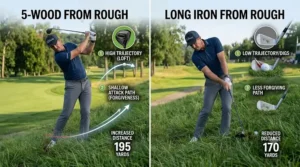
So what is a 5 wood from rough, exactly? A 5 wood from rough refers to using an 18-20 degree fairway wood to advance the ball from thick or semi-rough lies, relying on a rounded sole and shallow face to slide through grass rather than dig into it, producing a higher launch and steeper landing angle than a long iron or 3-wood would allow. It’s less a specialty club and more a Swiss Army knife — one that belongs in far more bags than currently carry one.
This guide isn’t a rehash of spec sheets you could find on any manufacturer’s site. It’s a research-backed breakdown of seven real 5 woods worth your money in 2026, why their sole and face designs behave differently once the ball is sitting down in grass, and how to actually choose between them based on your swing, not marketing copy. For a deeper primer on how woods evolved into the modern fairway metal, Wikipedia’s overview of the wood club category is a solid starting point if you want the historical context before we get into today’s hardware.
Whether you’re a 20-handicapper who needs forgiveness above all else or a low-single-digit player chasing workability, there’s a 5 wood from rough built for your game somewhere in the list below.
Quick Comparison Table
Before we dig into all seven clubs in detail, here’s a scannable snapshot to help you narrow the field fast.
| Product | Loft Options | Best For | Price Range |
|---|---|---|---|
| BombTech 4.0 | 18° | Budget-conscious buyers | Under $200 |
| Orlimar Escape HL | 19° | Seniors, shank-prone swings | Under $200 |
| Cleveland Launcher XL Halo | 18°, 21° | Mid-handicap rough escape | $250-$300 range |
| Ping G440 Max | 18.5°, 21° | Max forgiveness, high MOI | $350-$400 range |
| Callaway Quantum Max | 18°, 21° | Easy launch, all lies | $350-$400 range |
| TaylorMade Qi10 | 19° | Low-face mishit protection | $350-$400 range |
| Titleist GT2 | 18.5°, 21° | Versatile all-rounder | $350-$400 range |
Looking at the spread above, the budget tier from BombTech and Orlimar proves you don’t need to spend $400 to get a club that launches easily and survives contact with grass. The mid-to-premium tier — Cleveland, Ping, Callaway, TaylorMade, and Titleist — mostly separates on forgiveness philosophy rather than raw performance, since MOI, face flex, and sole geometry have all converged toward “easy to hit” in 2026. Your final call should hinge less on brand loyalty and more on which forgiveness profile matches your actual miss pattern, something we’ll unpack section by section.
💬 Just one click — help other golfers find the right club for their game too!😊
Top 7 5 Woods for Escaping the Rough: Expert Analysis
Here’s the deep dive — seven real, currently available fairway woods spanning budget to premium, each evaluated on how it actually behaves when the ball isn’t sitting pretty.
1. BombTech 4.0 Fairway Wood — best value for budget-conscious golfers
The BombTech 4.0 punches well above its price point, and that’s not a throwaway compliment — it’s a direct result of engineering choices most budget brands skip. The 18° head pairs with a strategically placed sole weight that keeps the center of gravity low and back, which is exactly the combination you want when the ball is sitting down and you need help getting it airborne without any extra effort on your part. The upgraded low-torque shaft is the real surprise here; it resists twisting through impact in a way that budget shafts historically haven’t managed, which means mis-hits from the rough don’t turn into wild pulls or blocks.
Based on the spec comparison against other clubs in this price bracket, this is the rare “cheap” club that doesn’t feel cheap at address or through the swing. It’s built for golfers who want a genuinely playable long-game club without financing it, and for mid-to-high handicappers who need forgiveness more than workability. Reviewers consistently report that the club resists the “dead” feel and inconsistent face response that plague many direct-to-consumer alternatives, though as with most smaller brands, the review pool is thinner than what you’ll find for the majors, so weigh that against the price savings.
Pros:
- ✅ Aggressive pricing without a “budget penalty” feel
- ✅ Low-torque shaft resists twisting on off-center hits
- ✅ 18° loft launches easily from compromised lies
Cons:
- ❌ Smaller review pool than major-brand competitors
- ❌ Fewer loft and shaft customization options
At under $200, this is one of the strongest value plays in the category — if your budget caps out below the premium tier, start here before assuming you need to spend more.
2. Orlimar Escape HL — best for shank-prone and senior swings
The Orlimar Escape HL is built around a single, honest premise: a lot of golfers who struggle with fairway woods aren’t struggling with distance, they’re struggling with squaring the face at impact. Its face-forward design and progressive heel weighting actively help rotate the clubface square through the hitting zone, which is precisely why it’s earned a reputation as one of the more shank-resistant options on the market. The 19° loft, combined with an ultra-light graphite shaft, creates a high-launching, slow-swing-friendly profile that flat-out helps players with moderate swing speeds get the ball up and moving forward.
What most buyers overlook about this model is that its forgiving sole shape does double duty from light rough — the wrap-around face construction extends the effective hitting area, meaning strikes toward the heel or toe still produce respectable ball speed instead of the anemic, off-line result you’d get from a traditional deep-faced wood. Reviewers frequently note that it feels stable and predictable in the hand, which builds confidence exactly where confidence tends to evaporate: standing over a ball buried in first-cut grass.
Pros:
- ✅ Face-forward design actively squares the clubface
- ✅ Ultra-light shaft suits slower swing speeds
- ✅ Excellent from the deck and light rough
Cons:
- ❌ High launch can balloon in windy conditions
- ❌ Limited workability for better players wanting to shape shots
If you or a playing partner has fought a slice or a shank with long clubs for years, this is worth a demo before you write off fairway woods entirely.
3. Cleveland Launcher XL Halo — best dedicated rough-escape design
Cleveland built the Launcher XL Halo with a specific problem in mind, and it shows. The Gliderails on the sole are two raised rails that reduce the surface area of the club actually contacting turf at impact, which lets the head glide through grass instead of getting snagged by it — a real, measurable advantage over traditional flat-soled designs when you’re hitting from anything heavier than a perfectly manicured fairway. Available in 18° and 21° lofts, it gives golfers a choice between maximum distance and maximum launch depending on how their bag is already gapped.
Here’s what the spec sheet won’t tell you outright: the Gliderail concept matters more the deeper the rough gets, so if your home course has a light, well-maintained first cut, you may not notice a dramatic difference versus a standard sole. But for golfers who regularly find themselves in the gnarly stuff — parkland courses with thick native grass borders, for instance — this is a genuinely purpose-built tool rather than a generalist club wearing a rough-escape label for marketing purposes. Aggregated review sentiment consistently praises the forgiveness and turf interaction, with the main complaint being that better players sometimes find the ball flight a touch higher than they’d prefer off the tee.
Pros:
- ✅ Gliderails measurably reduce turf drag and digging
- ✅ Two loft options fit different bag setups
- ✅ Forgiving on off-center strikes from rough
Cons:
- ❌ Ball flight can fly higher than preferred off the tee
- ❌ Premium mid-tier pricing versus budget alternatives
For golfers whose biggest long-game problem is specifically escaping rough rather than general ball-striking, this is the most purpose-built option on this list.
4. Ping G440 Max Fairway Wood — best for maximum forgiveness and stability
Ping doesn’t chase flashy marketing language, and the G440 Max reflects that engineering-first culture. The wider, shallower head shape produces some of the highest MOI (moment of inertia) numbers in the category, which in plain terms means the clubface resists twisting on mis-hits far better than a compact, better-player head would. Combined with a deep, low center of gravity, this translates directly into easier launch regardless of clubhead speed — a rare trait that benefits both slower-swinging seniors and faster-swinging low handicappers who mis-hit occasionally.
Based on the spec comparison, what separates the G440 Max from earlier Ping generations is subtle sole and chassis refinement specifically aimed at rough performance, not just fairway performance — the updated shaping lets the head move more cleanly through grass without losing speed at impact. Reviewers and independent testers alike consistently rank it among the easiest-launching fairway woods on the market, with the primary trade-off being a larger visual footprint at address that some better players find less confidence-inspiring than a compact, traditional head.
Pros:
- ✅ Industry-leading MOI for stability on mis-hits
- ✅ Shallow face and low CG make launch nearly automatic
- ✅ Refined sole glides cleanly through rough
Cons:
- ❌ Larger head shape may not suit better players’ eye
- ❌ Sits at premium pricing alongside Callaway and TaylorMade
If forgiveness is your single highest priority and you don’t care how the club looks at address, the G440 Max is hard to beat.
5. Callaway Quantum Max Fairway Wood — easiest launching 5 wood in the lineup
Callaway positioned the Quantum Max as the versatile middle child of its 2026 Quantum family, sitting between the draw-biased Max D and the tour-spec Triple Diamond, and the positioning fits. The AI-optimized face pairs with an ultra-low center of gravity specifically to get the ball airborne from any lie, and the Step Sole design shrinks the actual surface area interacting with turf, which is the mechanical reason it glides through heavy rough and tight fairway lies with noticeably less resistance than older Callaway fairway metals.
What most buyers overlook here is the tungsten placement: roughly 40 grams pushed low and forward keeps ball speed exceptionally high even on thin strikes off the low face, a common miss for golfers transitioning away from long irons. Compared to the previous Elyte model, the face sits shallower and more flush at address, which — based on early tester feedback — inspires more confidence because it visually reads more like an easy-to-hit hybrid than an intimidating fairway wood. Reviewers consistently describe it as the easiest-launching option in Callaway’s current lineup, particularly for players who’ve historically struggled with consistent fairway wood contact.
Pros:
- ✅ AI-optimized face maximizes ball speed on mis-hits
- ✅ Step Sole design reduces turf drag in heavy rough
- ✅ Shallow face builds confidence at address
Cons:
- ❌ Premium price point matches Ping and TaylorMade
- ❌ Less workable than the Triple Diamond for shot-shaping
For golfers who want a hybrid-like visual at address but full fairway-wood distance, this is one of the strongest 2026 options available.

6. TaylorMade Qi10 Fairway Wood — best for mis-hit protection on low-face strikes
TaylorMade didn’t tweak the previous generation with the Qi10 — they rebuilt the physics behind it. By shifting the Opti-Face technology lower on the face, they moved the effective COR (coefficient of restitution) zone to sit just below center, which turns what used to be a weak, low-face strike into a shot that still carries real distance. Combined with the legendary Thru-Slot Speed Pocket and V Steel sole, the club is engineered for exactly the conditions where clean contact is hardest to find — damp fairways, uneven lies, and rushed swings from the rough under pressure.
In independent testing, the Qi10 has proven unusually consistent on low-face contact specifically, which matters enormously for anyone hitting from a lie where the ball is sitting below the level of their feet or nestled down in grass. The Speed Pocket flexes on thin hits, preserving ball speed and reducing the skidding sensation that usually accompanies a mis-hit, while the laser-etched topline improves alignment so you’re set up square more consistently. The 19° loft promotes a strong, high launch, though more aggressive swingers occasionally find that launch a touch high for maximum roll-out on firm fairways.
Pros:
- ✅ Repositioned COR zone rescues low-face strikes
- ✅ Thru-Slot Speed Pocket preserves ball speed on thin hits
- ✅ V Steel sole maintains clean turf interaction
Cons:
- ❌ Launch may be too high for players chasing maximum rollout
- ❌ Premium pricing in line with category leaders
If your typical mis-hit from the rough is a thin, low-face strike, this club is engineered around solving that exact problem.
7. Titleist GT2 Fairway Wood — best all-around versatile utility
Titleist’s GT2 has quietly become the club that surprises golfers who assumed Titleist fairway woods were only for scratch players. It’s built with a compact, slightly traditional head shape that appeals visually while still delivering real forgiveness — an adjustable weight track in the sole distributes mass across five positions from heel to toe, letting you dial in a flight bias that suits your typical miss rather than accepting a one-size-fits-all setup. That kind of tunability is what separates a merely good fairway wood from one that adapts to your actual swing over time.
As a genuinely versatile 5 wood utility play, the GT2 earns its reputation by performing credibly off the tee, from the fairway, and out of moderate rough without demanding a major compromise in any single scenario. Reviewers describe being pleasantly surprised by its forgiveness on off-center strikes, a trait that’s historically been rarer in Titleist’s metalwoods than in its irons. Based on the spec comparison against TaylorMade and Callaway’s 2026 offerings, the GT2 doesn’t out-distance either, but it edges ahead on adjustability for golfers who want one club to handle multiple jobs in the bag.
Pros:
- ✅ Adjustable sole weight track tunes ball flight
- ✅ Balances forgiveness with a traditional, confidence-inspiring look
- ✅ Performs credibly across tee, fairway, and rough lies
Cons:
- ❌ Doesn’t out-distance TaylorMade or Callaway’s max-launch models
- ❌ Adjustability adds a learning curve for casual buyers
If you want one 5 wood to genuinely do everything reasonably well rather than one thing exceptionally well, the GT2 is the most complete generalist here.
Practical Usage Guide: Setting Up and Owning Your 5 Wood From Rough
Buying the right club is half the equation — using it correctly from day one is the other half, and it’s the half most buying guides skip entirely.
Get fit before you commit to a shaft. A 5 wood from rough performs dramatically differently depending on shaft flex and weight, and buying off the rack without at least a basic fitting session is the single most common way golfers end up blaming the club for what’s actually a shaft mismatch. Golfers swinging under 85 mph should lean toward lighter, more flexible shafts; those above 95 mph need the stability of a stiffer, heavier option.
Practice from an actual rough lie, not just the mat. Range mats are flat and forgiving in a way real rough never is. If your practice facility has a short-grass or rough area, spend time there specifically — the sensation of the sole interacting with grass, rather than rubber matting, is completely different and worth rehearsing before you need it mid-round.
Set up with the ball slightly forward of center. This encourages the sweeping motion that lets the sole glide rather than dig, which is exactly the swing shape that maximizes any rough-escape technology built into the club.
Maintain your grip and face condition. Grit and grass debris from rough shots accumulate in grooves faster than you’d expect. A quick wipe-down after every shot from thick lies keeps spin consistent — grass and mud in the grooves is one of the most common and most preventable causes of a flier lie you didn’t expect.
Avoid the common 30-day mistake: swinging harder from the rough. The instinct when the ball is sitting down is to swing harder to “get it out.” Resist it. A smoother, sweeping tempo through a well-designed sole does more work than raw effort ever will, and over-swinging is the single fastest way to turn a manageable lie into a chunked disaster.
Real-World Scenarios: Which Golfer Are You?
Numbers on a spec sheet only mean so much until you match them to an actual playing profile. Here are three realistic golfer types and the reasoning behind their best-fit club.
The weekend warrior with a moderate swing speed and a habit of finding the first cut. This golfer benefits most from a high-launching, forgiving design like the Orlimar Escape HL or the Ping G440 Max — both prioritize getting the ball airborne with minimal effort, and both forgive the inevitable off-center strike that comes with playing twice a month rather than twice a week.
The low-handicap player who wants distance and still needs occasional rough escapability. This is the Titleist GT2 or TaylorMade Qi10 territory — clubs that don’t sacrifice much workability or distance for forgiveness, letting a more accomplished ball-striker shape shots while still surviving the occasional errant drive.
The budget-first beginner replacing a 3-iron or 5-iron they can’t hit consistently. The BombTech 4.0 solves this directly and affordably, with an 18° loft engineered specifically to make launch easy without demanding an expert swing, all at a fraction of the premium-tier price.
Turf Interaction Design: Why Sole Shape Determines Rough Escapability
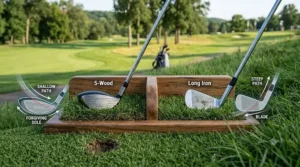
If there’s one concept that separates a genuinely useful 5 wood from rough from a fairway wood that only performs well off a tee, it’s turf interaction design. The sole of a fairway wood is engineered to slide across the ground rather than dig into it, and that single geometric decision is what makes a wood dramatically more forgiving from rough than a long iron, whose thin, sharp leading edge tends to catch grass and twist at impact.
Rounded, wide soles — like those on the Ping G440 Max and Callaway Quantum Max — spread contact pressure across a broader surface, letting the club skim through grass with less resistance. Cleveland’s Gliderails take a more surgical approach, raising two rails that physically reduce how much sole material actually touches turf, mechanically minimizing drag. Deeper faces tend to launch the ball higher and improve rough escapability further, since a taller face gets under the ball more effectively when it’s sitting down in grass; shallower faces, by contrast, prioritize lower spin and a more penetrating flight but demand more precise ball-striking to pull off consistently. Golf Monthly’s testing data on 2026 fairway wood models backs up this pattern across multiple manufacturers.
None of this is marketing fluff — it’s physics. A club with poor turf interaction design will decelerate more at impact, robbing you of ball speed exactly when you need it most, which is precisely why two clubs with identical lofts can feel and perform completely differently from the same rough lie.
5 Wood Approach Shots: Turning Long Trouble Into Scoring Opportunities
The single biggest reason to carry a well-fit 5 wood is what it does for your approach shots into greens from long range. A 5 wood typically produces a steeper descent angle than a 3-hybrid or long iron carrying similar total distance, which means it holds firmer greens far more reliably — a genuinely useful trait when you’re facing a 200-plus yard approach shot into a firm par-5 green or a monster par 4.
Where this matters most in practice is exactly the scenario this guide is built around: hitting 5 wood approach shots from a lie that isn’t perfect. Reviewers and independent testers alike note that modern 5 woods maintain more of their launch characteristics from semi-rough than older models did, largely thanks to the turf interaction improvements discussed above. That steeper landing angle becomes even more valuable from rough, since a low, running approach shot from a compromised lie is far less predictable than a higher, softer-landing one.
Based on the spec comparison across this list, the TaylorMade Qi10 and Cleveland Launcher XL Halo both stand out specifically for approach-shot performance from imperfect lies, thanks to their respective Speed Pocket and Gliderail technologies preserving ball speed when contact isn’t flush.
✨ Ready to stop dreading your long approach shots? Compare the full lineup above and find your fit today!
High Launching 5 Wood: What the Loft Numbers Actually Mean for Your Game
Loft selection seems straightforward until you realize how much it interacts with your individual swing. A 5 wood loft typically sits between 18-20 degrees, though manufacturers now offer meaningful variation — “strong” 5 woods at roughly 17-17.5° for players who want more distance and can generate their own launch, and high-launching 5 wood options at 19-20° for players whose attack angle needs help getting the ball into the air.
Golfers with shallow attack angles — meaning the club is moving relatively level or slightly upward through impact — benefit substantially from a high launching 5 wood in the 19-20° range, since it makes launch nearly automatic without requiring an aggressive downward strike. Players with steeper attack angles can handle, and often prefer, the lower 17-18° lofts, since they naturally generate enough launch on their own and gain distance from the reduced loft instead.
This matters even more from rough, where you have less control over exact contact quality. A high-launching 5 wood forgives a slightly fat or thin strike more gracefully than a low-lofted alternative, simply because there’s more built-in loft margin working in your favor before the ball comes out low and hot in an uncontrolled direction.
Versatile 5 Wood Utility: One Club, Many Jobs
Part of what makes this category so valuable is versatile 5 wood utility — the fact that a single, well-chosen club can realistically replace a 2-iron, 3-iron, and a 3-hybrid all at once, while adding capability none of those clubs offer. Off the tee on a tight par 4, it delivers more accuracy than a driver. From the fairway on a long par 5, it delivers more carry than a hybrid. From light rough, its wide sole and forgiving face outperform a long iron by a wide margin.
This versatile 5 wood utility is exactly why many modern players have dropped a hard-to-hit 3-iron entirely in favor of a well-fit 5 wood — the added forgiveness and rough performance simply outweighs the small distance edge a long iron might offer in perfect conditions, which, let’s be honest, rarely happen on a real golf course anyway.
The Titleist GT2’s adjustable weighting exemplifies this idea best on our list, letting a single club flex between a more neutral, all-purpose setup and a mild draw or fade bias depending on what the round demands.

How to Choose a 5 Wood From Rough
If you’re overwhelmed by the options above, here’s a simple, expert-informed process to narrow things down.
- Identify your typical miss first. If you consistently hit thin or off the low face, prioritize a club like the TaylorMade Qi10 that’s specifically engineered to rescue that strike pattern.
- Match loft to your attack angle. Shallow, sweeping swings should lean toward 19-20°; steeper swings can handle 17-18° without sacrificing launch.
- Get fit for shaft weight and flex. This single step prevents more buying regret than any other factor on this list.
- Consider your actual course conditions. If you rarely see rough deeper than a well-kept first cut, don’t over-index on rough-specific tech you may never fully use.
- Test from an actual rough lie if at all possible. Most golf retailers have a hitting bay or turf mat that simulates this — insist on it before buying.
- Weigh forgiveness against workability honestly. Better players sometimes overestimate how much shot-shaping control they truly need from a long club.
- Budget for the whole bag, not just this club. A $400 fairway wood makes less sense if it leaves you playing mismatched, worn-out irons elsewhere.
Common Mistakes When Buying a 5 Wood From Rough
Buying based on a friend’s recommendation alone. What works for a swing speed and attack angle completely different from yours can actively hurt your ball-striking. Recommendations are a starting point for research, not a purchase decision.
Ignoring shaft weight in favor of clubhead marketing. Manufacturers spend most of their marketing budget on face and sole technology, but the shaft accounts for a huge share of how a club actually feels and performs in your hands.
Assuming a higher price always means more forgiveness. As this list shows, the BombTech 4.0 and Orlimar Escape HL both deliver genuinely forgiving performance well below the premium tier — price and forgiveness aren’t perfectly correlated.
Skipping a proper fitting to save time. This is the single most expensive mistake on this list, since an ill-fitted shaft can turn even the best clubhead design into a frustrating, inconsistent club.
Overlooking turf interaction design entirely. Golfers obsess over distance numbers and completely ignore sole shape, despite sole geometry being the primary factor in how the club performs from anything other than a perfect fairway lie.
5 Wood vs 3 Hybrid: Which Wins From the Rough?
This is one of the most persistent debates in amateur golf equipment, and the honest answer is: it depends on your handicap and your priorities.
| Category | 5 Wood | 3 Hybrid | Best For |
|---|---|---|---|
| Average Carry (moderate swing speed) | ~185-190 yards | ~180-185 yards | 5 wood: raw distance |
| Green Hit Rate (15-handicap range) | Roughly 5% | Roughly 10% | Hybrid: accuracy |
| Turf Interaction from Heavy Rough | Good | Excellent | Hybrid: thick rough |
| Shot-Making Versatility | Moderate | High (chip, bump-run) | Hybrid: short game |
Research from independent equipment testing shows the 3 hybrid consistently outperforms the 5 wood in strokes gained for higher-handicap players, primarily because its shorter shaft and more compact head produce noticeably tighter dispersion. The hybrid’s smaller footprint also cuts through heavy rough more cleanly than a fairway wood’s wider sole, which can occasionally get caught in truly thick, matted grass. That said, the 5 wood still wins on raw carry distance and produces a more penetrating, driver-adjacent ball flight that many golfers simply find more satisfying to hit well.
The most honest takeaway: if your course features tight fairways bordered by genuinely thick rough, a hybrid likely serves you better overall. If your misses tend toward the first cut or light rough rather than deep native grass, a well-fit 5 wood from rough gives you more distance without sacrificing much reliability — and plenty of golfers carry both to cover every scenario.
🔥 Not sure which fits your bag? Check the comparison above, then explore the full club lineup to lock in your pick!
Long-Term Cost & Maintenance
A fairway wood is one of the longer-lived clubs in most bags — unlike wedges, which wear down from constant practice-green use, or drivers, which many golfers upgrade every few seasons chasing marginal distance gains, a well-chosen 5 wood often stays in play for five years or more.
That longevity changes the math on upfront price. A $350-400 range premium option amortized over five-plus years of regular play costs meaningfully less per round than it appears at checkout, especially if it genuinely improves your scoring on long approach shots. Budget options like the BombTech 4.0 or Orlimar Escape HL offer excellent immediate value, but if you play frequently, the marginal cost difference against a premium club shrinks dramatically when spread across hundreds of rounds.
Ongoing maintenance costs are minimal but not zero. Grip replacement every 40-60 rounds (more often for players who practice year-round) runs a modest amount and directly affects control from rough, where a slick grip compounds an already difficult lie. Cleaning grooves after every rough shot costs nothing but a few seconds and preserves spin consistency far longer than neglect would.
Safety, Regulations & Compliance Guide
Golf equipment isn’t a free-for-all — the USGA and The R&A jointly regulate specifications that apply to every club in your bag, fairway woods included. Overall club length, for instance, must fall between 18 and 48 inches under the current Equipment Rules governing club specifications, a limit that rarely affects fairway wood buyers since 5 woods are built well under that ceiling, but it’s worth knowing if you’re considering any custom shaft extension.
For casual and league play, conformance rarely becomes an issue with mainstream retail fairway woods from major manufacturers, since these clubs are designed and tested to meet USGA and R&A standards before release. If you play in sanctioned competitive events, it’s still worth confirming your specific model appears on the conforming equipment list, particularly with any aftermarket shaft or adjustable-hosel modifications that could technically alter playing characteristics mid-round — which the rules explicitly prohibit once a round has started.
Frequently Asked Questions
❓ What loft is best for a 5 wood from rough?
❓ Can a 5 wood replace a 3-iron entirely?
❓ Is a 5 wood or 3 hybrid better from heavy rough?
❓ How often should I replace a fairway wood?
❓ Do I need a fitting for a 5 wood specifically?
Conclusion
A genuinely good 5 wood from rough isn’t a luxury item — it’s one of the most quietly transformative clubs you can add to your bag, precisely because it solves a problem nearly every golfer faces: what to do when the ball isn’t sitting perfectly. Whether you land on the budget-friendly BombTech 4.0, the shank-resistant Orlimar Escape HL, the rough-specific Cleveland Launcher XL Halo, the ultra-forgiving Ping G440 Max, the easy-launching Callaway Quantum Max, the mis-hit-protecting TaylorMade Qi10, or the endlessly versatile Titleist GT2, the right choice comes down to your swing, your typical miss, and your course conditions rather than any single “best” answer.
Don’t skip the fitting process, don’t ignore turf interaction design, and don’t assume the most expensive option is automatically the most forgiving — as this list makes clear, that’s simply not how 2026’s fairway wood market shakes out. Test a few of these on real grass if you can, trust your own hands over marketing copy, and let the club that inspires the most confidence at address earn its spot in your bag.
✨ Don’t Miss These Exclusive Deals!
🔍 Take your long game to the next level with these carefully selected fairway woods. Click on any highlighted club above to check current pricing and availability. The right 5 wood transforms daunting approach shots into genuine scoring opportunities.
Recommended for You
- 5 Wood Long Iron Replacement: 7 Hybrids Golfers Trust in 2026
- Strong 3 Wood Mini Driver: 7 Best Picks for 2026
- 7 Best 3 Woods for Off The Deck Shots in 2026
Disclaimer: This article contains affiliate links. As an Amazon Associate, I earn from qualifying purchases. If you purchase products through these links, we may earn a small commission at no additional cost to you.
✨ Found this helpful? Share it with your friends! 💬🤗
