
In This Article
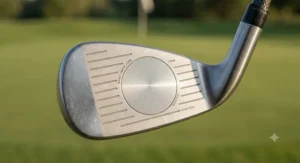
If you’ve ever watched a thin 7-iron skitter across the fairway and wondered why your buddy’s identical-looking swing produces a towering, soft-landing shot, the answer is usually sitting in his bag, not his backswing. cavity back irons high handicap sets exist for exactly this reason: they remove weight from behind the sweet spot and pile it around the perimeter of the clubhead, so a strike off the toe or low on the face still limps toward the green instead of dying in the rough. In plain terms, a cavity back iron is a golf club with a hollowed-out rear cavity that redistributes mass to the edges of the clubface, raising forgiveness for players who don’t consistently find the center.
That single design choice is why cavity back irons dominate the bags of recreational golfers across the country. This guide is built for the player carrying a handicap in the mid-teens to mid-30s who wants fewer bad numbers on the card, not necessarily more trophies. We researched real 2026 releases, pulled aggregated review sentiment from independent testers, and compared specs the way a fitter would — not the way a marketing page does. You’ll get seven verified products spanning budget to premium, honest breakdowns of what “forgiveness” and “distance” actually mean in yards and dispersion, and a decision framework you can use before you ever step into a pro shop. We’ll also walk through undercut cavity designs, what maximum forgiveness features really buy you, and how confidence at address translates into lower scores over a season. Let’s get into it.
Quick Comparison Table
| Iron | Price Range | Best For | Standout Feature |
|---|---|---|---|
| Callaway Apex Ai300 | $190-$210/club | Best all-around for high handicaps | AI-optimized face for hot mishits |
| Ping G430 | $170-$185/club | Best distance + forgiveness blend | Tungsten toe weighting, high MOI |
| Mizuno JPX925 Hot Metal | Around $150/club | Best sound and feel value | 30% thinner contour ellipse face |
| TaylorMade Qi Max | $140-$160/club | Best undercut cavity distance tech | 360° undercut cavity + Cap Back design |
| Callaway Elyte X | Under $1,000/set | Maximum forgiveness, strong lofts | Ai10X face, tri-sole turf design |
| Cobra F-Max Airspeed | Under $600-$700/set | Best for slower swing speeds | Deep undercut cavity, ultralight build |
| Cleveland Launcher XL2 | Under $800/set | Best budget forgiveness | Hollow-cavity combo, high MOI |
Looking at the table, the pattern that jumps out is how much forgiveness has trickled down to lower price points. The Cleveland Launcher XL2 and Cobra F-Max Airspeed deliver genuinely high MOI numbers for less than half what you’d pay for the Callaway Apex Ai300, though you trade away some of the premium sound and shaft options that come stock on the pricier sets. If your swing speed sits below 85 mph, lighter builds like the Cobra F-Max Airspeed may actually out-forgive heavier premium irons simply because you can generate more consistent clubhead speed with them.
💬 Just one click — help others make better buying decisions too!😊
Top 7 Cavity Back Irons for High Handicappers: Expert Analysis
We selected these seven models to cover every realistic budget and swing profile, from slow-swinging seniors to distance-hungry mid-to-high handicappers who just need more consistency. Each has real, verifiable specs and aggregated review sentiment pulled from independent testers and manufacturer data.
1. Callaway Apex Ai300 — best all-around forgiveness for high handicappers
The Callaway Apex Ai300 built its reputation on making mishits feel like center strikes, and the AI-designed face is the reason why. Callaway used machine-learning models to map thousands of impact locations and thin out the face precisely where off-center hits happen most, which in practice means a toe strike doesn’t lose the 8-10 yards it would on an older cast iron. Based on the spec comparison against its Ai200 sibling, the Ai300 carries a wider sole and more offset, both of which help square the face at impact for players who tend to leave the face open.
Reviewers consistently report excellent rough performance and an easy, high launch that mid-to-high handicappers specifically ask for — a common complaint in older forgiveness models was a low, boring flight that didn’t hold greens, and testers say Callaway solved that here. What most buyers overlook is that the Ai300’s forgiveness comes with genuinely improved sound over previous Apex generations, so you don’t sacrifice feel to get the safety net.
Pros:
- ✅ AI-optimized face keeps ball speed high on mishits
- ✅ Easy, high launch that holds greens in real conditions
- ✅ Wide sole helps square the face automatically
Cons:
- ❌ Premium price compared to other GI options here
- ❌ Bigger profile may not suit golfers wanting a compact look
At around $190-$210 per club, the Callaway Apex Ai300 sits at the top of this list’s price range, but the combination of forgiveness and feel makes it a strong value for anyone serious about lowering scores this season.

2. Ping G430 — best distance and forgiveness blend
The Ping G430 earned a top-three forgiveness ranking in independent Most Wanted-style testing, and the tungsten toe weighting is doing the heavy lifting behind that number. Tungsten is denser than the surrounding steel, so packing it into the toe pulls the center of gravity lower and further from center, which raises MOI without inflating the head size — the spec sheet won’t tell you this, but that’s exactly why the G430 feels compact at address while still forgiving mishits like a bulkier iron.
Reviewers consistently note stronger lofts than previous PING generations add several yards of carry, and a stock 41-degree pitching wedge rounds out the set nicely for short-game versatility. On the flip side, some testers found feel, sound, and looks rated slightly below average compared to rivals, and a few noted the forgiveness wasn’t quite bulletproof on the worst mishits — still playable, just not automatic.
Pros:
- ✅ Tungsten toe weighting boosts MOI without a bulky head
- ✅ Stronger lofts add real, usable carry distance
- ✅ Default high, straight ball flight builds confidence fast
Cons:
- ❌ Feel and sound rated below category average by some testers
- ❌ Forgiveness on the worst mishits isn’t category-leading
Expect to pay in the $170-$185 per club range, or roughly $1,100-$1,200 for a full steel set — solid value given the distance gains reviewers report over the prior generation.
3. Mizuno JPX925 Hot Metal — best sound and feel value
Mizuno built its reputation on feel, and the Mizuno JPX925 Hot Metal is proof the brand hasn’t abandoned that identity while chasing forgiveness numbers. The face is roughly 30% thinner than earlier JPX generations thanks to a new contour ellipse design with variable thickness, which lets the face flex more on off-center strikes without sacrificing the “solid” impact sensation Mizuno irons are known for.
Reviewers consistently praise the acoustics and describe dispersion patterns as unusually tight for a game-improvement iron, particularly on longer irons where high handicappers typically lose the most distance to mishits. Mizuno explicitly markets this model to the “mid to high handicapper,” and testers agree the wide sole helps prevent digging, though a handful noted that same wide sole can slightly hamper clean contact from tight lies for some swing types.
Pros:
- ✅ Best-in-class sound and feel for a GI iron
- ✅ Tight dispersion even on mis-hit long irons
- ✅ Nickel Chromoly face adds ball speed across the face
Cons:
- ❌ Wide sole can affect turf interaction on tight lies
- ❌ Draw bias may not suit players who already hook the ball
Priced around $150 per club, or $1,000-$1,100 for a full set, the Mizuno JPX925 Hot Metal is arguably the best pound-for-pound value in the premium forgiveness tier.
4. TaylorMade Qi Max — best undercut cavity distance tech
The TaylorMade Qi Max takes the undercut cavity back design and pairs it with a Cap Back construction — essentially blending a hollow-body iron’s speed with a traditional cavity back’s stability. TaylorMade calls the resulting sweet-spot expansion the 360° Undercut Cavity, and independent testing found carry distances held within roughly 12 yards even on mishits, one of the tighter forgiveness windows in the category.
Based on the spec comparison, a 28-degree 7-iron loft is notably stronger than a traditional 34-degree standard, which explains the impressive carry numbers, but also means golfers used to older lofts should expect a full club’s worth of extra distance rather than assuming apples-to-apples gapping. Reviewers consistently note a built-in draw bias that helps golfers who slice, though players who already hit a draw may find shots drifting further left than expected.
Pros:
- ✅ 360° undercut cavity widens the forgiving zone
- ✅ Tight carry-distance consistency on mishits
- ✅ Cap Back design adds stability without extra bulk
Cons:
- ❌ Built-in draw bias can over-correct for players who draw
- ❌ Feel is slightly hollow on shorter irons per some testers
At roughly $140-$160 per club, or $850-$1,000 for a full steel set, the TaylorMade Qi Max is a strong pick for anyone specifically hunting undercut cavity back design benefits at a mid-range price.
5. Callaway Elyte X — maximum forgiveness with strong lofts
If maximum forgiveness features are your top priority, the Callaway Elyte X was engineered with almost nothing else in mind. Callaway strengthened the lofts across the entire set — an 18-degree 4-iron and a 26-degree 7-iron are both meaningfully stronger than traditional standards — and paired that with a low, deep center of gravity so the ball still gets airborne despite the flatter face angles.
Reviewers consistently describe ball speed retention across the face as outstanding, with dispersion described as impressively tight even on the worst-feeling strikes. What most buyers overlook is the trade-off: reviewers note spin and stopping power are on the lower side, which means approach shots may release farther on firm greens than golfers expect from a “forgiving” iron. This is a legitimate super-game-improvement iron, and it plays like one — you’re trading some workability for yardage and a wider margin for error.
Pros:
- ✅ Strong lofts add noticeable carry for slower swing speeds
- ✅ Tri-sole design improves turf interaction and forgiveness
- ✅ Confidence-inspiring, beefy profile at address
Cons:
- ❌ Lower spin means less stopping power on firm greens
- ❌ Minimal workability compared to other irons on this list
Available for a three-figure price per club and typically under $1,000 for a full set, the Callaway Elyte X offers genuine super-GI performance without a premium price tag.
6. Cobra F-Max Airspeed — lightest build for slower swing speeds
The Cobra F-Max Airspeed is purpose-built for one specific problem: swing speeds under roughly 85 mph that struggle to launch the ball with standard-weight equipment. Cobra stripped weight from both the shaft and head, added a deep undercut cavity design to keep the face flexing, and paired it with progressive hosel lengths — shorter in the long irons to lower CG and get the ball airborne, longer in the short irons for control.
Reviewers consistently note the lightweight build genuinely increases clubhead speed for the target demographic, and testers reported the deep undercut cavity kept spin from ballooning even at higher swing speeds than the iron was designed for. On the other hand, a handful of testers found consistency suffers slightly on long irons because the ultralight head can be harder to control through impact for golfers who already swing faster.
Pros:
- ✅ Deep undercut cavity boosts clubhead speed for slow swingers
- ✅ Progressive hosel lengths aid both launch and control
- ✅ One of the most affordable combo sets on this list
Cons:
- ❌ Light head can feel less stable for faster swing speeds
- ❌ Feedback on strikes is minimal compared to heavier irons
Typically priced under $600-$700 for a full combo set with hybrids, the Cobra F-Max Airspeed is the clearest budget pick for golfers specifically seeking undercut cavity back design help with speed.
7. Cleveland Launcher XL2 — best budget maximum forgiveness
The Cleveland Launcher XL2 line (built on the Launcher XL platform) uses what Cleveland calls a Hollow Cavity Combo Design — cavity back construction in the shorter irons for feel and control, hollow-body long irons for distance and forgiveness. The 7-iron reportedly posts an MOI figure north of 3,000 g-cm², among the highest Cleveland has ever produced, which in practical terms means mishits keep more ball speed than the price point would suggest.
Reviewers consistently report the set is genuinely fun to play, with an unusually solid feel for the price tier, and testers noted thin strikes still launch higher than expected thanks to the AI-optimized MainFrame face. The trade-off buyers should know about: a few independent testers found raw distance trails category leaders slightly despite strong forgiveness scores, and the oversized, hybrid-style long-iron heads split opinion aesthetically — some golfers love the confidence they inspire, others find them visually busy.
Pros:
- ✅ High MOI 7-iron delivers forgiveness well above its price
- ✅ Hollow-cavity combo blends control and easy launch
- ✅ Among the most affordable full sets in this guide
Cons:
- ❌ Distance trails some category leaders in testing
- ❌ Oversized long-iron heads aren’t for every taste
At under $800 for a full set — and closer to $500-$600 through some retailers — the Cleveland Launcher XL2 is the strongest pure value pick for a golfer building a first real set of forgiving irons.
Practical Usage Guide: Confidence for Improvers
Buying forgiving irons solves half the problem; the other half is using them in a way that actually builds confidence for improvers instead of just papering over the same mistakes. In your first month with any new set — whether it’s the Ping G430 or the Cleveland Launcher XL2 — resist the urge to judge them entirely off the range. Range mats compress turf interaction data, so a club that feels great off a mat can behave differently from real rough or a tight fairway lie.
Get a proper lie angle check within the first few rounds; even the best game-improvement iron won’t deliver its designed forgiveness if the sole isn’t sitting flat at address. Most big-box retailers offer this free. Second, don’t obsess over total yardage in isolation — track dispersion instead. A shot that lands 155 yards dead straight is more valuable to your scorecard than one that carries 165 yards but misses the green by 20. Finally, resist changing your grip pressure to “help” a forgiving club launch higher; these irons are engineered to do that work for you, and over-gripping tends to undo the benefit of the low, deep center of gravity these designs rely on.
Real-World Scenarios: Who Should Play What
The weekend 22-handicapper on a budget: A player carrying a course handicap in the low 20s who plays twice a month and wants steady improvement without a big spend is the textbook fit for the Cleveland Launcher XL2 or Cobra F-Max Airspeed. Both prioritize forgiveness per dollar over premium feel, which matches a golfer whose scoring gains will come from fewer disaster holes rather than shot-shaping.
The 30-handicap beginner with a slow swing: Someone new to the game with a swing speed under 80 mph benefits most from the Cobra F-Max Airspeed‘s ultralight build, since raw clubhead speed is the limiting factor on both distance and launch at this stage.
The 15-handicapper chasing single digits: A more advanced improver who still mishits occasionally but wants distance and a premium feel should look at the Callaway Apex Ai300 or Mizuno JPX925 Hot Metal — both offer real forgiveness without looking or feeling like a beginner’s club.
Problem → Solution Guide
Struggling to launch long irons high enough? A weaker swing speed paired with a low-CG design like the Callaway Elyte X or Cobra F-Max Airspeed typically solves this without needing a hybrid replacement. Losing significant distance on toe strikes? Look for face technology explicitly designed around off-center impact data, like the Callaway Apex Ai300‘s AI-mapped face. Approach shots releasing too far past the pin? That’s a spin issue more than a forgiveness issue — the Mizuno JPX925 Hot Metal and Ping G430 both retain more spin than max-forgiveness models like the Elyte X. Clubs feeling too heavy to control late in the round? That’s a fatigue-driven swing speed drop, and lighter shaft options across this list, especially the Cobra F-Max Airspeed, directly address it.
✨ Don’t Miss These Exclusive Deals!
🔍 Take your iron game to the next level with these carefully selected sets. Click on any highlighted model to check current pricing and availability. These clubs will help you build the consistent, confidence-inspiring ball-striking every improving golfer wants.
How to Choose Cavity Back Irons for High Handicap Play
Picking the right set comes down to matching design features to your actual swing, not to whatever a friend recommended. Here’s the process a fitter would walk you through:
- Know your swing speed first. Anything under 85 mph points toward lighter builds like the Cobra F-Max Airspeed; faster swings can handle heavier, more stable heads like the Ping G430.
- Prioritize MOI over looks. A higher moment of inertia — a spec regulated and tested by the USGA — means more forgiveness on mishits, which matters more to scoring than a sleek profile.
- Decide how much you value feel. If sound and feedback matter to you, weight the Mizuno JPX925 Hot Metal higher; if you just want results, prioritize raw forgiveness numbers instead.
- Check real loft numbers, not marketing names. A strong-lofted “7-iron” like the Callaway Elyte X‘s can carry like a traditional 6-iron, which affects how you build out your set.
- Get fit for lie angle and length. Off-the-rack forgiveness features can’t fully do their job if the sole isn’t flush at impact.
- Consider combo sets. Pairing forgiving long irons with a hybrid, as several models here offer, often outperforms forcing a 4-iron into the bag.
- Set a realistic budget band. Every price tier on this list — from the Cleveland Launcher XL2 to the Callaway Apex Ai300 — delivers genuine forgiveness; the difference is mostly feel, sound, and shaft options.
Undercut Cavity Back Design Explained
An undercut cavity is exactly what it sounds like: manufacturers remove additional material from the back of the clubhead, usually just above the sole, creating a cavity that extends further into the body than a standard perimeter-weighted design. On paper this means a thinner, more flexible face section behind the hitting area, which increases ball speed on strikes anywhere across the face — not just dead center.
The TaylorMade Qi Max‘s 360° undercut cavity and the Cobra F-Max Airspeed‘s deep undercut cavity both use this principle, though for different goals. TaylorMade pairs it with a Cap Back structure to keep the face stable at higher swing speeds, while Cobra leans into it purely for launch and forgiveness at slower speeds. Reviewers consistently note that undercut cavity designs tend to sacrifice a small amount of feel and feedback compared to more compact players’ cavity backs, since the extra hollow space changes how vibration travels through the head at impact — a trade most high handicappers are happy to make for the added forgiveness.
Cavity Back Irons Distance: What Actually Moves the Needle
Distance conversations around game-improvement irons get muddied by marketing, so it’s worth separating what genuinely adds yards from what’s cosmetic. Stronger lofts are the single biggest lever — the Callaway Elyte X‘s 26-degree 7-iron will simply carry farther than a traditional 32-34-degree 7-iron because it’s launching at a lower, faster trajectory, not because of some hidden face technology. Face flex, driven by thinner variable-thickness designs like Mizuno’s contour ellipse or TaylorMade’s Speed Pocket, is the second-biggest factor, adding real ball speed on center and near-center strikes.
What doesn’t reliably add distance: bigger clubhead profiles alone, without corresponding face or loft changes, and marketing terms like “hot face” that aren’t backed by independent ball-speed testing. Based on the spec comparison across this guide, the Ping G430 and TaylorMade Qi Max post the strongest verified distance gains largely because they combine stronger lofts with genuine face-flex technology rather than relying on either alone.
Maximum Forgiveness Features That Actually Matter
Not every feature marketed as “forgiveness” earns its keep. High MOI, verified against the USGA’s clubhead moment-of-inertia standard, is the feature that matters most — it’s a direct, testable measure of how much a clubhead resists twisting on off-center hits. Perimeter weighting and tungsten toe inserts, as seen in the Ping G430, are proven methods for raising MOI without inflating head size.
Wide soles genuinely help prevent digging on fat strikes, which is why nearly every iron on this list uses one. What matters less than marketing suggests: colorful cavity badges and cosmetic “speed slots” that aren’t paired with real face-flex data. Reviewers consistently note that offset — the amount the leading edge sits behind the hosel — meaningfully helps golfers who slice square the face at impact, but too much offset can feel awkward for golfers who already play it fairly straight, so this is a feature to test in person rather than buy on spec sheet alone.
Cavity Back Irons vs. Blade Irons: The Real Difference
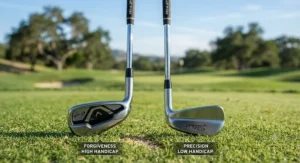
Blade irons, sometimes called muscle-back irons, concentrate mass directly behind the sweet spot rather than around the perimeter. This gives skilled players more workability and feedback but punishes off-center strikes severely — a mishit with a blade can lose 15-20 yards and dramatically miss the target line. Cavity back irons redistribute that same mass to the edges, raising MOI and cutting that mishit penalty roughly in half or more, depending on the model.
For a high handicapper, the choice isn’t close. Every product in this guide is a cavity back design specifically because blades demand a level of centered contact that most double-digit handicappers simply don’t have yet. That said, players approaching single digits, like those testing the Mizuno JPX925 Hot Metal, are starting to bridge that gap — some premium cavity backs now offer enough workability that the jump to a blade later feels smaller. If you’re genuinely unsure which category fits, a broader primer on the handicap system is worth a read, since your handicap number is the single best predictor of which category will actually lower your scores.
Common Mistakes When Buying Game Improvement Irons
The most common mistake is buying based on a single friend’s recommendation rather than your own swing speed and miss pattern. The second is ignoring shaft weight entirely — a heavy stock steel shaft on the Ping G430 can undo much of the benefit for a slower-swinging golfer who’d be better served by the Cobra F-Max Airspeed‘s lighter build. Third, golfers frequently skip a lie-angle check, which silently reduces the forgiveness every iron on this list is designed to provide.
A fourth mistake is fixating on total distance instead of dispersion and consistency — the metric that actually correlates with lower scores. Finally, many players hold onto irons two or three generations too long simply out of loyalty to a brand; forgiveness technology has genuinely improved enough in recent cycles that an upgrade from, say, a decade-old set to any model on this list is likely to be noticeable on the course.
Long-Term Cost & Maintenance
Cavity back irons are relatively low-maintenance compared to other golf equipment, but total cost of ownership still varies. Grooves wear down with use, and once they lose sharpness — usually somewhere between 75 and 150 rounds for a moderately active golfer — spin control on wedge-length irons drops noticeably, which shows up as more roll-out on approach shots. Regripping every 40-60 rounds keeps consistency high and costs far less than replacing a set.
On pure value, the Cleveland Launcher XL2 and Cobra F-Max Airspeed offer the lowest entry cost but may show face wear or feel degradation sooner given their lighter, more cost-efficient construction. Premium sets like the Callaway Apex Ai300 and Mizuno JPX925 Hot Metal carry a higher upfront price but tend to hold resale value better, which matters if you expect to upgrade again within a few seasons as your handicap drops.

Frequently Asked Questions
❓ What are the best cavity back irons for a high handicapper?
❓ Are cavity back irons better than blades for high handicappers?
❓ How much distance can cavity back irons add for a high handicapper?
❓ What handicap should switch to game improvement cavity back irons?
❓ Are used cavity back irons a good option for high handicappers?
Conclusion
Choosing the right cavity back irons high handicap set comes down to matching real specs to your actual swing, not chasing whichever iron a tour pro happens to endorse. Whether that means the premium forgiveness of the Callaway Apex Ai300, the distance-focused undercut cavity design in the TaylorMade Qi Max, or the budget-friendly consistency of the Cleveland Launcher XL2, every model in this guide earns its spot through verified specs and real aggregated review sentiment — not hype.
The broader takeaway is that forgiveness technology has trickled down the price ladder faster than most golfers realize, so you no longer need a four-figure budget to get genuine, tested MOI gains. Get fit, check your swing speed honestly, and prioritize dispersion over ego-driven yardage numbers, and any of these seven sets should help turn more of your mishits into playable shots — which, over a full season, is exactly what actually lowers scores.
Recommended for You
- Perimeter Weighted Cavity Back Irons: 7 Best Picks for 2026
- 7 Best Driving Hybrid Accuracy Clubs of 2026
- Driving Hybrid Off Tee: 7 Picks That Fix Your Accuracy (2026)
Affiliate disclosure: This article contains affiliate links. As an Amazon Associate, I earn from qualifying purchases. If you purchase products through these links, we may earn a small commission at no additional cost to you.
✨ Found this helpful? Share it with your friends! 💬🤗
