

In This Article
Senior golf hybrid clubs are forgiving, high-launching rescue clubs that pair an iron-like swing with a wood-like head, usually on lightweight graphite shafts. They replace the long irons that slower swings struggle to launch, helping the ball climb quickly, land softly, and escape rough lies that would swallow a 4-iron whole.

Let’s be honest about the long iron. It was a lovely club when your swing speed sat a few notches higher and your lower back didn’t file a formal complaint after every range session. Today, a 4-iron demands speed you may no longer have to spare, and the reward is a low, skidding ball that never quite reaches the green.
A hybrid flips the script. As the design history of the hybrid club shows, the wood-style head and shallow face add loft and backspin compared with the iron it replaces. The ball lifts, stalls, and drops with real bite.
That’s the promise. Delivering it is where the details matter, which is why this guide digs into what most roundups skip: graphite shaft weight, what truly counts as lightweight golf clubs for senior golfers, and how to choose golf clubs for seniors with slower swing speed without gambling on the wrong loft.
A quick word on method. Every spec and verdict below comes from published manufacturer specs and independent testing data from outlets such as Golf Monthly and National Club Golfer, then interpreted in plain English. We haven’t swung these clubs ourselves, and we won’t pretend otherwise. Owner-review averages shift daily, so check each product page for current ratings. Here are the seven senior golf hybrid clubs worth your short list in 2026.
Quick Comparison: The Best Senior Golf Hybrid Clubs at a Glance
| Hybrid | Standout Trait | Loft Options | Price Range (check current price) | Best For |
|---|---|---|---|---|
| Titleist GT1 | Highest launch, super-light build | 20°, 23°, 26°, 29° | $320–$340 range | Slower swings needing height |
| Ping G440 | Maximum forgiveness, solid sound | 17°–34° (six lofts) | Around $300 | Players who miss the sweet spot often |
| Callaway Quantum Max OS | Draw-biased, turf-friendly sole | 18°–32° (six lofts) | $310–$330 range | Slicers and rough-heavy courses |
| Mizuno JPX One | Easy launch, compact look | Roughly 19°–28° (varies by retailer) | High-$200s | Long-iron replacement |
| TaylorMade Qi4D Max | Carbon crown, rear weighting | 20°–34° (five lofts) | Around $300 | Slicers wanting versatility |
| Wilson Dynapwr | Best value | 17°–28° (five lofts) | $200–$250 range | Budget-conscious buyers |
| Srixon ZXi | Clean looks, strong ball speed | Check Srixon’s loft chart | High-$200s | Easy long-iron swap with style |
Read across the table and a pattern emerges. The Titleist GT1 and Ping G440 chase height and forgiveness, the shortest path to easier golf for slower swings, while the Callaway Quantum Max OS and TaylorMade Qi4D Max add draw-biased help for the dreaded left-to-right miss. Budget buyers should note that the Wilson Dynapwr gives up adjustability for a noticeably lower price, and the Mizuno JPX One suits anyone who wants an iron-like profile without iron-like difficulty. Prices are ranges at the time of research and may vary.
💬 Just one click — help others make better buying decisions too!😊
Top 7 Senior Golf Hybrid Clubs: Expert Analysis
Each review below turns the spec sheet into on-course meaning, drawing on independent test data rather than marketing copy. Confirm lofts and options with the retailer before ordering.
1. Titleist GT1 — highest launch in its family
Titleist built the Titleist GT1 as the high-flying member of its GT hybrids, and for senior golf hybrid clubs that is exactly the right job description. It has the largest head of the trio, sitting somewhere between a classic hybrid and a mini fairway wood.
The super-lightweight construction frees up mass for adjustable weights and a tunable hosel, so you get a high launch window without sacrificing ball speed. Testers recorded launch angles consistently pushing past 40 degrees. That is the height that turns a long approach into a soft landing rather than a low runner.
Based on the spec comparison, the Titleist GT1 is a smart fit if your main problem is getting the ball airborne. The 26° and 29° lofts are natural landing spots for golfers replacing mid-to-long irons. Golf Monthly named it their top pick for seniors, while National Club Golfer noted that spin can run high and the head carries a slight draw bias. We couldn’t verify aggregated owner-review data, so check current star ratings.
Pros:
- ✅ Large, confidence-inspiring footprint at address
- ✅ Lightweight build launches the ball easily
- ✅ Adjustable weights and hosel for fine-tuning
Cons:
- ❌ Spin may run too high for some swings
- ❌ Less raw power than GT2 or GT3
Expect the $320–$340 range; it’s a premium buy that pays off most for slower swingers.

2. Ping G440 — forgiveness king with the nicest sound
If forgiveness were a currency, the Ping G440 would be the richest club in this guide. Golf Monthly crowned it the most forgiving hybrid in its senior roundup, and National Club Golfer gave it the best-sounding award.
The secret is a carbon fly-wrap crown, which saves weight and also mutes the harsh metallic “ting” that plagues many hybrids. A shallower face helps the ball climb, and the thin, lively face keeps ball speeds strong. Six lofts, from 17° to 34°, mean you can cover almost any gap in the bag.
What the spec sheet won’t tell you, but testers note, is how calm the club feels on mishits. The generous footprint inspires confidence, and testers praised its steady flight from tee, fairway, and rough. For slower swings, that stability matters more than any headline distance number. The Ping G440 also lets better players shape shots, so it won’t feel like a training wheel as your game evolves. Owner-review aggregates couldn’t be verified here, so scan the current ratings.
Pros:
- ✅ Extremely forgiving on off-center strikes
- ✅ High, consistent ball flight
- ✅ Strong ball speed with a pleasant sound
Cons:
- ❌ Few cosmetic changes from the previous model
- ❌ Larger shape may not suit compact-head fans
Around $300 at the time of research, with deals appearing; strong value for the forgiveness delivered.
3. Callaway Quantum Max OS — slice-fighter with a turf-friendly sole
Slicers, meet your new best friend. The Callaway Quantum Max OS pairs a draw-biased head with a Step Sole designed to glide through turf, and Golf Monthly rated it best from any lie.
An Ai-optimized face targets forgiveness, Speed Wave 2.0 aims to protect ball speed, and the head is noticeably larger than its Quantum siblings. Six lofts from 18° to 32° and an OptiFit 4 hosel give you real tuning room.
On paper this means two things for golf clubs for seniors with slower swing speed: easier launch and fewer wild misses to the right. Reviewers praised the high, controlled flight and the way the sole interacts with the turf, which encourages you to attack pins from imperfect lies. The trade-off is that the hosel adjustment system is described as complicated, so ask a shop to set it once and leave it alone. We could not verify owner-review averages, so check current ratings before buying.
Pros:
- ✅ Extremely forgiving with tight dispersion
- ✅ Straight, high ball flight
- ✅ Excellent turf interaction from tricky lies
Cons:
- ❌ Hosel adjustability feels complicated
- ❌ Draw bias may not suit natural hookers
Expect the $310–$330 range; worth it if a slice is costing you strokes.
4. Mizuno JPX One — compact looks, easy launch
Not everyone wants a shovel-sized head staring up from the turf. The Mizuno JPX One offers a compact, uncluttered profile with surprising help underneath.
Mizuno’s Waffle Crown redistributes weight to lower the center of gravity, which lifts launch without ballooning the ball. Testers described a strong, penetrating flight with plenty of height and a steep descent angle, which gives stopping power into greens. Feel is powerful but never harsh.
Here’s what to weigh: this is a long-iron replacement for golfers who like the look of an iron but are tired of the difficulty. National Club Golfer rated it best for forgiveness, while Golf Monthly called it best for high launch, a rare double. The glossy crown divides opinion, so see it in person. Loft options vary by retailer (reports range from two to four options), so confirm availability. Owner-review data couldn’t be verified; check current ratings.
Pros:
- ✅ Forgiving and easy to launch
- ✅ Strong flight with real height
- ✅ Powerful feel without excess noise
Cons:
- ❌ Glossy crown won’t suit every eye
- ❌ Loft range varies by retailer
High-$200s; fair value for a refined, compact option.
5. TaylorMade Qi4D Max — carbon crown, rear-weighted launch
The TaylorMade Qi4D Max is a lesson in weight management. A 450 stainless steel body and an ultra-light carbon fibre crown shave mass up top so it can be moved low and back, which raises launch and boosts stability.
Twist Face geometry steadies off-center hits, and a Speed Pocket protects ball speed on low strikes. Five lofts from 20° to 34° cover most gapping needs. In Golf Monthly’s testing, the right miss was far less noticeable with this model than with the standard version, which is why it earned the best-for-slicers tag.
For slower swings, rear weighting is the quiet hero: it helps you get airborne without a heroic swing. Testers also found it versatile from the rough and even around the greens. The catch is zero adjustability, so what you buy is what you get. If you’d rather tinker, look at the Titleist GT1 instead. Owner-review aggregates weren’t verified; check current ratings.
Pros:
- ✅ Impressive distance and forgiveness
- ✅ Rear weighting aids launch
- ✅ Versatile from rough and around greens
Cons:
- ❌ No adjustability at all
- ❌ Pricier than value-focused rivals
Around $300 at the time of research; solid value if you want fuss-free help.

6. Wilson Dynapwr — best value for slower swings
Great hybrids don’t have to cost a small mortgage. The Wilson Dynapwr earned Golf Monthly’s best-value title by delivering forgiveness and versatility at a friendlier price.
Five lofts from 17° to 28° cover the long-iron territory most seniors need, and testers found it easy to generate high launch, a clear benefit for slower swing speeds. The address look is clean and confident, and the club performed well from the rough. Spin ran on the higher side, so moderate-speed players may prefer something lower-spinning, and there is no adjustability.
Here’s the practical interpretation: if you want a dependable rescue club and don’t care about hosel gadgetry, the Wilson Dynapwr removes complexity along with cost. One tester measured roughly a 20-yard carry loss on a low-face strike. That’s respectable for a value club but a reminder that no hybrid repeals the laws of physics. Owner-review data couldn’t be verified, so check ratings.
Pros:
- ✅ Solid forgiveness across the face
- ✅ Confidence-inspiring look at address
- ✅ Performs well from the rough
Cons:
- ❌ Higher spin may not suit every swing
- ❌ No adjustability
The $200–$250 range makes it the budget standout.
7. Srixon ZXi — best looks, easy long-iron swap
The Srixon ZXi is the quiet achiever of this list. National Club Golfer named it best looking, praising a clean matte black crown with understated silver and red accents.
Underneath, the larger head and forgiving face keep off-center hits playable, and testers found it easy to launch with strong ball speeds. It’s billed as an easy long-iron replacement, particularly appealing if your irons are already Srixon and you like a matching look.
Interpretation time: a bigger head inspires confidence, and confidence loosens tight shoulders, which tends to help slower swingers more than any technology badge. Published loft and shaft details are thinner than for rivals, so confirm options at the retailer or with Srixon directly before ordering. The Srixon ZXi also tends to be overlooked next to bigger-name rivals, which may translate into better deals. Owner-review aggregates couldn’t be verified; check current ratings.
Pros:
- ✅ Clean, confidence-inspiring design at address
- ✅ Excellent forgiveness on off-center strikes
- ✅ Strong ball speeds for the category
Cons:
- ❌ Larger profile won’t suit everyone
- ❌ Fewer published specs; confirm loft options
High-$200s; a fair price for a stylish, forgiving option.
Your First 30 Days: Setup and Practice Guide for New Senior Golf Hybrid Clubs
Buying the club is the easy part. Getting value from it takes a month of smart habits.
Week one: learn your numbers. Hit ten balls with each hybrid and note carry distance, not total distance. Then check your gaps, because a hybrid should sit roughly one comfortable club’s distance from its neighbors. If two clubs fly the same distance, one of them is redundant.
Week two: fix the swing thought. The most common first-month mistake is trying to scoop the ball into the air. A hybrid has the loft to do that job, so swing it like an iron and let the sweeping, shallow strike do the lifting. Keep the ball a touch forward of where you’d play a mid-iron.
Week three: test from real lies. Take the club into light rough and a slightly downhill fairway. This is where hybrids earn their keep.
Week four: adjust once, then stop. If your hybrid has an adjustable hosel or weights, change one setting at a time and record the result. Then leave it alone.
Maintenance: wipe the face after every round, keep the headcover on, and avoid leaving clubs baking in a hot trunk, which can stress shaft bonding. Check any adjustable hosel for tightness every few rounds.

Three Senior Golfers, Three Hybrids: Real-World Scenarios
These are illustrative profiles, not testimonials, built to show how the reasoning plays out.
Margaret, 68, walks nine holes twice a week and fights a slice. Her swing is smooth but slow, and her miss is always right. Draw bias and high launch are the priorities, so the Callaway Quantum Max OS or TaylorMade Qi4D Max fit best. Either one lets her swing within herself and still find the fairway.
Bob, 72, plays Saturday mornings and watches every dollar. He needs a reliable rescue club, not a science project. The Wilson Dynapwr gives him forgiveness and easy height at a price that leaves room in the budget for a lesson or two.
Dennis, 66, a former low-handicapper with a shorter swing. He wants stopping power on firm greens and a head that doesn’t look like a frying pan. The Mizuno JPX One or Ping G440 would suit him, with the Ping offering more forgiveness and the Mizuno a more compact look.
The pattern: match the club to the problem. Slicers want draw bias, low-confidence ball strikers want big heads, and tinkerers want adjustability.
✨ Don’t Miss These Exclusive Deals!
🔍 Take your long game to the next level with these carefully selected hybrids. Click on any highlighted item to check current pricing and availability. These clubs can help you build the confident approach shots that keep you smiling all the way to the 18th green!
How to Choose Senior Golf Hybrid Clubs: 7 Steps That Matter
- Know your swing speed. Shaft flex follows swing speed, not birthdays. A launch monitor session at a shop or range gives you a real number.
- Prioritize forgiveness. Larger heads and low centers of gravity protect you on mishits, which is why the Ping G440 and Callaway Quantum Max OS shine.
- Pick a launch-friendly loft. Lofts in the mid-20s to around 30° tend to be easiest to get airborne for slower swings.
- Match graphite shaft weight to your tempo. More on this below; it’s the most overlooked spec.
- Decide on adjustability. The Titleist GT1 offers it; the Wilson Dynapwr and TaylorMade Qi4D Max don’t. Pick based on whether you’ll actually use it.
- Demo before you buy. Golf Monthly’s senior hybrid buying advice recommends hitting taped-up demo clubs on the range to judge launch, feel, and consistency.
- Check gapping and budget. Make sure the new club doesn’t duplicate your current distances.
Graphite Shaft Weight: The Spec That Quietly Decides Your Distance
Most golfers obsess over the flex letter and ignore the grams printed beside it. That’s backwards. Two shafts labeled “Regular” can differ by dozens of grams and swing nothing alike.
One widely cited fitting guide estimates that every extra 10 grams of shaft weight costs roughly half a mile per hour of swing speed. Treat that as a rule of thumb, not a law. Fittings have also revealed differences of up to 21 yards between shaft weights for individual players, which is why measurement beats guessing.
For context, graphite shafts in woods and hybrids commonly land in the 50–85 gram range, while senior-oriented iron shafts for slow swings can drop into the 45–60 gram bracket. Tour-style hybrid shafts, with options up to around 105 grams, are generally aimed at faster swingers and are likely overkill for most seniors. Retail models sometimes ship with stock graphite around 60 grams, a sensible starting point.
The caution: lighter isn’t automatically better. Go too light and the club can feel whippy, hurting timing and consistency. Weight also interacts with swing weight, since adding 10 grams to the clubhead raises swing weight more than adding the same to the shaft.
The practical move: test two or three shaft weights on a launch monitor and pick the one that delivers the tightest dispersion, not just the highest speed.
Lightweight Golf Clubs for Senior Golfers: What “Light” Actually Means
“Lightweight” is a marketing word until you break it down. Total club weight is the sum of head, shaft, and grip, and each can be tuned independently.
Manufacturers are getting clever with the head. The Ping G440 and TaylorMade Qi4D Max use carbon crowns to save weight up high, then redistribute it low and deep for forgiveness. The Titleist GT1 uses a super-lightweight build to enable high launch while retaining ball speed. That’s engineering working in your favor, as opposed to simply making everything flimsy.
For lightweight golf clubs for senior golfers, the benefit is easier tempo and less fatigue late in the round. A club that feels effortless on the first tee still feels manageable on the sixteenth.
But balance matters as much as total grams. A very light shaft paired with a heavy head can feel head-heavy and hard to control. Ask the fitter about swing weight, and don’t hesitate to try a slightly heavier option if your tempo feels rushed.
Golf Clubs for Seniors With Slower Swing Speed: Loft, Launch, and Flex
When speed drops, the club must do more of the work. That means more loft, a lower center of gravity, and a shaft that loads without a fight.
Because a hybrid’s loft is typically higher than the iron it replaces, it launches higher and spins more, producing the stall-and-drop flight that holds greens. Seniors’ sets often include 5-iron equivalents among hybrid options, a sign of how helpful this club is for slower swings.
Draw-biased heads like the Callaway Quantum Max OS also help, because slower swings often leave the face open at impact. Forgiving flex matters too: a shaft too stiff for your speed won’t load, and you’ll lose both height and distance.
Don’t forget the body. An R&A-backed study of older golfers involving 152 participants aged 65 and over found that golfers had better static and dynamic balance than non-golfers, and that golf training improved strength, flexibility, and walking performance. Staying active and keeping rotation healthy supports swing speed, so equipment and fitness work as a team.
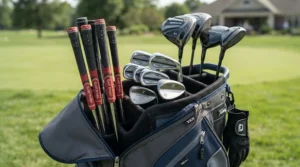
Senior Golf Hybrid Clubs vs. Long Irons and Fairway Woods
| Factor | Hybrid | Long Iron | Fairway Wood |
|---|---|---|---|
| Launch height | High and easy | Low, demands speed | High, needs sweeping swing |
| Forgiveness | High | Low | High |
| From rough | Excellent | Poor | Fair to poor |
| Stopping power | Strong | Moderate | Weak (more roll) |
| Best For | Most seniors replacing 3–5 irons | Fast, precise ball-strikers | Long tee shots and fairway approaches |
The table makes the case plainly: for slower swings, long irons ask for speed and precision that many seniors no longer want to spend, while fairway woods offer distance but struggle from the rough. Hybrids sit in the sweet spot, combining iron-style control with wood-style forgiveness. A fairway wood will still produce more club speed and roll, so many players keep both. The smartest bags use hybrids to replace the clubs that frustrate them most.
Features That Actually Matter (And Those That Don’t)
What matters: forgiveness, launch, shaft weight, and confidence at address. If a club inspires you to swing freely, it’s doing its job.
What doesn’t (as much as marketing suggests):
- Extreme adjustability. The Cobra OPTM offers 33 settings through its FutureFit33 hosel, but most seniors need a handful of options at most. If you won’t use them, don’t pay for them.
- Sound hype. A pleasant sound is nice, but it won’t fix a slice. Treat it as a tiebreaker.
- Brand loyalty. The Wilson Dynapwr and Srixon ZXi hold their own against bigger-name rivals.
- Crown color. Matte versus gloss is purely personal preference.
The rule of thumb: spend money on forgiveness and fitting, not on gadgets.
Common Mistakes When Buying Senior Golf Hybrid Clubs
- Buying by age, not swing speed. “Senior flex” is a label tied to speed, not a birthday.
- Choosing too little loft. A low-lofted hybrid can behave like the long iron you’re trying to escape.
- Skipping the demo. Looks and sound can fool you; launch numbers don’t.
- Ignoring gaps. Two clubs with the same distance waste a precious slot among your 14.
- Overpaying for adjustability. If you never touch the wrench, you’ve bought dead weight.
- Going too heavy. A shaft that fights your tempo costs distance and consistency.
Fix those six and you’ll avoid most buyer’s remorse.
Long-Term Cost & Maintenance: Price Range and Value Analysis
| Tier | Models | Price Range (check current price) | Value Verdict | Best For |
|---|---|---|---|---|
| Budget | Wilson Dynapwr | $200–$250 range | Excellent value, no adjustability | Cost-conscious players |
| Mid-range | Srixon ZXi, Mizuno JPX One | High-$200s | Strong all-round | Style- or feel-focused buyers |
| Premium | Ping G440, TaylorMade Qi4D Max | Around $300 | Top forgiveness | Maximum help |
| Premium+ | Callaway Quantum Max OS, Titleist GT1 | $310–$340 range | Best for launch and tuning | Tinkerers and slicers |
Cost per use tells the real story. A hybrid costing around $300, played for three seasons of roughly 40 rounds, works out to about $2.50 per round. Against that, one extra shot saved from the rough per round pays for itself quickly.
A standalone fitting reportedly runs about $100–$300, so ask whether a shop credits the fee toward a purchase. Maintenance is cheap: clean the face, protect the shaft, and re-check adjustable hosels. Grips wear out first, so expect to replace them before the club itself.
Rules and Safety: Conforming Clubs, Adjustable Hosels, and Staying Healthy
If you play in tournaments or league events, equipment rules matter. Clubs must conform to the Rules of Golf, and adjustable features are allowed only when they aren’t readily adjustable during a round. The USGA’s equipment FAQ notes that manufacturers are encouraged to submit adjustable features for evaluation. Using an adjustable feature to change a club mid-round can trigger penalties, so set your Titleist GT1 or Callaway Quantum Max OS at home. A conforming club must also meet the rules in every adjustable configuration, not just one. And remember the 14-club limit.
On the health side, check with your doctor or a physical therapist before ramping up your play, especially if you’re returning to golf. A few minutes of warm-up stretches before the round reduces strain, and a club that launches easily means you swing smoother, not harder.
FAQ
❓ What loft should the first of my senior golf hybrid clubs be?
❓ Can senior golf hybrid clubs replace my fairway wood?
❓ How many hybrids can a senior golfer carry?
❓ Is a custom fitting worth it for golf clubs for seniors with slower swing speed?
❓ Are adjustable senior golf hybrid clubs hard to set up?
Conclusion: Make the Long Game Easy Again
The long iron had a good run. For many players, though, the smartest move now is trading frustration for height, forgiveness, and a swing that feels like less work. Senior golf hybrid clubs deliver exactly that, especially when you pay attention to details the marketing glosses over, like graphite shaft weight, loft, and a head size that makes you want to swing.
To recap: the Titleist GT1 is the pick for sheer launch, the Ping G440 for forgiveness, the Callaway Quantum Max OS and TaylorMade Qi4D Max for slice help, the Mizuno JPX One for compact looks with real height, the Wilson Dynapwr for value, and the Srixon ZXi for style. Whichever you choose, demo it, match the shaft to your tempo, and respect the gaps in your bag.
The best club isn’t the most expensive or the most adjustable. It’s the one that lets you swing freely, find the green, and enjoy the walk afterward. Check current prices, compare a few on a launch monitor, and let one of these senior golf hybrid clubs do the heavy lifting.
✨ Ready to Hit Easier Long Shots?
🔍 Click on any highlighted product above to check current pricing and availability. The right hybrid could be the most satisfying club change you make all season!
Recommended for You
- Senior Golf Club Set: 7 Best Picks For 2026
- Professional Golf Driver For High Swing Speed: 7 Proven Picks 2026
- Premium Golf Iron Set: 7 Best Picks Worth The Money In 2026
Disclaimer: This article contains affiliate links. As an Amazon Associate, I earn from qualifying purchases. If you purchase products through these links, we may earn a small commission at no additional cost to you.
✨ Found this helpful? Share it with your friends! 💬🤗
