
In This Article
Standing over a 200-yard shot with the wrong club in your hands is a frustrating experience every golfer knows too well. I’ve watched countless players struggle with this exact scenario, debating between their trusty 3-wood and that hybrid sitting quietly in the bag. The fairway wood vs hybrid decision isn’t just about equipment preferences—it’s about understanding which tool gives you the best chance at reaching greens in regulation and shaving strokes off your scorecard.
The 2026 golf equipment landscape has evolved dramatically, with manufacturers like TaylorMade, Callaway, and Cobra pushing technological boundaries in both categories. Today’s fairway woods feature titanium frames and carbon crowns that were once exclusive to drivers, while hybrids have become precision instruments capable of replacing multiple long irons. According to USGA Equipment Standards, fairway woods must comply with specific dimensional requirements, including maximum clubhead volume and face area restrictions, creating a level playing field where performance truly matters.
But here’s what most golfers miss: the choice between fairway wood vs hybrid isn’t binary. Your swing speed, typical miss patterns, course conditions, and even the lies you commonly face all influence which club becomes your secret weapon. Some players need the penetrating ball flight and raw distance of a fairway wood, while others benefit from the higher launch and versatility of a hybrid. Understanding these nuances can transform your long game from a liability into a scoring advantage.
Quick Comparison Table
| Feature | Fairway Wood | Hybrid |
|---|---|---|
| Clubhead Size | Larger (185-200cc) | Smaller, compact |
| Shaft Length | Longer (42-43″) | Shorter (40-41″) |
| Typical Loft | 13-21 degrees | 17-28 degrees |
| Ball Flight | Lower, penetrating | Higher, softer landing |
| From Rough | Challenging | Excellent |
| Off the Tee | Excellent | Very Good |
| From Tight Lies | Requires skill | More forgiving |
| Average Distance (3W vs 3H) | 220-240 yards | 200-220 yards |
| Price Range | $299-$449 | $249-$399 |
| Best For | Maximum distance, skilled players | Versatility, improving players |
💬 Just one click – help others make better buying decisions too! 😊
Top 7 Fairway Woods & Hybrids: Expert Analysis (2026 Updated)
1. TaylorMade Qi4D Fairway Wood – The Complete Package
Price: $379.99 | Lofts Available: 15°, 16.5°, 18°, 21°, 24°
The TaylorMade Qi4D Fairway Wood dominated 2026 independent testing in a way equipment experts claim they’ve never witnessed before. This isn’t marketing hype—the TaylorMade Qi4D Fairway Wood swept nearly every category in comprehensive head-to-head comparisons against competitors from Callaway, Ping, Cobra, and Titleist.
Key Specifications:
- 185cc clubhead with refined shaping
- Speed Pocket technology for low-face forgiveness
- 8g Trajectory Adjustment System (TAS) weight
- 4-degree adjustable loft sleeve
- Multi-material construction with carbon crown
During testing, the penetrating flight combined with the ability to hold greens and stunning navy and orange aesthetics makes the TaylorMade Qi4D fairway wood a standout release for 2026. The Speed Pocket—a slot behind the face—protects ball speed on thin strikes, while Twist Face technology straightens out off-center hits through corrective face curvature.
What separates the Qi4D from previous generations is the refinement in every detail. TaylorMade engineers analyzed tour feedback to optimize sit points, lie angles, and center of gravity placement. The result is a club that looks confidence-inspiring at address while delivering tour-level performance for golfers across all skill levels.
Customer Feedback: Players consistently praise the versatility, noting it works equally well from the tee on tight par-4s and from fairway lies on long par-5s. The adjustability allows fine-tuning without requiring a new clubhead.
✅ Pros:
- Best-in-class ball speed consistency
- Works from tee and fairway equally well
- Extensive adjustability options
❌ Cons:
- Premium pricing
- May launch too low for slower swing speeds
2. TaylorMade Qi4D Max Fairway Wood – Maximum Forgiveness
Price: $379.99 | Lofts Available: 15°, 18°, 21°, 24°
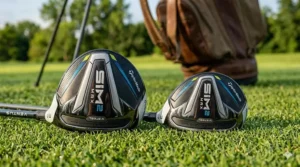
For golfers prioritizing forgiveness over workability, the TaylorMade Qi4D Max Fairway Wood offers a compelling alternative to the standard model. The massive 200cc head—17% larger than the Tour version—provides tremendous confidence at address and genuine performance benefits on mishits.
Key Specifications:
- 200cc clubhead (5% larger than standard Qi4D)
- Shallow face profile for easier launch
- Rear-weighted for higher MOI
- Perimeter weighting for stability
The massive 200cc head is designed to feel effortless to launch with a shallower face and a confidence-boosting footprint that helps you swing freely. By pushing size to the limit, weight moves toward the perimeter for higher moment of inertia and straighter results on off-center strikes.
The Max model excels for mid-to-high handicappers who struggle with consistent contact. The larger footprint reduces the visual intimidation factor that some players experience with compact fairway woods, while the engineering delivers real performance gains where they matter most—on those inevitable mishits.
Customer Feedback: High handicappers report significant distance gains and tighter dispersion compared to previous fairway woods. The easy launch makes it particularly effective from difficult lies.
✅ Pros:
- Extremely forgiving on mishits
- Easy to launch for moderate swing speeds
- Confidence-inspiring appearance
❌ Cons:
- Less workable than standard model
- Larger profile may not suit better players
3. Callaway Quantum Max Fairway Wood – Pure Distance King
Price: $399.99 | Lofts Available: 15°, 18°, 21°
If raw distance is your priority, the Callaway Quantum Max Fairway Wood topped testing charts for maximum carry and ball speed in 2026. The Quantum Max took the top spot for ball speed and carry distance with impressive numbers that challenged even some drivers.
Key Specifications:
- AI-optimized cupface design
- Speed Wave 2.0 tungsten weighting (40g)
- Step Sole for turf interaction
- OptiFit4 adjustable hosel
The cupface wraps around the crown and deeper into the sole than previous designs, creating a more pliant sole and hinge for better face deflection and higher launch. Speed Wave 2.0 positions 40 grams of tungsten low and forward, directly addressing the most common mishit among average golfers—the low-face strike.
Testing revealed ball speeds exceeding 153 mph with carry distances pushing 260 yards. The technology delivers, but what impresses most is how Callaway maintained forgiveness while pursuing maximum distance. This isn’t a one-dimensional club that only works on pure strikes.
Customer Feedback: Players note the solid, slightly muted feel that provides excellent feedback without being harsh. The consistency across the face width stands out during on-course testing.
✅ Pros:
- Maximum ball speed and carry distance
- Excellent from various lies
- Confidence-inspiring look at address
❌ Cons:
- Premium price point
- May produce too much spin for some players
✨ Don’t Miss These Exclusive Deals!
🔍 Take your long game to the next level with these carefully selected products. Click on any highlighted item to check current pricing and availability on Amazon. These clubs will help you create authentic scoring opportunities your playing partners will envy!
4. Cobra OPTM X Fairway Wood – Best All-Around Value
Price: $369.00 | Lofts Available: 15°, 18°, 21°
The Cobra OPTM X Fairway Wood represents Cobra’s innovative Point of Inertia (POI) concept, offering near-tour-level ball speeds with remarkable forgiveness for a compact-profile fairway wood. Built with multi-material construction featuring a lightweight matte black carbon crown and Titanium frame, the OPTM X introduces Cobra’s new POI technology that aims to minimize gear effect and tighten dispersion.
Key Specifications:
- Multi-material construction (titanium frame + carbon crown)
- POI technology for natural clubhead rotation
- Variable-thickness face with 15 zones
- Adjustable weighting options
During testing, the OPTM X delivered ball speeds nearly identical to the lower-spinning LS model but with a friendlier launch profile. This versatility makes it suitable for a wider range of golfers, from skilled mid-handicappers to low-handicap players seeking reliable performance.
Customer Feedback: The compact, strong appearance appeals to confident ball-strikers, while the forgiveness prevents the harsh feedback typical of players’ clubs. The penetrating flight provides excellent distance control.
✅ Pros:
- Excellent value pricing under $370
- Compact profile with surprising forgiveness
- Strong, workable ball flight
❌ Cons:
- May be too compact for high handicappers
- Limited availability compared to major brands
5. Ping G440 Max Fairway Wood – Forgiveness Champion
Price: $367.00 | Lofts Available: 15°, 18°, 21°
The Ping G440 Max Fairway Wood continues Ping’s legacy of producing exceptionally forgiving clubs that work for golfers across all skill levels. The shallow face and hybrid-like profile make it remarkably easy to hit from tight lies and fairway positions.
Key Specifications:
- CarbonFly Wrap crown for weight savings
- Spinsistency technology for consistent spin rates
- Flat sole design for turf interaction
- Trajectory Tuning 2.0 for adjustability
The G440 Max definitely appears to have a shallow, more of a hybrid-shaped face which makes it so easy to hit off the fairway and get the ball airborne off tighter lies. The low-profile face and flat sole design create exceptional launch conditions even on less-than-perfect strikes.
What sets the G440 Max apart is how it delivers forgiveness without sacrificing distance. Ping’s engineering ensures mishits maintain respectable ball speed and stay remarkably close to the intended target line—a combination that builds confidence over time.
Customer Feedback: Golfers consistently report hitting the fairway wood more accurately than expected on mishits, with shots staying in play even when contact feels poor.
✅ Pros:
- Exceptional forgiveness on all strikes
- Easy launch from any lie
- Competitive pricing
❌ Cons:
- May launch too high for fast swingers
- Less workable than compact models

6. TaylorMade Qi4D Rescue Hybrid – Best Hybrid Overall
Price: $299.99 | Lofts Available: 17°, 19°, 22°, 25°
The TaylorMade Qi4D Rescue Hybrid brings the same refined engineering from the fairway wood line into a more versatile hybrid package. With progressive shaping and precise center of gravity placement, this Rescue Hybrid creates reliable long-iron replacement that hits repeatable numbers.
Key Specifications:
- Multi-material construction (steel + carbon crown)
- Progressive topline thickness
- 8g TAS weight for adjustability
- 3-degree loft sleeve
TaylorMade’s approach mirrors what it’s done successfully in its iron lines: progressive shaping, progressive forgiveness, and progressive launch characteristics that scale with loft. The thinner topline appeals to players preferring an iron-like profile, while the construction delivers the launch and forgiveness benefits of a true hybrid.
The Qi4D Rescue hits specific carry yardages with a steep angle of descent—critical for holding greens on long approach shots. This predictability makes club selection straightforward and builds confidence in executing the shot you’ve visualized.
Customer Feedback: Players appreciate the clean appearance at address and the ability to work the ball when needed. The versatility from various lies makes it a genuine utility club.
✅ Pros:
- Excellent ball speed for the category
- Strong carry with steep descent angle
- Versatile from tee, fairway, and rough
❌ Cons:
- Premium hybrid pricing
- May be too low-launching for slower speeds
7. Titleist GT1 Hybrid – Distance Hybrid Breakthrough
The Titleist GT1 Hybrid represents Titleist’s highest-launching hybrid design, featuring a bowed face that stores and releases energy explosively at impact. This engineering generates ball speeds that swing speeds alone wouldn’t normally produce.
Key Specifications:
- Bowed face design for energy storage
- High-speed ball delivery
- Adjustable heel and toe weights
- Larger profile for confidence
The bowed face is the engineering detail that changes results most directly, storing and releasing energy more explosively at impact, generating ball speeds your swing speed would not normally produce on its own.
Testing revealed launch angles consistently exceeding 40 degrees with impressive stability and forgiveness across the face. This combination makes the GT1 particularly effective for players struggling to achieve height on long approach shots.
Customer Feedback: Golfers transitioning from long irons report immediate improvements in greens hit from 180+ yards. The high launch with controlled spin provides excellent stopping power.
✅ Pros:
- Highest launch in Titleist hybrid lineup
- Explosive ball speeds from bowed face
- Stable and forgiving across face
❌ Cons:
- May launch too high for some players
- Leans toward fairway wood size
Understanding Club Head Design Difference
The physical construction of fairway woods versus hybrids reveals fundamental differences that directly impact performance. These design variations aren’t merely aesthetic—they create distinct playing characteristics that make each club type excel in specific situations.
Fairway Wood Design Philosophy
Fairway woods feature larger, more rounded clubheads typically ranging from 150cc to 200cc in volume. The larger size allows manufacturers to distribute weight around the perimeter, increasing moment of inertia (MOI). Research from California Polytechnic State University demonstrates that a club head with a high MOI resists rotation around its center of gravity and is more forgiving than a club head with a low MOI because it resists twisting more when the club strikes the ball off-center.
The longer shaft length in fairway woods (typically 42-43 inches for a 3-wood) creates a wider swing arc, generating more clubhead speed and potential distance. However, this same length makes precise contact more challenging, particularly from tight lies or difficult positions. The lower loft angles (13-21 degrees) produce a penetrating ball flight that cuts through wind but requires proper technique to launch effectively.
Modern fairway woods utilize multi-material construction to optimize performance. Carbon crowns save weight that designers reposition low and forward in the clubhead, lowering the center of gravity. CG location directly influences launch, spin, and overall performance, with front CG promoting lower spin, lower launch, and higher ball speed, while back CG creates higher spin, higher launch, and higher stability.
Hybrid Design Advantages
Hybrids combine elements from both irons and woods, creating a unique design category. The smaller clubhead (typically 100-120cc) provides better turf interaction and sits more comfortably at address for players accustomed to irons. The shorter shaft (40-41 inches) offers better control and more consistent contact across the face.
Higher loft angles (17-28 degrees) make hybrids naturally easier to launch, particularly beneficial for golfers with moderate swing speeds. The compact design also performs exceptionally well from challenging lies—rough, divots, fairway bunkers—where larger fairway woods struggle to make clean contact.
The perimeter weighting in hybrids focuses on heel-toe forgiveness while maintaining a compact profile. This design creates a higher MOI relative to the clubhead size, providing excellent forgiveness without the bulk that can intimidate some players at address.
Launch Characteristics Comparison
The launch characteristics between fairway wood vs hybrid create perhaps the most significant practical difference for golfers. Understanding how each club type delivers the ball into the air helps players make informed decisions about which tool fits their game.
Fairway Wood Ball Flight
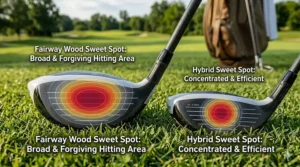
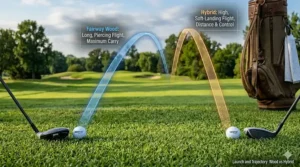
Fairway woods produce a lower, more penetrating trajectory that maximizes distance through a combination of ball speed and optimal launch conditions. The longer shaft generates higher clubhead speed, while the lower loft creates a flatter launch angle. This combination works beautifully for skilled players who can deliver the club consistently on-center.
However, the lower launch profile demands proper setup and swing mechanics. Players with slower swing speeds (under 90 mph) often struggle to achieve adequate height with traditional fairway woods, leading to shots that land with insufficient descent angle to hold greens. The penetrating flight also means less forgiveness on mishits—a thin strike produces a low screamer that runs forever but in unpredictable directions.
Wind conditions significantly impact fairway wood performance. The lower flight cuts through headwinds effectively but can balloon in tailwinds, making distance control challenging. Crosswinds also exert less influence on the flatter trajectory, an advantage for players competing in breezy conditions.
Hybrid Launch Dynamics
Hybrids deliver a higher, softer-landing ball flight that provides excellent versatility across different situations. The higher loft combined with a lower, more forward center of gravity creates launch angles typically 2-4 degrees higher than equivalent-lofted fairway woods. This additional height translates into better stopping power on greens—critical for long approach shots where you need the ball to land and hold rather than release.
The Callaway Elyte took both Best for Height and Best for Forgiveness, with the highest launch of 13.8 degrees and second highest peak trajectory at 36.5 yards, demonstrating how modern hybrid design maximizes launch performance. This vertical dimension gives golfers more margin for error, as shots that might run through greens with a fairway wood instead land softly with a hybrid.
The steeper descent angle creates better playability into greens. A ball landing at a 45-degree angle generates more spin and stops quicker than one arriving at 38 degrees. This characteristic makes hybrids particularly effective for precise distance control on long par-3s and approach shots where accuracy matters more than maximum distance.
Versatility Comparison: When Each Club Shines
Real golf happens in imperfect conditions, making versatility a crucial factor in the fairway wood vs hybrid debate. Each club type excels in specific situations while struggling in others, creating distinct use cases that inform smart club selection.
Fairway Wood Optimal Scenarios
Fairway woods dominate in several key situations. Off the tee on tight par-4s or reachable par-5s, the fairway wood provides maximum distance while offering more control than a driver. Tour professionals regularly employ this strategy, accepting 10-15 yards less distance in exchange for significantly tighter dispersion patterns.
From the fairway on longer approach shots (200+ yards), skilled players can generate impressive carry with a fairway wood on pure strikes. The lower flight cuts through wind, and the ball speed compensates for slightly mishit shots better than a hybrid might. On firm courses where the ball releases after landing, the flatter trajectory provides additional run-out that hybrids cannot match.
However, fairway woods struggle from rough, divots, and uneven lies. The larger sole and rounded leading edge tend to bounce or twist through thick grass rather than cutting cleanly through to the ball. Tight lies also challenge many golfers, as the larger profile makes it difficult to slide the club cleanly under the ball without the margin for error that turf provides.
Hybrid Versatility Advantages
Hybrids excel precisely where fairway woods struggle. From the rough, the compact clubhead and sharper leading edge slice through grass more effectively, maintaining ball speed and launch angle even from challenging lies. This versatility makes hybrids invaluable on courses with thick rough or less-than-perfect fairway conditions.
Hybrids excel in situations where fairway woods struggle, particularly from rough, fairway bunkers, or uneven lies. The shorter shaft provides better control and more consistent contact, while the higher loft helps players escape trouble and advance the ball meaningful distances rather than compounding mistakes.
Tight lies that intimidate with a fairway wood become manageable with a hybrid. The smaller footprint sits flush to the ground, creating confidence at address and allowing the club to work cleanly through impact. From fairway bunkers, the hybrid’s design generates sufficient height to clear lips while maintaining enough distance to make the shot worthwhile—a combination fairway woods rarely achieve.
The versatility extends to shot-making around greens. While neither club typically serves as a go-to option for chips and pitches, hybrids can execute bump-and-run shots from fringe areas where fairway woods prove unwieldy. This additional utility adds value beyond the primary role of long approach shots.
3 Wood vs 3 Hybrid: Direct Comparison
The most common club selection debate centers on the 3 wood vs 3 hybrid comparison, as these clubs occupy similar distance ranges but deliver vastly different performance characteristics.
Distance Gap Analysis
A typical 3-wood carries 13-15 degrees of loft and measures 42-43 inches in length, generating clubhead speeds that translate into carry distances of 220-240 yards for average golfers. The longer shaft creates a wider arc and more time for acceleration, maximizing ball speed at impact. For skilled players with swing speeds exceeding 100 mph, a 3-wood can reach 250+ yards carry.
A 3-hybrid typically features 17-19 degrees of loft with a 40-41 inch shaft, producing carry distances of 200-220 yards for the same golfer. The sacrifice of 15-20 yards compared to a 3-wood comes with significant benefits in consistency and versatility. Many golfers find they hit their 3-hybrid more reliably than their 3-wood, making the actual on-course distance difference smaller than raw numbers suggest.
The hybrid vs wood distance debate shifts when considering total distance versus carry-and-roll. Fairway woods produce more run-out on firm courses, potentially creating similar total distances despite less carry. However, on soft courses or when accuracy into greens matters more than maximum distance, the hybrid’s higher flight and steeper descent angle provide better control.
Practical Course Application
Course architecture often dictates which club provides better value. On courses featuring elevated greens, water hazards, or greens protected by bunkers, the hybrid’s ability to hold putting surfaces creates more scoring opportunities. The additional height helps clear obstacles and stick landings where a fairway wood might run through into trouble.
Conversely, on wide-open courses with firm conditions and generous landing areas, the fairway wood’s extra distance helps reduce the club needed for approach shots. Reaching a par-5 in two or converting a long par-4 into a short iron rather than a mid-iron creates scoring advantages that accumulate over a round.
Weather conditions also influence the decision. In windy conditions, better players often prefer the fairway wood’s penetrating flight, while recreational golfers find the hybrid easier to control despite the wind. Wet conditions favor the hybrid’s ability to launch from soggy lies and hold soft greens.
How to Choose Between Fairway Wood vs Hybrid
Making the right choice between fairway wood and hybrid requires honest self-assessment combined with understanding your typical playing conditions. The decision isn’t permanent—many golfers carry both—but prioritizing the club that addresses your biggest needs delivers immediate scoring benefits.
Swing Speed Considerations
Your swing speed with a driver provides the starting point for club selection. Golfers with driver swing speeds under 90 mph typically benefit more from hybrids, as the higher loft helps achieve adequate launch and carry distance. The shorter shaft also promotes more consistent contact, maximizing the limited clubhead speed available.
Players swinging 90-105 mph with the driver fall into a sweet spot where both clubs can work effectively. This group benefits from owning both a fairway wood and hybrid, using each where it excels. The fairway wood handles long approach shots from good lies, while the hybrid tackles rough, uneven lies, and situations requiring precise distance control.
Faster swingers (105+ mph driver speed) can generate sufficient clubhead speed to launch any fairway wood effectively. However, even skilled players increasingly carry hybrids for their versatility and shot-stopping ability into greens. The trend on professional tours toward replacing long irons with hybrids reflects this recognition of performance benefits beyond pure distance.
Miss Pattern Analysis
Your typical miss pattern strongly influences which club type suits your game. Players who struggle with slices find hybrids more forgiving because the compact design and shorter shaft make it easier to square the face at impact. The higher loft also reduces sidespin, helping keep shots more playable even when the face angle isn’t perfect.
Golfers who hit behind the ball (fat shots) benefit from hybrids’ turf interaction and forgiveness on low-face strikes. The design helps the club glide through turf rather than digging, maintaining reasonable ball speed and trajectory even on less-than-pure contact. Fairway woods punish fat shots more severely, producing low, weak shots that lose significant distance.
Conversely, players who tend to hit thin shots might find fairway woods more forgiving at first, as the larger sole provides some protection. However, learning proper hybrid technique often proves easier than mastering fairway wood consistency from various lies.
✨ Don’t Miss These Exclusive Deals!
🔍 Take your club selection to the next level with these carefully selected products. Click on any highlighted item to check current pricing and availability. These clubs will help you create authentic confidence and lower scores!
Course Conditions You Typically Face
The courses you regularly play should heavily influence your decision. If you play mostly target-style courses with thick rough, elevated greens, and water hazards, hybrids provide clear advantages. The ability to escape trouble, launch from challenging lies, and hold greens creates more scoring opportunities than the extra distance a fairway wood might provide.
On links-style courses or firm, fast conditions where the ground game matters, fairway woods excel. The lower flight and additional roll-out help maximize distance and create opportunities to run shots onto greens. The penetrating trajectory also handles wind better, an essential consideration on exposed courses.
Climate matters too. In wet climates where courses stay soft year-round, hybrids’ high-launching, soft-landing characteristics align perfectly with conditions. In drier climates with firm fairways, fairway woods’ ability to generate maximum total distance provides better value.
Should I Use Fairway Wood or Hybrid? Expert Recommendations
The question should i use fairway wood or hybrid deserves a nuanced answer that considers multiple factors beyond simple distance comparisons. Professional clubfitters and instructors consistently recommend the same framework for making this decision.
Skill-Based Recommendations
High Handicappers (15+): Hybrids should dominate your bag selection. Replace the 3-wood, 5-wood, and any long irons (3-5 iron) with hybrids at matching lofts. The forgiveness, easy launch, and versatility from various lies will create more consistent results and lower scores. A driver paired with 3-hybrid, 4-hybrid, and 5-hybrid covers long approach shots more effectively than struggling with clubs that require precise contact.
Mid Handicappers (8-15): Carry both a fairway wood and hybrids, selecting specific lofts based on your distance gaps. A typical setup might include a 3-wood (15°) for maximum distance needs, a 4-hybrid (22°), and a 5-hybrid (25°). This combination provides options for different situations while maintaining proper gapping throughout the bag.
Low Handicappers (Under 8): Your skill level supports carrying a 3-wood and 5-wood if you prefer workability and trajectory control. However, many accomplished players still carry a hybrid (typically 3-hybrid or 4-hybrid) for versatility from rough and tight lies. The decision becomes less about capability and more about shot-making preferences and course strategy.
Strategic Bag Building
Building a strategic golf bag means considering how clubs work together rather than viewing each in isolation. The USGA adopted additional specifications for grooves and punch marks in the impact area of fairway woods and hybrids to ensure fair competition and equipment standards, creating a level playing field where performance matters most.
Most golfers benefit from the following framework:
- Driver for maximum distance off the tee
- Either 3-wood OR 3-hybrid (not both—they overlap too much)
- 4-hybrid and 5-hybrid to replace difficult long irons
- Irons starting at 6 or 7 iron
- Multiple wedges for scoring
This setup provides excellent distance coverage while maximizing forgiveness in the most challenging parts of the bag. The gap between driver and hybrid/fairway wood (typically 30-40 yards) rarely creates problems in practice, as few approach shots fall precisely in that window.

Hybrid vs Wood Distance: What the Data Shows
Understanding the actual distance differences between hybrids and woods helps golfers make informed decisions rather than chasing theoretical yards that may not materialize on course. Independent testing provides valuable insights into real-world performance.
From the numbers, the Titleist GT1 hybrid achieved first and third place for ball speed in its forward and back weight positions, demonstrating that modern hybrids can generate impressive ball speeds that were once exclusive to fairway woods. Ball speed alone doesn’t determine distance—launch angle, spin rate, and descent angle all contribute to total carry and rollout.
Measured Distance Gaps
Testing across multiple golfers with varying swing speeds reveals consistent patterns:
Driver Swing Speed 85-95 mph:
- 3-Wood: 185-205 yards carry
- 3-Hybrid: 175-195 yards carry
- Distance difference: 10-15 yards
Driver Swing Speed 95-105 mph:
- 3-Wood: 210-230 yards carry
- 3-Hybrid: 195-215 yards carry
- Distance difference: 15-20 yards
Driver Swing Speed 105+ mph:
- 3-Wood: 235-255 yards carry
- 3-Hybrid: 215-235 yards carry
- Distance difference: 20-25 yards
These ranges account for variations in strike quality, weather conditions, and individual swing characteristics. Notice that the distance gap increases with swing speed—faster swingers extract more performance difference from the longer shaft and lower loft of fairway woods.
Total Distance vs. Carry Distance
The distinction between carry distance and total distance becomes crucial when comparing fairway woods and hybrids. Fairway woods typically generate 15-25 yards more roll after landing due to their flatter trajectory and lower spin rates. On firm courses, this additional roll can match or exceed the carry distance advantage.
Hybrids land with a steeper descent angle and higher spin rate, producing minimal roll after landing. On soft courses or when targeting greens protected by hazards, this characteristic provides better distance control. However, on firm fairways, the lack of roll means the total distance gap between fairway wood and hybrid widens beyond the carry difference.
Strategic course management recognizes these differences. Into a par-5 green where you need the ball to stop quickly, the hybrid’s 200-yard carry with 5 yards of roll works better than a fairway wood’s 220-yard carry with 20 yards of roll. But approaching a wide-open green on a firm day, the fairway wood’s extra total distance creates a shorter club for the next shot.
Common Mistakes When Choosing Between the Two
Even knowledgeable golfers make predictable errors when evaluating the fairway wood vs hybrid decision. Avoiding these pitfalls leads to better club selection and improved on-course performance.
Chasing Distance Over Consistency
The most common mistake is prioritizing maximum distance over reliable performance. A 3-wood that you pure once every five swings doesn’t help your score as much as a 3-hybrid you strike solidly three times out of five. The yards you gain on perfect strikes disappear when mishits lose significant distance and accuracy.
Calculate your average distance with each club type rather than comparing best-case scenarios. Hit ten shots with a fairway wood and ten with a hybrid, then compare the median distance (5th longest shot out of 10). This realistic assessment often reveals that the practical distance gap is smaller than perceived, making the hybrid’s consistency and versatility more valuable.
Ignoring Lie Conditions
Many golfers test clubs exclusively from perfect range mats or pristine fairway lies, then struggle when facing real course conditions. A fairway wood that performs beautifully from a teed-up range ball often disappoints from tight lies, divots, or light rough—situations you encounter regularly during actual rounds.
Test potential clubs from various lies before making a purchase decision. Hit shots from rough, tight lies, and uphill/downhill positions to understand how each club performs across the spectrum of situations you’ll face. The hybrid’s ability to maintain performance from challenging lies creates value that pure distance measurements miss entirely.
Overlooking Shaft Specifications
Focusing solely on clubhead design while ignoring shaft characteristics undermines club fitting. The shaft determines launch conditions, spin rates, and consistency as much as the clubhead design. A fairway wood with the wrong shaft can perform worse than a properly-fitted hybrid, regardless of design advantages.
Work with a qualified clubfitter to identify proper shaft weight, flex, and kickpoint for your swing. Modern launch monitor technology provides objective data about how different shaft/clubhead combinations perform, removing guesswork from the equation. The investment in proper fitting pays dividends in consistency and confidence over the club’s lifespan.
Frequently Asked Questions
❓ Can I replace my 5-wood with a 5-hybrid?
❓ What's the easiest club to hit: 3-wood, 5-wood, or hybrid?
❓ Do professional golfers use hybrids or fairway woods?
❓ How much distance do I lose going from fairway wood to hybrid?
❓ Should I carry both a 3-wood and a 3-hybrid?
Conclusion: Making Your Choice
The fairway wood vs hybrid decision ultimately hinges on your individual game, swing characteristics, and playing conditions rather than universal rules. Both club types have earned their place in modern golf through genuine performance advantages—fairway woods deliver maximum distance and penetrating trajectories, while hybrids provide versatility and consistent launch from various lies.
Your honest self-assessment should guide the decision. Players with faster swing speeds and solid ball-striking can leverage fairway woods’ distance advantages, while those prioritizing consistency and versatility benefit more from hybrids. The beauty of 2026 equipment is that both options deliver exceptional performance when properly fitted to your swing.
Remember that club selection represents just one element of effective long-game performance. Proper technique, realistic expectations about your capabilities, and strategic course management all contribute as much or more to scoring than the specific clubs you carry. The best equipment amplifies your strengths while minimizing weaknesses—choose clubs that accomplish this goal rather than chasing theoretical performance that may not materialize on course.
Consider starting with hybrids if you’re uncertain which direction to pursue. Their forgiveness and versatility create an easier path to consistent performance, building confidence that can later support adding fairway woods if desired. Many golfers discover that a driver paired with strategic hybrid selection covers their distance needs more effectively than the traditional driver/3-wood/5-wood progression.
✨ Don’t Miss These Exclusive Deals!
🔍 Take your long game to the next level with these carefully selected products. Click on any highlighted item to check current pricing and availability. These clubs will help you create authentic scoring opportunities your family will love!
Recommended for You
- 7 Best 7 Wood Golf Clubs 2026 | High Launch & Distance
- Best 5 Wood 2026: Top 7 Picks for Distance & Forgiveness
- 7 Best 3 Wood for High Handicappers 2026 – Easy Launch
Disclaimer: This article contains affiliate links. If you purchase products through these links, we may earn a small commission at no additional cost to you.
✨ Found this helpful? Share it with your friends! 💬🤗
