
In This Article
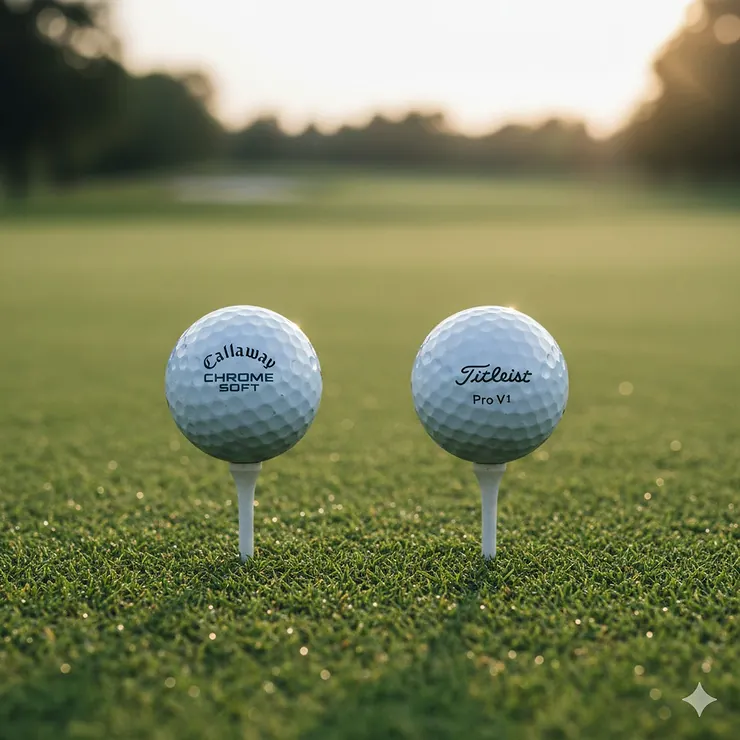
If you have ever stood in the golf ball aisle at your local pro shop, staring blankly at two sleeves — one from Callaway, one from Titleist — you already know the struggle. The callaway chrome soft vs titleist pro v1 debate has fueled countless clubhouse arguments, and honestly, it shows no signs of cooling off anytime soon. Both are legitimate tour-quality offerings played at the highest levels of competitive golf, and both promise a combination of distance, soft feel, and greenside spin that weekend warriors crave.
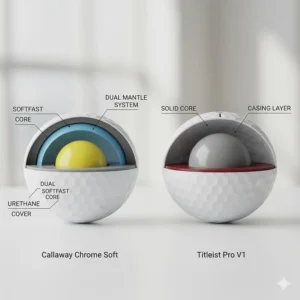
So, what really separates these two iconic premium golf balls? In short, the callaway chrome soft vs titleist pro v1 comparison comes down to construction philosophy, feel preferences, and how each ball responds to your individual swing speed. The Chrome Soft uses a three-piece build with Callaway’s new Tour Fast Mantle for increased ball speed, while the Pro V1 relies on a three-piece design with a high-gradient dual core and a cast urethane cover engineered for maximum spin separation. Both deliver exceptional greenside spin and low long-game spin — yet they accomplish it through distinctly different engineering paths.
I have personally tested dozens of premium balls over the past few seasons, and I keep coming back to this matchup because the margins are so thin it almost feels like splitting hairs. Almost. Let me walk you through everything you need to know before clicking that buy button.
⚡ Quick Comparison Table: Chrome Soft vs Pro V1 at a Glance
| Feature | Callaway Chrome Soft 2026 | Titleist Pro V1 2025 |
|---|---|---|
| Construction | 3-piece | 3-piece |
| Cover | Soft Urethane | Cast Urethane Elastomer |
| Core Technology | Tour Fast Mantle | High-Gradient Dual Core |
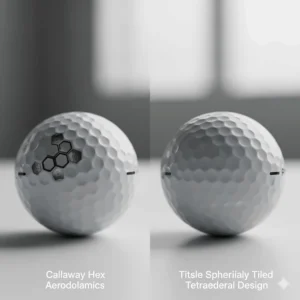
| Dimple Pattern | Hybrid Aero (Hex + Circular) | 388 Tetrahedral |
| Compression | Low-Mid (~75) | Mid (~87) |
| Feel | Very Soft | Soft |
| Driver Spin | Low | Low |
| Greenside Spin | High | Very High |
| Price (per dozen) | $57.99 (2026) / ~$49.99 (prev gen) | $54.99 |
| Best For | Soft-feel seekers, mid swing speeds | All-around control players |
💬 Just one click – help others make better buying decisions too! 😊
✨ Don’t Miss These Exclusive Deals!
🏆 Top 7 Premium Golf Balls: Expert Analysis for 2026
1. Callaway Chrome Soft 2026
The 2026 edition of the Chrome Soft marks a significant leap forward for Callaway’s softest premium offering. At its core sits the new Tour Fast Mantle — a material with 16% higher flex modulus that functions like a stiffer spring at impact, generating noticeably more ball speed without cranking up compression. The three-piece construction wraps everything in a soft urethane cover that delivers a buttery feel from tee to green.
Price: $57.99 per dozen (Amazon/retail) | Rating: 4.8/5 ⭐
✅ Tour Fast Mantle generates measurable speed gains
✅ Softest feel in the Chrome family
✅ Advanced Seamless Tour Aero for consistent flight
❌ Lower greenside spin than four-piece competitors
❌ New 2026 model carries a slight price increase
Golfers who tested the Chrome Soft reported that it felt noticeably softer than the Chrome Tour while still delivering competitive distance off the tee.
2. Titleist Pro V1 2025
There is a reason the Pro V1 sits atop more ball counts on professional tours worldwide than any other model. The 2025 iteration features a reformulated high-gradient dual core that produces more ball speed while increasing iron and wedge spin — exactly the kind of “steeper spin slope” that serious players demand. The cast urethane cover provides exceptional greenside spin, and the 388 tetrahedral dimple design promotes a penetrating, consistent ball flight.
Price: $54.99 per dozen (Amazon/retail) | Rating: 4.8/5 ⭐
✅ Industry-leading spin separation (low driver, high wedge)
✅ Superior wind performance
✅ Consistent, penetrating trajectory
❌ Firmer feel may not suit all preferences
❌ Rarely discounted
Customer feedback consistently highlights the Pro V1’s predictability — especially on iron approaches where consistency matters most.
3. Titleist Pro V1x 2025
If you want everything the Pro V1 offers but with a higher flight and even more spin, the Pro V1x is your answer. This four-piece tour ball comparison favorite uses a speed-amplifying high-flex casing layer and a new 348 tetrahedral dimple design optimized for a higher, more consistent trajectory. It feels slightly firmer than its sibling, which many faster swingers actually prefer.
Price: $54.99 per dozen (Amazon/retail) | Rating: 4.8/5 ⭐
✅ Higher launch and steeper descent angle
✅ More iron and wedge spin than the Pro V1
✅ Four-piece construction for enhanced spin control
❌ Firmer feel is not for everyone
❌ Higher spin can be counterproductive for some swing types
4. Callaway Chrome Tour 2026
The Chrome Tour is Callaway’s direct answer to the Pro V1 in the four-piece category. It shares the same Tour Fast Mantle technology as the Chrome Soft but adds an extra layer for increased spin separation. This ball is what Xander Schauffele used during his dominant 2024 major championship run. It provides a mid-spin profile that balances distance, ball flight, and control beautifully.
Price: $57.99 per dozen (Amazon/retail) | Rating: 4.7/5 ⭐
✅ Four-piece construction with exceptional spin separation
✅ Tour-proven by multiple major champions
✅ Seamless Tour Aero for outstanding consistency
❌ Slightly firmer than the Chrome Soft
❌ Premium price point
5. TaylorMade TP5 2024
Do not overlook TaylorMade’s five-layer marvel in this tour ball comparison. The TP5 features progressive construction that optimizes spin separation across every club in the bag. Its new Speed Wrapped Core delivers a softer sound and faster overall design, while the soft cast urethane cover produces marshmallow-like feel on greenside shots. With a compression rating of approximately 53, this is TaylorMade’s softest five-layer ball.
Price: $44.99–$54.99 per dozen (Amazon) | Rating: 4.7/5 ⭐
✅ Five-layer progressive construction
✅ Incredible greenside feel and spin
✅ Often available at discounted prices
❌ Slightly slower ball speed than Chrome Tour X
❌ Five-layer design may feel less responsive for some players
6. Bridgestone Tour B XS 2024
Designed with direct input from Tiger Woods, the Tour B XS features Bridgestone’s REACTIV X System — a combination of their REACTIV iQ Smart Cover Technology with an XCLRNT mid-layer. This ball is built for golfers with swing speeds over 105 mph who want maximum greenside spin without sacrificing distance. The cover literally stays on the clubface longer during scoring shots.
Price: $44.99–$49.99 per dozen (Amazon) | Rating: 4.7/5 ⭐
✅ REACTIV X cover adapts to impact speed
✅ Extremely high greenside spin
✅ Tiger Woods stamp of approval
❌ Requires 105+ mph swing speed for optimal performance
❌ Higher full-bag spin may not suit all players
7. Srixon Z-Star Diamond 2025
The most underrated ball on this list — and possibly the best premium golf ball value available today. Originally designed for Brooks Koepka, the Z-Star Diamond earned gold medals in nearly every category during independent robot testing. It features a FastLayer DG core with a Spin Skin+ coating that digs deeper into grooves for enhanced control. Around the greens, this three-piece ball generates an extraordinary 6,137 rpm of backspin.
Price: $49.99 per dozen ($34.99 on sale at Amazon) | Rating: 4.7/5 ⭐
✅ Robot-test champion in multiple categories
✅ Outstanding greenside spin for a three-piece ball
✅ Frequently discounted — excellent value
❌ Less brand recognition than Titleist or Callaway
❌ Best suited for mid-to-high swing speeds
📊 Head-to-Head Specifications: Top 7 Premium Balls Compared
| Golf Ball | Pieces | Cover | Compression | Driver Spin | Greenside Spin | Price/Dz |
|---|---|---|---|---|---|---|
| Chrome Soft 2026 | 3 | Urethane | ~75 | Low | High | $57.99 |
| Pro V1 2025 | 3 | Cast Urethane | ~87 | Low | Very High | $54.99 |
| Pro V1x 2025 | 4 | Cast Urethane | ~90 | Low | Very High | $54.99 |
| Chrome Tour 2026 | 4 | Urethane | ~85 | Low-Mid | High | $57.99 |
| TP5 2024 | 5 | Cast Urethane | ~53 | Low | High | $44.99 |
| Tour B XS 2024 | 3 | REACTIV iQ | ~88 | Low | Very High | $49.99 |
| Z-Star Diamond 2025 | 3 | Spin Skin+ Urethane | ~82 | Low | Very High | $49.99 |
🔬 Construction Breakdown: What Is Inside These Tour Balls?
Understanding how a premium golf ball is engineered helps explain why the callaway chrome soft vs titleist pro v1 debate even exists. Both balls must conform to USGA equipment standards, which mandate that a conforming ball cannot weigh more than 1.620 ounces or measure smaller than 1.680 inches in diameter. Beyond those limits, manufacturers have remarkable freedom in how they build their products.
Three-Piece vs Four-Piece vs Five-Piece — Does It Matter?
The number of layers in a golf ball directly affects spin separation. A three-piece ball like the Chrome Soft or Pro V1 relies on a large core, a single mantle layer, and a urethane cover to create the right spin profile. Adding a fourth piece — as in the Chrome Tour or Pro V1x — introduces an additional mantle layer that gives engineers more fine-tuning control over how spin behaves at different impact speeds. According to Wikipedia’s entry on golf ball construction, most modern premium balls feature 300 to 500 dimples arranged symmetrically to ensure consistent aerodynamic behavior.
The Role of the Graphene Dual Core and Tour Fast Mantle
Callaway’s 2026 Chrome lineup leans heavily on the Tour Fast Mantle — a material with 16% higher flex modulus than previous designs. As Eric Loper, Callaway’s Senior Director of Golf Ball R&D, explained, this stiffer mantle essentially creates a stronger spring effect at impact. The result is more ball speed without increasing compression, which means the Chrome Soft retains its characteristically soft feel.
On the Titleist side, the Pro V1’s high-gradient dual core is designed with a gradual shift in density from the center outward. This gradient approach optimizes speed at every swing velocity while contributing to the ball’s famous spin slope — low spin off the tee, progressively higher spin as you move through your irons and wedges.
🎯 Greenside Spin and Short Game Performance
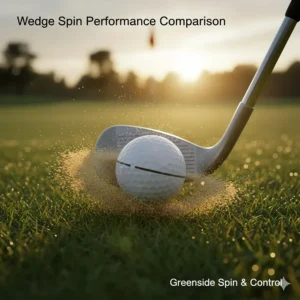
For many golfers, the short game is where the chrome soft or pro v1 decision truly gets made. Both balls feature a cast urethane cover — the gold standard for greenside performance — but they behave slightly differently when you start pitching, chipping, and putting.
The Pro V1 generates marginally more wedge spin in most independent tests, which translates into that satisfying “check and stop” response on approach shots. The Chrome Soft, while still very much a tour-caliber performer around the greens, tends to release just a touch more. Some players actually prefer this because it creates more predictable rollout on bump-and-run shots.
If maximum greenside spin is your absolute top priority, the Bridgestone Tour B XS and the Callaway Chrome Tour X (which generated a remarkable 6,343 rpm in robot testing) deserve serious consideration alongside the Pro V1. For a more balanced short-game feel that does not demand razor-sharp contact, the Chrome Soft strikes a beautiful middle ground.
✨ Don’t Miss These Exclusive Deals!
🔍 Take your golf game to the next level with these carefully selected premium balls. Click on any highlighted item to check current pricing and availability. These tour-quality balls will help you create authentic scoring improvements your playing partners will notice!
🏌️ Distance and Driver Performance: Which Ball Goes Farther?
This is the question every golfer asks first, even though it probably should not be the primary decision driver. Both the Chrome Soft and Pro V1 are designed to produce low driver spin and high ball speed — the recipe for maximizing carry distance while maintaining a stable flight window.
In Callaway’s 2026 Chrome family, the Tour Fast Mantle technology generated measurable speed gains across the lineup. Early testing from multiple independent reviewers confirmed that the Chrome Soft produces competitive driver distances while maintaining a slightly higher launch than the Chrome Tour or Chrome Tour X. The Pro V1, meanwhile, continues to deliver a lower, more penetrating ball flight off the tee — a characteristic that gives it an edge in windy conditions.
Real-world differences between these two balls off the driver typically amount to fewer than five yards for most amateur swing speeds. Your fitting, your launch angle, and your strike quality will have a far greater impact on distance than the ball you choose. That said, if you consistently swing above 100 mph, the slightly firmer Pro V1 may optimize your compression dynamics better than the softer Chrome Soft.
🌬️ Wind Performance and Ball Flight Stability
One area where the tour ball comparison gets genuinely interesting is how each ball handles breezy conditions. The Titleist Pro V1 has long been considered the benchmark for wind performance among premium golf balls. Its lower peak trajectory and exceptional flight consistency in crosswinds are well documented by both tour players and independent testers.
Callaway’s response in 2026 is the Advanced Seamless Tour Aero technology — a manufacturing process that creates a more uniform cover thickness across the entire ball. According to PGA Tour’s equipment report, this process reduces the variation between in-seam and cross-seam shots to approximately a three-foot window — a dramatic improvement in flight consistency. The Chrome Soft benefits from this same aero package, though its higher launch profile naturally makes it slightly more susceptible to wind than the flatter-flying Pro V1.
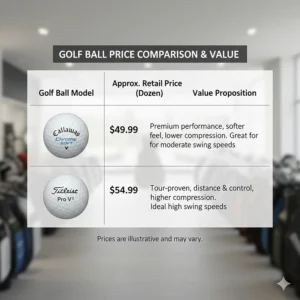
💰 Price and Value Analysis: Bang for Your Buck in 2026
Let us talk dollars, because premium golf ball pricing has crept up steadily and it matters for most recreational players.
| Ball | MSRP/Dozen | Typical Amazon Price | Cost Per Ball | Value Rating |
|---|---|---|---|---|
| Chrome Soft 2026 | $57.99 | $57.99 | $4.83 | ⭐⭐⭐ |
| Pro V1 2025 | $54.99 | $54.99 | $4.58 | ⭐⭐⭐ |
| Chrome Tour 2026 | $57.99 | $57.99 | $4.83 | ⭐⭐⭐ |
| TP5 2024 | $54.99 | $44.99 | $3.75 | ⭐⭐⭐⭐ |
| Tour B XS 2024 | $49.99 | $44.99 | $3.75 | ⭐⭐⭐⭐ |
| Z-Star Diamond 2025 | $49.99 | $34.99 (sale) | $2.92 | ⭐⭐⭐⭐⭐ |
The Srixon Z-Star Diamond stands out as the best premium golf ball value, frequently dropping below $35 per dozen during sales. The TaylorMade TP5 and Bridgestone Tour B XS also offer outstanding performance at lower price points than the Chrome Soft and Pro V1. If budget is a major consideration and you still want legitimate tour-level performance, these alternatives are worth every penny.
That said, Callaway’s decision to price the 2026 Chrome Soft at $57.99 — a $3 increase over the previous generation — raised a few eyebrows. The Pro V1 held steady at $54.99 through its latest refresh, which gives it a slight edge in the value column despite being the more established (and arguably less innovative) option.
🧪 How to Choose Between Callaway Chrome Soft and Titleist Pro V1
Picking the right ball does not have to be complicated. Here is a straightforward step-by-step approach:
- Assess your swing speed. If you swing the driver under 95 mph, the softer Chrome Soft will likely compress more efficiently for your game.
- Prioritize your feel preference. Hit a few putts and chips with each ball. The Chrome Soft feels noticeably softer; the Pro V1 feels firmer and more responsive.
- Consider your typical ball flight. The Chrome Soft launches higher and suits players who want easy carry distance. The Pro V1 flies lower and more penetrating.
- Evaluate your short game needs. If you need maximum wedge spin for firm greens, the Pro V1 has a slight edge. If you prefer a softer response with moderate spin, the Chrome Soft excels.
- Test in wind. Play both balls on a breezy day. The Pro V1 traditionally holds its line better in crosswinds.
- Factor in your budget. At $57.99 vs $54.99 per dozen, the difference adds up over a season of play.
- Get fitted. Many golf retailers now offer ball-fitting sessions using launch monitors. This 15-minute investment can save you hundreds of dollars in trial and error.
🏅 Who Uses These Balls on Tour?
The best way to gauge a golf ball’s performance ceiling is to look at who trusts it under competitive pressure. The Pro V1 and Pro V1x combined dominate the USGA Conforming Golf Ball List and are played by more professionals than any other models worldwide. Scottie Scheffler, arguably the best player in the world, relies on Titleist golf balls week in and week out.
On the Callaway side, the Chrome Tour (the four-piece sibling to the Chrome Soft) is played by Xander Schauffele, Sam Burns, and Jon Rahm — three players who collectively have won multiple major championships. While the Chrome Soft itself is positioned more toward the accomplished amateur market, its underlying technology is directly derived from the same R&D effort that produces the Chrome Tour.
Bridgestone’s Tour B family counts Tiger Woods and Jason Day among its advocates, while the Srixon Z-Star Diamond was originally developed for Brooks Koepka. TaylorMade’s TP5 family has Rory McIlroy, Collin Morikawa, and Nelly Korda in its corner. In other words, every ball on this list has genuine tour credibility.
🔄 Chrome Soft vs Pro V1: Durability and Longevity
Premium urethane-covered balls are softer than their ionomer-covered counterparts, and that softness comes with a trade-off: durability. Both the Chrome Soft and Pro V1 will show scuff marks after a few aggressive wedge shots — this is completely normal and does not significantly affect performance for most of the ball’s usable life.
In my experience, both balls hold up admirably for 18 holes of normal play. The Pro V1’s slightly firmer cover tends to resist cosmetic damage a touch longer, while the Chrome Soft’s softer cover shows wear a bit sooner. Neither ball should be considered a “two-round” ball if you are making flush contact with your wedges.
Interestingly, Callaway’s investment in what they call the most technologically advanced ball manufacturing plant in the world — backed by over $100 million and 382 billion collected data points — has improved cover consistency in the 2026 Chrome lineup. According to Golf.com’s coverage, the new grinding process creates a uniform cover thickness that was not possible in previous generations.
❓ FAQ
❓ Is callaway chrome soft vs titleist pro v1 the right comparison for mid-handicappers?
❓ Can high handicappers benefit from a best premium golf ball like the Pro V1?
❓ What is the main difference between a graphene dual core and a Tour Fast Mantle?
❓ Does the cast urethane cover on the Pro V1 generate more greenside spin than the Chrome Soft?
❓ Which ball is better for windy conditions in a tour ball comparison?
🏁 Conclusion: So, Which One Should You Buy?
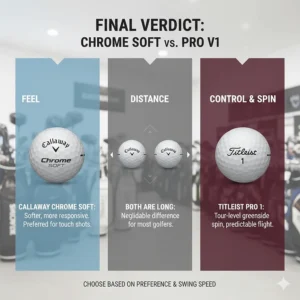
The callaway chrome soft vs titleist pro v1 debate ultimately comes down to personal preference — and that is not a cop-out answer. These are two genuinely exceptional golf balls that represent the pinnacle of what modern golf ball engineering can deliver.
Choose the Chrome Soft if you prioritize soft feel, play in calm conditions, swing under 100 mph, and want the latest Callaway technology at a competitive price. Choose the Pro V1 if you value iron control, need reliable wind performance, appreciate a firmer response off the putter face, and trust the most battle-tested ball in the professional game.
And if neither feels perfect, do not sleep on the Srixon Z-Star Diamond or TaylorMade TP5 — both deliver comparable performance at significantly lower price points. The best premium golf ball is the one that matches your swing, your short game, and your wallet. Get fitted, test a sleeve or two, and let the results on the course — not the marketing materials — guide your final decision.
✨ Don’t Miss These Exclusive Deals!
🔍 Take your scoring to the next level with these carefully selected premium golf balls. Click on any highlighted item to check current pricing and availability. The right ball can make a real difference in how you play — and how much you enjoy the round!
📖 Recommended for You
- 7 Best Titleist Pro V1 vs Pro V1x Models 2026
- 7 Best Golf Balls for High Handicappers 2026
- 7 Best Golf Balls for Seniors 2026 | Low Compression Guide
Disclaimer: This article contains affiliate links. If you purchase products through these links, we may earn a small commission at no additional cost to you.
✨ Found this helpful? Share it with your friends! 💬🤗
