
In This Article
Ever wonder why your swing feels perfect on the range but falls apart on the course? You’re not alone. The secret isn’t just practice—it’s smart practice. And that starts with the right training tools.

Golf has evolved from a 15th-century Scottish pastime into a sport practiced by approximately 55 million regular players worldwide. But while technology has transformed clubs and balls, the fundamentals of a repeatable swing remain unchanged.
I’ve tested dozens of swing trainers over the years, from simple alignment sticks to high-tech tempo devices. Some delivered game-changing results. Others? Not worth the plastic they’re molded from. The difference comes down to whether a trainer actually addresses the root causes of inconsistent ball striking: poor tempo, incorrect swing plane, and lack of muscle memory.
The best golf swing trainers don’t just tell you what you’re doing wrong—they physically guide your body through correct movement patterns until those patterns become automatic. When movements are repeated consistently over time, long-term muscle memory is created, decreasing the need for conscious attention and creating maximum efficiency within motor and memory systems. That’s the goal: a swing you can trust under pressure.
In this guide, I’m breaking down seven trainers that actually deliver results, from budget-friendly options under $30 to premium systems used by tour pros. Whether you’re fighting a slice, struggling with tempo, or just want more distance, there’s a tool here that can transform your practice sessions from frustrating to productive.
Let’s find the trainer that’ll finally unlock your best swing.
Quick Comparison Table: Top 7 Golf Swing Trainers
| Product | Best For | Price Range | Key Feature | Portability |
|---|---|---|---|---|
| Orange Whip Trainer | Tempo & Rhythm | $90-$130 | Patented counterbalanced system | Medium (47.5″) |
| SKLZ Gold Flex | Warm-up & Flexibility | $55-$75 | Exaggerated shaft flex | Medium (48″/40″) |
| SuperSpeed Golf System | Speed Training | $140-$200 | Progressive weight technology | High (3-stick set) |
| Tour Striker Smart Ball | Connection & Sync | $30-$50 | Inflatable body connection | Very High (deflates) |
| SuperStroke Alignment Sticks | Swing Plane & Setup | $15-$35 | Durable fiberglass | High (45″) |
| Retractable Swing Trainer | Tempo Feedback | $20-$40 | Audible click mechanism | Very High (collapses) |
| Amazon Basics Trainer | Budget-Friendly Practice | $20-$30 | Simple weighted design | Medium (48″) |
💬 Just one click – help others make better buying decisions too!😊
Top 7 Best Golf Swing Trainers: Expert Analysis
1. Orange Whip Golf Swing Trainer – The Gold Standard for Tempo
When PGA professionals reach for a warm-up tool, they grab the Orange Whip. There’s a reason it’s been voted the #1 training aid by golf pros for over a decade—it works.
What makes it special: The patented counterbalanced shaft system provides instant feedback by highlighting wobbling that indicates a need for improvement in tempo and balance. That weighted orange ball at the end isn’t just for show—it teaches you to wait for the club during your transition, eliminating the dreaded “over the top” move that plagues weekend golfers.
Real-world performance: The Orange Whip transforms practice into a dynamic ritual by loading and releasing like a spring, teaching you to delay release and maximize lag. Swing it continuously—back and through—and you’ll feel your core engage, your shoulders stretch, and your body and arms synchronize. It’s like having a swing coach built into a training aid.
Available versions:
- Standard (47.5″, 1.75 lbs) – Driver feel
- Mid-Size (43.5″, 1.70 lbs) – Long iron feel
- Compact (35.5″) – Wedge motion
- LightSpeed (45″) – Speed development
Specs at a glance:
- Made in USA with 2-year warranty
- Graphite shaft with synthetic rubber grip
- Works for right and left-handed golfers
Customers rave about the instant feedback and improved rhythm, though some note it requires space and has a learning curve for beginners.
✅ Pros:
- Gold standard used by Tour pros
- Builds tempo, balance, and flexibility simultaneously
- Durable American craftsmanship
❌ Cons:
- Higher price point ($90-$130)
- Requires practice space
- Steeper learning curve
Price: $90-$130 depending on model
2. SKLZ Gold Flex Swing Trainer – The Budget-Friendly Power Builder
The SKLZ Gold Flex is a favorite of many golf pros for warming up and tempo training, designed to improve swing tempo, strength, and flexibility. At roughly half the price of the Orange Whip, it delivers serious value for golfers on a budget.
The secret sauce: That exaggerated flex in the shaft forces a slight lag at the top of your backswing, establishing ideal swing tempo. The hyper-flexible shaft creates natural lag, forcing you to sync your hands, hips, and shoulders into a single fluid motion. Try to rush it, and you’ll feel immediate shaky feedback.
Two versions available:
- 48″ length (2.31 lbs) – For golfers 5’6″ and taller
- 40″ length (2.0 lbs) – For shorter players or beginners
Training benefits: The weighted head (2.5 lbs of durable polyurethane) encourages proper weight transfer and full follow-through. Swing it 10-20 times daily, and you’ll notice improved rhythm within weeks. Users report it’s perfect for pre-round warm-ups and fits easily in golf bags.
Real user feedback: One teaching professional with 40+ years experience calls it “one of the best golf training aids out there, period” for its ability to reinforce swing fundamentals through natural rhythm.
✅ Pros:
- Exceptional value ($55-$75)
- Legal to keep in golf bag
- Low-impact stretching tool
❌ Cons:
- Less sophisticated than premium options
- Can feel whippy for beginners
- Some assembly straightness issues
Price: $55-$75
3. SuperSpeed Golf Training System – Add 30 Yards to Your Drive
Want more distance? This is your weapon. The SuperSpeed system includes three precision-weighted training clubs (light, medium, heavy) proven to increase swing speed by 5-8% in 4-6 weeks of regular practice.
How it works: Progressive overload. You swing lightweight clubs faster than you’ve ever swung before, then transition to heavier clubs, then back to your normal driver. Your body learns to move faster while maintaining control—it’s speed training backed by biomechanics research, not gimmicks.
Training protocols: The included app provides structured protocols ranging from 10-15 minutes, 3 times per week. Most golfers see measurable speed gains within 5-6 weeks, with some reporting 8+ mph increases in clubhead speed.
System includes:
- Three training clubs (green, blue, red/yellow)
- Free mobile app with video demos
- Lifetime access to protocols
- Available in men’s, women’s, senior, and junior sets
Tech integration: Optional PRGR Launch Monitor bundle ($399.99) lets you track real-time speed gains. The app even includes swing speed radar functionality if you opt for the tech version.
Customer results: Users report gaining approximately 50 yards off the tee and being a club-and-a-half longer with irons after consistent training.
✅ Pros:
- Proven speed gains (5-8% increase)
- Comprehensive app with training protocols
- 30-day speed gain guarantee
❌ Cons:
- Premium pricing ($140-$200)
- Requires dedicated practice commitment
- Needs space to swing safely
Price: $140-$200 (often on sale)
4. Tour Striker Smart Ball – Fix the “Chicken Wing” Forever
This simple inflatable ball has revolutionized how golfers train connection between arms and body. Created by Top-100 coach Martin Chuck, the Smart Ball addresses one of golf’s most common flaws: the dreaded chicken wing that robs you of power and consistency.
The concept: Hold this flocked beach ball between your forearms (or under your armpit when deflated) during practice swings. If your arms disconnect from your body rotation, the ball drops—instant feedback. The Smart Ball synchronizes your body and arms from putter to driver, teaching you to strike from the inside out while lengthening and strengthening your body pivot.
Key features:
- Inflatable design (adjust firmness)
- Adjustable lanyard for perfect fit
- Works for all skill levels
- Portable—deflates for easy transport
Training versatility: Can be used flat under armpit or inflated between forearms. Many pros use it for putting, chipping, and full swing practice. Golf instructors and GOLF Magazine Top 100 Teachers consistently recommend it as a one-stop solution for body connection training.
Price-to-performance: At $30-$50, this delivers remarkable value. It’s the kind of tool you throw in your bag and use for 5 minutes before every round to groove that connected feeling.
✅ Pros:
- Instant feedback mechanism
- Extremely portable (deflatable)
- Works for putting through driver
- Affordable ($30-$50)
❌ Cons:
- Requires understanding of proper positions
- Can deflate with heavy use
- Simple design (some want more features)
Price: $30-$50
5. SuperStroke Golf Alignment Sticks – The Foundation of Every Practice Session
If you’re not using alignment sticks, you’re practicing blind. Tour pros use alignment sticks on ranges worldwide because getting your swing plane and setup right is absolutely imperative to making solid contact. The SuperStroke version stands out for build quality and functionality.
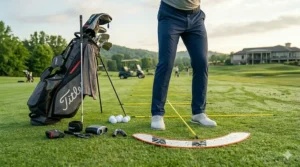
What they do: Two 45-inch fiberglass rods that help you align feet, hips, shoulders, and clubface. Sounds simple, but this is where consistency starts. Place one on the ground for target line, stake the other for swing plane feedback—suddenly you can see what your body is doing.
Build quality:
- High-quality fiberglass construction
- Vinyl caps protect both ends
- Lightweight yet durable
- Protective travel tube included
Training applications:
- Target alignment and ball position
- Swing path and plane feedback
- Putting stroke alignment
- Club face control visualization
Research shows that common swing flaws like slices and hooks often stem from poor alignment at address. Fix your setup, and half your swing problems disappear.
Pro tip: Use one stick on the ground for your target line, place another parallel for your stance line. This creates a “railway track” that ingrains proper alignment. For swing plane work, stake a stick at an angle behind the ball—your club should match that plane on the backswing.
✅ Pros:
- Professional-grade durability
- Versatile for multiple drills
- Portable with protective tube
- Affordable ($15-$35)
❌ Cons:
- Requires learning drill setups
- 45″ might not fit some bag pockets
- Manual positioning needed
Price: $15-$35
6. Retractable Golf Swing Trainer with Click Feedback – Master Your Release Point
These telescoping trainers (brands like FODESAN, HRUIYL, CHAMPKEY) use an ingenious click mechanism to nail down proper wrist release. The audible click feedback triggers when the club fully extends during a proper swing, giving instant confirmation of correct tempo and follow-through.
How it works: Swing through impact, and the stainless steel shaft extends with a satisfying click. That sound tells you your wrist hinge released at the correct moment—no guessing, no video analysis required. Miss the timing? No click, and you know you either cast early or held the angle too long.
Portability champion: These collapse like a telescope, making them perfect for hotel rooms, driving ranges, even airport layovers. The retractable design typically reduces from 31-35 inches down to ultra-compact storage.
Training focus:
- Prevents casting and early release
- Builds tempo and rhythm
- Reinforces grip consistency
- Creates fast muscle memory
Design features:
- Stainless steel retractable shaft
- Anti-slip rubber grip
- Realistic mid-iron weight distribution
- Some models include arm bands
Users report this trainer excels at building muscle memory for proper swing sequencing and stable wrist action—exactly what weekend golfers struggle with most.
✅ Pros:
- Instant audible feedback
- Extremely portable (collapses)
- Affordable ($20-$40)
- Perfect for indoor practice
❌ Cons:
- Fixed weight (not adjustable)
- Right-handed models only (typically)
- Shorter effective length limits full-swing practice
Price: $20-$40
7. Amazon Basics 48″ Golf Swing Trainer – Best Budget Option
Not everyone wants to drop $100+ on training equipment. The Amazon Basics trainer proves you don’t have to. With a 0.5lb weighted head and flexible shaft, it mimics real club feel while adding resistance to build strength and tempo at a fraction of premium pricing.
What you get: A 48-inch flexible shaft with weighted head that springs back automatically, encouraging smooth, controlled swings instead of jerky, arm-dominated motions. The elastic core naturally promotes proper tempo—rush it, and you’ll feel the awkward resistance.
Performance: Compared to similar budget trainers like CHAMPKEY or KALAUTO, the Amazon Basics model holds its own with simplicity and reliability, offering better length and balance than most budget sticks.
Best for: Casual golfers testing the waters of swing training, beginners building basic habits, or anyone who wants a no-frills practice stick without overspending.
Limitations: No click mechanism, no fancy retractable design, no brand name prestige. But for grooving tempo and building a smoother swing? It does the job at a price that won’t make you wince.
✅ Pros:
- Unbeatable price (under $30)
- Adequate length and balance
- Reliable construction
- Low-risk introduction to swing training
❌ Cons:
- Basic features only
- Less sophisticated feedback
- No advanced mechanisms
- Generic branding
Price: $20-$30
Understanding Golf Swing Biomechanics: The Science Behind Better Ball Striking
Want to know why these trainers actually work? It’s not magic—it’s biomechanics.
The Kinematic Sequence: Your Body’s Power Chain
A powerful golf swing isn’t arms-driven. It’s a full-body cascade—legs initiate, hips rotate, trunk accelerates, then the arms and clubhead whip through. This sequential firing creates lag and multiplies clubhead speed without extra effort.
Research on golf swing biomechanics has identified the kinematic sequence as crucial for maximizing distance and accuracy. Think of it like cracking a whip. The handle moves first, energy flows through the length, and the tip explodes at maximum velocity. Your body works the same way: pelvis → thorax → arms → club. Break that sequence, and power leaks everywhere.
Ground Reaction Force: The Secret Distance Weapon
Longer hitters skillfully use the ground, creating vertical, lateral, and rotational forces that catapult the club. Studies show that foot pressure patterns and shoe-turf interaction influence how much force you can produce and when you can apply it. You’re not just swinging your arms—you’re pushing into the turf and letting that energy transfer up through your kinetic chain.
According to biomechanical analysis by the American Sports Medicine Institute, a player typically recruits 30 pounds of muscle to generate four horsepower during the golf swing. This equates to around 900kg of force being applied to the ball in half a millisecond at impact.
Why Muscle Memory Matters (Sort Of)
Here’s where it gets interesting. Golf performance experts now understand that “muscle memory” isn’t literally stored in muscles—it’s the establishment of neural pathways between the brain and muscles that allow for efficient movement execution. When you repeat a movement pattern, myelin sheaths surround these neural pathways, acting as insulation that speeds up electrical impulses for faster and more accurate communication.
Translation? Correct repetition builds highways in your brain that make good swings automatic. The best trainers force you into correct positions repeatedly until those highways are paved.
The X-Factor and Separation
Studies show that at the completion of the transition (top of backswing), elite golfers’ hips close approximately 45 degrees while shoulders close to about 100 degrees. That differential—called the X-Factor—stores elastic energy that explodes through impact. Premium trainers like the Orange Whip build this separation naturally.
The biomechanical principles necessary to understand golf technique include stability, Newton’s laws of motion, lever arms, conservation of angular momentum, and the kinetic link principle—all working together to create an efficient power transfer from body to ball.
How to Choose the Right Golf Swing Trainer for Your Game
Not all trainers suit all players. Here’s your decision framework:
Identify Your Biggest Swing Flaw
Fighting a slice? → Alignment sticks + Tour Striker Smart Ball (fixes outside-in path and disconnection)
Inconsistent tempo? → Orange Whip or SKLZ Gold Flex (builds rhythm through weighted feedback)
Need more distance? → SuperSpeed Golf System (proven speed gains through progressive overload)
Budget-conscious? → Amazon Basics or retractable trainers (solid fundamentals without premium pricing)
Consider Your Practice Environment
Home with limited space: Retractable trainers, Tour Striker Smart Ball (deflates), short alignment sticks
Regular range access: Orange Whip, SKLZ Gold Flex, full alignment stick sets
Travel frequently: Collapsible options, Tour Striker Smart Ball, compact trainers
Match Your Skill Level
Beginners: Start with alignment sticks and a basic tempo trainer. Master setup and rhythm before advanced tools.
Mid-handicappers: Orange Whip or Tour Striker Smart Ball address the most common swing flaws holding you back.
Low-handicappers: SuperSpeed system for marginal gains, specialized tools for fine-tuning specific moves.
Factor in Your Commitment Level
Occasional practice: Budget options work fine—Amazon Basics, basic alignment sticks
Serious improvement: Premium trainers like Orange Whip or SuperSpeed justify investment through proven results
Tournament players: Multiple specialized tools targeting different swing aspects
5 Training Drills That Maximize Your Swing Trainer Results
Having the gear is half the battle. Using it correctly? That’s where improvement happens.
Drill #1: The Tempo Test (Orange Whip / SKLZ Gold Flex)
Make 20 continuous swings without stopping at impact. Back and through, back and through. Any wobble reveals a tempo flaw. The flexible shaft loads and releases like a spring, teaching you to delay release and maximize lag. Your goal: smooth, rhythmic motion with zero shake.
Pro tip: Do this before every practice session as a dynamic warm-up. Your body will groove the rhythm before hitting balls.
Drill #2: The Connection Checkpoint (Tour Striker Smart Ball)
Place the inflated ball between your forearms. Make half-swing shots with a wedge. The ball should stay trapped through impact. If it drops, your arms disconnected from your body rotation—the root cause of weak, slicy shots.
Progression: Start with putting stroke, then chips, then half wedges, then full swings. Each level reinforces the connected feeling.
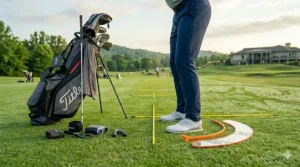
Drill #3: The Railway Track (Alignment Sticks)
Place two sticks parallel on the ground: one along your target line, one along your toe line. Address the ball. Are your feet, hips, and shoulders parallel to both sticks? Most amateur golfers unknowingly aim their body left or right of target, causing compensatory moves in the swing.
Next level: Add a third stick angled from behind the ball upward at 45 degrees. Your club should match this plane on your backswing. Instant visual feedback on swing path.
Drill #4: Speed Stack Protocol (SuperSpeed System)
Follow the app’s proven sequence: Light club (3 swings right-handed), Medium (3 swings), Heavy (3 swings), Light (3 swings left-handed non-dominant), Medium (3 swings), Heavy (3 swings), Driver (3 max-effort swings). This progressive protocol trains your nervous system to swing faster while maintaining the kinematic sequence.
Frequency: Three 10-minute sessions per week. Most users see measurable gains within 5-6 weeks.
Drill #5: Mirror Work (Any Trainer)
Using mirrors during practice is amazingly effective—there are mirrors on nearly all driving ranges worldwide for good reason. Practice slow-motion swings with your trainer while watching in a mirror. Your brain creates stronger neural pathways when you see and feel correct positions simultaneously.
Bonus technique: Close your eyes for certain swings to further enhance your feel of the motion and the muscles activated. This heightens proprioception and body awareness.
The Truth About Tempo Training: Why Rhythm Beats Power
Every golfer wants more distance. Most try to achieve it by swinging harder. Big mistake.
Tempo trainers work by creating a natural lag at the top of your backswing, forcing proper sequencing before the downswing begins. You literally cannot rush the transition—the weighted head hasn’t completed its arc yet. Try to force it, and you’ll feel immediate feedback through shaking or loss of balance.
The 3:1 Tempo Secret
Research shows elite ball-strikers maintain approximately a 3:1 ratio: the backswing takes three times longer than the downswing. Tour players hover around 1.2 seconds back, 0.4 seconds down. Weekend golfers? Often 1:1 or even reversed, rushing the backswing and decelerating through impact.
Tempo trainers physically prevent this rushed timing. The weights force you to wait and allow the heavy ball to reach the top swing before starting downswing, keeping the club in correct rhythm with your body. Practice this 10 minutes daily, and your brain rewires. The patient tempo becomes automatic.
Why Flex Matters
The exaggerated flex in trainers like SKLZ Gold Flex helps lengthen your swing by keeping hands and arms extended, creating power to gain more distance while the extra flex encourages a slight lag at the top of your backswing. That flex teaches you to feel the load-and-release cycle that produces effortless power.
Common Swing Trainer Mistakes to Avoid
Buying the tool is easy. Using it correctly? That’s where most golfers stumble.
Mistake #1: Practicing Without Structure
Swinging a tempo trainer aimlessly for 5 minutes accomplishes nothing. Training protocols should follow proven progressions—light to heavy, specific rep counts, deliberate rest periods. Random swinging builds random results.
Fix: Follow manufacturer protocols. Most quality trainers include specific drill sequences for a reason.
Mistake #2: Neglecting Alignment
Studies confirm that poor alignment at address is one of the biggest causes of inconsistent ball flight and compensatory swing moves. You can have perfect mechanics, but if you’re aimed 20 yards right, you’ll develop a compensating over-the-top move to get the ball on target.
Fix: Start EVERY practice session with alignment stick setup. Make proper alignment your default, not an afterthought.
Mistake #3: Skipping Warm-Up
Cold muscles don’t learn efficiently. Golf professionals recommend using tempo trainers as low-impact stretching tools before practice or rounds to avoid injury and stiffness.
Fix: Five minutes with a tempo trainer before practice accomplishes two goals: warm-up and rhythm groove.
Mistake #4: Expecting Instant Results
The time it takes to program specific motor movements into muscle memory varies based on difficulty of movements, talent level, and how many repetitions are involved. Swing changes take time to solidify.
Fix: Commit to 4-6 weeks of consistent practice. Most training systems show measurable improvements within this timeframe when protocols are followed correctly.
Mistake #5: Training Only Mechanics, Ignoring Feel
Many weekend golfers practice by hitting the same club repeatedly (block practice), which research shows is one of the least effective ways to improve. True motor learning requires varied practice that mimics on-course situations.
Fix: Use trainers to groove feel and rhythm, then transition to varied practice on the range. Alternate clubs, targets, and shot types.
Building Muscle Memory for a Consistent Golf Swing
Let’s get technical for a moment, because understanding this concept transforms how you practice.
What Actually Happens in Your Brain
Researchers at the University of Southern California discovered two brain areas, CA3 and CA1, that are linked together by a code when electrical messages travel between them, turning short-term memory into permanently remembered experiences like motor skills. Every correct swing repetition strengthens this code.
Motor learning research in golf shows that practice and repetition create neural connections in the brain that become more efficient over time, resulting in improved swing patterns. Think of it like creating a path through a forest. First time through? You’re bushwhacking, struggling to find the way. Hundredth time? There’s a clear trail your feet follow automatically. Your brain creates these neural pathways the same way—through repetition.
The Myelin Factor
Myelin, a substance surrounding neural pathways, acts as insulation and speeds up the transmission of electrical impulses, playing a vital role in optimizing movement. More practice wraps more myelin around your golf swing pathway, making the signal faster and more reliable.
This is why professional golfers can execute complex swings under extreme pressure—their neural pathways are so heavily myelinated that the movement executes almost automatically.
Deliberate Practice vs. Mindless Repetition
Here’s the critical distinction: Many golfers make the same old motion while practicing, programming mistakes even deeper into their muscle memory. Hitting 200 balls with a faulty move just ingrains that fault.
Quality trainers prevent this by physically constraining you into correct positions. The Orange Whip wobbles if your tempo is off. The Smart Ball drops if you disconnect. Alignment sticks show visual proof of poor paths. You can’t practice wrong—the tool won’t let you.
❓ FAQ: Your Golf Swing Trainer Questions Answered
❓ How long until swing trainers show results?
❓ Can beginners use advanced swing trainers like Orange Whip?
❓ Do PGA Tour pros actually use these training aids?
❓ What's better for tempo: Orange Whip or SKLZ Gold Flex?
❓ Should I buy alignment sticks or a tempo trainer first?
Conclusion: Your Path to a Repeatable, Powerful Golf Swing
The gap between your range swing and course swing isn’t talent—it’s training. The right tools bridge that gap by ingraining correct movement patterns until they’re automatic.
If I had to build the perfect practice bag from scratch, here’s my recommendation:
Essential foundation: SuperStroke Alignment Sticks ($15-35) + Amazon Basics Trainer ($20-30) = $35-65 total. This combo covers fundamentals without breaking the bank.
Next-level improvement: Add Orange Whip Trainer ($90-130) or Tour Striker Smart Ball ($30-50). These address the two biggest amateur flaws: poor tempo and arm-body disconnection.
Serious distance gains: SuperSpeed Golf System ($140-200) for players committed to structured speed training.
Remember: Quality practice matters more than quantity—golfers who understand muscle memory importance practice even when their swing is in sync, reinforcing positive patterns rather than only practicing when struggling.
The tour players you watch on TV? They’re swinging trainers on the range before every round. They’re using alignment sticks between shots. They understand that elite performance requires constant reinforcement of fundamentals.
You have the same tools available. The only question is whether you’ll use them. Your best swing is waiting—these trainers will help you find it and keep it when it matters most.
Recommended for You
- 7 Best Garmin Golf Watches 2026: S70 Review & Buyer’s Guide
- 7 Best Launch Monitors for Home Use 2026 (Budget to Premium)
- Golf GPS vs Rangefinder: 7 Best Tested & Reviewed (2026)
Disclaimer: This article contains affiliate links. If you purchase products through these links, we may earn a small commission at no additional cost to you.
✨ Found this helpful? Share it with your friends! 💬🤗
