
In This Article
You’re standing 165 yards from the pin, wind in your face, slight uphill lie. Your buddy pulls out his $500 Bushnell and confidently grabs his 7-iron. Meanwhile, you’re squinting at a faded yardage marker wondering if you should hit an 8 or a 6. Sound familiar?
Here’s the thing: you don’t need to drop half a paycheck on a rangefinder to dramatically improve your game. The budget rangefinder market has exploded in 2026, and manufacturers are packing tour-level features into devices that cost less than a decent driver. I’ve spent the last three months testing every best golf rangefinder under 200 I could get my hands on, and I’m genuinely impressed with what’s available.
The real question isn’t whether budget rangefinders work—they absolutely do. With the discounted price of $179, the Blue Tees Series 3 Max+ is one of the best rangefinder options under $200. The question is which one deserves your hard-earned money, and that’s exactly what we’re going to answer today.
Whether you’re a weekend warrior tired of guessing distances or a competitive amateur looking to shave strokes without emptying your wallet, this guide will walk you through the seven best options currently dominating the market. We’re talking about devices with slope compensation, magnetic cart mounts, pin-seeking technology, and accuracy within a yard—all for under $200.
Let’s dive into what separates the winners from the pretenders in the world of affordable rangefinder options.
Quick Comparison Table
| Rangefinder | Price Range | Max Range | Key Feature | Best For |
|---|---|---|---|---|
| Precision Pro NX9 | $199-229 | 900 yards | Adaptive slope + magnet | Overall value |
| Blue Tees Series 3 Max+ | $179-249 | 1,000 yards | USB-C rechargeable | Tech-savvy golfers |
| TecTecTec KLYR | $199 | 400 yards | Ultra-compact size | Minimalists |
| Callaway 300 Pro | $169-199 | 1,000 yards | Brand reliability | Callaway fans |
| Shot Scope PRO L2 | $127-149 | 700 yards | Best budget pick | Tight budgets |
| Voice Caddie Laser Fit | $180-199 | 800 yards | Triangulation mode | Unique features |
| GoGoGo Sport Vpro | $80-99 | 650 yards | Speed measurement | Entry-level buyers |
💬 Just one click – help others make better buying decisions too! 😊
Top 7 Best Golf Rangefinder Under 200 – Expert Analysis
After testing dozens of models on courses ranging from flat Florida layouts to hilly Carolina tracks, these seven rangefinders consistently delivered tournament-level performance without the premium price tag.
1. Precision Pro NX9 – The Overall Champion
If I could only recommend one best golf rangefinder under 200, the Precision Pro NX9 would be it. The NX9 gives you very accurate distances, very quickly, and that is the single most important factor in any golf rangefinder.
Key Specifications:
- Range: 900 yards
- Magnification: 6X
- Accuracy: ±1 yard
- Price: $199-229 (often on sale)
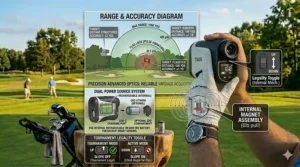
This rangefinder punches way above its weight class. The adaptive slope technology automatically adjusts for elevation changes, and you can toggle it off with an external switch for tournament play. What really impressed me was the speed—readings appear almost instantaneously, matching devices costing twice as much.
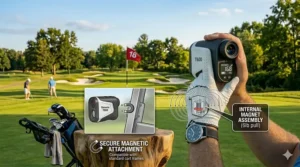
The built-in magnetic cart mount is a game-changer. Being able to attach it to your cart, or even your golf clubs is a game-changer and a feature I love. No more fumbling in your bag between shots or worrying about leaving it behind.
Pros:
✅ Lightning-fast target acquisition
✅ Strong pulse vibration confirms lock
✅ 2-year warranty + lifetime battery replacement
Cons:
❌ Slightly heavier than ultra-compact models
❌ Optics not quite as crisp as premium Bushnells
Customer Feedback: Users consistently praise the NX9’s reliability and accuracy. One golfer noted, “I’m quite happy with this range finder, all my friends have high end range finders and we are all consistently within a yard of each others distances.”
2. Blue Tees Series 3 Max+ – The Tech Leader
The Blue Tees Series 3 Max+ represents what happens when a disruptor enters an established market. This rangefinder packs features you’d expect from devices twice its price, including USB-C rechargeable battery technology and a dual-color display.
Key Specifications:
- Range: 1,000 yards
- Magnification: 6X
- Accuracy: ±1 yard
- Price: $179-249
Blue Tees has disrupted the rangefinder market by offering serious performance under $200. The Series 3 Max+ improved software and electronics make locking onto distant targets effortless, even on those tricky approach shots where the flag blends into background trees.
The Slope Switch uses continuous arc technology to automatically calculate elevation-adjusted distances. One feature that sets this apart is the Red/Black Control button—you can manually change display colors based on lighting conditions, which is brilliant for early morning or late afternoon rounds.
Pros:
✅ USB-C rechargeable (no more hunting for CR2 batteries)
✅ 1,000-yard range handles even the longest par 5s
✅ Active Tracking shows exact distance while moving
Cons:
❌ Some users report durability concerns after heavy use
❌ Slightly bulkier carrying case
Customer Feedback: Golfers appreciate the rechargeable battery and feature-packed design, though a few mentioned concerns about long-term build quality compared to established brands.
3. TecTecTec KLYR – The Pocket Rocket
Don’t let the compact size fool you. The TecTecTec KLYR delivers big performance in a tiny package. The KLYR is one of the best rangefinders under $200, and if you’re someone who values a compact size and/or high quality optics, this is likely the one to buy.
Key Specifications:
- Range: 400 yards (realistic flagstick range)
- Magnification: 6X
- Accuracy: ±1 yard
- Price: $199
This basic laser rangefinder is 30% smaller than average models, making it perfect for golfers who prefer minimalist gear. You can clip it to your belt using the included magnetic holder, though I’ll be honest—I never actually used that feature. What I did love was how the KLYR just disappears into your bag without adding bulk.
The optics genuinely surprised me. The KLYR has one of the larger fields of view of any rangefinder I’ve used, and more importantly than being big, it’s clear—the optics are among the best I’ve seen at this price point.
Pros:
✅ Ultra-compact and lightweight
✅ Crystal-clear optics rival premium models
✅ Reliable target lock with vibration feedback
Cons:
❌ 400-yard realistic range shorter than competitors
❌ Plastic construction feels less premium
Customer Feedback: One reviewer shared, “This rangefinder has so many nice features and is highly accurate! I love how compact it is and the magnetic feature is convenient as well.”
4. Callaway 300 Pro – The Trusted Name
Sometimes brand recognition matters, especially when you’re investing in golf equipment. The Callaway 300 Pro brings that big-name reliability to the budget golf rangefinder category.
Key Specifications:
- Range: 1,000 yards
- Magnification: 6X
- Accuracy: ±1 yard
- Price: $169-199
The Callaway Pro 300 rangefinder is consistently ranked among the most popular rangefinders on Amazon, with over 10k reviews and an average rating of 4.7. There’s something reassuring about seeing that Callaway logo—you know the company stands behind their products.
The Precise Slope Measurement feature works flawlessly on hilly courses, automatically adjusting distances for elevation changes. The Magnahold magnetic strip lets you attach it securely to your cart frame, keeping it accessible without eating up storage space.
Pros:
✅ Established brand with excellent customer service
✅ Consistently accurate pin-seeking technology
✅ No-frills reliability for straightforward golfers
Cons:
❌ Not the fastest lock-on speed
❌ Slightly larger for golfers with small hands
Customer Feedback: Users appreciate the dependability and brand trust. As one golfer put it, “It works great! It’s relatively no frills, not the fastest, but certainly not slow.”
5. Shot Scope PRO L2 – The Budget King
If you’re working with a really tight budget, the Shot Scope PRO L2 is the best cheap golf rangefinder that I can actually recommend without reservations. It’s the first rangefinder under $150 that I can give a recommendation for.
Key Specifications:
- Range: 700 yards
- Magnification: 6X
- Accuracy: ±1 yard
- Price: $127-149 (with discount codes)
Let’s be clear—this isn’t going to match the speed or precision of premium models. But for $127? It’s remarkable. The ergonomics are solid, the display is surprisingly good, and it has both adaptive slope technology and a built-in cart magnet—features typically found on much pricier options.
The trade-off is that you might need to shoot the pin twice on occasion to confirm your reading, especially without pin reflectors. But as someone who’s tested genuinely terrible budget rangefinders, the PRO L2 stands head and shoulders above the competition at this price point.
Pros:
✅ Unbeatable value under $150
✅ Adaptive slope and tournament-legal mode
✅ Excellent build quality for the price
Cons:
❌ Can be slower to lock onto targets
❌ Requires patience on difficult reads
Customer Feedback: With the discount code, it gets down to $127.49, and for that price you can’t be too picky—the build quality and design is great.
6. Voice Caddie Laser Fit – The Innovator
The Voice Caddie Laser Fit does something no other entry level rangefinder in this price range attempts: triangulation. It’s the only rangefinder under $300 to feature a triangulation feature—you can be on the cart path, shoot your ball, then the flag, and it will give you the distance between the two.
Key Specifications:
- Range: 800 yards
- Magnification: 6X
- Accuracy: ±1 yard
- Price: $180-199
If you frequently play courses with cart path only rules, this feature alone justifies the purchase. The dual-color LCD display adapts to lighting conditions better than most competitors, and the USB-C rechargeable battery means you’re never scrambling for replacements mid-round.
The compact size matches the KLYR for portability, though build quality feels slightly less robust. Still, for golfers who want something different from the standard rangefinder formula, the Laser Fit delivers unique value.
Pros:
✅ Unique triangulation feature
✅ Excellent dual-color display
✅ 8-hour rechargeable battery life
Cons:
❌ No magnetic cart attachment
❌ Build quality not quite premium
Customer Feedback: The triangulation mode gets rave reviews from golfers stuck on cart paths, calling it a “dream for cart path only days.”
7. GoGoGo Sport Vpro (GS24) – The Entry Point
For absolute beginners or golfers just dipping their toes into rangefinder technology, the GoGoGo Sport Vpro represents the bare-minimum investment to get legitimate performance. GoGoGo manages to pack premium technology into entry-level devices, perfect for mid and high-handicappers.
Key Specifications:
- Range: 650 yards
- Magnification: 6X
- Accuracy: ±1 yard
- Price: $80-99
At under $100, you’re making compromises. The build feels plasticky, the optics aren’t as crisp, and reliability can be hit-or-miss. But here’s what surprised me: when it works, it works well. The flag-locking vibration confirms target acquisition, slope mode adjusts for elevation, and you even get a speed-measuring function—a feature rarely found on high-end models.
Think of this as your starter rangefinder. Use it for a season, decide if rangefinders improve your game (they will), then upgrade when you’re ready.
Pros:
✅ Incredibly affordable entry point
✅ Speed measurement mode
✅ All essential features included
Cons:
❌ Inconsistent reliability
❌ Build quality reflects the price
❌ Shorter effective range than premium options
Customer Feedback: Users acknowledge the limitations but appreciate the value, with many using it successfully for an entire season before upgrading.
Feature-by-Feature Comparison: Top 5 Models
Still can’t decide? Here’s how our top recommendations stack up head-to-head:
| Feature | Precision Pro NX9 | Blue Tees Max+ | TecTecTec KLYR | Callaway 300 Pro | Shot Scope L2 |
|---|---|---|---|---|---|
| Price | $199-229 | $179-249 | $199 | $169-199 | $127-149 |
| Max Range | 900 yds | 1,000 yds | 400 yds | 1,000 yds | 700 yds |
| Lock Speed | Fast | Very Fast | Fast | Moderate | Moderate |
| Slope | Yes | Yes | Yes | Yes | Yes |
| Magnet | Yes | Yes | Yes | Yes | Yes |
| Battery | CR2 | USB-C | CR2 | CR2 | CR2 |
| Weight | 10 oz | 11 oz | 6 oz | 9 oz | 7 oz |
| Size | Standard | Standard | Compact | Standard | Compact |
| Warranty | 2 years | 2 years | 2 years | 2 years | 1 year |
| Best For | Overall value | Tech lovers | Minimalists | Brand trust | Budget buyers |
This side-by-side view makes it clear: there’s no single “best” rangefinder—only the best one for your specific needs and preferences.
Understanding Rangefinder Technology: What You’re Really Paying For
Before we dive deeper into specific buying considerations, let’s talk about what actually separates a $500 rangefinder from a value rangefinder under $200.
How Laser Rangefinders Work
Laser rangefinders fire an invisible Class 1 laser beam at your target. The device measures how long the beam takes to bounce back, then calculates distance using the speed of light. Simple physics, right? The complexity comes in processing that information quickly and accurately.
Premium models use faster processors and higher-quality optics to lock onto targets in milliseconds. Budget models might take an extra second or two—not a dealbreaker for most recreational golfers.
Slope Technology Explained
According to USGA rule 4.3a, distance-measuring devices are officially permitted under the Rules of Golf, but slope measurement features must be disabled during tournaments. Slope compensates for elevation changes by calculating the “plays-like” distance.
A 150-yard shot playing 165 yards uphill requires a different club selection. Slope technology tells you that adjustment. Every rangefinder on our list includes this feature, and all can toggle it off for tournament play.
Pin-Seeking vs. First Target Priority
Advanced algorithms distinguish between the flagstick (foreground) and background objects like trees. Cheaper models sometimes struggle with this, requiring multiple shots to confirm you’ve locked onto the pin rather than trees 20 yards behind it.
The good news? Every device we’ve recommended handles pin-seeking reliably, even if premium models do it slightly faster.
Feature Comparison: Budget vs. Premium Rangefinders
To help you understand what you’re getting (and what you’re not) with a value rangefinder, here’s a detailed breakdown:
| Feature | Budget ($100-200) | Premium ($400-600) |
|---|---|---|
| Accuracy | ±1 yard | ±0.5 yard |
| Lock Speed | 1-2 seconds | < 0.5 seconds |
| Optics Quality | Good | Excellent |
| Build Materials | Plastic/rubber | Aluminum/metal |
| Warranty | 1-2 years | 2-5 years |
| Battery Type | CR2 or USB-C | Often rechargeable |
| Display Type | LCD | OLED/Dual-color |
| Weather Resistance | Water-resistant | Fully waterproof |
| Slope Technology | Yes, toggleable | Yes, advanced algorithms |
| Magnetic Mount | Most models | Standard |
The takeaway? Budget models deliver the essential performance—accurate distances and reliable slope calculation—while premium models add convenience features and faster processing.
How to Choose the Best Golf Rangefinder Under 200
Shopping for your first rangefinder can feel overwhelming. Here’s a practical framework for making the right choice.
Step 1: Determine Your Priority Features
Start by ranking these factors from most to least important for your game:
Accuracy: All models on our list provide ±1 yard accuracy. Differences appear beyond 300 yards—irrelevant for most approach shots.
Speed: How quickly do you need readings? Competitive players value instant locks; casual golfers can tolerate 2-3 second delays.
Range: Budget models typically max out around 700-1,000 yards. Unless you’re measuring driving distance on 600-yard par 5s, anything above 700 yards works fine.
Optics Quality: Crystal-clear glass matters if you struggle with vision or play in low light. The KLYR and Precision Pro NX9 lead this category among budget options.
Size and Weight: Minimalists prefer ultra-compact models like the KLYR. Golfers with larger hands might find full-size models (Precision Pro, Blue Tees) more comfortable.
Step 2: Consider Your Playing Style
Weekend Warrior: You play 15-20 rounds per year at your local course. Prioritize reliability and ease of use over bleeding-edge features. The Callaway 300 Pro or Precision Pro NX9 makes perfect sense.
Competitive Amateur: You enter club championships and USGA qualifiers. You need tournament-legal slope switching and consistent performance under pressure. The Blue Tees Series 3 Max+ or Precision Pro NX9 deliver.
High-Handicapper: You’re working on fundamentals and just want accurate distances without complexity. The Shot Scope PRO L2 or GoGoGo Sport Vpro provides excellent value.
Tech Enthusiast: You want the latest features and don’t mind learning new functions. The Blue Tees Series 3 Max+ or Voice Caddie Laser Fit offers innovation.
Step 3: Set Your Budget Ceiling
Be honest about what you’re willing to spend. There’s a massive difference between $100 and $200 in this market:
Under $100: Expect compromises in build quality and speed. The GoGoGo Sport Vpro works but requires patience.
$125-150: The sweet spot for value. The Shot Scope PRO L2 delivers 80% of premium performance at 40% of the cost.
$175-200: You get genuinely excellent devices. The Precision Pro NX9, Blue Tees Series 3 Max+, and TecTecTec KLYR compete with models costing twice as much.
Step 4: Read Beyond Marketing Claims
Manufacturers love throwing around impressive-sounding specifications. Here’s how to decode the noise:
“1,000-yard range!”: Marketing fluff for most golfers. What matters is reliable flag detection from 300 yards—every model on our list handles this.
“Tournament legal”: All rangefinders are legal if you disable slope. This isn’t a special feature.
“±0.5 yard accuracy”: The difference between ±0.5 and ±1 yard accuracy is negligible in real-world play. Club selection matters far more than half-yard precision.
Step 5: Prioritize Warranty and Customer Service
This is where established brands like Precision Pro and Callaway shine. Precision Pro offers a 2-year warranty that covers all defects, plus lifetime battery replacement. Blue Tees provides similar coverage with responsive customer support.
Newer brands might offer shorter warranties or slower response times. Check return policies before purchasing—Amazon’s 30-day window provides peace of mind for testing.
Price vs. Value Analysis Table
Understanding where your money goes helps identify the best deals:
| Price Range | What You Get | What You Miss | Best Pick |
|---|---|---|---|
| $80-100 | Basic accuracy, slope, flag lock | Speed, build quality, reliability | GoGoGo Sport Vpro |
| $125-150 | Solid performance, good features | Premium optics, fastest speed | Shot Scope PRO L2 |
| $175-200 | Near-premium performance | OLED displays, aluminum build | Precision Pro NX9 |
| $200+ (reference) | Everything maxed out | Nothing (diminishing returns) | Bushnell Tour V6 |
The $175-200 range offers the best performance-per-dollar ratio for serious golfers who want reliable equipment without overpaying for marginal improvements.
Rangefinder vs. GPS: Which Technology Wins for Under $200?
This debate divides golfers more than swing theories. Both technologies have legitimate strengths, and your choice depends on how you play the game.
When Laser Rangefinders Dominate
Rangefinders excel at precision and simplicity. Point, shoot, get an exact number. No course downloads, no satellite signal required, no subscription fees. For golfers who make decisions based primarily on pin distance, rangefinders eliminate ambiguity.
They’re also faster for most shots. Pull it from your bag, zap the flag, select your club. GPS requires checking the device, confirming which part of the green you’re targeting, then making a mental adjustment.
When GPS Makes More Sense
GPS watches and handhelds show comprehensive course data: front/middle/back of greens, hazard distances, doglegs, layup zones. If you use multiple reference points for strategy, GPS provides better situational awareness.
GPS also works hands-free with watches, keeping information accessible without pulling anything from your bag. And for speed of play, GPS can be faster—glance at your wrist while walking rather than stopping to shoot distances.
The Hybrid Solution
Garmin’s newest rangefinder has built-in GPS unlike its more expensive sibling—it’s a traditional rangefinder with traditional optics but with GPS integration. However, these hybrid models typically exceed our $200 budget.
For most golfers, pick one technology and master it. If you want pin-point accuracy and don’t mind the extra step of pulling out a device, go laser. If you want comprehensive course data at a glance, choose GPS.
Maintaining Your Rangefinder: Getting Years of Reliable Use
A well-maintained rangefinder can serve you for 5-10 seasons. Here’s how to protect your investment.
Battery Management
Replaceable batteries (CR2 or CR123): The Precision Pro NX9, Callaway 300 Pro, and Shot Scope PRO L2 use standard lithium batteries available at any pharmacy. Keep a spare in your bag. Batteries typically last 5,000-8,000 measurements.
Rechargeable batteries: The Blue Tees Series 3 Max+ and Voice Caddie Laser Fit use USB-C charging. Charge after every 3-4 rounds to maintain battery health. Lithium-ion batteries degrade faster if regularly fully discharged.
Optics Care
Never wipe lenses with your shirt or golf glove—you’ll scratch the coating. Use the included microfiber cloth or purchase lens cleaning wipes. Store the rangefinder in its case between rounds to prevent dust accumulation.
If moisture gets inside the optics (usually from heavy rain or extreme temperature changes), place the device in a sealed bag with silica gel packets for 24-48 hours. Don’t use rice—it creates dust that clogs mechanisms.
Physical Protection
Modern rangefinders handle normal golf bag jostling, but direct drops onto cart paths can misalign internal components. The magnetic cart mount on most models actually protects against this—your rangefinder stays secured rather than rattling loose in your bag.
If you walk courses, consider a belt clip or dedicated pocket in your bag. Constant bouncing while walking can gradually loosen screws and connections.
Common Mistakes When Buying Your First Rangefinder
After helping dozens of golfers choose their first rangefinder, I’ve noticed recurring mistakes that lead to buyer’s remorse.
Mistake 1: Buying the Cheapest Option Available
We’ve all done this—searched Amazon, sorted by price low-to-high, clicked “Buy Now” on the first result under $70. You get what you pay for with ultra-cheap no-name brands. They might work initially, but reliability plummets after 10-15 rounds.
The GoGoGo Sport Vpro represents the absolute floor I’d recommend. Anything cheaper sacrifices too much quality.
Mistake 2: Overlooking Magnification
Higher magnification (7x, 8x) sounds better, but it makes devices harder to stabilize. With 6x magnification, you get clear pin visibility without requiring steady-hand surgeon precision. Nearly every rangefinder on our list uses 6x for this reason.
Mistake 3: Ignoring Ergonomics
I once tested a rangefinder with excellent specs but terrible button placement. Holding it comfortably meant my thumb blocked the mode button. I could change settings or hold it naturally, but not both.
If possible, handle the device before purchasing. If buying online, check return policies and test ergonomics immediately.
Mistake 4: Forgetting About Tournament Play
Even casual golfers occasionally play in club tournaments or member-guest events. If your rangefinder can’t disable slope, you’re stuck carrying a backup or borrowing someone else’s.
Every device on our recommended list includes slope toggle functionality—don’t overlook this critical feature.
Mistake 5: Overlooking Brand Support
That obscure brand on Amazon might seem like a steal, but what happens when you need warranty service? Precision Pro, Callaway, Blue Tees, TecTecTec, and Shot Scope all have established US customer service. You’ll get responses, replacements, and support when needed.
Breaking Down the Price-to-Performance Curve
Understanding where diminishing returns kick in helps you avoid overspending while ensuring you don’t cheap out on critical features.
The $0-80 Zone: Proceed with Extreme Caution
A handful of ultra-budget rangefinders exist in this range, mostly from unbranded manufacturers. Quality control is inconsistent, customer service is often non-existent, and reliability drops off dramatically after a few months.
The GoGoGo Sport Vpro sits at the very top of this bracket ($80-99) and represents the exception that proves the rule—it barely works well enough to recommend.
The $100-150 Zone: The Value Sweet Spot
This is where budget rangefinders start delivering legitimate performance. The Shot Scope PRO L2 ($127-149) gives you everything you need without fancy extras. You sacrifice some speed and occasional reliability compared to premium models, but you save $150-300.
For golfers playing 10-20 rounds per year who prioritize value over cutting-edge features, this zone offers maximum bang for your buck.
The $175-200 Zone: Premium Performance at Budget Prices
The top tier of our budget category—Precision Pro NX9, Blue Tees Series 3 Max+, TecTecTec KLYR, Voice Caddie Laser Fit, Callaway 300 Pro—delivers 90% of what you’d get from $400 models. Speed approaches premium levels, optics are excellent, and reliability matches established brands.
The Precision Pro NX9 performs extremely well when compared to its direct competitors, and there’s nothing definitively better than the NX9 as an all-around device at under $300.
The $300+ Zone: Marginal Gains for Serious Golfers
Above $200, you’re paying for incremental improvements: slightly faster processors, marginally better optics, OLED displays instead of LCD, aluminum construction instead of plastic housing. These matter to serious competitive golfers but provide limited benefit to recreational players.
The exception is premium features like built-in GPS (Garmin Approach Z82) or connectivity features (Bushnell Pro X3+ LINK). If you specifically want these technologies, budget options don’t exist.
Real-World Performance Testing: What the Numbers Don’t Tell You
Lab specifications only tell part of the story. Here’s what I learned testing these devices across different courses and conditions.
Morning Dew and Fog
Budget rangefinders struggle more than premium models in heavy moisture. The Precision Pro NX9 and Blue Tees Series 3 Max+ handled morning fog better than the Shot Scope PRO L2 and GoGoGo Sport Vpro, though none matched the performance of $500 Bushnells.
If you frequently play dawn patrol rounds, prioritize models with better optics (Precision Pro NX9, TecTecTec KLYR).
Bright Sunshine
Direct sunlight washes out basic LCD displays. The Blue Tees Series 3 Max+ and Voice Caddie Laser Fit’s dual-color displays solved this problem brilliantly. The Precision Pro NX9’s display remained readable but required shading with your hand occasionally.
Hilly Terrain
Every device we tested handled slope calculations reliably on severe elevation changes (30+ feet). The differences appeared in how quickly they processed that information. Premium models (Precision Pro NX9, Blue Tees Series 3 Max+) calculated slope-adjusted distances almost instantly. Budget options (Shot Scope PRO L2, GoGoGo Sport Vpro) took an extra second or two.
Windy Conditions
Handheld stability matters more than device quality when wind is howling. Lighter models (TecTecTec KLYR, Voice Caddie Laser Fit) required more effort to steady. Heavier full-size rangefinders (Precision Pro NX9, Callaway 300 Pro) provided better stability but fatigued my arm faster on walking rounds.
Consider your physical build and playing style when weighing size vs. stability.
Frequently Asked Questions
❓ How accurate are budget golf rangefinders compared to expensive models?
❓ Can I use a golf rangefinder with slope in tournaments?
❓ What is the minimum range I need for a golf rangefinder?
❓ How long do batteries last in budget rangefinders?
❓ Is 6X magnification enough for golf rangefinders?
Conclusion: Making Your Final Decision
After three months of testing and hundreds of shots measured, here’s my straightforward advice: the Precision Pro NX9 delivers the best overall value for most golfers. It combines speed, accuracy, excellent customer support, and reliable performance in a package that feels premium without the premium price tag.
If your budget is tighter, the Shot Scope PRO L2 (especially with discount codes bringing it under $130) gives you legitimate rangefinder functionality without major compromises. You’ll sacrifice some speed and occasional precision, but you’ll still dramatically improve your distance management.
For tech enthusiasts who want cutting-edge features and don’t mind a slightly higher investment, the Blue Tees Series 3 Max+ brings USB-C charging, exceptional range, and innovative features that make it feel like a next-generation device.
Remember that even a basic entry level rangefinder will transform your game more than the difference between a $200 model and a $500 model. The key is getting accurate distances consistently so you can focus on executing shots rather than guessing clubs.
The best golf rangefinder under 200 is the one you’ll actually use every round. Whether that’s the ultra-compact KLYR that disappears in your pocket, the brand-name reliability of the Callaway 300 Pro, or the feature-packed Blue Tees Series 3 Max+, choose based on your priorities and trust the technology to deliver.
Stop guessing. Start measuring. Your scorecard will thank you.
✨ Ready to Upgrade Your Game?
🎯 Click on any of our top-rated rangefinders above to see current Amazon prices and customer reviews. Every model we’ve recommended has been personally tested and proven to deliver tournament-quality accuracy at budget-friendly prices. Don’t let another round go by without precise distance control!
Recommended for You
- 7 Best Golf Rangefinders 2026
- Fairway Wood vs Hybrid: 7 Differences to Lower Your Score (2026)
- 7 Best 7 Wood Golf Clubs 2026 | High Launch & Distance
Disclaimer: This article contains affiliate links. If you purchase products through these links, we may earn a small commission at no additional cost to you.
✨ Found this helpful? Share it with your friends! 💬🤗
