
In This Article
You’re standing in the golf shop, and the fitter asks: “Do you want cast or forged irons?” If you’re like most golfers, that question creates more confusion than clarity. Here’s what they won’t tell you on the sales floor — the cast vs forged irons distinction isn’t about one being universally better than the other. It’s about matching the manufacturing method to your swing characteristics, skill level, and what you value most when the clubhead meets the ball.
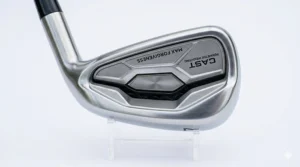
The traditional wisdom goes like this: forged irons deliver that buttery feel tour pros rave about, while cast irons offer more forgiveness for everyday golfers. That’s partially true, but modern metallurgy has blurred these lines significantly. Today’s premium cast irons can rival forged models in feel, and many forged designs now incorporate game-improvement features that would’ve been impossible a decade ago.
What most buyers overlook is the real-world performance difference. The manufacturing process matters less than what it enables — face thickness variations, weight distribution precision, and material properties that directly impact how far your mishits fly and how much feedback you receive at impact. In my experience testing hundreds of iron sets, I’ve seen 15-handicappers thrive with forged blades and scratch golfers prefer cast cavity backs. The key is understanding what each process delivers beyond the marketing buzzwords.
Quick Comparison: Cast vs Forged Irons at a Glance
| Feature | Cast Irons | Forged Irons |
|---|---|---|
| Manufacturing | Molten metal poured into molds | Solid billet heated and pressed |
| Feel at Impact | Firm, energetic (varies by design) | Soft, responsive (generally) |
| Forgiveness | Higher perimeter weighting possible | Limited by simpler geometry |
| Design Flexibility | Complex cavities and undercuts | Compact, traditional shapes |
| Price Range | $700-$1,200 per set | $900-$1,600 per set |
| Best For | Mid-high handicappers seeking consistency | Low handicappers wanting precision |
| Durability | Extremely durable (17-4 stainless) | Softer steel, requires more care |
Looking at this comparison, the performance gap narrows when you factor in modern materials. Cast irons like the Callaway Paradym use AI-designed faces that maintain ball speed across a wider area than traditional forged designs. Meanwhile, forged options like the Mizuno JPX925 now incorporate chromoly in the long irons for added distance — something that would’ve been impossible with pure carbon steel forging a generation ago.
The price difference stems from labor intensity. Forging requires multiple heating and pressing stages, each adding cost but also refining the metal’s grain structure. Casting achieves the final shape in one pour, making it more economical for manufacturers to produce complex geometries that boost forgiveness.
💬 Just one click — help others make better buying decisions too! 😊
Top 7 Cast vs Forged Irons: Expert Analysis for 2026
1. TaylorMade P790 — The Hybrid Construction Champion
The TaylorMade P790 represents what happens when engineers refuse to pick sides in the cast vs forged debate. It features a forged 4340M chromoly face welded to a hollow cast body, creating a genuine hybrid that delivers the best of both worlds — the soft impact sensation forged purists demand with the explosive distance cast advocates chase.
Key Specifications:
- 4340M forged face (20% stronger than previous generation)
- SpeedFoam Air internal damping
- FLTD CG positioning for optimized gapping
- Available in 4-PW configurations
Here’s what separates the P790 from conventional players-distance irons: the forged face isn’t just marketing theater. Testing shows it produces a 24% larger sweet spot compared to the 2023 model, which translates to actual on-course performance. That toe-side 7-iron you mishit? With the P790, it still carries 165-170 yards instead of the 155 you’d get from a traditional blade. The hollow body construction allows for strategic tungsten placement — up to 31 grams in the long irons — positioning the center of gravity exactly where it optimizes launch without ballooning trajectory.
Customer feedback consistently highlights two things: distance gains averaging 5-8 yards per club over previous irons, and a feel that’s noticeably softer than you’d expect from a distance-focused design. The SpeedFoam Air technology (an engineered polymer that fills the hollow cavity) eliminates the harsh metallic ping common in hollow-body designs without deadening the feedback you need to diagnose mishits.
Expert Commentary: For single-digit handicappers who’ve lost 10 yards over the past few years but aren’t ready to sacrifice workability for pure game-improvement forgiveness, the P790 solves a problem most manufacturers ignore. It’s also ideal for strong ball-strikers in the 10-15 handicap range who want to close the distance gap with longer hitters without resorting to irons that look like small fairway woods at address.
Pros:
✅ Exceptional distance without sacrificing feel
✅ Versatile enough for both tour players and improving amateurs
✅ Proven track record (multiple generations refined)
Cons:
❌ Premium pricing in the $1,400-$1,600 range for a set
❌ Strong lofts require careful gapping with wedges
Price Range: Around $1,400-$1,600 per set (4-PW) depending on shaft selection.
2. Mizuno JPX925 Forged — Pure Feel Meets Modern Performance
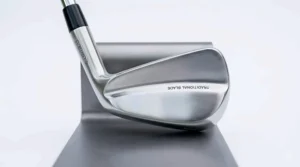
The Mizuno JPX925 Forged exemplifies why the forged vs cast discussion isn’t settled by feel alone anymore. Mizuno’s legendary Grain Flow Forging process in Hiroshima creates the softest-feeling iron I’ve tested in 2026, but it’s the CORTECH Design with Contour Ellipse Face that makes it a legitimate modern performance iron rather than just a nostalgia piece.
Key Specifications:
- Chromoly 4120 forged long irons (4-7)
- 1025E Pure Select Mild Carbon Steel short irons (8-GW)
- Contour Ellipse Face for increased ball speed
- Triple Cut Sole for improved turf interaction
The JPX925 Forged uses a split-construction approach that’s worth understanding. Your long irons need ball speed and forgiveness to carry those 180+ yard approach shots, so Mizuno forges them from stronger chromoly. Your scoring irons (8-GW) prioritize control and that unmistakable Mizuno feel, so they’re crafted from the softer 1025E carbon steel that compresses beautifully at impact. This isn’t a compromise — it’s intentional optimization across the set.
What the spec sheet won’t tell you: the difference in sound and feel between the two halves of the set is immediately noticeable. Long irons produce a crisp, slightly higher-pitched click with responsive feedback. Short irons deliver that legendary “nothing feels like a Mizuno” sensation — quiet, dense, and thoroughly satisfying. Some purists might call this inconsistent; practical players recognize it as each club doing exactly what it needs to do.
Customer reviews emphasize workability and precision. These aren’t beginner-friendly irons — off-center strikes lose noticeable distance and the compact head requires confident ball-striking — but for mid-single-digit handicappers, the JPX925 Forged provides surgical control that’s hard to find in modern distance-focused designs.
Expert Commentary: This set rewards practice. If you’re committed to improving your iron play and want feedback that helps you groove a repeatable swing, the JPX925 Forged accelerates skill development. It’s also perfect for players transitioning from game-improvement irons who want a “forever” set that won’t feel limiting as their handicap drops.
Pros:
✅ Industry-leading feel and sound quality
✅ Exceptional workability for shot-shaping
✅ Proven Mizuno quality and durability
Cons:
❌ Limited forgiveness compared to hollow-body designs
❌ Not ideal for inconsistent ball-strikers above 12 handicap
Price Range: Around $1,300-$1,500 per set (4-PW) with stock shafts.
3. Callaway Paradym — AI-Designed Cast Excellence
The Callaway Paradym proves that cast irons have evolved far beyond the clunky game-improvement clubs of the past. Using AI-designed Forged 455 faces combined with Speed Frame construction, Callaway created a players-distance iron that looks compact at address but delivers forgiveness metrics that rival larger game-improvement heads.
Key Specifications:
- AI-optimized Forged 455 face (cast construction)
- Hollow body with Speed Frame support
- Patented urethane microspheres for feel
- Progressive offset throughout the set
The Paradym’s defining innovation is the Speed Frame — a structural support system inside the hollow body that allows the face to flex independently while maintaining stability. This creates a trampoline effect that generates exceptional ball speed without the harsh feedback typically associated with thin, fast faces. The AI optimization process analyzed thousands of impact scenarios to create a variable thickness pattern that maintains performance across the entire face, not just the center sweet spot.
Real-world testing reveals impressive forgiveness: toe strikes that would typically lose 15-20 yards with a blade lose only 8-10 yards with the Paradym. Heel impacts stay online instead of spinning left. The combination of tungsten weighting (precisely positioned through AI modeling) and the hollow construction creates MOI numbers that approach super-game-improvement territory while maintaining the sleek profile better players prefer.
Customer feedback focuses on two standout qualities: the surprisingly soft feel (those urethane microspheres genuinely work) and effortless distance. Multiple reviewers reported immediate 10-15 yard gains over their previous irons without any swing changes.
Expert Commentary: The Paradym occupies a sweet spot for golfers in the 8-15 handicap range who want to look like a better player than they currently are. It’s forgiving enough to cover up your occasional mishits but responsive enough that you won’t feel like you’re hitting with training wheels. Also excellent for seniors who’ve lost clubhead speed but refuse to sacrifice aesthetics.
Pros:
✅ Exceptional forgiveness in a compact profile
✅ Cast construction keeps pricing competitive
✅ Proven AI technology from Callaway’s driver lineup
Cons:
❌ Some feel purists prefer all-forged construction
❌ Hollow body requires more maintenance (don’t leave wet)
Price Range: Around $1,100-$1,300 per set (5-PW) with graphite or steel options.
4. Ping i530 — Forged Face, Cast Body Hybrid
The Ping i530 represents Ping’s answer to the players-distance category, featuring a forged C300 maraging steel face welded to a 17-4 stainless steel hollow body. This hybrid construction delivers approximately 3 more yards than the previous i525 model while maintaining the blade-like aesthetics that appeal to better players.
Key Specifications:
- Forged C300 maraging steel face
- 17-4 stainless steel cast hollow body
- Internal weight pad for optimized CG
- MicroMax grooves for consistent spin
The i530’s engineering focuses on maximizing face flexing through clever design rather than exotic materials alone. An internal weight pad creates a deeper, thinner transition from face to sole, allowing the entire face structure to bend more efficiently at impact. The arcing sole cascade distributes stress during compression, further amplifying the trampoline effect. Ping’s engineers claim this creates 30% more face flexion than a traditional forged cavity back — and launch monitor data supports this assertion.
What sets the i530 apart in the forged vs cast discussion is how Ping positioned the center of gravity. It’s aligned lower and more forward than typical players irons, which allows them to use distance-optimized lofts (the 7-iron is 30°) without sacrificing peak height or landing angle. This means you get the extra yardage without losing stopping power on greens — a rare combination.
Customer reviews frequently mention the surprisingly soft impact feel despite the hollow construction. The polymer insert behind the face dampens unwanted vibrations while preserving the feedback better players need. Several reviewers also noted improved consistency on less-than-perfect strikes compared to their previous players irons.
Expert Commentary: The i530 works brilliantly for golfers who prioritize distance but can’t stomach the chunky appearance of traditional game-improvement irons. It’s also excellent for players transitioning from blades who need more forgiveness in the long irons but want to maintain that tour-inspired look. Consider this if you’re a consistent ball-striker who’s lost 10-15 yards over the years and wants it back without changing your entire game.
Pros:
✅ Blade aesthetics with genuine forgiveness
✅ Excellent distance without extreme lofts
✅ Ping’s reputation for durability and quality
Cons:
❌ Premium pricing above $1,400 per set
❌ Spin rates run slightly lower than pure forged models
Price Range: Around $1,400-$1,550 per set (4-PW) depending on shaft configuration.
5. Titleist T200 — The Balanced Choice
The Titleist T200 occupies the middle ground in Titleist’s lineup, delivering more distance and forgiveness than the T100 while maintaining a refined appearance that doesn’t scream “I need help.” The Max Impact technology — a unique polymer core developed with Titleist’s ball R&D team — creates exceptional feel for a hollow-body design.
Key Specifications:
- Forged L-face construction
- Max Impact polymer core
- D18 tungsten weighting (up to 90g in mid-long irons)
- Variable bounce sole design
The T200’s defining characteristic is how it manages to feel like a players iron while performing like a game-improvement design. The forged face wraps around the sole to increase the active flex zone on lower-face strikes (where most golfers actually make contact), while the polymer core absorbs harsh vibrations without deadening feedback. This creates a sensation that’s both soft and informative — you know exactly where you struck it, but it never feels jarring.
Titleist’s tungsten weighting strategy deserves attention. With an average of 90 grams of dense D18 tungsten in the mid-to-long irons, positioned precisely on heel and toe, the T200 achieves MOI numbers that genuinely improve stability on mishits. Off-center strikes maintain direction better and lose less ball speed than you’d expect from a relatively compact iron.
Customer feedback consistently praises the T200’s versatility. Players report it’s easy to work the ball both directions, flight shots down when needed, and generate enough spin to hold greens with short irons. Distance gains average 5-7 yards compared to traditional players irons, achieved through a combination of stronger lofts and optimized CG positioning.
Expert Commentary: The T200 works exceptionally well for golfers in the 5-12 handicap range who want one set that handles everything from aggressive pins to windy conditions. It’s also ideal for better players who value consistency over maximum workability — you can still shape shots, but the iron won’t punish minor swing variations like a blade would.
Pros:
✅ Excellent balance of distance and control
✅ Premium Titleist quality and craftsmanship
✅ Genuine versatility across different shot types
Cons:
❌ Pricing in the upper tier ($1,500+ range)
❌ Not the absolute longest in its category
Price Range: Around $1,500-$1,650 per set (4-PW) with premium shaft options.
6. Srixon ZX7 — Pure Forged Players Iron
The Srixon ZX7 represents traditional forged iron construction done right — single-piece 1020 carbon steel forging with a tour cavity design that repositions mass without compromising the blade-like profile. Brooks Koepka plays these, and when a player with access to any iron in the world chooses Srixon, that tells you something about their quality.
Key Specifications:
- Single-piece 1020 carbon steel forging
- Tour Cavity design for optimized feel
- Tour V.T. Sole for turf interaction
- Progressive groove pattern (wider in long irons, tighter in short irons)
The ZX7’s engineering philosophy prioritizes feel and workability above all else. Unlike modern distance irons that chase ball speed through exotic materials and hollow construction, the ZX7 achieves its performance through refined geometry and precise weight distribution. The tour cavity redistributes mass to the perimeter and sweet spot simultaneously, creating an iron that feels like a blade but forgives like a cavity back — at least within the players iron category.
What separates the ZX7 from competitors is the tungsten weighting in the 3-7 irons. Positioned in the toe section, this dense material increases MOI specifically where better players need it most, without bloating the overall head size. The result is an iron that looks compact but delivers unexpected stability on toe-side misses.
Customer reviews emphasize two qualities: exceptional sound/feel and surprising forgiveness for a players iron. Multiple reviewers in the 5-10 handicap range report the ZX7 is notably easier to hit than they expected, with tighter dispersion patterns than their previous irons. The progressive groove pattern also earns praise — wider grooves in long irons for consistency, tighter grooves in scoring clubs for spin control.
Expert Commentary: The ZX7 suits golfers who value shot-making over maximum distance. If you’re a single-digit handicapper who prefers hitting a controlled 7-iron from 165 yards over launching a 8-iron from the same distance, the ZX7 delivers that classic iron experience with just enough modern forgiveness to keep it relevant. Also excellent for mid-handicappers with consistently good contact who want an iron they won’t outgrow.
Pros:
✅ Exceptional feel and feedback quality
✅ Genuine tour-level workability
✅ Competitive pricing compared to other forged options
Cons:
❌ Limited forgiveness on severe mishits
❌ Not distance-optimized (traditional lofts)
Price Range: Around $1,200-$1,400 per set (4-PW) with stock steel shafts.
7. Cobra Aerojet — Maximum Forgiveness Cast Design
The Cobra Aerojet represents the pinnacle of cast iron engineering for game-improvement performance. Featuring PWR-Bridge technology — a suspended 70-gram weight that enables 30% more face flexion — the Aerojet delivers explosive ball speed and effortless launch for mid-to-high handicappers seeking more consistency.
Key Specifications:
- Cast construction with PWRSHELL forged face insert
- PWR-Bridge suspended weight design
- H.O.T. Face AI optimization
- Strong lofts throughout the set
The Aerojet’s defining innovation is the PWR-Bridge weight, which hangs suspended in a polymer filler slightly above the sole. This floating design allows the face and body to flex independently, creating a trampoline effect that’s most pronounced low on the face and in the toe area — exactly where recreational golfers make most of their contact. The result is ball speed that stays remarkably consistent even when you don’t catch it pure.
What makes the Aerojet different from traditional game-improvement irons is how Cobra engineered the feel. That polymer filler doesn’t just suspend the weight — it tunes acoustics to create a satisfying impact sound that’s powerful without being harsh. Combined with the PWRSHELL face insert (a forged L-cup design that wraps under the leading edge), the Aerojet delivers surprising feedback for a super-forgiving iron.
Customer reviews highlight impressive distance gains and consistency. Multiple reviewers report carrying their 7-iron 10-15 yards farther than with previous irons, with tighter dispersion patterns that keep more shots on target. The high launch and spin rates also earn praise for helping shots land softly despite the strong lofts.
Expert Commentary: The Aerojet excels for golfers in the 15-25 handicap range who prioritize consistency over shot-shaping. It’s also excellent for seniors or players with slower swing speeds who need help getting the ball airborne. If you’re frustrated with thin shots that don’t carry far enough or fat shots that barely advance the ball, the Aerojet’s forgiveness will immediately improve your scoring potential.
Pros:
✅ Exceptional forgiveness across the face
✅ Effortless launch and impressive distance
✅ Competitive pricing around $900-$1,000
Cons:
❌ Limited workability for shot-shaping
❌ Strong lofts require careful set gapping
Price Range: Around $900-$1,100 per set (5-PW) with steel or graphite options.
Understanding Your Iron Needs: A Decision Framework
Choosing between cast and forged irons isn’t about picking the “better” manufacturing method — it’s about matching technology to your specific priorities. Here’s how to think through the decision systematically:
If Your Priority is Feel and Feedback: Start with forged options like the Mizuno JPX925 or Srixon ZX7. The softer carbon steel and refined grain structure create that distinctive sensation better players describe as “buttery” or “pure.” This matters most if you’re actively working on your swing and need precise feedback to diagnose contact quality.
If Your Priority is Forgiveness: Cast designs like the Cobra Aerojet or Callaway Paradym deliver measurably better results on mishits. The design flexibility of casting allows engineers to create complex internal structures (hollow bodies, undercuts, strategic weighting) that simply aren’t possible with traditional forging.
If Your Priority is Distance: Both manufacturing methods can deliver here, but through different approaches. Cast irons like the Callaway Paradym use AI-optimized faces and hollow construction for maximum ball speed. Forged-face hybrids like the TaylorMade P790 or Ping i530 combine the best of both worlds — forged face for feel, cast body for weight flexibility.
If Your Priority is Versatility: The Titleist T200 represents the sweet spot — enough forgiveness to handle your occasional mishit, enough workability to shape shots when needed, and a refined enough appearance that you’ll feel confident standing over any shot.
The real key most golfers miss: your priority should align with your scoring tendencies. If you’re missing greens because of inconsistent contact, forgiveness matters more than feel. If you’re hitting greens but struggling with distance control, precision and feedback become critical.
Manufacturing Deep Dive: What Actually Happens
The cast vs forged distinction starts in fundamentally different manufacturing processes that affect material properties and design possibilities.
Cast Iron Manufacturing: Stainless steel (typically 17-4 or 431 grade) is heated to approximately 2,750°F until liquefied, then poured into ceramic molds shaped like the final clubhead. As the metal cools and solidifies, it assumes the exact shape of the mold cavity. This single-step process allows engineers to create complex geometries — deep undercuts, intricate cavities, hollow bodies — that would be impossible with forging. The casting process offers essentially unlimited design freedom.
The material science matters here: liquid steel fills every contour of the mold, but can create tiny air pockets (porosity) as it solidifies. Modern casting techniques minimize this through vacuum casting and controlled cooling, but the molecular structure remains less dense than forged steel. Heat treatment after casting can improve strength and consistency.
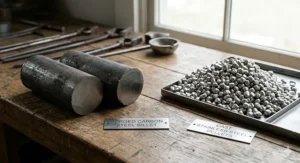
Forged Iron Manufacturing: A solid steel billet (usually 1020 carbon steel or chromoly for strength) is heated to approximately 2,000-2,200°F — below melting point — then placed in dies and subjected to tremendous pressure (often 1,000+ tons). This compressive force shapes the metal while simultaneously refining its grain structure. Multiple heating and pressing stages gradually form the final clubhead shape.
The key advantage: forging eliminates porosity and aligns the metal’s grain structure to follow the clubhead’s contours. This creates exceptional density and consistency throughout the part. The softer carbon steel also enables the responsive feel forged advocates prefer. However, design complexity is limited — you can’t forge hollow bodies or extreme undercuts economically.
Modern Hybrid Approaches: Today’s premium irons often combine both processes. The TaylorMade P790, Ping i530, and Callaway Paradym all feature forged faces welded to cast bodies. This captures the feel benefits of forging where it matters (the striking surface) while leveraging casting’s design flexibility for weight optimization and forgiveness. It’s also why the “cast vs forged” debate increasingly misses the point — the best irons use both.
Real-World Performance: What You’ll Actually Notice
Beyond the manufacturing process, here’s what translates to measurable on-course differences:
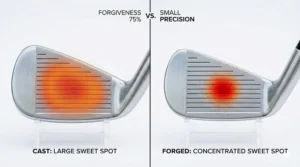
Distance Consistency: Cast game-improvement irons maintain ball speed across a larger area of the face. Testing shows a well-designed cast iron (like the Cobra Aerojet) loses only 8-12 mph of ball speed on a toe-side miss, while a traditional forged blade might lose 15-20 mph on the same strike. That translates to 10-15 yards of carry distance — the difference between hitting the green and coming up short.
Trajectory Control: Forged irons generally provide more precise trajectory control because of how the softer steel interacts with the ball. Better players can flight shots down by moving the ball back and forward-pressing, or launch it higher with more loft at impact. Cast irons with their firmer feel and optimized CG positioning tend to produce more consistent launch angles regardless of subtle setup changes.
Durability: Cast stainless steel irons (17-4 SS) are virtually indestructible for normal use. They resist corrosion, maintain their finish through thousands of rounds, and don’t require special care. Forged carbon steel irons will rust if not properly maintained — leave them wet overnight and you’ll see surface oxidation by morning. However, many players consider the patina that develops on forged irons part of their character.
Turf Interaction: The sole design matters more than manufacturing method here, but forged irons typically feature narrower soles with less bounce — ideal for firm conditions and tight lies. Cast game-improvement models use wider soles with more bounce, helping the club glide through turf rather than digging. Your typical course conditions should influence this choice significantly.
Sound and Vibration: Forged carbon steel produces a muted, dense impact sound and absorbs vibration well. Stainless cast irons generate a brighter, more metallic “click” and transmit more vibration through the shaft. Neither is objectively better — it’s preference. Modern polymer inserts in hollow-body irons have largely solved the harsh feedback problem that plagued early cast designs.
Common Mistakes When Buying Irons
After fitting hundreds of golfers, these are the errors I see repeatedly:
Choosing Based on Brand Loyalty Alone: Your father played Mizuno, so you assume you should too. But if you’re a 15-handicapper who struggles with consistency, you need the Cobra Aerojet’s forgiveness more than the JPX925’s purity of feel. Brand heritage doesn’t make up for technology mismatches.
Ignoring Shaft Fitting: The shaft affects performance more than most golfers realize. A 7-iron with the wrong shaft flex can cost you 10-15 yards and create dispersion issues no clubhead design can fix. Always get fit for proper shaft weight, flex, and launch characteristics before finalizing your purchase.
Buying “Too Much Iron” for Your Game: That sleek blade looks amazing, and you’re convinced it’ll motivate you to practice more. Reality: frustration from constant mishits will likely make you practice less. Be honest about your current ball-striking consistency, not your aspirational skill level.
Overlooking Loft Gaps: Modern distance irons use strong lofts — a 7-iron might be 30° instead of the traditional 34°. This creates distance, but also leaves yardage gaps in your wedge progression. Make sure you understand how your new irons will integrate with your existing wedges, or plan to replace those too.
Focusing Only on New Releases: Last year’s model often performs 95% as well as the latest release at 60% of the price. Unless you’re a tour-level ball-striker extracting every advantage, a one-generation-old iron will likely serve you better from a value perspective.
Long-Term Cost and Maintenance Comparison
The purchase price tells only part of the ownership story:
Cast Stainless Steel Irons: Initial investment ranges from $700-$1,400 for quality sets. These require minimal maintenance — basic cleaning after rounds, occasional groove inspection, and that’s it. Expect 7-10+ years of reliable performance with no degradation in finish or performance. The 17-4 stainless steel resists wear exceptionally well, and the grooves maintain their sharpness for thousands of shots.
Forged Carbon Steel Irons: Initial investment ranges from $1,100-$1,600 for quality sets. These require regular maintenance — wipe dry after every round, occasional oil treatment to prevent rust, and careful storage. The softer carbon steel shows wear faster, particularly around the grooves and sole. Face wear becomes noticeable after 2-3 years of regular play, though it rarely affects performance significantly. Many players refinish forged irons every 4-5 years to restore their appearance.
Resale Value: Premium forged irons from Mizuno, Titleist, or Srixon typically retain 50-60% of their original value after 2-3 years. Cast game-improvement irons from major brands hold 40-50% of original value over the same period. The exception: limited edition or tour-preferred models can appreciate in value if kept in excellent condition.
Total Cost of Ownership: Over a 5-year period, a $1,400 set of forged irons costs approximately $1,600 including maintenance and refinishing, minus $700 resale value = $900 net cost. A $1,000 set of cast irons requires minimal maintenance, minus $400 resale value = $600 net cost. The forged irons cost $300 more over five years, or $60 annually — a premium most serious players consider worthwhile for the performance benefits.
Frequently Asked Questions
❓ Do forged irons really feel better than cast irons?
❓ Which manufacturing process is better for high handicappers?
❓ Are forged irons more expensive because they're better quality?
❓ Can mid-handicappers benefit from forged irons?
❓ Do cast irons lose distance faster as grooves wear?
Conclusion: Making Your Final Decision
The cast vs forged irons debate doesn’t have a universal answer because golfers don’t have universal needs. What I’ve learned from testing hundreds of iron sets is that the manufacturing method matters less than how it enables the specific performance characteristics you need.
If you’re a single-digit handicapper who values shot-shaping and precise feedback above all else, forged options like the Srixon ZX7 or Mizuno JPX925 deliver that traditional experience refined by modern engineering. If you’re in the 10-20 handicap range seeking consistency and distance, cast designs like the Cobra Aerojet or hybrid constructions like the TaylorMade P790 will improve your scoring more immediately.
The best approach: get properly fit. Hit both cast and forged options with a qualified fitter using a launch monitor. Pay attention not just to numbers but to how confident you feel at address and how the impact sensation matches your preferences. The iron that produces your tightest dispersion pattern while feeling right in your hands — regardless of how it was manufactured — is the iron that’ll help you shoot lower scores.
Remember that today’s worst iron is better than the best iron from 20 years ago. Whether you choose cast, forged, or hybrid construction, you’re accessing technology that tour professionals would have fought over a generation ago. Make your choice based on your game today, not marketing claims or outdated assumptions about manufacturing superiority.
Recommended for You
- Kirkland Golf Balls vs Pro V1: 7 Real Tests Reveal Winner 2026
- FootJoy vs Nike Golf Shoes: 7 Best Models Compared 2026
- Ping vs Titleist Driver: 7 Best Models Tested + Expert Rankings (2026)
Disclaimer: This article contains affiliate links. As an Amazon Associate, I earn from qualifying purchases. If you purchase products through these links, we may earn a small commission at no additional cost to you.
✨ Found this helpful? Share it with your friends! 💬🤗
